
Found 0 posts

This is our fourth installment of our book reviews project designed to introduce you to books that Cydcor team members find especially valuable. This review is by Amanda, a Cydcor team member, and is the first review that Amanda has done for us.
Title: Lean In
Author: Sheryl Sandberg
Description of the book: This book focuses on the advancement of women and encouraging women to take on more leadership roles.
Why should you read this? Both men and women can really get something out of this book. It encourages women to keep reaching for new opportunities regardless of future plans. For men, it challenges the way they don't even realize they may be thinking. The book points out how research shows that success and likeability are positively correlated for men and negatively correlated for women. We have so many strong females at Cydcor, we should all take a moment to look inward and challenge our own thinking.
This is our fifth installment of our book reviews project designed to introduce you to books that Cydcor team members find especially valuable. This review is by Gary Polson, Cydcor CEO, and is third Gary has written for us. Gary has previously reviewed other books for us, including Wooden: A lifetime of observations and reflections on and off the court and The Effective Executive.
Title: When the Game was ours
Author: Larry Bird, Earvin Magic Johnson, with Jackie Macmulllan
Description of the book: Larry Bird and Magic Johnson will always be linked as two competitors. They are linked like Muhammad Ali versus Joe Frazier and Wilt Chamberlain versus Bill Russell. They first competed against each other in the NCAA basketball championship, which has the highest ratings of viewers of any game in history. They then competed against each other in the NBA and in three NBA finals. One was white and one was black; one from a city and one from the country; one was quiet and shy and one outgoing and loved being around people. The one thing that they had in common is that neither was a great athlete. They were considered slow, with poor jumping ability. They were great because of their work ethic and their deep desire to be great. They out-worked and out-competed their competition.
They did not like each other at first, yet there was respect. They each practiced hard, and were motivated to beat the other. Then because of a television commercial they became friends. This book tells about each of their lives, how hard they worked and practiced and how they became friends.
Why should you read this? This is a must read for people who want to be successful. It does help if you have a slight interest in basketball, but it may not be necessary. This is a compelling story of what it takes to win. We often think these great stars are born great. Not the case with most and especially Bird and Magic. They did it by will and effort.
My favorite part: One of the best quotes from the book, summarizes what I am referring to about why this book is a must read for those who want to know what it takes to be successful: “[Magic] worked tirelessly on his ball-handling and his rebounding with the advice [Coach] Fox gave him imprinted on his mind: when you think you have done enough, do a little more, because someone out there is working harder than you. Bird was told the same thing by Coach Jim Jones. As he advanced from high school to the college game, he wasn’t sure that “other person” truly existed. ‘Not until I met Magic,’ Bird said.”
This is our third installment of our book reviews project designed to introduce you to books that Cydcor team members find especially valuable. This review is by Edvil, a Cydcor DM Lead. This is the first review that Edvil has done for us.
Title: The One Minute Manager
Author: Ken Blanchard and Spencer Johnson
Description of the book: Story is about a young man who wants to find out what makes a great manager. He meets a manager that everyone talks about in a company and how amazing he is at managing people. He talks to several people about this manager and finally speaks with the manager himself. He gives him some tools on how to become a good "one minute manager".
Why should you read this? If anyone is new at managing this would be a good book to start out with on how to manage people. It's a very easy read and easy to understand the logic behind the tips/tools given to become a good manager.
My favorite part: Favorite part for me was on how to make the people you manage lead the meetings we have and come up with their own ideas/goals. Making them feel like they came up with them instead of me "telling" them what to do. Makes them manage their own notes and prepare better before the meetings.
Want a sneak peak of some of the reviews that will be up on this site? Check out our Book Reviews: Cydcor Presents on our Slideshare:
Cydcor reviews from Cydcor
This is our second installment of our book reviews project designed to introduce you to books that Cydcor team members find especially valuable. This review is by Gary Polson, Cydcor CEO. Gary has previously reviewed other books for us, including Wooden: A lifetime of observations and reflections on and off the court.
Title: The Effective Executive
Author: Peter F. Drucker
Review by: Gary Polson, CEO
Description of the book: Peter F. Drucker is one of the top business thinkers and executive coaches of the 20th century. He believes, and I agree with him, that people need to learn business and leadership skills, that they do not come naturally to people. It is like learning to play the piano, if you have never played, you cannot expect to sit down and play a beautiful song. Only through hard work can you play a beautiful song. In this book he teaches us the tools to be an ‘effective executive’.
Why should you read this? According to Drucker we know very little about self-development. What we do know however, is that people grow according to the demands they make on themselves. They grow according to what they consider achievement and attainment. If they demand little of themselves, they will remain stunted. If they demand a good deal of themselves, they will grow to giant stature – without any more effort than is expended by the non-achievers.
From my own experience, I know this to be true, except for the part about effort. I think it does take more effort. For me it required time reading, thinking, discussing one’s self-improvement. It also requires the mental energy to get out of one’s comfort zone. The best way to improve the performance of your team is to lead by example. Your high standard of performance will raise the bar for everyone. It is very simple. The key is whether you have the will.
My favorite part: “In human affairs, the distance between the leaders and the average is constant. If leadership performance is high, the average will go up. The effective [leader] knows that it is easier to raise the performance of one leader than it is to raise the performance of a whole mass.” -Peter Drucker, The Effective Executive
Welcome to Cydcor Reviews! This is our first installment of our book reviews project designed to introduce you to books that Cydcor team members find especially valuable. Check back soon for more reviews!
Title: Wooden; A Lifetime of Observations and Reflections On and Off the Court
Author: John Wooden with Steve Jamison
Review by: Gary Polson, Cydcor CEO
Description of the book: Coach Wooden is one of the great men of modern time who exemplified the balance of family, success and contribution. If you read any Coach Wooden book, this is the one I recommend.
Why should you read this? This easy-to-read book begins at his foundation: family, values and virtues and then discusses and offers wisdom on the topics of success, achievement, competition and leadership.
My favorite part:
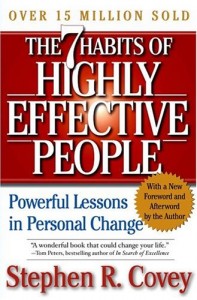
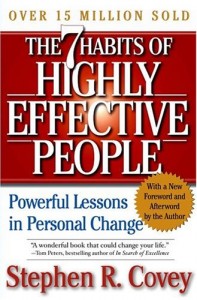
My copy of Stephen R. Covey’s The Seven Habits of Highly Effective People is signed by the author and constantly referenced. Most noticeable is that it is dog-eared, and well worn,—a sign not of neglect, but rather of its indispensability and enduring appeal over the years. I find its ideas as relevant and meaningful today, as when they were first introduced over 20 years ago.
One passage in particular always strikes a chord:
“…[I]f you want to have a happy marriage, be the kind of person who generates positive energy and sidesteps negative energy rather than empowering it. If you want to have a more pleasant, cooperative teenager, be a more understanding, empathic, consistent, loving parent. If you want to have more freedom, more latitude in your job, be a more responsible, a more helpful, a more contributing employee. If you want to be trusted, be trustworthy. If you want the secondary greatness of recognized talent, focus first on primary greatness of character.”
What resonates is the premise that we must look within to find the change we seek and to become our best selves. We must first earn self-mastery and develop great character—what Covey calls achieving the “private victories.” Only then, can we achieve the "public victories" of teamwork, cooperation, communication, social recognition and influence. And to sustain this success, we must internalize “Seven Habits” that embody fundamental principles at the foundation of true effectiveness, such as fairness, integrity, honesty, dignity, service, quality, potential and growth.
These “Seven Habits” express a simple yet compelling idea: To be effective, we must adopt a principle-centered, character-based approach. We must work from the “inside-out,” guided by the habits that correspond with each stage along the “Maturity Continuum.”
Habits 1 (Be Proactive), 2 (Begin with the End in Mind) and 3 (Put First Things First) make up the private victories that move us from dependence on circumstances and other people to greater independence, self-reliance and personal accountability. These first three habits help us build the character base from which we can progress to interdependence, the stage when we cooperate and work successfully with others to attain “public victories” that are greater than anything we could accomplish independently. All of the Habits are just that, habits and principles that we can incorporate in our daily lives through discipline.
Habit 7, “Sharpen the Saw,” makes all the other habits possible through self-renewal and continuous improvement. This habit focuses on balancing the doing with our ability and capacity to do, so we preserve and enhance our most valuable asset—us.
At whatever stage along the path to maturity we may be, the “Seven Habits” offer us a powerful framework to solve problems, maximize opportunities, enrich relationships and continually learn and grow. For over two decades, the “Seven Habits” have given us the tools to create the lives, livelihoods and relationships we most desire—effective, productive and purposeful.
Each of the Seven Habits will be the topic of our blog for the next several weeks. Focusing on these is in itself a good habit.
- Vera Quinn
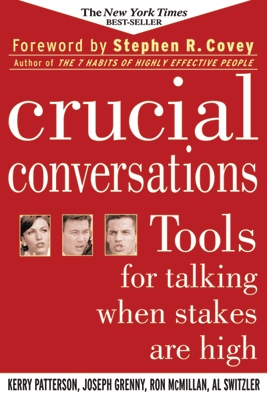
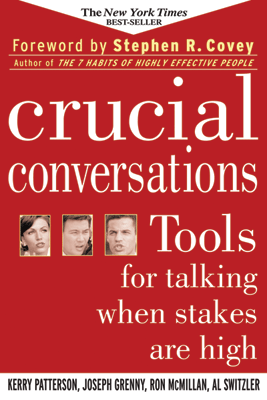
How do you approach a touchy, but important, subject with someone at home or at work without damaging the relationship?
This has always been a challenge for me, and for most people I know. Because we are afraid the conversation will damage the relationship we tend to avoid it or dance around the issue, which in the long-term is more damaging.
An effective conversation starts with first understanding what you are trying to accomplish with the conversation? Do you want to show who is boss? Win an argument? Shame them? Defend yourself? Dump your uncertainty, anxiety on them?
I learned at the “Crucial Conversations” class, given by Vital Smart that the objectives of crucial conversations are to:
(1) Get facts
(2) Learn
(3) Build the relationship
(4) Get a productive result
If I focus on this and not on any emotions, anxieties, etc., it will go well. I try to avoid these conversations when I am upset or have strong emotions. It makes it about me rather than the four objectives. Is it a good time for them? I try not to be the coach to yell at the kids in the outfield to “keep your eye on the ball” right after they drop it. They are too embarrassed and self-shaming to listen to coaching at that time.
Timing is important.
The basic outline that often works is a 3-step approach.
I start with the belief that I do not know. I just have a hunch. Also, I try not to be accusatory and have a calm tone. “Why would an intelligent, reasonable person do this” is a good mindset.
“Joe, I observed when you were talking to Cindy that you interrupted her three times in the conversation; I noticed you interrupted Juan twice when he gave his side of the story. I am wondering if interrupting people is a reason you are struggling building your team. What is your perspective?”
Then LISTEN.
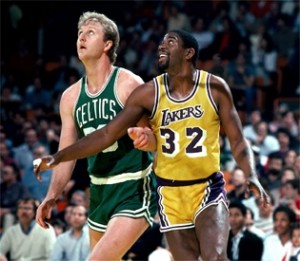
One of the best books written by sports greats is When the Game was Ours by Larry Bird and Earvin Magic Johnson, with Jackie MacMullan.
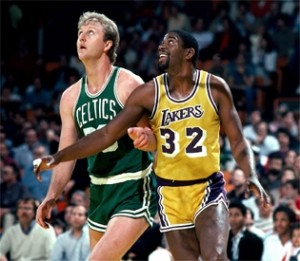
Larry Bird and Magic Johnson will always be linked as two competitors. They are linked like Muhammad Ali versus Joe Frazier and Wilt Chamberlain versus Bill Russell. They first competed against each other in the NCAA basketball championship, which has the highest ratings of viewers of any game in history. They then competed against each other in the NBA and in three NBA finals. One was white and one was black; one from a city and one from the country; one was quiet and shy and one outgoing and loved being around people. The one thing that they had in common is that neither was a great athlete. They were considered slow, with poor jumping ability. They were great because of their work ethic and their deep desire to be great. They out-worked and out-competed their competition.
They did not like each other at first, yet there was respect. They each practiced hard, motivated to beat the other. Then because of a television commercial they became friends. This book tells about each of their lives, how hard they worked and practiced and how they became friends.
This is a must read for people who want to be successful. It does help if you have a slight interest in basketball, but it may not be necessary. This is a compelling story of what it takes to win. We often think these great stars are born great. Not the case with most and especially Bird and Magic. They did it by will and effort.
One of the best quotes from the book, summarizes what I am referring to about why this book is a must read for those who want to know what it takes to be successul: “[Magic] worked tirelessly on his ball-handling and his rebounding with the advice [Coach] Fox gave him imprinted on his mind: when you think you have done enough, do a little more, because someone out there is working harder than you. Bird was told the same thing by coach Jim Jones. As he advanced from high school to the college game, he wasn’t sure that “other person” truly existed. ‘Not until I met Magic,’ Bird said.”
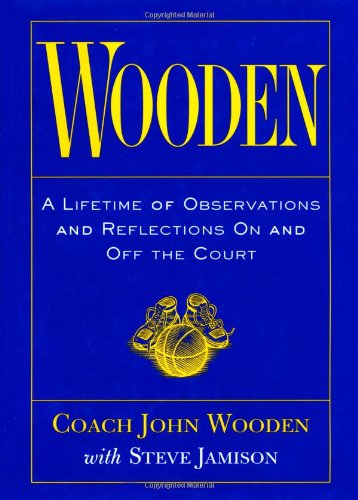
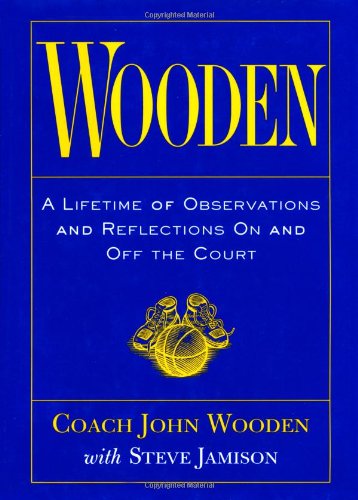
Coach Wooden is one of the great men of modern time who exemplified the balance of family, success and contribution. If you read any Coach Wooden book, this is the one I recommend.
This easy-to-read book begins at his foundation: family, values and virtues and then discusses and offers wisdom on the topics of success, achievement, competition and leadership.
I've pulled some of my favorite quotes from the book to share with you:
Someone asked me yesterday for tips on how to develop an entry level person that has strong potential. My primary goal is to build the person’s confidence. I do this by spending meaningful time with them to improve their skills. This tends to improve their confidence in two ways. First, my spending time with them makes them feel valuable and worthy, which builds confidence. Second, their skills will improve, which will build their confidence.
Ken Blanchard uses situational leadership to discuss this in his One Minute Manager series. Briefly, if someone is new at a skill or goal, he or she needs to be patiently shown how to do it. The person needs direction and frequent follow-up for feedback.
Once the person has learned the skill fairly well, he or she needs little direction and more support. If they are frustrated, they may need to vent and hear another’s perspective for support.
As managers, we often do the opposite. Someone is new at a skill and we often do not give enough direction or appropriate follow up. We show them one time and expect them to know it. When they feel frustrated, we either shame them for not getting it right or give them support rather than more direction. We should observe them doing the skill and then show them how to do it better.
Sometimes when someone knows the skill fairly well but is in a slump, we show them how to do it. This feels like micromanaging and often takes away confidence. They know the skill, they probably need support.
I recommend the One Minute Manager series by Ken Blanchard to learn more about self leadership.