Found 0 posts
New Year‘s is a time to reflect on things we want (or need) to change, from getting fit or quitting smoking to getting a better job or spending more time with family. It’s a time to replace bad habits with good ones and to follow through on them.
How many of us, however, have made our resolutions with the best of intentions, only to break them weeks or months later? Perhaps more urgent matters crop up that consume our energies, leaving us too exhausted for anything else. Or perhaps we get discouraged with our progress and lose our desire and resolve to carry on. Whenever I face just such a dilemma, I look to Covey’s third habit, “Put First Things First,” for perspective and guidance.
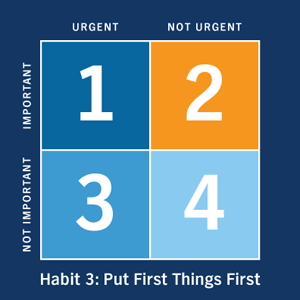
While Habit 2 is about self-leadership, Habit 3 is about self-management. Leadership defines the "first things,” and management is the discipline to carry them out in accordance with our core principles. “Putting first things first” means we have the will to do something when we don't want to; to say “no” to some things (even seemingly urgent things); and to act on our values, rather than on impulse. Simply, it means focusing our time on what’s truly important.
According to Covey, we can spend our time in four ways:
Habit 3 tells us to spend most of our time in Quadrant 2, to minimize our time spent in Quadrant 1 and to stay out of Quadrants 3 and 4 altogether. In doing so, we pursue our highest priorities—the relationships and results that matter. Our crises would then become more manageable because we’re proactively doing the things that prevent them from happening in the first place.
For me, “putting first things first” is not only a habit of effectiveness, but also an act of integrity to our commitments and purpose. By honoring both, we position ourselves to seize the right opportunities at the right time—ones that can enrich our lives and livelihoods in the New Year and beyond.
- Vera Quinn
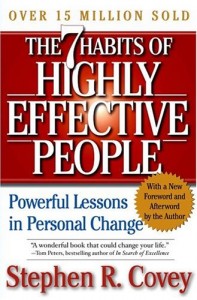
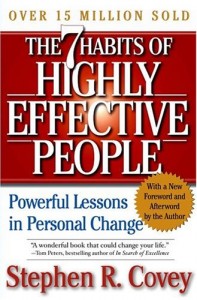
My copy of Stephen R. Covey’s The Seven Habits of Highly Effective People is signed by the author and constantly referenced. Most noticeable is that it is dog-eared, and well worn,—a sign not of neglect, but rather of its indispensability and enduring appeal over the years. I find its ideas as relevant and meaningful today, as when they were first introduced over 20 years ago.
One passage in particular always strikes a chord:
“…[I]f you want to have a happy marriage, be the kind of person who generates positive energy and sidesteps negative energy rather than empowering it. If you want to have a more pleasant, cooperative teenager, be a more understanding, empathic, consistent, loving parent. If you want to have more freedom, more latitude in your job, be a more responsible, a more helpful, a more contributing employee. If you want to be trusted, be trustworthy. If you want the secondary greatness of recognized talent, focus first on primary greatness of character.”
What resonates is the premise that we must look within to find the change we seek and to become our best selves. We must first earn self-mastery and develop great character—what Covey calls achieving the “private victories.” Only then, can we achieve the "public victories" of teamwork, cooperation, communication, social recognition and influence. And to sustain this success, we must internalize “Seven Habits” that embody fundamental principles at the foundation of true effectiveness, such as fairness, integrity, honesty, dignity, service, quality, potential and growth.
These “Seven Habits” express a simple yet compelling idea: To be effective, we must adopt a principle-centered, character-based approach. We must work from the “inside-out,” guided by the habits that correspond with each stage along the “Maturity Continuum.”
Habits 1 (Be Proactive), 2 (Begin with the End in Mind) and 3 (Put First Things First) make up the private victories that move us from dependence on circumstances and other people to greater independence, self-reliance and personal accountability. These first three habits help us build the character base from which we can progress to interdependence, the stage when we cooperate and work successfully with others to attain “public victories” that are greater than anything we could accomplish independently. All of the Habits are just that, habits and principles that we can incorporate in our daily lives through discipline.
Habit 7, “Sharpen the Saw,” makes all the other habits possible through self-renewal and continuous improvement. This habit focuses on balancing the doing with our ability and capacity to do, so we preserve and enhance our most valuable asset—us.
At whatever stage along the path to maturity we may be, the “Seven Habits” offer us a powerful framework to solve problems, maximize opportunities, enrich relationships and continually learn and grow. For over two decades, the “Seven Habits” have given us the tools to create the lives, livelihoods and relationships we most desire—effective, productive and purposeful.
Each of the Seven Habits will be the topic of our blog for the next several weeks. Focusing on these is in itself a good habit.
- Vera Quinn


The book begins, “Here is Edward Bear, coming downstairs now, bump, bump, bump, on the back of his head, behind Christopher Robin. It is, as far as he knows, the only way of coming downstairs, but sometimes he feels that there really is a another way, if only he could stop bumping for a moment and think of it. And then he feels perhaps there isn’t.”
When I read this seventeen years ago to my daughter, I thought “I am Edward Bear.” I felt that I was not getting the business results that I wanted, yet I kept doing the same things over and over. I realized that I need to approach my work week differently.
This probably happens to most business people at some point. What do you do about it? One suggestion is to talk to a mentor or to key people on your team to get their perspective. Another suggestion is to spend more time on your weekly planning challenging yourself as to what is one or two things that you can do, besides the normal maintenance, that would get the business to a different level.
Does your head feel like Edward Bear’s?
Gary
How do you approach a touchy, but important, subject with someone at home or at work without damaging the relationship?
This has always been a challenge for me, and for most people I know. Because we are afraid the conversation will damage the relationship we tend to avoid it or dance around the issue, which in the long-term is more damaging.
An effective conversation starts with first understanding what you are trying to accomplish with the conversation? Do you want to show who is boss? Win an argument? Shame them? Defend yourself? Dump your uncertainty, anxiety on them?
I learned at the “Crucial Conversations” class, given by Vital Smart that the objectives of crucial conversations are to:
(1) Get facts
(2) Learn
(3) Build the relationship
(4) Get a productive result
If I focus on this and not on any emotions, anxieties, etc., it will go well. I try to avoid these conversations when I am upset or have strong emotions. It makes it about me rather than the four objectives. Is it a good time for them? I try not to be the coach to yell at the kids in the outfield to “keep your eye on the ball” right after they drop it. They are too embarrassed and self-shaming to listen to coaching at that time.
Timing is important.
The basic outline that often works is a 3-step approach.
I start with the belief that I do not know. I just have a hunch. Also, I try not to be accusatory and have a calm tone. “Why would an intelligent, reasonable person do this” is a good mindset.
“Joe, I observed when you were talking to Cindy that you interrupted her three times in the conversation; I noticed you interrupted Juan twice when he gave his side of the story. I am wondering if interrupting people is a reason you are struggling building your team. What is your perspective?”
Then LISTEN.
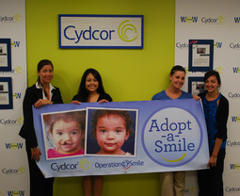
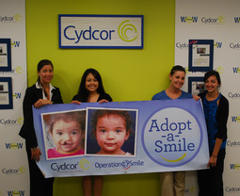
Today we named Operation Smile this year's official corporate cause. The international children's medical charity treats facial deformities, such as cleft lips and palates, around the globe. We are partnering with its network of independently owned and operated offices to raise funds for the organization.
This is the first time Cydcor has adopted a charitable organization of this scale – it's a great way to exercise team building among our offices and we are proud to support an organization that improves the quality of so many lives.
We are partnering with our network of independently owned and operated sales companies to reach a goal of$150,000 in order to support an Operation Smile medical mission, currently slated to take place in Peru. Sales Companies are establishing their own "smile" campaign support pages and have fundraising goals starting at$1,000 per office. Cydcor has established its own "smile" page with a goal of $21,000 – enough to pay for 90 surgeries, each costing approximately $240.
"The need for quality cleft care is urgent; there are so many children around the world who desperately need our help," said Dr. Bill Magee, Founder and CEO of Operation Smile. "We are grateful for the generosity of our supporters and volunteers. It is only with their help that we can continue to give new smiles and transform the lives of our patients."
Click here to read the full release or coverage on The Daily Tell.

We just wrapped up our annual R&R Owners Weekend event at the Fontainebleau Miami Beach. This is an appreciation event for key members of our network of independently owned sales companies. While the event had an element of business, the primary focus was rest and relaxation for the more than 600 in attendance.
We enjoyed a weekend full of themed dinners, private group pool cabanas, ocean kayaks, banana boat rides, bocce ball, and ping-pong. The weekend culminated with a "Havana Nights" theme dinner, where we participated in a customized "Minute to Win It" and had a chance to win cash prizes.
We also held our 3rd Annual Charity Tournament event there, helping to raise support and awareness for Operation Smile, an international children's medical charity treating facial deformities such as cleft lips and cleft palates all around the world.
Watch our video recap here: [youtube]http://www.youtube.com/watch?v=EWL4vug9dDo[/youtube]


We're so happy to announce that we've made San Fernando Valley's 'Best Places to Work' for the third year in a row. Cydcor was specifically recognized for a supportive work environment and culture, volunteer opportunities, quality and commitment of management, and benefits.
The Business Journal and Best Companies Group worked together to identify and recognize area companies with a strong commitment to workplace excellence.
Both publicly and privately held organizations were selected based on benefits, corporate philanthropy, policies, work-life balance, internal working conditions, local management, satisfaction, camaraderie and support of employees' personal growth. Selections were based on company surveys and employee comments.


I had a conversation with an employee the other day concerning self-development. He believed it was vital at this stage in his career to get to the next level and asked me for my advice. My suggestion was for him to have an intense student mentality right now and to ask for and follow suggestions from his mentors, whether he agrees with the advice or not, as long as he feels the advice is ethical.
Why follow advice that you disagree with? A well known and respected CEO, and friend of mine, has been coaching me for about four years now and is often giving me suggestions that I feel will lead to a bad result. I will give him reasons why I feel his advice is bad but after a conversation if he still believes I should follow his suggestion, I will.
The reason I follow his advice is because I want to learn to grow. If I always do what I think is best or what I feel comfortable with then I will not grow. I will just be doing the same thing over and over, like a hamster on a wheel. The key is not the result I get from following his suggestion, but what I learned in the process.
If I follow my coach's suggestion and get a positive result, that is great and I will have learned new skills that will last me a lifetime. However, if I follow his suggestion and get a bad result, not all is lost. I will first review the process and results with my coach to see if I executed properly, but if I find that in the end the suggestion just doesn't work, then I learned a valuable lesson in what not to do in the future.
A good or a bad result is not important. What is important is what is learned along the way. Getting a good result, but not learning from the process, won't serve you as well long-term as getting a bad result, but learning the lessons from it.


The San Fernando Valley Business Journal recently sat down with our very own Gary Polson to discuss his role as CEO of Cydcor for nearly a decade now, what he thinks has contributed to Cydcor's success as one of the best sales outsourcing companies in the world and what opportunities he sees in growing Cydcor.


We kicked off our Cydcor Cares program at the Boys and Girls Club in Thousand Oaks, California this month. The event was designed to help kids become more interested in reading. Cydcor office team members dressed up as their favorite fictional characters and read to children in kindergarten through fourth grade.
The Bookaneer, a local used bookstore in Thousand Oaks, donated dozens of children’s fiction titles to help support the event. Owner, Tracy Benedict, was thrilled with the results and thanked Cydcor for making it a priority to give back to their local community and for providing such a great program for children to participate in.
Read more about Cydcor Cares and this event at The Daily Tell.

Cydcor is proud that its Neighborhood Leader Program has reached significant milestones. To date, more than 500 team members from the various independent Cydcor offices throughout the United States and Canada have dedicated almost 300 hours to their local communities through charity and volunteer work – helping more than 28 organizations.
Organizations helped in various local communities through the Neighborhood Leader Program include the Lupus Alliance of America, Feed the Children, Big Brothers Big Sisters, Make-a-Wish, Special Olympics, Habitat for Humanity, Project Bread, the Boys & Girls Club, the Muscular Dystrophy Association, the American Cancer Society, the Multiple Sclerosis Society, the March of Dimes, and a number of food banks and animal rescues and sanctuaries.
To further demonstrate dedication to the Cydcor Community, the company recently formed a new program, Cydcor Cares, which will enable internal employees to band together and use their eight allotted volunteer hours that Cydcor offers on a yearly basis. The Cydcor Cares first event will take place at the Thousand Oaks Boys and Girls Club, where Cydcor team members will read to children from kindergarten to fourth-grade age.
Click here to read more.