
Found 0 posts
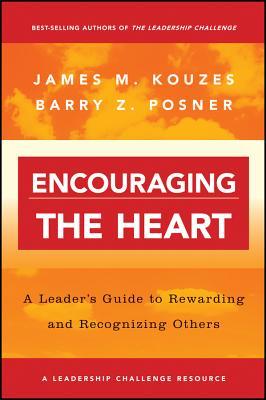
This article is the fourth in a series of five blog posts from management expert, and Cydcor Chief People Officer, Jeannie Finkel. In this series, Jeannie recommends the Top Five Books she believes can help you transform your management style and become a better, more effective leader.
What really motivates people? What is that drives people to do their best work and be the most effective version of themselves? As a manager and leader, it pays to not just be able to confidently answer these questions but to lead in a way that inspires and fosters that passion to execute. While we all work to earn money, there are myriad rewards and benefits of a career that go far beyond monetary needs, and leaders who understand how to encourage employees and feed their emotional needs as well, have the opportunity to unlock hidden talents and potential – the kind that only emerge when employees love what they do.
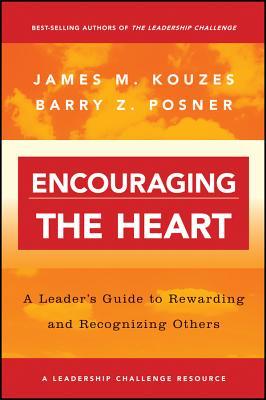
Below Jeannie Finkel recommends the book Encouraging the Heart by James Kouzes and Barry Posner to any manager looking to motivate his or her employees and help team members reach their potential through encouragement and inspiring leadership.
Book #4 Encouraging the Heart
Author: James Kouzes & Barry Posner
Short summary: This is a wonderful book about the art of rewarding and recognizing others, that opens up a world of possibilities beyond just monetary rewards. The book helps us explore what really motivates people and makes them feel appreciated. The authors are best known for their major works on leadership. First was The Leadership Challenge, published in 1987, and the associated leadership development program and assessment instrument they created, used by major multinational companies. The second was Credibility, which examines what makes leaders credible, based on years of research. This book is based on one of the “5 Leadership Practices” identified in The Leadership Challenge, and it’s the only one the authors chose to build out in such detail. Kouzes and Posner recognize that one of the hardest, but most vital, things for leaders to do is excel in meeting those basic needs we all have: to be respected for who we are and recognized for what we do. This book is a “how to” manual that will help and inspire you to become great at not just meeting those needs but also unleashing truly high performance and commitment.
What you’ll learn: As with the other Kouzes and Posner books, this one starts with some foundational research, principles, and introspection. You’ll take a self-test to see how you score on the “Encouragement Index” (and might learn, to your dismay, that you’re not as good at this as you could be!). The bulk of the book takes you through the “7 Essentials of Encouraging the Heart: Set Clear Standards; Expect the Best; Pay Attention; Personalize Recognition; Tell the Story; Celebrate Together; and Set the Example.”
In the concluding section, the authors revisit introspection, with a few thought-provoking pages on “Finding Your Voice”. And finally, they provide 150 suggestions for ways to get started!
Why it’s a must read: Honestly, all three of Kouzes and Barry Posner’s books should be read by anyone who aspires to be a leader. This one, in particular, is special because it speaks to those basic needs we all have, and what we hope we will experience from this thing called “work”. As the authors say, “To us, leadership is everyone’s business. Leadership is not about a position or a place. It’s an attitude and a sense of responsibility for making a difference.” Anyone who has to work with others to get things done can benefit from the wisdom and wealth of practical suggestions in this small volume. If we put them into practice, we can make our workplace a better place…and hopefully a BEST place!
If you found this book recommendation valuable, check back to read the upcoming and final post in this series. These books can help you become the kind of leader who inspires the passion, drive, and innovation necessary for organizations to produce extraordinary results. In case you missed it, don’t forget to read last week’s post about the book Leadership is an Art.
To find out more about Cydcor, check us out on Facebook, LinkedIn, Instagram, and Twitter.

Jeannie Finkel, Chief People Officer at Cydcor, the recognized leader in outsourced sales, has more than twenty-five years of business experience, managing human resources and administration at top firms. Jeannie served for nearly twelve years as a Senior Vice President of Human Resources at Charles Schwab & Co. Jeannie was also Head of Human Resources and Administration for a leading asset management firm, and served as Managing Director, Talent Management Systems and Strategies for a Fortune 100 organization. Jeannie later became a Partner with leading global retained search firm, Heidrick & Struggles. With years of experience managing teams and overseeing organizations, Jeannie is a seasoned expert in management, administration, and leadership.
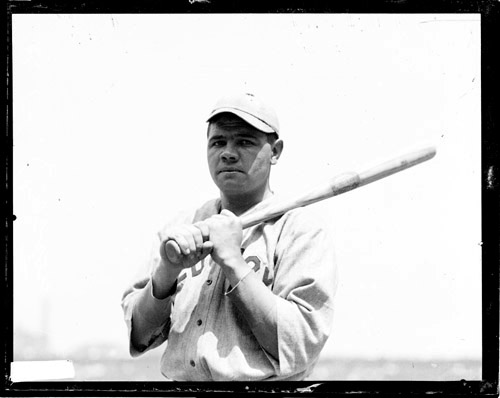
Becoming a great athlete requires passion, perseverance, and hard work. And just like sales, sometimes in sports you need to fail before you can succeed. These motivational sales quotes from some of the world’s best athletes show that attitude and perspective are key when it comes to achieving your goals. Because whether you’re playing shortstop in MLB or working in sales, being out in the field can be thrilling and challenging. These motivational sales quotes can help you out along the way!
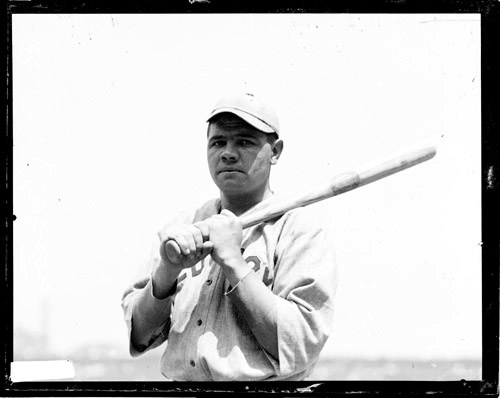
When you’re in sales, the prospect of striking out with a potential buyer can be intimidating. However, don’t allow fear of failure stop you from going out there and giving it your all. Believing in yourself is the first step when it comes to succeeding in sales.

2. “Talent wins games, but teamwork and intelligence win championships.” – Michael Jordan
Without a doubt, being a great salesperson requires talent. But even the most talented individuals in the world are nothing without their team! Here at Cydcor, we support each other and work together in order to achieve great things.

3. “Set your goals high, and don’t stop till you get there.” – Bo Jackson
Never underestimate what you can accomplish. The higher you set your goals, the more you will achieve in the long run. With hard work and determination, you can do anything.

4. “Celebrate what you've accomplished, but raise the bar a little higher each time you succeed.” – Mia Hamm
Accomplishing your goals is an amazing feeling. It’s a sign of hard work paying off! Every time you reach one of your goals, set a new one, and always strive for improvement.
5. “Champions keep playing until they get it right.” – Billie Jean King
As the old adage goes, practice makes perfect. In sales, you might make mistakes from time to time. Instead of getting down on yourself, learn from what you did wrong, and get ready to hit the field again with more knowledge and experience than before.

6. “You miss 100 percent of the shots you don’t take.” – Wayne Gretsky
Sales is all about putting yourself out there. If you don’t try, you’ll have no idea of what you’re capable of. When you see an opportunity for a potential client, go for it, and you’ll end up scoring in no time.

7. “When you fall, get right back up. Just keep going, keep pushing.” – Lindsey Vonn
The best salespeople are individuals with exceptional drive. You may come across bumps in the road, but don’t sweat it! Challenges can be an excellent learning opportunity. Just maintain a strong mental attitude and keep going.

8. “I am lucky that whatever fear I have inside me, my desire to win is always stronger.” – Serena Williams
Sales attracts strong, passionate individuals. Combat your doubts with your desire to succeed, and you’ll be on your way to achieving your very best.

9. “There may be people that have more talent than you, but there’s no excuse for anyone to work harder than you do.” – Derek Jeter
Some things in your career aren’t under your control, but one thing that is under your control is your work ethic. Putting in 100% effort is what makes people great at what they do, and giving it your all until the very last minute will give you amazing results.

10. “You can’t put a limit on anything. The more you dream, the farther you get.” – Michael PhelpsAlways dream big. Strong aspirations will transform your career from ordinary to extraordinary. If you believe you can do great things, then you will.
These famous athletes know that it takes more than just hard work to be your best; it takes passion and grit to overcome setbacks, fight through pain, and believe in yourself no matter what! Hopefully, these motivational sales quotes will help inspire your own drive to push through challenges and reach your dreams.
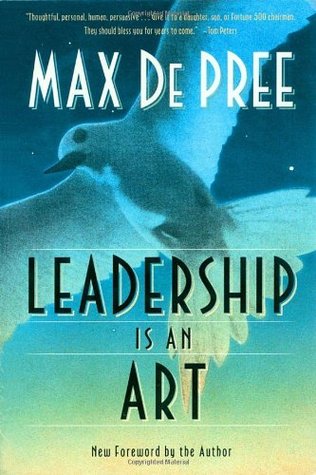
This article is the third in a series of five blog posts from management expert, and Cydcor Chief People Officer, Jeannie Finkel. In this series, Jeannie recommends the Top Five Books she believes can help you transform your management style and become a better, more effective leader.
There are some clear cut skills that can help anyone become a better manager, but it can take a harder-to-define set of qualities to be a strong leader. Management expert Jeannie Finkel recommends Max De Pree’s Leadership is an Art to anyone looking to find out how to establish your unique point of view as a leader, fill your organization with passion, and foster loyalty and drive within your organization. Great managers show enormous faith in the potential of their people, and this book can help you discover how to lead by establishing relationships based on mutual trust, building a culture of inclusiveness, and by offering constant support.
Below, Jeannie Finkel explains why every manager and aspiring manager should read Max De Pree’s book on leadership, to build their identity as a leader and help shape their vision for their organization:
Book #3: Leadership is an Art
Author: Max De Pree
Short summary: This is a beautifully written collection of leadership principles written by Max De Pree, son of the founder and former CEO and Chairman of Herman Miller, Inc. Herman Miller is a nearly 100-year-old company, but it has consistently been recognized throughout its history as one of the best companies to work for in America, as well as one of the best managed and most innovative.
If you’re looking to understand how leaders can create a culture and set of principles that can stand the test of time, this book is a great place to start.
De Pree opens with a story about his father as a young manager whose experience with the death of a long-time employee shaped his philosophy of leadership. De Pree’s father went on to weave those ideas into the fabric of his company and the hearts and minds of his sons, who ran the company after him. The various chapters, each written as a little essay, bring this philosophy to life, starting with the question everyone asks at one point or another: “What is Leadership?”
What you’ll learn: The most important aspect of this book is the humanity and belief in the potential of people and the human spirit that it expresses. If you are not familiar with the concept of servant leadership, by the time you finish reading, you will be, and hopefully will be inspired by it.
De Pree also lays out his ground rules for how work relationships should operate based on mutual accountability. He looks at the capitalist system and helps us imagine how it could be enhanced through a more inclusive mindset where everyone participates. He provides guidance on how to stimulate innovation by recognizing and supporting “giants”, and he reminds us of the importance of sharing culture, values and shared history through storytelling. De Pree also offers techniques for becoming alert to the signs of complacency in ourselves, and he teaches us how to recognize the signals of organizational entropy, as well.
Every time I read this book (which is about once a year!) I take something new away from it.
Why it’s a must read:
This is an enduring classic. I came upon this one because I fell in love with Herman Miller’s products and services, and their exquisite attention to design, aesthetics, functionality and harmony in creating a work environment in which people were inspired and enabled to do their best. I had the privilege to have HMI as a client when I was in the recruiting business, and in order to do my best work and find the right people for them, I had to understand the culture. The manager I worked with encouraged me to study the company and read the book – and I was captivated. It helped me visualize the kind of company I hoped to be a part of and the kind of leadership I wanted to practice. It left me with a sense of my obligations as a leader which I’ve tried hard to live up to ever since.
And on top of everything else, the writing is absolutely beautiful – it’s like reading poetry!
If you found this book recommendation helpful, make sure to check back for upcoming posts in this series to learn about two more books that can help managers build their skills, earn the trust of their team, and lead their organizations to success. In case you missed it, don’t forget to read last week’s post about the book The Elements of Style.
To find out more about Cydcor, check us out on Facebook, LinkedIn, Instagram, and Twitter.
Jeannie Finkel, Chief People Officer at Cydcor, the recognized leader in outsourced sales, has more than twenty-five years of business experience, managing human resources and administration at top firms. Jeannie served for nearly twelve years as a Senior Vice President of Human Resources at Charles Schwab & Co. Jeannie was also Head of Human Resources and Administration for a leading asset management firm, and served as Managing Director, Talent Management Systems and Strategies for a Fortune 100 organization. Jeannie later became a Partner with leading global retained search firm, Heidrick & Struggles. With years of experience managing teams and overseeing organizations, Jeannie is a seasoned expert in management, administration, and leadership.


It's always a boon to morale to show gratitude to employees. Making sure employees know their hard work doesn't go unnoticed is a nice reminder that the bottom line isn't the only thing that matters in sales. Is there a better time to explore ways of showing gratitude and the positive effects it can have at work than Thanksgiving?
Call-Outs: A simple "good job" in any form – whether it's during a meeting, included in a company-wide email or posted on a bulletin board in a common area – goes a long way. It may mean more when the recognition comes from management or the C-suite level, but don't discount the value of peer recognition. Encourage your employees to keep everyone informed if they think part of their team is doing exceptional work. It goes a long way towards fostering a team-oriented environment and building community within your office.
Rewards: Verbal call-outs are great, but tangible gifts and experiences can leave an even bigger mark. Gifts don't have to be extravagant; even something as simple as a photo frame for the team member’s desk, a funny coffee mug, or a stylish journal is a great way to recognize someone. Personalizing a reward to suit an employee's taste goes the extra mile toward positive reinforcement. Gift cards, a lunch out or tickets to a show also make great tokens of recognition. We’re not suggesting you should make handing out awards a daily occurrence, but recognizing employees who consistently go above and beyond is a great practice.
Group Activities: The only potential downside to singling employees out is the risk of alienating other employees who feel they were passed over. So much of business is a team effort, so why not plan a team outing that lets people relax and get to know each other on a more personal level? Dinner out, sporting events, leisure sports like bowling, scavenger hunts, live shows and movies are all great options.
If group outings feel too costly or burdensome to coordinate, consider buying lunch for the office. Planning a potluck and supplying the main dish can also bring people together.
At Cydcor, we’re constantly working to achieve outstanding results on behalf of our clients, but that doesn't mean forgetting the amazing people who make those achievements possible. It’s important to take the time to remind your employees that your own success and that of the company depends on them, their passion, their drive, and the time and effort they devote to helping the team reach its goals.
We hope you and your work family all have a safe and happy holiday season.
Happy Thanksgiving!


This is the second in a series of five posts on tips and books for managers, and Cydcor Chief People Officer, Jeannie Finkel. In this series, Jeannie recommends the Top Five Books she believes can help you transform your management style and become a better, more effective leader.
Writing well isn’t just a nice talent you can use to impress friends and colleagues. Sure, it can do that as well, but effective writing is much more important than that. Clear, concise writing is essential to be an effective communicator, a skill you must have if you ever hope to succeed in a leadership or management role. The way you write and communicate can mean the difference between getting the job or not, gaining approval for a critical project, earning the confidence of your team or organization, and the ability to explain yourself in cases when your actions are not as well received or understood. Effective writing ability is not just nice, it’s critical. It can directly impact your ability to survive and thrive in the workplace and your future growth potential.
Below, Jeannie Finkel recommends a book she believes any manager must have to help improve writing ability and communication:
Book #2: The Elements of Style
Author: William Strunk Jr. and E.B. White
Short summary: If any aspect of your work involves written communication – beyond texting – and you want the quality of your writing to stand out, this little book will teach you what you need to know to master the core principles of writing clearly. It focuses on the fundamentals, clearly explaining proper usage and composition, and helping explain and address the rules of good writing that are most frequently violated.
This really isn’t a book you “read” per se. Rather, it’s a great reference tool that everyone who aspires to write well, or needs to influence, explain, or inspire would do well to study. It’s less than 100 pages, divided into three segments. The first segment is two chapters which give a set of “rules” for English usage and composition (you’ll remember grammar class in grade school!). Then there’s a terrific section about words and expressions that are most often misused – EVERYONE should review this part. The book ends with a set of 21 tips to keep in mind as you create your own writing style.
What you’ll learn: What you learn from this book really depends on what you need. If you’re newer to business and fresh from writing college papers, you might have to change your style to adapt to the brevity required for business writing, such as reports, PowerPoints, and emails. Find excellent advice to guide you through this transition under the sections entitled “Use definite, specific, concrete language” and “Omit needless words”.
Or, if you’ve been in the business world for some time and now need to or communications for publication, you’ll benefit from reviewing the chapter entitled, “Misused Words and Expressions”. We don’t notice many of these in our everyday conversations with friends, but they really stick out in a written piece!
Dip into the book enough and you’ll experience a true appreciation of the beauty and richness of our language, and realize the professor who wrote the original book truly loved his subject and hoped to pass on the art of communication to future generations.
Why it’s a must read: This is a desk reference I’ve kept with me ever since a rather embarrassing experience with a boss many years ago. I had just been promoted to my first Vice President level assignment, working for someone who had a reputation for being extremely tough. I was a literature major in college, and I thought I wrote pretty well. I wanted to impress him and show I was worthy of the big new job and title, so I wrote a lengthy memo about something I thought he should consider changing. But, I was afraid to be too direct in case he thought I was overstepping. Instead, I made it so indirect and wishy washy that (as I realized later) it was impossible to figure out what I was trying to say.
Thankfully, rather than ripping up what I’d written and leaving it in shreds on my desk, he said nothing. Instead, after lunch, I came back to a little brown paper bag from the bookstore down the street with this book in it, sitting on top of a copy of my memo. I opened it up and looked at the content. My boss had gone so far as to check off the sections he thought I should read, and underline several key sentences in red ink. This was the President of a key business unit who’d taken the time to go out and get this book for me and do this!! After I got over feeling mortified, I rewrote the memo (it was probably two pages shorter) and went in to thank him and make my case, this time much more directly, confidently, and clearly. We went on to be a great team and work together for many years, and we are still good friends today. I credit him, and this book, with setting me on a path to becoming an effective business writer! Maybe it will do the same for you.
Look out for upcoming posts in this series to learn about three more books every manager must have on his or her bookshelf to bolster professional growth and personal development. In case you missed it, don’t forget to read last week’s post about the book 13 Fatal Errors Managers Make and How you can Avoid Them.
To find out more about Cydcor, check us out on Facebook, LinkedIn, Instagram, and Twitter.
Jeannie Finkel, Chief People Officer at Cydcor, the recognized leader in outsourced sales, has more than twenty-five years of business experience, managing human resources and administration at top firms. Jeannie served for nearly twelve years as a Senior Vice President of Human Resources at Charles Schwab & Co. Jeannie was also Head of Human Resources and Administration for a leading asset management firm, and served as Managing Director, Talent Management Systems and Strategies for a Fortune 100 organization. Jeannie later became a Partner with leading global retained search firm, Heidrick & Struggles. With years of experience managing teams and overseeing organizations, Jeannie is a seasoned expert in management, administration, and leadership.
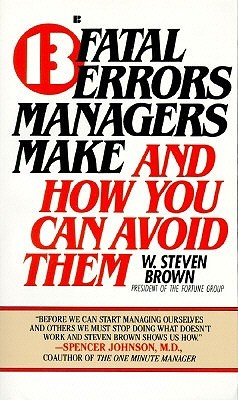
This is the first in a series of five posts by management expert, Jeannie Finkel. In this series, Jeannie weighs in on the top five books for managers, featuring one book each week.
Being a great manager is a skill that benefits from constant honing and refinement. While some are born with the innate ability to influence others, inspire action, and drive results, most leaders require a great deal of training, practice, and studying to become as effective as they hope to be. There are many incredible management training courses available, but they can be very pricey. Luckily, there is a wealth of information that can help you transform the way you lead and manage your team available for free, from the local library.
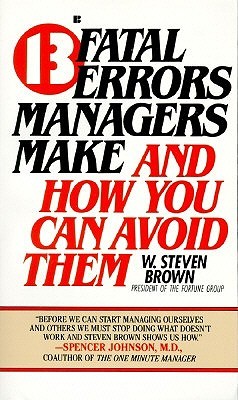
Book #1: 13 Fatal Errors Managers Make and How You Can Avoid Them
Author: W. Steven Brown
What it’s all about: Brown draws on his years of experience as a sales and management coach and consultant, working with Fortune 500 companies, to identify the top errors managers tend to make repeatedly, so we can recognize and stop doing them, or better yet, avoid committing them in the first place. The good and somewhat surprising news he shares is that there really aren’t that many – just 13 of them! He describes each one clearly, illuminating why the error gets in the way of achieving our goals as managers, and provides stories, examples, and suggestions to help us understand what the error looks like and how to correct it. He also ends chapters with helpful tools and a workbook section to create an action plan, summarize your key learnings, and think about how you’ll apply them.
What You’ll Learn: Whether you’re a new manager or one who’s been around a long time, there’s something in this little book for everyone. For newer managers, especially if you’ve been promoted from among a group of your former friends and peers, the transition to the role of “boss” and having to hold your friends accountable, can be very tough. For those in this tricky situation, the chapter, “Fatal Error #8: Be a Buddy, Not a Boss,” might really help.
For more experienced managers, who find yourselves wishing you could get your team to be more productive, there are great insights in the chapters “Fatal Error #3: Try to Control Results Instead of Influencing Thinking,” and “Fatal Error #7: Concentrate on Problems Rather than Objectives.” Or, maybe you’ve always been a top performer, and even though you set a high bar for your team, somehow, you know they can do even better. The chapters, “Fatal Error #5: Manage Everyone the Same Way,” and “Fatal Error #12 Recognize Only Top Performers,” could provide some good tips!
Why it’s a Must Read: I bumped into this book soon after it was first published, when I was a young manager. It was a godsend to me, as the firm I worked for did not provide any management training so I had to figure things out for myself. I discovered that I was committing most of these errors, and I quickly realized that the suggestions the author provided actually work. When I applied them to my own role, I became a much better leader of people, in large part because of the simple lessons this book offers.
This is a top management book I revisit every so often, and I recommend it to any new manager who’s just starting their leadership journey, as well as more experienced managers looking to strengthen their leadership skills. It’s really easy to read – you can probably finish it on a cross country plane flight or quiet Sunday afternoon – but the wisdom sticks with you long afterwards!
Look out for more book recommendations from management expert, Jeannie Finkel, as we continue our series on The Top Five Books for Managers. No matter where you are in your career, feeding your student mentality with advice from the top management experts can only aid you in your quest to reach your current and future goals and achieve success.
To find out more about Cydcor, check us out on Facebook, LinkedIn, Instagram, and Twitter.
Jeannie Finkel, Chief People Officer at Cydcor, the recognized leader in outsourced sales, has more than twenty-five years of business experience, managing human resources and administration at top firms. Jeannie served for nearly twelve years as a Senior Vice President of Human Resources at Charles Schwab & Co. Jeannie was also Head of Human Resources and Administration for a leading asset management firm, and she served as Managing Director, Talent Management Systems and Strategies for a Fortune 100 organization. Jeannie later became a Partner with leading global retained search firm, Heidrick & Struggles. With years of experience managing teams and overseeing organizations, Jeannie is a seasoned expert in management, administration, and leadership.
There are no better examples of leadership than the legacies of our great historical leaders. While they achieved tremendous fame, they did not do so without facing the occasional failure and enduring hardship. As we strive to become better leaders and learn how to inspire others, we would do well to reflect on the greatest leaders from history to see the characteristics, mentality, and habits that allowed these most revered leaders challenge norms, empower the oppressed, galvanize action, and spark change.
Lesson One: Learn from the Past
The best sources for what works in leadership are the lessons of the past. The trials and tribulations of historical leaders, while sometimes on a grander scale than our own lives, can teach us how to succeed or fail. We can learn how to lead effectively from reading about or watching movies on history, and anyone hoping to become a better leader should make a habit of it. Why make your own mistakes when you can benefit from the lessons learned by those who eventually achieved greatness? Study their lives, follow in their footsteps, and apply their leadership approaches as you drive your own team to reach its goals.
Lesson Two: Character Matters
The greatest historical leaders knew that character can often matter even more than ideas when it comes to leading others to find the greatness in themselves. Benjamin Franklin identified Thirteen Critical Virtues necessary for a successful live and vowed to exemplify them. George Washington is admired for his honesty, and Gandhi demonstrated remarkable restraint and self-discipline in his use of non-violent protest to drive change. Whether reading about George Washington, Ben Franklin, Mahatma Gandhi, Martin Luther King or Nelson Mandela, their character stood out and earned them respect, built trust with others, and translated to a highly-regarded reputation.
Lesson Three: Take Risks
You must be bold, and you must accept that you will sometimes fail. Failing can be an important stop on route to success. Lincoln lost a number of elections, including the Illinois Senate race in 1858, yet he ran for President in 1860. Washington struggled to win a major battle against the British for years, yet he had the courage to stay the course. Gandhi, King and Mandela were humiliated for many years on their paths toward civil rights and representation. Facing the occasional failure is a sign that you took on challenges, pushed yourself outside of your comfort zone, and it is an opportunity to prove your resilience and willingness to learn from your mistakes.
Lesson Four: You are Not a Victim of Your Circumstances
We can rise above poverty, lack of education, or lack of support to achieve greatness. Charlie Chaplin grew up in the direst circumstances, reminiscent of a Dickens novel, yet he revolutionized silent film. Men and women who had once been slaves and peasants, overcame the odds to become generals, emperors, and queens. While challenges can sometimes feel insurmountable, the stories of remarkable historical leaders prove that even when things seem hopeless, determination, passion, and grit can overcome the odds.
Lesson Five: Self Discipline is a Must
Lincoln had just one year of formal education, but he read constantly to feed his curiosity and continued to expand his knowledge. Franklin devised ways to improve his character by evaluating himself daily, assessing one character trait each day. Michael Jordan and Kobe Bryant were relentless in their routines to develop their skills and conditioning. The stories of great leaders of the past up to the present teach that our potential is boundless if we are willing to push ourselves. Achieving greatness as a leader means having the passion and drive to continuously transform yourself and expand your boundaries. Nobody will do that for you. To become a leader that can inspire others and provoke action, you must first be willing to lead yourself.
History is full of incredible stories of leaders who rose above their circumstances, exemplified character, and endured and overcame setbacks on their path to success. By studying their stories and seeking to understand which qualities and actions allowed them to achieve greatness, you can improve your own chances of doing the same. The stories of historical leaders are a goldmine from which I have learned so much about the kind of leader I hope to be.
To find out more about Cydcor, check us out on Facebook, LinkedIn, Instagram, and Twitter.
Gary Polson is Chief Executive Officer and Chairman at Cydcor, the market leader in outsourced sales. With more than 25 years of business operations experience in accounting, legal and senior management, Gary has propelled Cydcor to unprecedented achievement with clients, culture and philanthropy since 2001. Under his leadership, Cydcor has increased its revenue more than six-fold since 2001 and has been recognized as “…the most respected sales outsourcing company in the world” by Datamonitor and The Black Book of Outsourcing, one of the “Best Places to Work” by the Los Angeles Business Journal for eight consecutive years. Gary’s passion for excellence and never-satisfied approach has led Cydcor to earn both industry and employer recognition. With Gary at its helm, Cydcor has built its reputation on maintaining long term relationships with clients by consistently delivering results and by going above and beyond to help Cydcor’s clients gain market share and grow.


Building resilience is one of the cornerstones of success in business—especially entrepreneurial pursuits. The ability to pick yourself up, dust yourself off, and get right back to the task at hand is paramount to success in business, at every level.
Whether you’re a seasoned sales professional or just starting out on your entrepreneurial journey, these tips for building and maintaining personal resilience will put you on the path toward having the strength and flexibility required for success.
Pick Your Battles
Knowing your strengths is a key component to success in any endeavor; leveraging your strengths in your work will get you farther, faster, than spinning your wheels in areas where you lack knowhow and confidence. No one is good at everything, though, and learning when to power through a difficult course of action versus when to delegate is important. Building resilience includes challenging oneself, but it also means knowing when a task is best given to someone else—and being OK with that.
Build & Maintain Your Self Confidence
Building personal resilience relies heavily on recognizing your strengths and maintaining your confidence in them. You know what you know—make sure others know it too! Personal resilience takes practice and self-reflection. Take some time to honestly consider which facets of your profession you’re best at and make a list you can reference to boost your self-confidence and bolster your self-awareness.
Hone Your Skills
When you know your strengths, you can get to work on improving them. When your areas of expertise and your specialized skills are all second nature, the business of bouncing back from times of difficulty—or even failure—becomes easier. Call on your talents, experience, and knowledge to help you get through tough times, and build on those unique advantages to move on from setbacks. Honing your skills also reinforces your self-confidence, creating a powerful feedback loop for yourself as you maintain your personal resilience.
Be a Team Player
Business is built on relationships. You want—need—to be someone people want to work with. Reliable. Helpful. Trustworthy. Talented. The list of superlatives people want from their teammates and networks can go on and on, but the bottom line is this: being an indispensable member of your professional community is key to building professional and personal resilience. When your network is strong, bouncing back and moving forward—and extending successes—is much easier, because you can call on those relationships as you seek new opportunities, constructive feedback, and emotional support.
Manage Emotions During Losses—and Wins
The most resilient people have a keen understanding of their emotions and are skilled at managing them. This doesn’t mean building resilience requires stoicism—the opposite, in fact. Those who take the time to see the good in things and spread their positive outlook find it easier to work through rough patches. They see each experience, positive or negative, as a way to learn. These are also the people who are self-aware enough to see when things are going well and celebrate them.
What strategies do you use for building your personal resilience? Share your thoughts on Twitter and be sure to follow @Cydcor on Instagram to learn more about our company and our culture.
Entrepreneurship is an exciting opportunity for those, with the right attitude and pioneering spirit, to build something from the ground up, take ownership of their time and decisions, and potentially, achieve financial independence. But what are the characteristic of successful entrepreneurs? Why do some succeed while some don't?
Becoming a successful entrepreneur requires unwavering focus and commitment to your craft, strong relationships, and an open mind to new perspectives. We asked a group of entrepreneurs about what drives them and what they believe it takes to achieve success. What we discovered, is that even when you do everything right, success is not guaranteed, but the thrill of the journey, the chance to influence and support others, and the potential payoff are what drive daring entrepreneurs to venture down this career path time and again.
COMMON CHARACTERISTICS OF SUCCESSFUL ENTREPRENEURS
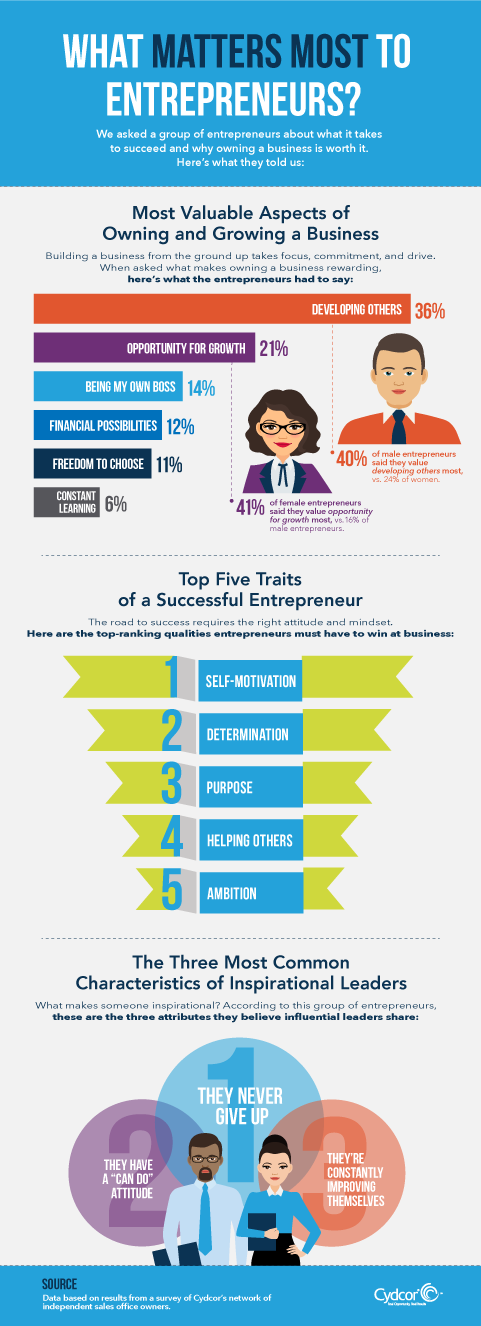
What sets entrepreneurs apart is not their mastery of specific hard skills such as writing, programming, or public speaking. From our discussions with independent business owners, we learned that the top characteristics of successful entrepreneurs are rooted in soft skills shaped by the right attitude and mindset, seen in the infographic below.
Self-Motivation
It’s easy to talk about building a business, but it’s entirely another thing to do it. The number one characteristic of successful entrepreneurs is self-motivation—the ability to put ideas into action. Think about some of the best-known entrepreneurs. Steve Jobs, for instance, didn’t wait for a company to come looking for him to build a new kind of personal computer. Instead, he partnered with the right people, turned his ideas into real-life products, and convinced the public that they needed the Apple Computer. Self-motivation can mean the difference between dreaming and achieving.
Determination
Our business owners identified determination as another major characteristic of successful entrepreneurs. This important trait is the drive that helps us follow through once we start. It’s what pushes us back up when we fall, and keeps us moving through uncertainty until we reach our long term goal.
THE BENEFITS OF ENTREPRENEURSHIP
Going from ideas to great products or startup to corporation is a remarkable feat that requires passion, focus, and resilience. It’s not a straight path, and there will often be twists, turns, and moments of uncertainty. We wanted to understand what makes it all worth it? What is it about the life of an entrepreneur that continues to drive so many to brave those, sometimes, stormy waters?
Developing Others
The majority of entrepreneurs said the most valuable benefit of entrepreneurship is the opportunity to help others grow and develop. Think about it. At one point, these entrepreneurs were employees, too. At the helm of a business, an entrepreneur has the experience to recognize greatness in others, and the leadership expertise to inspire them to get there.
Opportunity for Growth
Have you ever felt like you’re not getting anywhere in your current role, or looked up the organizational chart and didn’t like what you saw? Another major benefit of entrepreneurship is the opportunity for growth. And not just career growth, but personal growth, as well. Taking a chance on yourself and pursuing your passions will test your comfort zone, but the freedom to be your own boss and do what you love is an unparalleled experience and a unique benefit of entrepreneurship.
See what else entrepreneurs had to say about why owning and growing your own business is worth it.
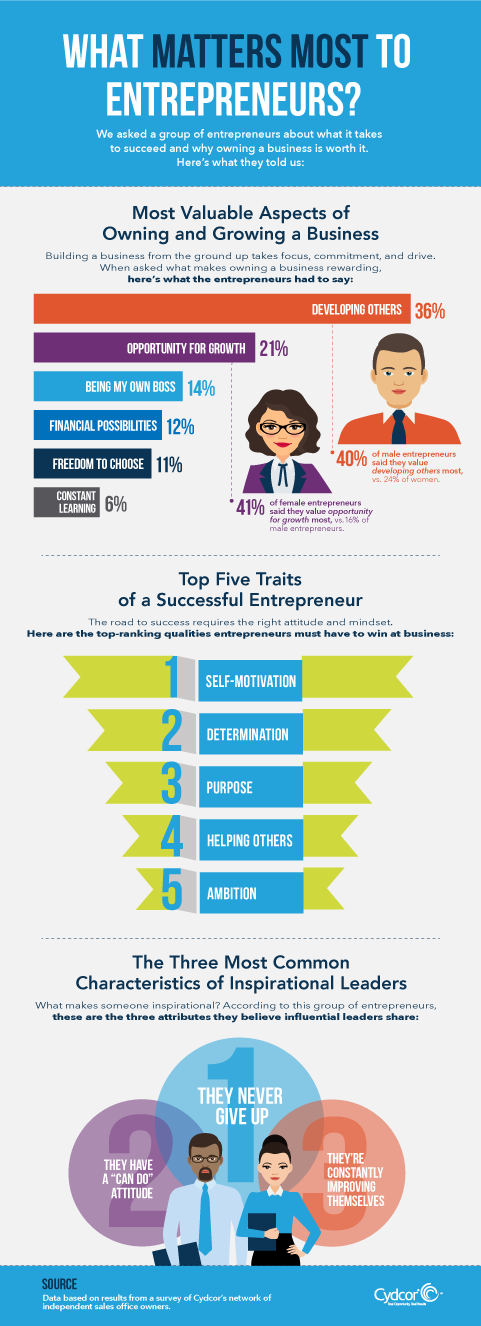
Building a successful business of your own is not something that happens overnight. It takes unwavering dedication, unshakable focus, and a healthy dose of endurance. It’s an accomplishment, much like a marathon, that is achieved one step at a time. But for those who stick with it and embrace the adventure, the benefits of entrepreneurship can be life-changing.


Self-confidence is a quality that can affect almost every part of your life including peer perceptions, decision-making, job performance, and growth opportunities. Learning to feel comfortable in your own skin and believe in yourself can do much more than just improve your well-being, it can directly impact the course of your career. Having low self-confidence can prevent you from accepting challenges that might help you get ahead, stop you from asking for the salary or title you know you deserve, and hamper your journey toward roles of greater leadership and responsibility. Learning to build self-confidence and helping others develop their own self-confidence, can improve you and your team’s prospects for success. Learn how to build confidence in yourself and others with these helpful tips.
If you doubt your own qualifications or question whether you deserve your job, you’re not alone. What you’re feeling is called “imposter syndrome,” and it affects many successful people, from executives to founders, causing them to doubt their abilities no matter how many great accomplishments they have achieved. You have earned your place, and nobody can take away the work it took to get there. Here are a few small steps you can take to start acting like you belong right now: hold your head high, make eye contact when speaking with coworkers, and shake hands firmly. Body language goes a long way toward conveying to coworkers that you belong there, and not only will it build confidence in yourself, it will build others’ confidence in you, as well.
Confident people always seem to know what they’re talking about, and that’s because many confident people maintain a student mentality. They constantly seek out and absorb vital information to strengthen their expertise and provide more value to others. When you know your stuff, you’re prepared for tough questions, and your coworkers and team members will notice. Being an expert in your field holds a lot of credibility, and being knowledgeable helps your team members feel more confident about your leadership and about their own chances for success as part of your team.
Mentoring others can help you gain confidence in your abilities. Helping others master critical job skills forces you to hone your own knowledge of those skills, while also improving your ability to communicate essential information to others. Collaboration and coaching also builds confidence in others by helping them feel well prepared and informed to conquer the tasks ahead of them.
When someone lacks confidence, even the slightest mistakes can haunt them. When you or members of your team make mistakes, avoid placing blame or dwelling on what went wrong. Instead, work together to develop a strategy to move forward and avoid that same mistake in the future. The process will help boost your confidence as a leader or colleague, and it will help your team member feel supported and reassured that making mistakes is part of the learning process. Knowing that you have their back can make team members and colleagues feel more self-assured and confident about the work environment and their chances of success.
As you work with your team, you’ll see the value each of your team members bring, whether that be a skillset or mindset. Recognize team members’ individual contributions, and they will bring that value more confidently to the table. People love to be recognized for things they do well, and they appreciate being coached to overcome their weaknesses. By recognizing things your team members do well, they’ll do the same for you, helping to build confidence for the entire team.
People don’t like to admit it, but self-doubt is normal. Everyone has doubts and worries about not being the best, the smartest, or the most liked, and even the most confident people struggle to keep those doubts from derailing their goals. Once you recognize that, it levels the playing field. No longer is that keynote speaker an unapproachable business guru, he’s just another person trying to make it, just like you. Remember that your doubts and insecurities are just feelings, and they don’t define you or represent your real potential. Don’t let them stop you from stepping out of your comfort zone or going after your long-term goals and dreams.
Learning how to build confidence starts with just acting the part. Practice using confident body language, even when you’re feeling uncertain inside. Sometimes, the image we present on the outside, helps us begin to feel the part on the inside as well. Use the tips above to bolster your own feelings of self-confidence, and whenever possible, help to support others who may also be feeling uncertain. By focusing on others’ journeys toward growth, you distract from your own self-doubt while helping someone else achieve his or her goals. Throughout that process, you’ll discover that, not only will they become more confident, but you will as well.


Who doesn’t want to be more influential? People who are influential can drive others to accomplish more and achieve goals, they can inspire action, effect change, and transform people and organizations. Influential people are powerful. They command attention and they garner respect. Being influential means that what you say and do matters, because it sets the tone for others who will strive to follow in your footsteps.
You don’t have to be a billionaire or a genius to influence others. Influence is about moving and motivating others through effective communication. Anyone can build influence by focusing on the way they present themselves and how they deliver their message. Becoming an influential leader is about much more than getting your way. It can make you an invaluable asset to a business by helping to unite teams, get employees on board with new projects, earn investments, realign thinking, and strengthen partnerships. By practicing the tips above, you may be surprised by your own power to move others to action, and no matter your goals, being more influential is a critical step toward becoming an effective leader and getting things done through and with others.


Written by Nia Bowers
Some leaders arrive at the top of a company. Vera Quinn built her way there.
She got her start over 25 years ago as a door-to-door sales representative within the outsourced sales industry. What followed was an impressive ascent in business leadership when she joined Cydcor (a leader in the outsourced sales arena): VP of Operations, Senior VP of Sales Operations, Chief Operating Officer, President, and finally CEO in 2020.
Founded in 1994 and headquartered in Agoura Hills, California, Cydcor is a trusted provider of outsourced customer acquisition solutions. Through its network of independently owned and operated sales companies, Cydcor offers Fortune 500 and emerging brands a blend of personal connection and technology that has kept clients coming back year after year.
When Quinn took over as CEO, the world was six weeks into a pandemic that had effectively outlawed the face-to-face sales model Cydcor’s business was built on. Many companies in that position played defense. Quinn led Cydcor’s corporate team to develop and launch touchless selling technologies, equipping the network of independent sales companies with entirely new strategies for customer acquisition and enabling the business to evolve and thrive.
It wasn't a pivot born of desperation. It was the kind of move that only happens when a leader knows the machinery well enough to rebuild it under pressure.
Since becoming CEO, Quinn has led Cydcor through consistent revenue growth, expansion into new industry verticals, and recognition on the Inc. 5000 list of America’s fastest-growing private companies. In 2025, Cydcor posted double-digit revenue growth for the fourth consecutive year, continued to serve long-standing clients, and saw its network scale their own businesses and develop new entrepreneurs.
Quinn talks about culture the way most executives talk about strategy as the thing everything else depends on.
"If you want great results, you have to invest in the people around you," she says. "It’s about giving them the tools, the clarity, and the belief that they can achieve more than they thought possible."
That belief isn’t decorative. At Cydcor, it operates as a management principle, one that runs through how the corporate team functions, how Cydcor approaches its relationship with the network of independently owned and operated sales companies that carry out field execution, and how it maintains the client relationships that have, in many cases, lasted decades.
"Clients stay with us because we’re consistent and because we do what we say we’ll do," Quinn explains. "They trust the integrity of our team and the strength of our network."
Cydcor has earned the DIRECTV Dealer of the Year Revolution Award for nine consecutive years. That kind of sustained recognition is less about any single campaign and more about what happens when accountability is baked into how a company operates at every level.
Under Quinn’s leadership, Cydcor has also been named a Best Place to Work in Los Angeles 13 times, a reflection of a corporate culture that doesn’t treat growth and team investment as competing priorities.
The accolades of the past few years read less like a peak and more like a confirmation of something that's been compounding for a long time.
Quinn was honored by Comerica and the Los Angeles Lakers with their Women of Business Award, named CEO of the Year by the Los Angeles Business Journal Valley Women's Leadership Awards, and was an honoree of the LA Times Studios Inspirational Women Forum & Leadership Awards - recognized for her focus on driving sustained business growth and building a high-performance, opportunity-based culture.
The Valley Women's Leadership Symposium spotlights influential leaders across the San Fernando Valley and greater Los Angeles who are driving innovation, cultivating inclusive workplaces, and shaping the future of business. Quinn's inclusion wasn't a lifetime achievement moment, it was a recognition of something actively in motion.
Quinn also serves as Executive Director of Liberty Children’s Home in Belize extending the same investment-in-people philosophy that defines her leadership at Cydcor into work that has nothing to do with revenue targets. Through Cydcor and its network, the company’s relationship with Operation Smile has helped fund nearly 4,000 smile-restoration surgeries for children, with over $1,000,000 raised.
It's a pattern worth noting: the leaders who build durable companies tend to be the ones who aren't only building companies.
Quinn has spent more than two decades learning within the industry and leading through a period that would have broken a less prepared successor. The numbers reflect it. So does the culture. And so, increasingly, does the industry recognition that keeps finding her, not because she's chasing it, but because the results keep demanding it.
Vera Quinn is the President and CEO of Cydcor, a leader in outsourced sales headquartered in Agoura Hills, California. Learn more at cydcor.com.