
Found 0 posts

Having a well-chosen, fully trained, sales team with the right attitude is essential if your organization is trying to increase sales. The sales team is the last line of defense. After all the investment your company has made toward developing, testing, and perfecting the product, branding, and promotional campaigns, it is the sales team who will ultimately make or break efforts to increase sales because they are the ones who will have direct contact with the customers. At Cydcor, a leader in outsourced sales, we’ve had more than 25 years’ experience building and growing great sales teams fully prepared to increase sales and achieve clients’ revenue growth goals.
Be Selective
Take the time to hire the right people. Be sure everyone on the team has clear expectations of what’s expected of them, simple goals, and ambitious but achievable targets – both for the team as a whole and for each individual salesperson. It’s okay (even great!) to have high standards, just make sure both sides are clear on those standards, nobody likes that kind of surprise.
Don’t be a stranger. Building a sales team positioned to increase sales is not a set it and forget it process. Hiring well is just the first step. Get to know your people. Talk to them. See them as individuals who bring their own individual strengths to the overall team. This will allow you to use them most effectively.
Get Everyone Trained Up to Speed
Once you have the right team in place, it’s important that they’re well trained and up-to-date on all sales strategies. Keep it simple, train your team only on what’s necessary to improve sales without added fluff, twists or turns. Since turnover is inevitable, make sure you have frequent trainings that are easily repeatable.
Also, remember that not everyone learns the same way. Some people learn better through presentations, others through reading materials. Some people have no problem just learning things conceptually and can then repeat them, but others may need to take a more hands-on approach with training. Have the most successful reps train the others and pay attention to make sure they’re getting it. You may even ask your team how they prefer to be taught. By involving them in the process you will get more buy in and participation.
Keep the Team Motivated
A team that’s eager to succeed is a must if you want to optimize your sales program. By keeping goals simple, clear and refreshed, you can always make sure your sales team knows what’s expected of them. Talk about goals daily. Reward and recognize those who increase sales and meet goals frequently. Healthy competition is good, but a collaborative environment where people are willing to help each other serves everyone, and that comes if everyone feels like their hard work is being rewarded.
Much like with training, different individual sales people will respond to different things. Everyone has their own carrot. Some are looking for recognition and respect, a star on the wall with their name on it. For others, bonuses and financial incentives may be the way for them to meet their full potential. Again, ask your team their preference. Get them involved in the process!
Ensure They’ve Got the Right Stuff
You’ll want to be sure to review your strategies to increase sales with the team to make sure all essential steps and needed communications are present in the sales process. Does the customer understand the product and service? Do they understand when they will receive the product or service? Will they need to do any follow-up? Don’t walk out the door until all of the customer’s questions are answered or, at least, until there’s a plan in place to get them answered.
Make sure your sales teams have the right tools, they need to be efficient. Making sure they have the right product information including pricing, a snapshot of the product or service benefits, pricing, and offer information is essential to help them improve sales and succeed.
There’s no one way to improve sales, but these strategies to build and maintain a great sales team should set you up for success. Hire the right people, train them well and keep them motivated, learn your customer and your product backwards and forward, and you should be well on your way to increase sales and achieve your business goals.
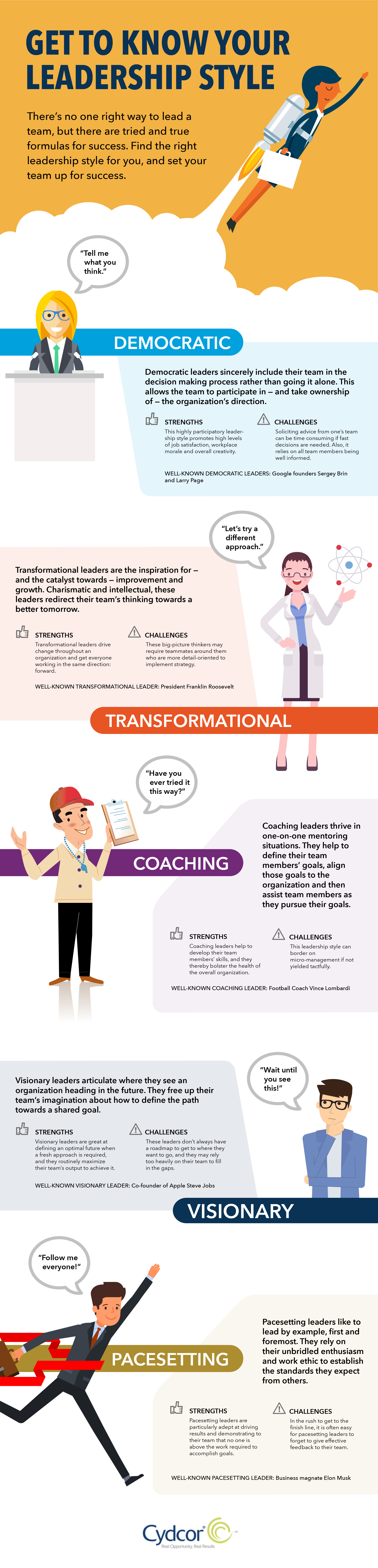
There’s no one right way to lead a team, but there are tried and true formulas for success. As you grow in your career, you’ll get more and more experience leading people. An understanding of different well-known and proven types of leadership can help you find the right path that resonates for you. Find the right leadership style for you, and set your team up for success.
Democratic Leadership Style
Democratic leaders strive to sincerely include their team in the decision making process rather than going it alone. This type of leadership allows the whole team to participate in―and take ownership of―the organization’s direction. This highly participatory style promotes high levels of job satisfaction, workplace morale and creativity. Everyone feels connected to the overall health and well-being of the organization. However, just like any leadership style, it does have its drawbacks. Soliciting advice from one’s team can be time consuming if decisions are needed quickly. Also, it relies on all team members being well informed. Democratic leaders need to strike a balance within their team of both decisive action and rich participation.
Transformational Leadership Style
Transformational leaders work with their team to implement improvement and growth. Charismatic and intellectual, these leaders redirect their team’s thinking towards a better tomorrow. The transformational leader solicits input from her team to identify what areas of the organization require change, creates the vision to guide that change, and then works with her team to execute the redirection. These big-picture thinkers may require teammates around them who are more detail-oriented to implement processes, and they need to develop strategies for soliciting their teammates’ assistance.
Coaching Leadership Style
Coaching leaders thrive in one-on-one mentoring situations. They help to define their team members’ goals, align those goals to the organization and then assist team members as they pursue their goals. The coaching style of leadership can be thought of as a sort of win-win relationship between the leader and her teammates. Coaching leaders help their team members to develop professionally, and they also thereby bolster the health of the overall organization. However, it can be easy to go overboard with this type of leadership and engage in behaviors that border on micromanagement. Coaching leaders need to yield their influence tactfully.
Visionary Leadership Style
Visionary leaders articulate where they see an organization heading in the future. They craft compelling―and often unheard-of―visions of what an organization can become. This style of leadership acts to inspire the team towards a shared goal. The internal drive they spark in their team members frees up creativity, and that freedom allows all the team members to delve into innovative strategies on how to get from Point A to Point B. However, visionary leaders need to keep in close contact with their team and stay involved in the team’s progression. Such an approach keeps everyone grounded as they strive towards the future.
Pacesetting Leadership Style
Pacesetting leaders like to lead by example, first and foremost. They rely on their unbridled enthusiasm and work ethic to establish the standards they expect from others. They are the roll-up-the-sleeves-and-get-dirty types. Pacesetting leaders are particularly adept at driving results, because they set the bar so high. They demonstrate to their team that no one is above the work required to accomplish goals. Pacesetting leaders should be cautious, however, and strive not to become single-minded. Narrowing one’s vision down to a single goal―or several―can mean that effective feedback and mentoring get neglected. Pacesetting leaders need to check in with their team members or a regular basis.
It is likely that you recognize one or more of these types of leadership in your own style. It’s rare that any one individual engenders just one leadership style. Explore which styles resonate with you. By cultivating a dynamic leadership style that encompasses a number of different approaches, you can find the right tools within yourself to tackle even the largest challenges.

Leadership is a popular topic in business, which means leadership myths abound. After all, a company cannot survive for very long without strong, consistent, visionary leadership providing direction to the team. Good leaders affect everything from big-picture growth to the daily details of operations. So, what constitutes good leadership? You may be surprised to learn that conventional thinking has shifted in the office environment. The following outmoded leadership mantras are counterproductive to building an effective, cohesive team. Being aware of these team-leading myths—and correcting them—can have considerable impact on your bottom line over time. How many of these leadership myths are still accepted as fact at your company?
Leadership Myth #1: A Leader Directs
While this statement is true to a certain degree, it’s just the tip of the iceberg. This team-leading myth evokes the distant, hands-off approach that is increasingly seen as out of touch by the workforce of today. To define effective, well-rounded leadership, the sentence should read: A leader directs by encouraging active communication and engaging employees in coming up with solutions.
Leadership Myth #2: Strong Leaders Must Always Be Right
Being able to admit when you’re wrong shows those around you that you are not unreasonably rigid and are able to adjust your views when new information becomes available. Mistakes are part of the journey, and good leaders grow into great leaders by acknowledging mistakes and improving because of them. Infallibility is not a quality that defines effective leadership.
Leadership Myth #3: Winning Leaders Motivate Through Fear
Using intimidation as a means for obtaining results is one of the fastest ways to lose the engagement of your staff. While you may have their full attention while you’re wildly gesticulating, issuing ultimatums, or otherwise creating emotional mayhem in the office, what you’re really doing is undermining your own authority by losing your employees’ respect. Instead, lead by example, with empathy.
Leadership Myth #4: Natural Leaders Command Attention
This leadership myth presupposes that leaders must be in the spotlight—getting or seeking attention—to operate effectively. In fact, effective leadership recognizes that the spotlight is best and most valuable when shared. Attention should naturally shift to various members of a well-balanced team as circumstances dictate to give each team member their moment to shine and have a unique impact on results.
Leadership Myth #5: True Leaders Are Extroverts
This fallacy incorrectly assumes that only extroverts can be natural leaders. Some of the top names in tech, such as Bill Gates, Marissa Mayer, and Elon Musk (admitted introverts all), shoot that team-leading myth right out of orbit.
Leadership Myth #6: Legitimate Leaders Have a Certain Position or Job Title
Leadership is an attitude, not a specific position. Employees at any level within an organization can demonstrate leadership, and their efforts to provide guidance to their teams should be valued. The best, most effective companies help employees hone and grow those skills to turn budding leaders into the results-driving executives of tomorrow.
Want to be a more effective leader? Start by rejecting false assumptions about the true meaning of leadership. Everyone wins when leaders encourage, challenge, and acknowledge their team in the effort to motivate them to be the best they can be. Effective leaders seek balance, learning from and admitting their mistakes. They work hard while also delegating wisely, and they lead by example. So, what are you waiting for? The most important trait of an effective leader is the willingness to step up and try.

Management and leadership are two sides of the same coin, and both are necessary for a business to succeed. Learning the difference between management and leadership is important for developing effective management skills.
Great leadership is about inspiring enthusiasm and drive, while great management is about building highly efficient teams that produce impressive results. Managers are experts at getting things done and meeting targets and deadlines; leaders know how to evolve people and organizations and help them meet their potential. Each is a unique discipline that helps teams meet their short- and long-term goals, while also fostering commitment to a shared vision and outside the box thinking.
Management skills are concerned with assigning tasks, committing to deadlines, and creating systems, while leadership is focused on defining a purpose and uniting individuals behind big ideas. Managers ensure teams meet their deadlines and deliver what’s expected of them, while leaders focus on the future and how teams might prepare for challenges on the horizon. Management is about limiting risk, while leadership encourages bold action. Leadership is primarily about engagement, while management has more to do with execution. Management focuses on performance, while leadership focuses on development. Managers develop processes and create smooth operations, while leaders build relationships, encourage communication, and build trust. The most successful businesses are built with an ideal balance of management skills and leadership skills.
Scenario 1: Suzy Business Owner has promised a new client 2,000 flyers by the end of the month, but she recently lost two employees, and she knows it’s going to be a stretch. She creates a workflow document that helps remaining team members understand when they must complete their portion of the project, and she meets with each team member one-on-one to train them on the new system. By following the workflow correctly, the team is able to meet their deadline.
Is this an example of management or leadership?
Answer: Management
Suzy is faced with a short-term business challenge, and by managing her overstretched team correctly, she’s able to help them successfully achieve their goal.
On the other hand…
Suzy should be careful. Her team is being pushed beyond its limits. To continue her team’s successful streak, Suzy must also lead. She has to remind team members that accepting these kinds of challenges can help them transform the organization, leading to a more successful future for everyone involved.
Scenario 2:
Jim Entrepreneur is hoping to push his company to become the leader in its industry within the next five years. He knows it’s possible if everyone gets on board. He calls a team meeting where he presents his long-term vision and asks team members to imagine what it will feel like to someday be the best of the best. He hands out paper and crayons and asks everyone to draw a picture of one thing the company can start doing differently to help towards its goals. The team eagerly participates and many turn in more than one idea.
Is this an example of management or leadership?
Answer: Leadership
While Jim’s meeting may not produce any tangible results immediately, it serves to unite the team and get everyone excited about the company’s potential. His brainstorm encourages creativity, and it reminds each team member that his or her ideas matter. The meeting also helps inspire people to focus on the big picture rather than just short-term results.
On the other hand…
Jim has a talent for getting his team fired up, but this effect could fade if his team members start to notice that he’s all talk and no action. Jim will need to use his management skills to prove that he can translate ideas into tangible business systems.
Scenario 3:
Eric the Executive grows concerned when the company does not hit its goals for the quarter. He schedules one-on-one meetings with each member of his team to investigate the problem. One team member, who has struggled to meet his deadlines, says he’s been having trouble with the company’s current software, and he has been leaving work 10 minutes early every day to take a training class on another software he was hoping to pitch as a replacement. Eric tells the team member he’s sorry to hear the current software is challenging, but he asks the employee to consider dropping the class to allow him the extra time needed to finish his daily tasks. The employee agrees to focus on his work.
Is this an example of management or leadership?
Answer: Management
Eric is doing a great job using his management skills to monitor the bottom line and ensure his company is meeting its quarterly goals. He understands that every team member must be contributing 100 percent of what is expected of them if the company hopes to produce the results it has promised.
On the other hand…
While Eric has solved the problem in the short term, he may be missing longer term opportunities to help the company operate more efficiently. If he had found a way to help the team member stay in the class, Eric would have provided the employee with a chance to develop himself while also exploring a new software solution which might improve company operations far into the future.
Scenario 4:
Brenda the Boss has discovered that her team’s projects have consistently come in over budget, and the executive team has suggested that if Brenda can’t curb spending, they may have to reduce her department’s budget for next quarter. Brenda can think of a few ways she could reduce spending, but instead of implementing those ideas automatically, she decides to throw the problem to her team, asking them to brainstorm some solutions to cut costs.
Is this an example of management or leadership?
Answer: Leadership
By empowering her team to find solutions, Brenda encourages them to think outside the box and demonstrates confidence in their abilities to problem solve. She also shows that her priority is not implementing her ideas, but rather, finding the solutions that are best for the team.
On the other hand…
Brenda will still need to make sure the solutions her team comes up with will deliver as promised. If they cannot reach their cost cutting goals, the whole team will suffer under a slashed budget, so Brenda may have to nix more creative ideas if they don’t seem likely to reach the goal.
Every business needs both great management and bold leadership in order to achieve its goals. Vision without action is ineffectual, and efficiency without a purpose is a recipe for maintaining the status quo. Managers help businesses function like well-oiled machines, while leaders help organizations evolve and take giant leaps forward. Innovative companies can count on their managers to work out the kinks, lower costs, and increase volume, while well-managed companies benefit from the creativity, passion, and unity leaders inspire. Whether it’s achieved by one executive or a team of one hundred, the most successful companies will be those who recognize the difference between management and leadership see the two as complementary and inseparable parts of any thriving business.