
Found 0 posts

Integrity means that you have high moral principles and follow professional standards. Simply put—to practice integrity in the workplace you can’t just talk the talk—you have to walk the walk. A lack of integrity can lead to poor decision-making and have a negative influence on your work and your employer.
Integrity Begins With You
Be well groomed at all times. Keep your work area and your car neat and clean. This habit shows that you care about the impressions you make as a representative of your company. Clients and colleagues will see that you respect your employer’s values and are a responsible person. If you make a promise you must keep it. It proves that you’re a dependable person. Only agree to provide services that you can actually deliver. Don’t over promise. If you do something wrong, fix it as soon as possible.
How Do I Show Integrity at Work?
You have to be honest and ethical in all of your actions if you want to practice integrity in the workplace. Understand that you’re a role model for your colleagues, clients, and vendors. Be consistent about how you apply your ethical standards. Rely on facts at all times in your interactions at work. Never make excuses or avoid sharing bad news. Integrity requires that you speak up when you notice a practice or behavior that diverges from the company’s ethical standards.
Practice Company-wide Integrity
Practicing integrity at work provides positive outcomes for your company. However, you need to understand how your company practices integrity. Become familiar with your company’s core values and use them as a guide for developing your workplace integrity. Allow your team members to share their concerns about anything they see as going against your company’s values. Encourage an atmosphere that supports honesty and fairness.
Integrity Welcomes Risk
Every decision you make will involve some elements of risk. You must be willing to take a risk in order to achieve excellence and be competitive. If there are objections to your suggestions, remain positive. Gaining support from team members and stakeholders requires effort. Do the work. Ask for input from all participants and encourage them to share their concerns.
Practice What You Preach
Your behavior at work must offer a good example for your team members, colleagues, customers, and your community. Recognize your own skills and appreciate the contributions of others. Share your experience with your team and help them to develop their own integrity in the workplace.
Learn more about Cydcor by visiting us on Flickr! https://www.flickr.com/photos/cydcor/

Description of this book: In Over Our Heads by Robert Kegan is an exploration of the mental demands in modern society. The book discusses how we are overwhelmed with expectations about our roles from work, family and media experts. It then goes on to discuss how we might navigate all that stimuli into a productive, happy life. The book showcases how we often feel overwhelmed and what happens to our brains in those situations, then how to cope. Kegan, a professor of psychology and education at Harvard, approaches the topics of the book with empathy and strong teaching skills. He believes that emphasizing adult development is as important as childhood development.
Cydcor recommends this book to career professionals because: This book discusses communication and techniques for processing information. Specifically, there are sections that cover work and interpersonal relationships, but also cover parenting, childhood, and learning. The book will show what to look for when seeking and hiring for jobs, how to communicate your ideas and receive communication, and how our brains learn new things and cope with stress. It is important in the workplace to master conflict resolution, learning all aspects of the job, and getting along with your team. Kegan writes about how to navigate those relationships and scenarios.
Our favorite part: The book is written at a high level and full of good research and communication studies. The chapter called Dealing With Difference breaks down management styles and shows examples of communication for each style.
Cydcor is a leading sales company that specializes in face-to-face relationships and professional development. Would you like to see more tips and advice on becoming a strong leader and building a successful Career? Find all of our inspiration on the Cydcor Pinterest Page.

The Cydcor Community chose to review Don't Sweat the Small Stuff by Dr. Richard Carlson as a great book for personal development and stress management.
Description of this book: Dr. Richard Carlson has built a career on teaching people how to manage stress and let go of the minor pressures of a fast paced American lifestyle. This is the original in a series of books on making life happier and more manageable by not “sweating” the small stuff, and pointing out even in the subtitle “it’s all small stuff”. It is easy to get frustrated and hung up over things like bills, appointments, accidents and more hurdles in life, but the main message of this book is that stress and worry only make situations work. Training your brain to think about solutions rather than fret is a powerful lifestyle choice.
Cydcor recommends this book to leaders because: Stress can be detrimental to your health and career. Stressed out people also radiate negative energy and cause others to feel stressed or demotivated. Good managers need to learn how to project productive and positive energy in order to maintain workplace harmony. This book provides great perspective and can help you change your mental state to becoming a calm, happy and inspiring leader. The book offers easy to commit to strategies that incorporate small changes that make a huge difference.
Our favorite part: "Without question, many of us have mastered the neurotic art of spending much of our lives worrying about a variety of things all at once." Dr. Carlson writes with whimsy and clarity that makes this book easy to read and convey its message. This is one that will stick with you for life.
Cydcor is a leading sales company that specializes in face-to-face relationships and professional development. Follow Cydcor on LinkedIn or Twitter for more professional development advice.

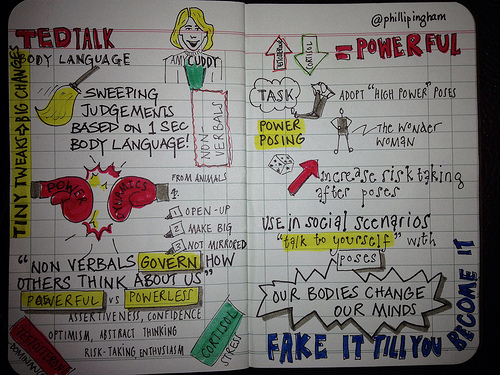
In sales, people have to have to interact with each other all day. Success in sales comes from being able to feel confident and comfortable in most situations. At Cydcor, we do our best to present the most effective sales teams around. One way to easily improve your sales confidence can be as simple as taking two minutes to stand powerfully.
Nonverbal communication has a lot of value in society. How we interact with each other can lead to very important decisions in life, such as whether someone is hired, sued, or accepted for a date. One second of political candidate facial expressions can predict election outcomes 70% of the time.

In addition to using body language to judge others, social psychologist Amy Cuddy has reported research that the way we move and carry ourselves also affects the way we judge ourselves. Further, many body expressions and postures reflect similar positions in the animal kingdom. When we are afraid we make ourselves small and meek, trying to appear insignificant. When we want to display power, we make ourselves big and open.
Power stances are known across the animal kingdom. Also, that powerful people express power chronically as well as in moments of victory. Even people who were born blind have been showed to display the upward v shape with the arms after winning something, the way racers do when they cross a finish line.
When powerful people and fearful people interact, body language reflects this as well. People unaware of fear will often shrink in the face of an open power stance without realizing it. Professor Cuddy realized the difference in power stances in the classroom, and decided to try an experiment to see if grades would improve on students she trained to stand powerfully.
The results were stunning. It turns out that powerful stances for two minutes actually increase hormones that contribute to self-confidence and assertion. So the fake-it-till-you-make-it strategy actually has a physiological affect that helps people be more confident and assertive. See the amazing talking by Professor Cuddy below: