
Found 0 posts

As much as you may want to stay on the clock 24-7, chasing leads and locking down the next deal, it's important to allow yourself time to decompress. Great salespeople know in order to always be closing, sometimes you have to step away for a few. Pulling back from planning and pitching, however, doesn't mean your free time can't be spent putting yourself in position for future sales success.
Discover how to spend free time in ways that don't just help you relax, but also help you continue to sharpen your saw, refine critical skills, and increase your value in the workplace. In this infographic, Cydcor shows you how a few sales titans have used their favorite activities, hobbies and interests to help push themselves to the apex of their industries. You'll meet the man whose sales techniques helped shape modern sales and the woman who turned the color pink into big green. You'll learn the greatest sin in sales and see how the greats have even turned their hobbies into record-breaking achievements.
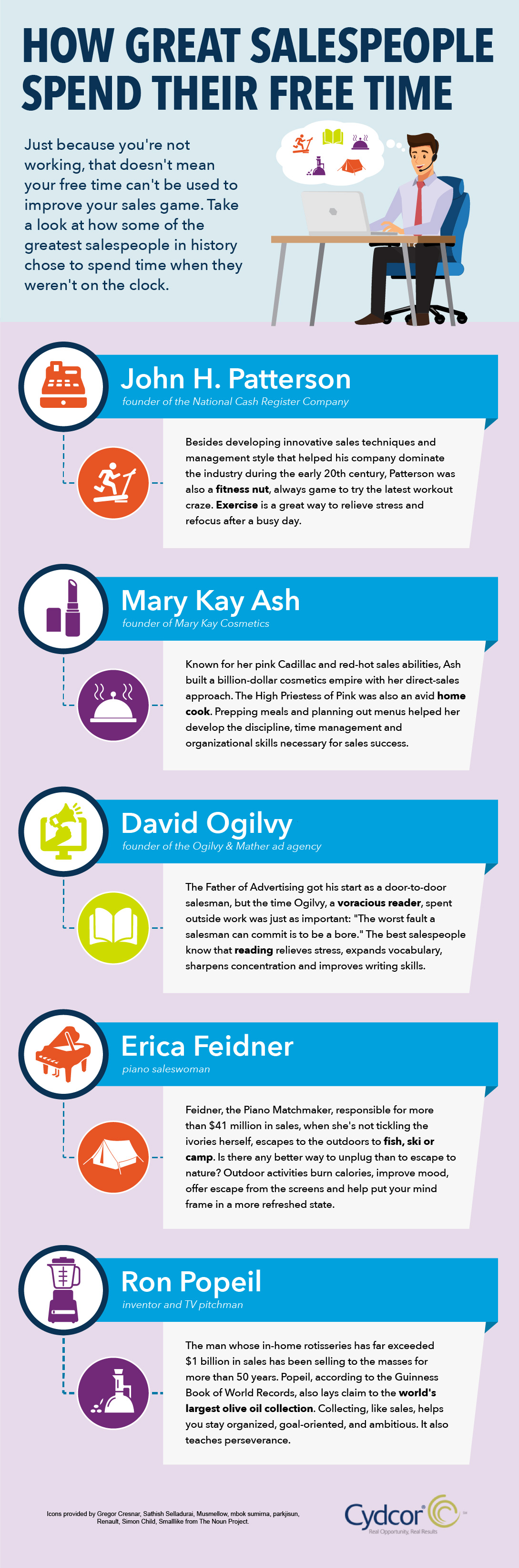
We hope you'll use these examples to help guide how to spend your free time. Print it out and post it at your desk, or use it when you just need a little extra motivation. The next time you're considering working through the weekend, consider instead how you can make the most of your leisure time by finding activities that feed your need to unwind while also fueling your passion for long-term growth.
Share on social media to inspire others. If you're looking for help with time management techniques or productivity tips, we can help in those departments too. Just don't forget to build in some time away for yourself.


The crowd falls silent as you walk out to the podium, and with hundreds of eyes fixed on you, you try to speak, only to realize you can’t remember a single word of your speech! This is the nightmare scenario so many of us play in our heads in the hours before we know we’ll need to speak in front of a crowd. The fear of public speaking, glossophobia, is one of the most common phobias, and many people avoid public speaking in order to escape their anxiety. But dodging the microphone or avoiding speaking in front of others can have career consequences that are worse than that temporary feeling of dread.
Public speaking is a great opportunity to demonstrate leadership, draw positive attention to yourself, and share your point of view. Avoiding public speaking invitations, simply because you’re afraid, is doing yourself a disservice that could stifle your career growth. You can overcome your fear of public speaking by approaching it with the right attitude and by calling on a few helpful tips and tricks.
1) Focus on Them, Not You: Public speaking anxiety often centers around feelings of insecurity about how you look and sound. By focusing on what the audience is getting out of your speech, you can take your mind off those worries about being judged. Remember that you’re speaking in front of a crowd to communicate something important. Are they absorbing your message? Are they connected? The more energy you put into conveying your main point, the less you’ll have available for self-criticism.
2) Speak from the Heart: Public speaking can feel awkward because we may think we have to pretend to be someone else – someone smarter – more knowledgeable. Instead of playing a role, just be sincere. Use examples you know well, relate to, and about which you feel strongly. The audience will pick up on your passion for the subject. When you speak in front of a crowd about your own perspective, you’re more likely to remember your speech, remain calm, and be convincing and compelling.
3) Breathe: It may seem obvious, but breathing properly is a proven technique for overcoming anxiety. Being deliberate about your breathing during a public speaking engagement can have multiple benefits. It reminds you to stay in the moment and get out of your head, and it slows you down, which prevents rushing through your speech and allows you to build confidence as you go. Breathing deeply also helps you control the sound of your voice, and it has a calming effect that prevents nerves from creeping up on you.
4) Practice, Practice, Practice: The better rehearsed you are, the more confident you’ll feel on stage, helping mitigate any fear of public speaking. Focus on your delivery more than specific words, and practice reading your presentation aloud. If possible, perform your speech in front of an audience, even if it’s just a friend or loved one. If you plan to use cue cards or a PowerPoint, practice with those as well, and make sure you’ve designed your cheat sheets in ways that are simple and easy to read. Cue cards with huge blocks of text can be confusing. Instead, use clean bullet points, and make sure the cards are numbered so you don’t mix up the order of your presentation. Record yourself via audio or video recorder and review your presentation as though you were an audience member. You’d be surprised how much changing your perspective can help you improve your public speaking performance.
5) Take Pauses: When you’re nervous, it’s tempting to rush through your presentation, but taking occasional pauses can help to calm your nerves and improve your delivery. Pauses create a break in your speech, which gives the audience a chance to react and absorb your message. Pauses help to add emphasis and can force you to get back into the moment rather than obsessing about the next line you have to recite.
6) Embrace Your Nerves: Don’t judge yourself for being nervous. Your anxiousness about public speaking is a sign that you care about doing well and you’re invested. Studies have shown that trying to stop yourself from being nervous is a losing battle. Instead, transform your nerves into another feeling: excitement. Use your nerves as a way of bringing energy to your presentation as you speak in front of a crowd.
7) Start with a Story: When it comes to public speaking, what people will remember most is how you start and how you finish. Begin with a story, joke, or memory to draw the audience into your presentation right away. This also helps you put their focus on your message rather than your performance as a speaker.
8) Don’t Memorize Every Word: It’s tempting to rehearse to the point that you know every single word, pause, and inflection by heart. This could backfire big-time if you happen to miss a word, completely throwing you off for the rest of your presentation. Instead, memorize the beats, the main points you need to make, and instead of focusing on the exact delivery, put energy into staying in the moment and connecting with your audience.
Public speaking doesn’t have to be painful. In fact, it shouldn’t be. Taking center stage to speak to a crowd is an exciting opportunity to share your voice and demonstrate your ability to motivate and inspire. While your instincts might tell you to get through it as fast as you can and to try not to think about what you’re doing, that approach will almost guarantee a poor performance. As daunting as it may seem, try to enjoy the moment. Remind yourself of the potential benefits of doing a good job, and remember that the people in the audience aren’t there because they want to see you fail. They are there to learn something and to hear what you have to say. Prepare yourself well and your ability to capture the crowd may surprise you.

Like it or not, being on time matters. In fact, it matters a lot. It communicates to others whether they can trust and rely on you. It gives others insight into how you view them and how you view yourself. Being chronically late can have countless unintended consequences, and it’s a seemingly small thing that can have a huge and lasting negative effect on your career. By contrast, learning the importance of punctuality – or being consistently on-time, or even early – is an incredibly simple way to set yourself apart from the crowd. It allows you to make an instant good impression, and it can help you reach your goals faster by helping others see you as someone worth listening to.
There is no excuse for being late. Barring true emergencies, being on time is completely within your control. Taking ownership of your time, knowing the importance of punctuality, and choosing never to be late again, is one easy thing you can do to change your life and career for the better.
Being on time doesn’t come naturally to everyone, but it doesn’t have to. Even those of us who struggle with punctuality will admit that being on time just takes a little planning, and most importantly, admitting to ourselves that being on time matters. Just think about it. When you really care about being somewhere on time, you’re able to make it happen. Right? That’s because the biggest trick for improving your time management isn’t a trick at all. It’s just knowing the importance of punctuality.


Wouldn’t it be nice if we could just create new habits at the snap of our fingers? Wouldn’t you love to just wake up one morning to discover that your new morning workout, improved time management, or daily reading habit has already become automatic? Unfortunately, as we all know, adopting new habits just isn’t that easy. It takes commitment, hard work, planning, and consistency. That is why it’s so easy to go back to your old ways. But there are proven methods you can use to form good habits that stick.
Starting a new habit is pretty easy, but sticking to one is something almost everyone struggles with. Still, with a little organization, a strong sense of purpose, and by using the tricks above, you can give yourself the best possible chances of success. The most important thing to remember is to be patient, because after all, changing ourselves for the better is the most challenging new habit of all!

Distractions are everywhere! Sometimes it’s hard to believe anyone can get anything accomplished when friends can reach us at any time on our mobile phones, social media notifications nag us to check in, and a 24-hour news cycle means there’s always something new and interesting just one Google search away. But focus, like exercise, eating right, and flossing, is just another habit. It’s a behavior we need to constantly practice and hone, and it IS something we can train our busy brains to do better.








Staying focused at work is something almost everyone struggles with. It’s not an easy thing when everything in our lives seems to be designed to grab our attention. But focus is something you can learn to do better. Start with the tricks above and take it slow. Even if you can only concentrate for five or ten minutes at a time in the beginning, just continue to work at it, and in no time at all, your brain will start to build the defenses it needs to banish distractions for good.

For more information about Cydcor, check out our profile on CrunchBase.
Jack London once said of creativity, “You can’t wait for inspiration. You have to go after it with a club.” Waiting around for a spark of motivation or creativity isn’t always an effective option when you have clients to attend to. Sometimes you need to go out and find the inspiration yourself.
Being creative can be exhausting, and sometimes the best way to recharge is to step away from the project or task for a while. You might be surprised at how stepping away can aid in your creative flow. Focusing on one task can sometimes lead to a narrow-minded view and can impede your creativity. Exiting the task for a short while and returning to it can often lead to new ideas and a fresh perspective.
In the same vein, break away from your usual routine if you’re finding yourself stuck. See a movie in a theater you haven’t been to before, read a new book or visit a local park or beach in a different area than the norm. You might find upon your return the sense of familiarity can make it easier to sit down and pick up where you left off.
If you find yourself struggling with an idea, share it with someone else. Seek out a new creative perspective by having a team member comment on how they’d envision the project heading. Sometimes sharing the details of your idea can allow others to aid you in connecting the dots in new ways.
There are also many apps to help promote creativity. Take advantage of new technology and tools available, such as ways to store your notes, visuals to display your presentation, and brainstorming exercises to help you break away from mental roadblocks.
Always remember to take care of yourself, and rest when needed. Sleep can do amazing things for the mind, and some challenges are better undertaken after a good rest. Avoid tackling important projects until you get a proper sleep, so your mind can be up to the task.
Cydcor is on Twitter. Be sure to follow us @Cydcor!


A quote by Carl Zuckmayer says, “One-half is luck; the other half is discipline—and that’s the most important half, for without discipline you wouldn’t know what to do with luck.”
Luck doesn’t just happen, and it’s Cydcor is a firm believer that it's entirely possible to create your own. There are many events that happen over the course of an individual’s life that they have nothing to do with—both negative and positive occurrences.
The concept of ‘luck’ is truly about being at the right time and the right place. But how can you be sure you are?
Those who are successful project an appearance of being positive. When someone is positive, others want to be around him or her. What does ‘be positive’ really mean? Radiate appreciativeness and share your knowledge and friendship with others. Everyone has insecurities, and spending time with those who are negative only exacerbates them.
The more effort you put into creating a positive, professional relationship, the more opportunities will be presented to you. Others will see you have a ‘can-do’ attitude and will turn to you for help. People want to work with those who provide solutions and aren’t bogged down by negative frustrations.
Things are also not as black and white as they appear. Try to keep an open mind and make sure your vision isn’t narrow when it comes to what you feel is possible or impossible. You can miss out on opportunities if you have tunnel vision.
Create your own luck by setting yourself up for opportunities!
Check our the Cydcor CareerBuilder page to learn about our current open positions.