
Found 0 posts


If you are looking to advance your career, you will definitely want to consider the power of positive thinking. While it may sound hokey at first, adopting a positive frame of mind can have a real impact on your potential for success, not to mention, making you feel good! Actively working towards positive thoughts in your everyday interactions with yourself and with others can improve your confidence, strengthen your relationships, and lead you to your life’s goals.
What is positive thinking?
Positive thinking involves a mental attitude that expects good and promising results. Incorporating positive thinking into your mind and your life can lead to a great deal of benefits because it can transform positive energy into reality.
You may not think of yourself as a positive or a negative person—you’re a realist. While that may be the case, even realists can get bogged down by a negative train of thought. Harnessing the power of positive thinking will train your mind to consider a positive outcome and then truly believe that that outcome will come true.
The problem with negativity
Negative thoughts are incredibly limiting. Henry Ford once said, “If you think you can, or you think you can’t—you’re right.” If you don’t think you can land a sale, you won’t. If you don’t think you can advance to your dream job, you won’t. Negativity will make you overthink your interactions, your work, or your effort, and it will make you believe that none of it is cutting it. A negative mindset can also make you comfortable with failure, which certainly won’t do you any favors.
Negativity doesn’t let you see the forest for the trees. It narrows your thoughts, creating stress and a flight or fight response. It can make you fixate on a single problem without giving you the room to consider alternative possibilities. Learning how to counter negativity with positive thoughts is essential for maintaining an upwards career trajectory.
How to use the power of positive thinking
Thoughts create your reality. Harkening back to another one of Henry Ford's most motivational quotes, "if you believe you will land a sale, your confidence will shine through, and you are more likely to achieve that goal. Additionally, a positive mindset doesn’t come naturally to a lot of people; it takes concerted effort to rewire your brain to think in this manner.
Try the following actions in your day-to-day in order to reap the benefits of positive thinking:
The benefits of positive thinking
When you actively work towards a positive attitude, you will begin to experience more joy, contentment, and love in your life. Furthermore, the power of positive thinking has a tendency to create what some call an “upward spiral.” Like a downward spiral, which is associated with the slippery slope of negative thoughts, an upward spiral can provide the momentum for broadening your horizons and increasing your rate of success. Use the baby steps tactic that you learned about to help propel you into an upward spiral.
Another great benefit of positive thinking is that you will be able to handle feedback and conflict in a new way. If constructive criticism used to make you squirm, positive thoughts can help you reframe that feedback into a learning experience. The same can be said for conflict: you can create new pathways in your brain to handle additional setbacks or issues so you can approach conflicts with a level head.
While many people think that success is a result of work ethic, persistence, or drive, behind it all is the power of positive thinking. Few of the most successful people would be where they are today—whether elite athletes, CEOs, or business owners—without the positive mindset and confidence that they would eventually attain their goals. Replace your negative thoughts with positive ones to start believing in yourself and believing in your own success. You will probably be surprised by difference positive thoughts can make.
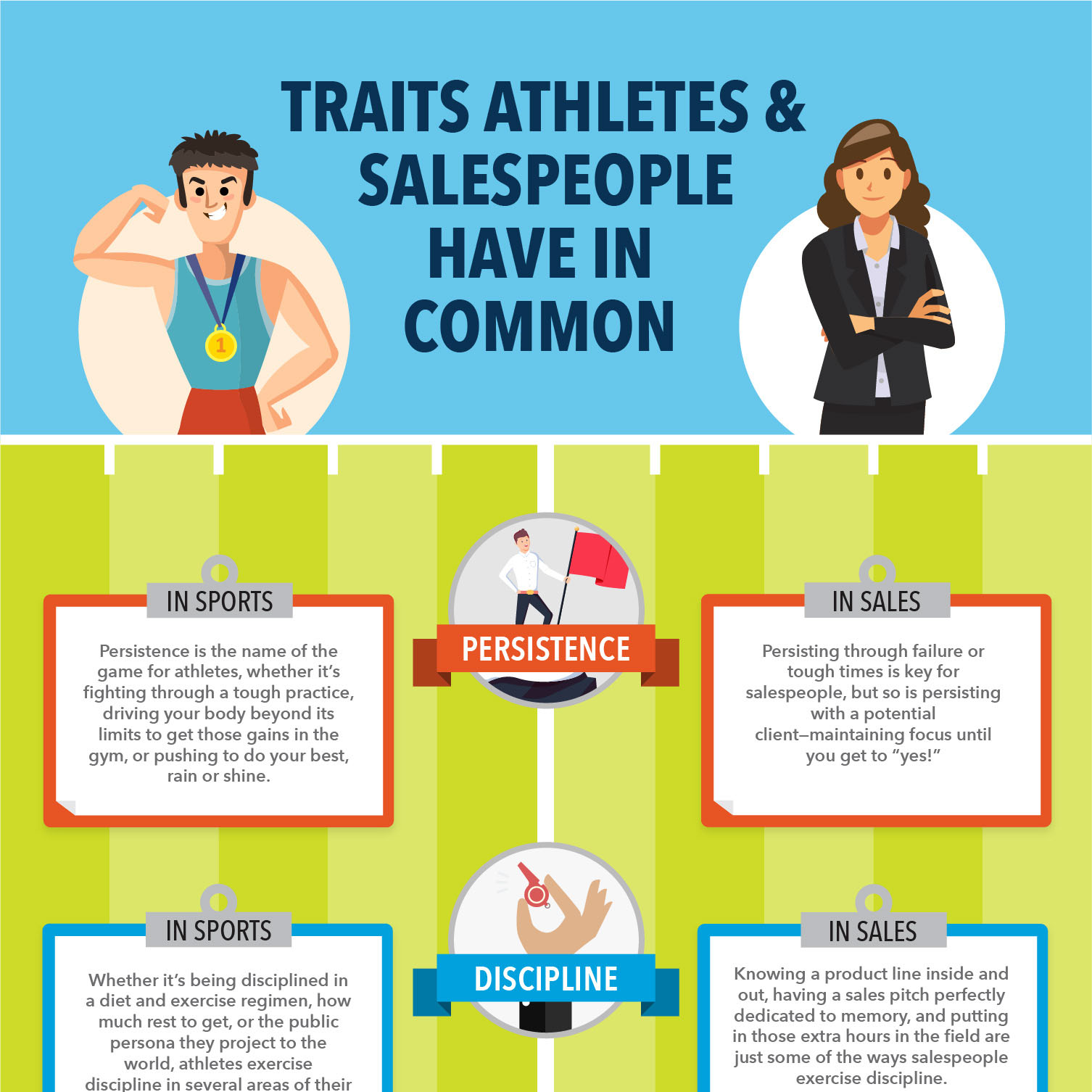
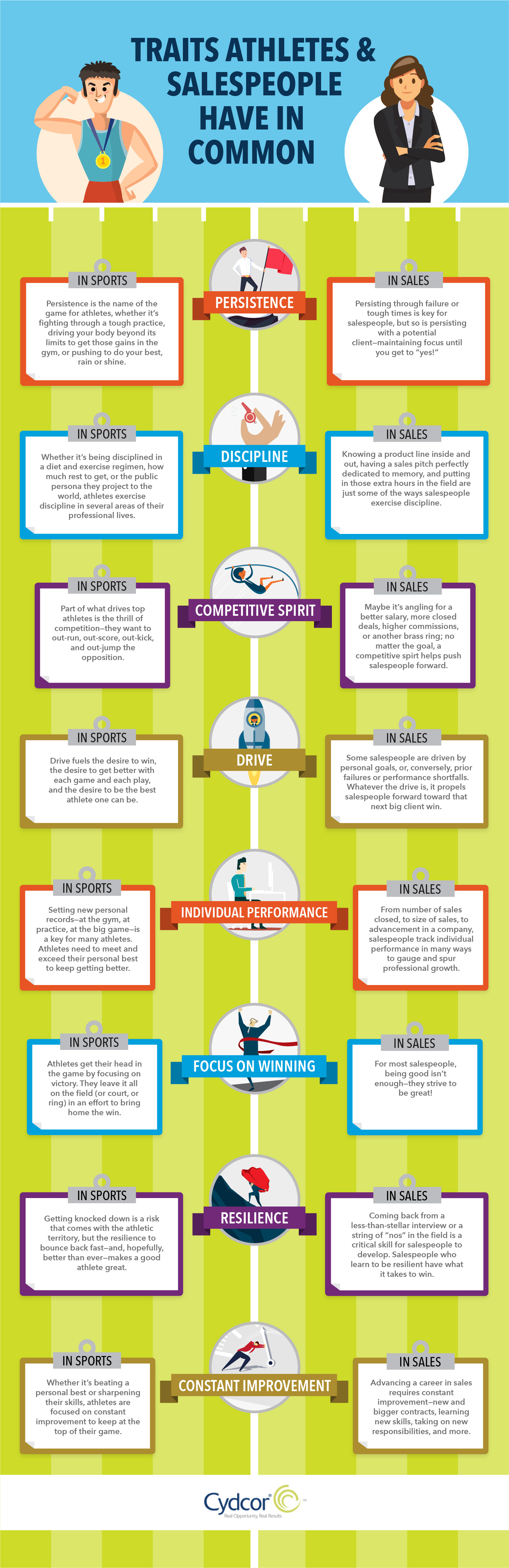
You may wonder what athletes and salespeople have in common – it’s more than you think. Whether you’re trying to win on the field or in the field, sales people and athletes have many common characteristics. Think of the superstar athletes you idolized when you were growing up. Maybe you dreamed of making slam dunks like Michael Jordan, winning Wimbledon like Serena Williams, or hitting home runs like Ken Griffey, Jr. You recognized in them what so many others have too – not only do they have the talent to succeed, they have the drive to make it happen.
Athletes thrive on competition, using it as a motivator to heighten their own games. This is what athletes and salespeople have in common. You may never play in the Super Bowl or the World Cup, but you can take a page out of these superstars’ win-at-all-costs playbook when it comes to sales motivation.
To be successful in a competitive atmosphere, similar qualities, disciplines, and tactics to top athletes are required. Here are the top common traits amongst sales people and athletes.
1. Persistence
When Michael Jordan was in high school in North Carolina, he was already a talented basketball player, but his coaches didn’t recognize just how talented he was. When he tried out for his varsity team, he didn’t make the cut, and he was placed on the B-Team instead. Rather than let that get him down, he kept at it and eventually went on to be regarded as the greatest basketball player of all time. This kind of persistence is key in sales motivation. In sales, you may hear “no” a lot. When you’re just starting out, you’re likely going to hear it a lot more than often than you hear “yes”. You can’t let it discourage you, and you can’t give up.
2. Discipline
Tiger Woods was a golf prodigy who began playing when he was two years old and could outplay many professionals before he was in his teens. Despite these innate gifts and all the accolades he’s received, Woods still practiced endlessly growing up and continues to this day. In order to be the very best in sales, you need to have the discipline to work hard every day, to put in the hours it takes to be successful.
3. Competitive Spirit
“I am the greatest,” Muhammad Ali once said. “I said that even before I knew I was.” There’s a reason why Ali is the most legendary boxer of all time. Sure, he’s immensely skilled and talented, but that’s true of a lot of other boxers too. But Ali is as famous for his confidence and competitive spirit as for his boxing acumen. It’s that kind of fighting spirit that’s going to serve as prime sales motivation and take you far in this industry. There’s a lot of other people out there trying to make a sale – you have to want it more.
4. Drive
Perhaps no athlete best exemplifies the drive you need to succeed in sports than Serena Williams. Growing up in Compton, Williams did not have the advantages that a lot of successful young tennis champions do. But today she earns tens of millions of dollars in endorsements every year and she holds the all-time record in countless tennis achievements, from Grand Slams to U.S. Open wins to singles matches. Today, many consider Williams not just the greatest female athlete or the greatest tennis player, but the greatest athlete of all time. The drive to succeed like Serena Williams is part of what athletes and salespeople have in common. No matter what advantages you start off with, you take what you’re given and make it work.
5. Focus on Winning
There’s probably no professional sports team that most exemplifies winning more than the New York Yankees. They’ve appeared in 40 World Series (twice the amount of the next best team) and they’ve won 27 of them (far more than twice the amount of the next best team). Whether it’s the era of Ruth and Gehrig or DiMaggio and Mantle or Jeter and A-Rod, there’s no period in baseball in which the New York Yankees weren’t considered the top dog. That unrivaled degree of success should serve as prime sales motivation for any salesperson. No matter what team you root for, you want to win like the Yankees.
6. Resilience
You can take lessons from teams that aren’t quite as successful as the Yankees too. For 108 years, the Chicago Cubs were renowned as the “lovable losers” of American sports. No professional sports team in America has ever gone that long without winning a championship. Some claimed they were cursed, others just accepted they didn’t have the money to compete with big market teams like the Yankees and the Dodgers, and many accepted the Cubs were always destined to lose… and then came 2016 and one of the most memorable World Series of all time. This resilience is part of what athletes and salespeople have in common. Setbacks happen, and sometimes they’re unavoidable. The key is to pick yourself up, dust yourself off, and get back out there. Eventually, you’ll succeed.
7. Constant Improvement
At the 1936 Olympics, when Jesse Owens set the world record of running a 100 meter dash in 10.2 seconds, it was an astounding world record achievement that made Owens one of the most celebrated athletes of all time. It’s a record that has since been broken over 50 times. Athletes are never satisfied that the best has already been achieved: they’re always ready to run faster, be stronger, and accomplish more. That’s what athletes and salespeople have in common. No matter what level of success you feel you’ve reached in this industry, there are always opportunities to do better, to work harder. This constant drive to do your best can work as powerful sales motivation.
We’re not all blessed with the amazing physical gifts of these superstar athletes. But hard work and determination are not things you’re born with, they’re things you work toward. Using these amazing athletes as your sales motivation can be the first steps to an amazing sales career.

What do CEOs John Paul DeJoria, Warren Buffet and Howard Schultz all have in common? They all cut their teeth in sales, and they have used that knowledge to help propel their success! A background in sales can provide you with invaluable skills, as you can see from the work histories of some of the top CEOs out there. Sales teaches tenacity, leadership, discipline, communication skills and so much more. All of the skills you learn in sales can help to fortify you as you move forward in your career path. People who work in sales learn how to persevere against the odds, inspire their teammates, stay on-task and truly listen to the needs of those around them. These top-performing CEOs put their background in sales to good use, and so can you!
John Paul DeJoria, cofounder and CEO of John Paul Mitchell Systems, is truly a self-made marvel. To help support his family at only nine years old, he began selling Christmas cards and newspapers with his older brother. In fact, this CEO’s work history is full of sales jobs early in his career. He worked as a door-to-door encyclopedia salesman as well as an insurance salesman. The job that got him started in hair care was in sales also. While selling Redken hair products door to door in the middle of a gas crisis, DeJoria was making only $600 a month! His tenacity paid off, however. He and his partner Paul Mitchell started John Paul Mitchell in 1980 with a loan of $700 while DeJoria was living in a 20-year-old Rolls Royce automobile. After a few rough years starting out, DeJoria’s sales background truly paid off. Today, Paul Mitchell products can be found on the shelves of over 150,000 salons.
“The biggest hurdle is rejection… When 10 doors are slammed in your face, go to door number 11 enthusiastically, with a smile on your face.” ―John Paul DeJoria
Warren Buffett is a name that is synonymous with success. Chairman and CEO of Berkshire Hathaway Inc. since 1970, Buffett is widely acknowledged as one of the most successful and wise investors of the modern era. As of June 2018, his net worth stands at $84 billion! This makes him the third wealthiest person in the world. Before all the attention, however, Buffett had an early background in sales. As a child he was inspired by a book he borrowed from the public library, One Thousand Ways to Make $1000, and he undertook one of his first business ventures selling chewing gum, Coca-Cola bottles and weekly magazines door-to-door. Other childhood ventures like working as a paperboy and selling a horse-racing tip sheet helped to inform Buffett’s first adult job after college, selling securities at Buffett-Falk & Co in the early 1950s. His sales background helped propel his career forward. With communication skills and business knowledge gained from sales, in less than 20 years Buffet became a CEO.
“The most important investment you can make is in yourself.” ―Warren Buffett

Howard Schultz, the CEO of Starbucks from 1986-2000 and again from 2008-2017, has his roots firmly set in the world of sales. This CEO’s work history starts after college with Xerox Corporation as a sales representative. There he learned the importance of listening to his clients and networking as well as how to lead. This job led him to become the general manager of Swedish drip coffee manufacturer Hammarplast. Schultz knew his product at the time exceptionally well―like any good salesman should! He became curious as to why one of his customers, a fledgling coffee-bean shop in Seattle called Starbucks, ordered so many plastic cone filters. He was incredibly impressed with the shop’s knowledge of coffee, so much so that he stayed in contact with them over the next year and eventually took a position as their Director of Marketing. During this time, he took a trip to Italy where he fell in love with the coffee shop culture and developed the aesthetic for which Starbucks would become known. He eventually left the marketing position to open his own coffee shop. Not long after, Starbucks management decided to switch focus and sell off their retail division to Schultz. Schultz aggressively grew the Starbucks empire to the over 28,000 international locations they boast today.
"I am convinced that most people can achieve their dreams and beyond if they have the determination to keep trying." ―Howard Schultz

As all of these CEOs’ work histories attest, a sales background can be beneficial no matter what industry you choose. To learn more about how a background in sales can accelerate your career―and for other professional advice―be sure to visit the Cydcor blog today.
As much as you may want to stay on the clock 24-7, chasing leads and locking down the next deal, it's important to allow yourself time to decompress. Great salespeople know in order to always be closing, sometimes you have to step away for a few. Pulling back from planning and pitching, however, doesn't mean your free time can't be spent putting yourself in position for future sales success.
Discover how to spend free time in ways that don't just help you relax, but also help you continue to sharpen your saw, refine critical skills, and increase your value in the workplace. In this infographic, Cydcor shows you how a few sales titans have used their favorite activities, hobbies and interests to help push themselves to the apex of their industries. You'll meet the man whose sales techniques helped shape modern sales and the woman who turned the color pink into big green. You'll learn the greatest sin in sales and see how the greats have even turned their hobbies into record-breaking achievements.
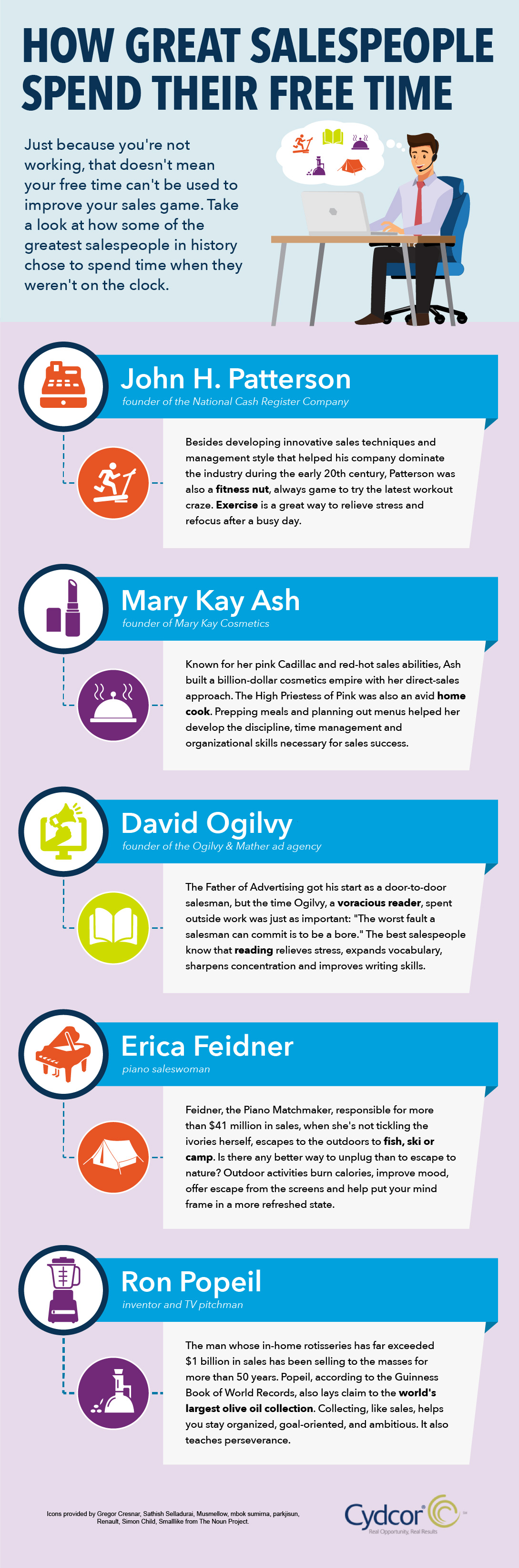
We hope you'll use these examples to help guide how to spend your free time. Print it out and post it at your desk, or use it when you just need a little extra motivation. The next time you're considering working through the weekend, consider instead how you can make the most of your leisure time by finding activities that feed your need to unwind while also fueling your passion for long-term growth.
Share on social media to inspire others. If you're looking for help with time management techniques or productivity tips, we can help in those departments too. Just don't forget to build in some time away for yourself.

Have you taken the time to ponder what you really want in life? Is there a bigger picture that drives you – a future that you feel deeply passionate about? Do you know what will give you an ultimate sense of peace and fulfillment? People find their internal motivations in a variety of ways, whether it’s focusing on providing for the ones they love most, envisioning the life they’d like to build for themselves, overcoming personal challenges and weaknesses, or conquering ambitious goals. Whatever you choose as your personal internal motivation, it has to be something that truly matters to you. Have you clarified your “why?”
#1: When you know your “why,” you have a reason to jump out of bed each morning.
Nothing is more mobilizing than having a purpose. It’s arguably better than a bucket of cold water being splashed on your face. When you have a compelling vision for your future as your internal motivation, you can’t help but to get up, get moving, and do all you can to have a productive day―even when no one’s standing there ready to pour.
#2: When you know your “why,” you develop successful habits.
Anyone who’s serious about their big picture goals wants to achieve them sooner rather than later, so they don’t have time for bad habits. People with a “why” design their day to day lives to lead them towards the future they want. They realize that since success isn’t achieved overnight, the fastest way to get to their goals is to remain self-disciplined throughout the week.
#3: When you know your “why,” you stay the course.
People who know where they’re going don’t just turn the car around and go home when they see a road block. That would only delay their ETA! They’ve got somewhere to be and they have every intention of getting there―no matter what challenges they face along the journey.
#4: When you know your “why,” you’re a stronger leader.
Everyone likes to follow someone who knows where they’re going―particularly since so many people don’t. When you’re on a mission for greatness, you attract like-minded people who are excited about joining you on your journey. Your contagious passion will make you a compelling leader who others will happily get behind.
#5: When you know your “why,” you’re more comfortable with sacrifice.
No one necessarily likes the idea of giving up one thing in order to have another―but there’s no such thing as actually “having it all.” The thing about making sacrifices, though, is that it’s all in the eye of the beholder. If you aren’t passionate about specific end goals, you’ll feel resentful about what you’re giving up. But if you are―when you really know your “why” and are grounded in your internal motivation―you’ll be ready and willing to do whatever it takes to acquire the things you want the most. As Friedrich Nietzsche said, “He who has a why to live for can bear almost any how.”
#6: When you know your “why,” you avoid unnecessary regret.
When you don’t have a grand plan, it’s easy to end up somewhere you don’t want to be. And the tricky part is that most people don’t know it until they’re already there. You can avoid looking back with anguish by making choices that are in sync with your greater vision. Connecting the dots from the short term to the long term will prevent loads of haphazard decisions that you’ll wish you didn’t make.
#7: When you know your “why,” you don’t get burned out.
When you’re passionate about your vision and truly driven by your internal motivation, all of your hard work is for an important cause. Even when the hustle gets exhausting, you know that you’re building towards the future you want. Your burning desire to get there provides the fuel you need to keep going.
#8: When you know your “why,” you’re a happier person.
Living a meaningful life is one the absolute best ways to become a happier, more positive person. When you care deeply about your end goals and you get to chip away at them every day, you can’t help but to feel grateful and excited about what’s to come.
If you’ve just finished reading this and you’ve realized “I don’t know my why!” don’t worry. Make it a priority to sit down with a mentor or wise friend to dig deep about what you want for your future.
If you’re someone who knows your “why,” tell us in the comments below! We’d love to hear what drives you and how your vision has helped you in your career.

Saturday, Oct. 13th is National Train Your Brain Day! In honor of this heady holiday, here are some valuable tricks and tips you can use to keep your brain fast, fit, and fired up. Like much of our bodies, brainpower can be a game of “use it or lose it.” Just as it’s important to continue going to the gym and staying active throughout our lives, exercising our mind muscle is just as critical to help keep our brains sharp, especially as we age. The good news is there are simple brain exercises that can help keep your mind firing on all cylinders for years to come. In fact, you may already be doing some of these brain-enriching activities without realizing that you're also helping to maintain your brain power.
Brain Exercise #1: Read
This may seem like a no-brainer (pun intended), but reading engages our minds in a variety of ways. It doesn't matter what you like to read, whether it's sci-fi, high fantasy, murder mysteries or non-fiction in your fields of interest. Read anything and everything, as much as you can. This will help your brain engage with new ideas, spark your imagination, and more. Reading is also a great way to renew and refresh your analytical thinking skills. Reading has many benefits, and you should work to make it a lifelong habit. Whether you're a die-hard library fan or find it simpler to roll with your e-reader or phone, this brain exercise is portable and vital to maintaining a healthy, active mind.
Brain Exercise #2: Craft
When you create something with your own two hands, you use your brain to ideate, follow instructions, and problem-solve. Research by the Mayo Clinic has shown that knitting and other handcrafts can reduce the risk of cognitive impairment,[i] while other studies have shown that crafting can help improve memory, enhance social skills, and promote mindfulness as well as helping you generally manage stress.[ii] This type of brain exercise can include knitting, crochet, sewing, woodworking, leather tooling, and many other types of creative crafting, so experiment to find one that speaks to you. If you can't find classes or craft groups near you, consider mining YouTube videos and other online resources.
Brain Exercise #3: Learn a Language
Learning another language is a great way to exercise your brain. The challenges of mastering another language can give your memory a workout in addition to activating the language centers of your brain — not to mention helping you out when you travel! Even if you don't become fluent in your chosen language, you will probably have some cultural knowledge and basic vocabulary to help you navigate everyday interactions the next time you're abroad. And don't forget to think outside the language box: you could learn coding languages or American Sign Language and communicate in new-to-you ways.
Brain Exercise #4: Games
Even if Sudoku isn't your thing, there are plenty of other games out there that can double as brain exercises. Crossword puzzles, matching games, and memory games are just some examples of more traditional games you can find in convenient workbooks. (Whether you use pen or pencil is up to you!) You can also find a huge selection of free game apps that will challenge your brain with mazes, color gradient sorting, and other unique puzzles to solve. Don’t rule out video games, either! Studies have shown that educational games and video games can help improve brain function, structure and cognitive ability.[iii]
Brain Exercise #5: Exercise
Yes, exercising your body can help keep your mind healthy, too. Learning new skills and building familiar ones will help give your mind a workout while the rest of you benefits from exercise endorphins (not to mention burning calories, improving heart health and more). In fact, studies have shown that physical activity can help protect us against cognitive decline and dementia later in life.[iv] See whether your local community center or gyms offer classes and pursue that activity you always wanted to try, be it archery, cycling, salsa dancing, or whatever appeals most to you!
Brain exercises can be as simple as increasing activities you do anyway (like reading or playing games), or they can be new challenges for your mind and body. Keeping your mind sharp is important as you age, but it can also help you stay on the ball in times of high stress. Whether you're pursuing a high stakes sales job or simply navigating your busy life, brain exercises are a great way to give yourself an edge.
[i] https://www.ncbi.nlm.nih.gov/pmc/articles/PMC3204924/
[ii] https://well.blogs.nytimes.com/2016/01/25/the-health-benefits-of-knitting/
[iii] https://www.ncbi.nlm.nih.gov/pmc/articles/PMC4513287/
[iv] https://www.ncbi.nlm.nih.gov/pmc/articles/PMC5440589/
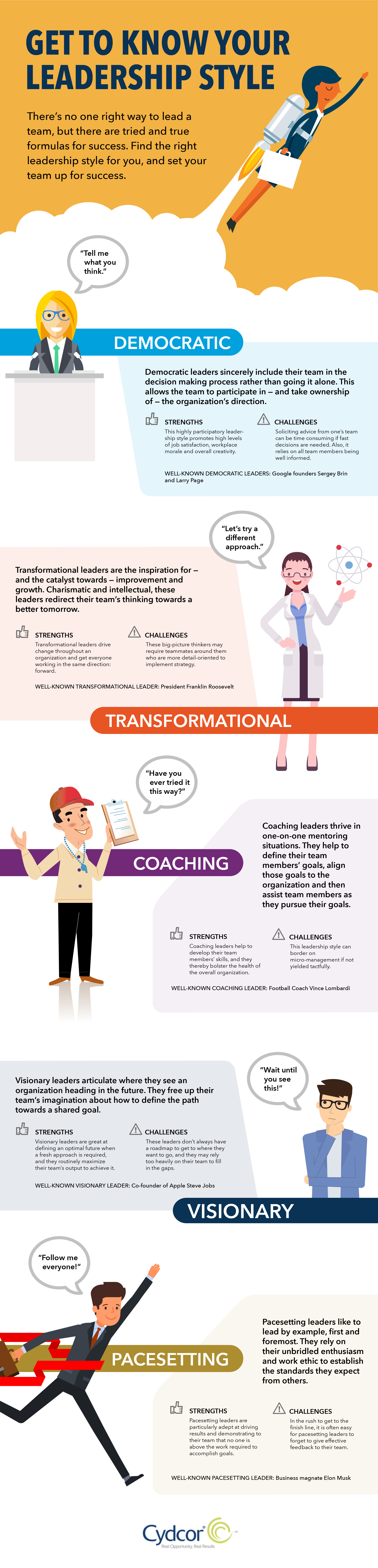
There’s no one right way to lead a team, but there are tried and true formulas for success. As you grow in your career, you’ll get more and more experience leading people. An understanding of different well-known and proven types of leadership can help you find the right path that resonates for you. Find the right leadership style for you, and set your team up for success.
Democratic Leadership Style
Democratic leaders strive to sincerely include their team in the decision making process rather than going it alone. This type of leadership allows the whole team to participate in―and take ownership of―the organization’s direction. This highly participatory style promotes high levels of job satisfaction, workplace morale and creativity. Everyone feels connected to the overall health and well-being of the organization. However, just like any leadership style, it does have its drawbacks. Soliciting advice from one’s team can be time consuming if decisions are needed quickly. Also, it relies on all team members being well informed. Democratic leaders need to strike a balance within their team of both decisive action and rich participation.
Transformational Leadership Style
Transformational leaders work with their team to implement improvement and growth. Charismatic and intellectual, these leaders redirect their team’s thinking towards a better tomorrow. The transformational leader solicits input from her team to identify what areas of the organization require change, creates the vision to guide that change, and then works with her team to execute the redirection. These big-picture thinkers may require teammates around them who are more detail-oriented to implement processes, and they need to develop strategies for soliciting their teammates’ assistance.
Coaching Leadership Style
Coaching leaders thrive in one-on-one mentoring situations. They help to define their team members’ goals, align those goals to the organization and then assist team members as they pursue their goals. The coaching style of leadership can be thought of as a sort of win-win relationship between the leader and her teammates. Coaching leaders help their team members to develop professionally, and they also thereby bolster the health of the overall organization. However, it can be easy to go overboard with this type of leadership and engage in behaviors that border on micromanagement. Coaching leaders need to yield their influence tactfully.
Visionary Leadership Style
Visionary leaders articulate where they see an organization heading in the future. They craft compelling―and often unheard-of―visions of what an organization can become. This style of leadership acts to inspire the team towards a shared goal. The internal drive they spark in their team members frees up creativity, and that freedom allows all the team members to delve into innovative strategies on how to get from Point A to Point B. However, visionary leaders need to keep in close contact with their team and stay involved in the team’s progression. Such an approach keeps everyone grounded as they strive towards the future.
Pacesetting Leadership Style
Pacesetting leaders like to lead by example, first and foremost. They rely on their unbridled enthusiasm and work ethic to establish the standards they expect from others. They are the roll-up-the-sleeves-and-get-dirty types. Pacesetting leaders are particularly adept at driving results, because they set the bar so high. They demonstrate to their team that no one is above the work required to accomplish goals. Pacesetting leaders should be cautious, however, and strive not to become single-minded. Narrowing one’s vision down to a single goal―or several―can mean that effective feedback and mentoring get neglected. Pacesetting leaders need to check in with their team members or a regular basis.
It is likely that you recognize one or more of these types of leadership in your own style. It’s rare that any one individual engenders just one leadership style. Explore which styles resonate with you. By cultivating a dynamic leadership style that encompasses a number of different approaches, you can find the right tools within yourself to tackle even the largest challenges.


No one likes conflict, but the good news is that the toughest conversations can also be the most fruitful. If you’re struggling to deliver negative feedback, there are lots of things you can do to minimize tension and achieve a positive result. Check out Cydcor’s tips for making your next difficult conversation go more smoothly.
Listen and Acknowledge
When emotions are running high, it helps to remind yourself to take a step back and just listen. Make an effort to hear the other person out. Resist the urge to interject. Show that you’re listening by maintaining eye contact, nodding and reflecting back what was said. You don’t have to be in agreement in order to make the other person feel like he or she has been heard.
Stay Focused on the Issue at Hand
Don’t make a difficult conversation even harder to navigate by bringing up unrelated grievances. Keep the focus of your discussion as narrow as possible, and avoid airing out other frustrations that come into your mind while you’re talking.
Make Sure Your Words Match your Intentions
Never go into a tough conversation without putting some serious thought into how you want the other person to feel -- and ultimately, what you’d like them to do. Assuming your intention is to influence new positive behavior rather than to cut ties, you’ll want to steer clear of any language that is discouraging, accusatory or hurtful. Be careful not to sabotage what you really want to accomplish by saying what feels good in the moment.
Watch Your Tone of Voice and Body Language
Remember, it’s not just what you say, it’s how you say it. Set the stage for a constructive conversation by keeping your tone of voice positive and your body language neutral. Avoid speaking too loudly, sounding irritated, sighing out loud, rolling your eyes or crossing your arms.
Don’t Exaggerate
This is where it helps to be prepared! Make your next difficult conversation go more smoothly by citing specific facts and instances, rather than making generalizations or referring to vague circumstances in the past. Avoid embellishing or using words like “always” or “never,” which are bound to trigger a defensive response.
Keep an Open Mind
This one’s tough. As human beings, we’re not generally good at realizing we’re wrong. But do the best you can to consider the merits of the other person’s point of view. Perhaps there are circumstances you didn’t know about or facts that weren’t clear before. You never know, maybe you’ll see things differently by the end of the conversation.
Focus on What’s Next
Once you’ve addressed where you’d like to see change, shift the focus of the conversation to the future. Put on your problem-solving hat and delve into a constructive conversation about how both parties will behave moving forward, and ideally, how you can work together to achieve a positive outcome.
Do you have your own tips for tackling tough conversations? We’d love to hear! Share them with Cydcor on social media.

Just getting started in your career? Chances are, your brother’s new girlfriend, last night’s Uber driver, and your second cousin once-removed have all offered their wisdom. While, certainly, you’re lucky to be surrounded by a well-meaning community, deciphering good career advice from bad career advice is no easy task.
When it comes to making smart career moves, the stakes couldn’t be higher. So, before you follow one of these four pieces of bad advice, be sure to think twice.
“You need work-life balance”
Building a successful career requires long hours; don’t let the popularized “work-life balance” lingo trick you. It doesn’t matter if you’re an athlete, a sales representative, or a scientist: the top achievers in any industry are those who’ve lived unbalanced lives in order to get to where they are today.
This isn’t to say that spending time with loved ones and taking time to recharge aren’t important ― of course they are. That said, if you’re just launching your career, now is the time to grind. Delay gratification. Invest your time and energy into building. Balance will come later.
“Give it a try”
This is another piece of bad career advice often imparted to young people. On one hand, it’s great to keep an open mind to new opportunities. But on the other, “trying something out” is often the same as making the premature decision to quit when challenges arise.
Anything worth doing is going to require an unwavering commitment. This means not giving up at the first sign of discomfort; or in other words, closing your back doors. No matter the career path you choose, if you want to reap the benefits, you have to stay the course.
“Choose a job that doesn’t feel like work”
It probably hasn't been long since you've seen this popular Confucius quote appear on one of your social media feeds: “Choose a job you love and you’ll never work a day in your life.”
While it's certainly great advice to select a career that you’ll find gratifying, don’t be fooled by this oversimplification. As the happiest of employees and entrepreneurs will tell you, even when you love what you do, not every task is intrinsically enjoyable. Even the most rewarding careers require tasks that are unglamorous, monotonous, or simply unpleasant. Sometimes, work just feels like work ― and that’s okay.
There is real danger in continuously looking for the “perfect job.” Be careful not to pass up a great opportunity just because you don’t love every inch of it.
“Follow your passion”
This is often synonymous with “do what you’re good at.” Unfortunately, as you may have noticed, talents don’t necessarily translate into lucrative careers.
But that’s not even the biggest fault in this piece of bad career advice. The problem with telling young people to follow their passions is that in many cases, they’ve yet to develop them. Passion is achieved through mastery of a subject ― which takes years!
Don’t expect that the best career for you is the thing that you are currently the best at doing. Figure out what your goals are, and then do what it takes to achieve them ― even if it doesn’t come naturally to you at first.
What’s some of the worst career advice that you’ve received? Did you know it was bad advice at the time? Tell us in the comments below!

Rejection is a natural part of the sales process. It’s hard to avoid, and even harder to face. However, have you ever considered the silver lining of rejection? Maybe all of those “nos” have made you who you are today. Hearing “no” forces salespeople to climb out of their shell, think outside of the box, and reach for new horizons. Working in sales and facing “no” on a daily basis can help you build critical skills that can prepare you to withstand and excel against the rigors and challenges of the business world. Enduring a little rejection now can train you to be resilient, flexible, and mentally strong – all skills that can benefit you greatly as you grow your career.
You Learn
In order for someone to grow as a sales professional, he or she has to understand what works and what doesn’t work. When you recognize that some part your pitch, approach, or presentation isn’t working, you learn how to make critical decisions to correct the problem and get back on track. You discover how to do better, so that it does work the next time around. Salespeople are constantly learning, trying to improve the process. Only with a “no” can you get that much closer to a “yes.” Since business is an ever-changing landscape, as you progress through your career, having the ability to learn will make you a more desirable hire. It’s what fuels your personal growth.
You Develop Patience
We all know the saying: patience is a virtue. Boy, is that true, especially in the world of sales. The sales business is a numbers game that teaches you to accept that if the first customer says “no,” you just have move to the next one and keep going. There is no room or time to throw up your hands in exasperation. The best salespeople understand that a successful sales day is a marathon, not a sprint. Over time, sales professionals learn how to maintain a patient, positive mindset no matter what. Developing this kind of unwavering resilience will also prepare you for managerial positions, even owning a company. Things will go wrong, people will quit, rejection will befall you, and unfair things will happen. Maintaining your patient disposition through it all is what will set you apart from the competition.
You Learn How to Be Flexible
Salespeople can’t afford to be stuck in their ways. Sales is a process of experimentation and refinement. When good salespeople face rejection, they learn how to rethink their approach to avoid a sales blunder in the future. Overtime, sales teaches you how to apply self-discipline to correct course, test new approaches, and perfect your pitch until you can consistently deliver results.
You Communicate Better
Sometimes, you face rejection because your communication skills weren’t up to par. Perhaps you misspoke, failed to listen, or just delivered a message without any energy. Communication is the cornerstone of every business interaction. Hearing “no” can inspire you to do what it takes to hear that “yes” next time. You’ll refine your messaging and communication approach. Within business, communication is how critical information about sales, services, and products is relayed to key stakeholders. You need to know how to communicate quickly, effectively, and with authority. It’s time to get started.
You Toughen Up
Finally, it’s inevitable that rejection is going to force you to develop thicker skin. However, that’s not a bad thing. In the world of professional sales, it’s an incredibly important attribute. You’ll learn to listen to your gut and intuition, rising above rejection to focus on what you need to do to get the job done. You’ll develop your own personal shield that keeps you protected. As you climb towards the top, this internal toughness will better prepare you for the obstacles and stakes ahead, like hiring/firing decisions, expansions, acquisitions, and the list goes on.
We all know the time-old adage, “what doesn’t kill you makes you stronger.” In sales, this saying proves true. A healthy amount of rejection is necessary for personal growth and advancement. The next time you’re faced with a “no,” smile, for it is another opportunity to grow and flourish as an individual and a professional; it’s another opportunity to see things in a new light and appreciate a new way of doing things; and it’s another opportunity to become wiser, stronger, and better.
What have you learned from rejection in the past, and how has that helped to accelerate your personal growth? Share them with Cydcor in the comments below.

Mobile devices are more than just modern conveniences. In today’s business climate, having the right mobile tools at your disposal is critical to your professional survival. Staying connected around the clock is the accepted norm, not the exception and remaining competitive means keeping yourself up-to-date on the best apps to help you work smarter, faster, and better.
As thousands of new apps are released into the market every day, staying current on the best and most effective apps for improving productivity and performance can feel like a very daunting task. Luckily, Cydcor has created a shortcut to help you wade through this vast ocean of available apps. We’ve compiled a list of some of most useful apps to help busy professionals stay organized, communicate better and more efficiently, quickly get where they need to go, and be more productive.