
Found 0 posts

Defining a business and sales strategy comes with an important choice: to withhold information or to be 100% forthright with the truth. And sure, there are plenty of dishonest salespeople out there, but here's the best sales tip you'll ever get: don't be one of them! The most successful and salespeople are those who consistently choose truth over deception. Rather than embellishing during a sales meeting, they prefer to under-promise and over-deliver. Instead of leaving out inconvenient facts, they proactively share any and all relevant details with their customers. Top sales professionals know that honesty in sales is possibly the most effective strategy for long-term success.
The good news for salespeople is that honesty isn’t just the best policy, morally speaking. Truthful communication is also a lucrative sales strategy that will serve you well in your career.
Never underestimate a customer’s ability to sense that something’s not quite right. Sales prospects can detect when you’re embellishing important details about a product or service, glazing over the facts, or telling them what they want to hear. As a result, they are less likely to buy. While an unscrupulous sales strategy might work for you every now and then, in the long run, you’ll lose more sales than you close because people don’t trust you. Focus instead on creating a sales strategy that respects the customer's intelligence. You're likely to generate more successful sales in the short term and build stronger long-term relationships with customers.
Every salesperson knows that it’s easier to deal with an excited customer than a skeptical one. While it might seem simpler to answer questions with short answers or withhold certain information, it’s quite the opposite. Being selective with the truth only invites more questions -- and not the good kind. It’s actually much more efficient, and more likely to increase sales, if you take the time to thoroughly and openly address all of your customer’s concerns to ensure that they feel confident about the decision to buy.
There’s a decent chance that your target customer has already been pitched in the past by another sales rep. In many of those cases, their decision against buying was due to a lack of trust -- not a lack of interest. By being completely straightforward and authentic, you’ll ending up signing up customers who had previously said no, bringing you closer to achieving your sales goals.
Nothing leads to an order cancellation faster than a negative surprise. Thankfully, the secret to a high quality, sticky sale is simple: ensure that your customer has realistic expectations. The strongest salespeople go out of their way to communicate relevant information, ensuring that buyers are fully prepared and informed.
No one wants to talk to a sales robot. Consumers are much more likely to buy from someone they can connect with -- someone who seems genuine and trustworthy. Simply being yourself and leading with honesty, makes it easier to build rapport. And as all strong salespeople know, building a relationship is often the difference between a yes or a no.
We all know that satisfied customers become loyal customers, but did you know that simply being honest also generates leads? After a positive experience, customers are not only more likely to buy from you again in the future, but satisfied existing customers will also send you referrals of their friends, families, and neighbors.
As soon as you realize that you don’t have to rely on white lies, exaggerations, and “tricks of the trade” in order to make a sale, you’ll become a more confident salesperson. Not only will you sleep better at night knowing that you conducted business with integrity, but this boost to your self-esteem will make you a stronger salesperson and a great sales team leader.
Never be afraid that you'll scare off a potential buyer with the truth. Remember: the mark of a strong salesperson is both quantity and quality of sales. Focus on being 100% honest, transparent, and authentic. Not only is this the right thing to do, but this simple sales strategy it can put you on the fast track to achieving your career goals.

You’ve set your SMART goals. You’ve written them down. You’ve discussed them with a mentor. You’ve shared them with friends and family. You’re working hard. You care deeply about your “why” and you’re excited about the future.
...But why aren’t you where you want to be?
Let’s take a look at eleven ways that you might be holding yourself back from achieving your goals.
1. You’re not staying with problems long enough. Giving up too soon is a surefire way to never reach your goals. If you’re throwing in the towel or retreating to your comfort zone every time you start to struggle, you’re hurting your chances of success and missing out on key opportunities to take steps forward toward your goals.
2. You’re only doing the right things SOME of the time. Consistency and self-discipline are the name of the game. You can’t expect to achieve your goals with any efficiency if you haven’t developed the right habits. You might be working really hard in the short term, but if you keep pumping the breaks, you’re only tiring out the engine and slowing yourself down.
3. You’re sweating the small stuff. Every time you lose your attitude, you’re moving in the wrong direction. If you don’t have thick skin, you’ll go down an emotional rabbit hole whenever you face failure or frustration. Doing so only diverts your attention away from what’s most important and drains the precious energy you need to stay motivated and keep pushing.
4. You’re avoiding the stuff you don’t want to do. We all have tasks we’d rather not tackle, conversations we’ve been putting off, and areas of professional development that we’ve been hesitant to address. But oftentimes, the things we’re avoiding are the things we most need to do. If you haven’t hit your goals yet, it might just be because you’re not stepping up. Adopt a sense of urgency by giving yourself smaller time-bound goals that will help you move the needle as you battle your procrastination.
5. You lack self-awareness. If you want to improve in any area of your life, it begins with looking in the mirror. Many people end up stagnant because they blame their lack of progress on outside factors instead of understanding their own role in their successes and failures. Once you see yourself clearly and lose the excuses, you’ll be able to focus on self-improvement and start taking the right steps towards your long term goals.
6. You’re not planning your days and weeks. When you’ve got big goals to hit, every minute counts. By not planning ahead, you are not only wasting time, but you are leaving space for lower priority tasks to crowd out the ones that will make the biggest impact on your advancement. Make time management a priority to make room in your schedule for things like professional learning and development which can help you build skills you'll need to finally achieve your goals.
7. You’ve been too focused on just yourself. It sounds counter-intuitive, but sometimes focusing too much on your own career goals can set you back -- especially if you’re working in a team-oriented environment. You’ll find that if you prioritize helping your team hit their goals, that you will in turn hit your own. By sharing your knowledge and skills with others, you'll reinforce your own strengths while you help others achieve their own personal goals.
8. You’re not receptive to coaching. If your pride is more important than your professional development, your progress will inevitably be slow. If you want to hit your goals sooner than later, it is essential to listen to your mentors and make the changes they recommend.
9. You’re not working hard enough. If your goals are big, then your effort has to be huge. You can’t expect to accomplish anything great if you’re not giving 100% each day. You might already be working really hard, but sometimes that little bit extra is what’s needed to push you over the edge.
10. You’re surrounded by the wrong people. If you find yourself regularly associating with naysayers and Negative Nancys, it’s going to inevitably chip away at your morale. When you’ve got big performance goals to hit, you need every ounce of energy and positivity you can get. People tend to emulate the people they spend the most time with -- so choose to spend time with only those who are helping you achieve your goals and not setting you back.
11. Success takes time. Never underestimate the role that time plays in reaching your goals. You need to patiently, but persistently, persevere and trust that if you do the right things, you’ll get where you want to be.
As frustrating as it may be to not have achieved your goals yet, it’s important to remember that you’re exactly where you’re supposed to be. Professional development is a lengthy process, but as soon as you recognize the reasons why you haven’t hit your specific goals and start to make the right changes, you’ll be that much closer to the finish line.

Sometimes, becoming a better salesperson simply comes down to thinking like a customer. People like to feel they are being heard and improving your active listening skills can help salespeople quickly build rapport that is critical in gaining the customer’s trust, and ultimately making the sale. Practicing active listening techniques can help you serve the customer better while also increasing your chances of earning their business, because being a good listener helps you gather the information necessary to address their needs and overcome any concerns.
There are several active listening techniques you can use to make sure you’re keeping focus where it belongs: on the customer. But first, ask yourself why active listening skills, which seem so fundamental, are so hard for most people to master.
Talking too much: Talking puts us in the driver’s seat, in control, where most of us prefer to be, but listening lets the other person speaking briefly lead the conversation. That can be scary, but not if you think of it the right way.
Get sharp tip: While listening opens the door to the unknown, it also opens the door to opportunity. The customer might share his or her main objection. Bingo! Now you know what you need to overcome their objections and build trust. Changing the way you think about interpersonal communication is an active listening technique you can practice to improve your sales results.
Thinking ahead: While the customer is talking, it’s tempting to start planning your response. After all, what if he or she finishes speaking, and you’re left struggling to come up with a response. The problem, of course, is that while your full attention is focused on writing the perfect, cucumber-cool reply in your head, you’re missing all the invaluable information and nonverbal cues the customer is sharing.
Get sharp tip: While getting out of your own head can be one of the trickiest active listening skills to master, remember that by the time you get to unveil your perfectly composed response, it might already be out of date. The customer may have already shifted his or her interest to other topics. So instead of tuning out while you think up the ideal answer, pay attention and learn to buy yourself time in other ways. Take a deep breath before you speak or compliment the customer on his or her question. Saying something like, “that’s a really interesting point,” is an active listening technique that can give you back those few seconds you need to pull your thoughts together.
Acting like you’re listening: We have trained through social norms that listening is about nodding, smiling, making eye contact, and showing interest in what the other person is saying. The problem is, sometimes we’re so good at the “show” that when the conversation is over, we realize we haven’t really heard most of what the other person has said.
Get Sharp Tip: An easy way to improve your active listening skills is to repeat back all or part of what the customer says. This might feel silly at first, but it will force you to stop acting like you’re listening and really listen.Practicing this active listening technique can help you listen carefully to absorb more of what the customer is saying, providing you with valuable ammo and key points you can use to solve problems to address their concerns and close the sale.
Improving your listening skills isn’t easy. Getting good at active listening involves breaking deeply ingrained habits, but just like body language or facial expressions, listening can be improved by staying focused and practicing. Try some of the active listening techniques above to keep yourself present and tuned in while interacting with customers. Notice how much more information you’re able to gather about the customer. As active listening begins to pay off in the form of more sales, you may find that it will become easier as well. Eventually, you may start to see active listening as yet another essential tool your sales arsenal, a must-have interpersonal skill that can help catapult you toward your career goals!

Why be average in business when you can be authentic? If you ask us, average is overrated, and the importance of being yourself far outweighs fitting the mold. True authenticity allows you to shine. You set yourself up for opportunity. You surprise people. You’re memorable. You’re relatable. You’re happier. You get to create your own unique story. Ultimately, you thrive.
Let’s take a look at a few specific ways that being yourself at work can be your very own secret weapon in your growing career.
Being yourself is a powerful way to attract the right people. When you are transparent with your intentions and open about your goals, it’s easier to find people who are aligned with your vision. In building a team, this minimizes turnover and ensures that you are spending your time and energy with the right people.
Authenticity is crucial in winning hearts and minds. When you’re true to yourself as a leader, you stick to your principles no matter the time, place, or circumstance. For the most part, you behave the same in your professional capacity as you do in your personal life. You say what you mean and you mean what you say. Your consistency, trustworthiness, and strength of character make people want to follow you.
There is power in vulnerability. Openness and transparency are qualities that make you magnetic as a leader. Your team members want to know that you’re fallible, like they are, and that you can admit to your mistakes. They want the assurance that you’re in this together; and by being yourself, you show them that you are. Not only does your realness earn you the respect of your team members, but it inspires them to make mistakes and keep going too.
Being genuine is essential to being persuasive. Whether or not you’re in a ‘sales’ role in the traditional sense of the word, sincerity is the most effective way to convince another person to act. Many salespeople believe they have to speak in a special tone of voice or adopt a sugary demeanor to be effective – but it’s exactly the opposite. Customers hate a cliché sales pitch – and they can tell when you’re not comfortable in your own skin. Being your (professionally mannered) self reduces skepticism and allows for natural conversation to flow, which in turn, sets the stage for a sale.
When you’re comfortable being yourself, you’re less sensitive to the opinions of others. While you appreciate the well-intentioned advice of your loved ones, you don’t feel the need to please everyone. You have the confidence to make tough decisions about what’s best for your future – even if those decisions are unpopular with your family members and friends. The ability to follow your own path is a super power that will take you far in your career.
Being yourself increases positivity. Why? Well, firstly, because embracing your individuality just feels good! It is incredibly freeing to stop trying to be someone you’re not. But secondly, instead of wasting your precious energy trying to fit in, you get to focus on building a life that has meaning to you. Tackling your authentic “why,” rather than emulating what’s popular, gives you purpose. This purpose transcends whatever bumps you face along the road and inspires you to get back on the horse after facing a setback. When you’re honest with yourself about what you really want in life and you’re actively taking steps to achieve your goals, you can’t help but to be .
Do you have a story about how being yourself at work has paid off in your own career? Tweet us at @Cydcor. We’d love to hear it!

You’re not alone if you have a love/hate relationship with email. As much as we’ve come to rely on it for efficient communication, no one enjoys an overwhelming pileup of messages to read. Thankfully, learning how to manage your email inbox can be quite simple. Let’s start by taking a look at the six inbox management tips listed below.
It’s 9am. You sit down at your desk, power up your computer, and you’re greeted with three dozen new emails. What should you do? Should you start at the top and just work your way down? Should you pick up where you left off yesterday? No and no.
The best way to tackle your inbox in the morning is to start by opening emails from a specific set of people. In most cases, this will be your manager or a small list of high-priority business associates. Though it may require some will power, leave all of your other messages unread until you’ve at least taken preliminary action (more on this in #2) on what’s most important.
Do not use your inbox in place of a schedule or to do list. We repeat. Do not use your inbox in place of a schedule or to do list. This widely used practice is one of the main reasons that so many people struggle to control their inboxes.
Instead, think of checking your email as a time to get organized. Start by creating a sorting system that allows you to easily keep track of your emails by either subject matter or priority level. Then, come up with a plan for swiftly tackling new messages. If a response will take you two minutes or less, go ahead and handle it right away. But, if a new email requires more extensive action on your part, move it to its respective folder, and block out time on your calendar to handle it.
One of the easiest ways to simplify the sorting process, and in turn, control your inbox, is to use descriptive subject lines. For example, instead of the ambiguous title, “Question,” write, “Question About XYZ Project.” This way, when you get a response, you won’t have to open the email to remember what the exchange was about. Not only will this make it faster to sort your messages, but it will also ensure that the email is easily discoverable if you’re searching for it again later.
Another simple way to manage inbox clutter is to simply reduce what’s cluttering it. This starts with the obvious: hitting the “unsubscribe” button. While it might seem faster to archive or delete promotional emails as they come in, it’s better to avoid future distractions altogether by yanking weeds from the root.
As for the subscriptions that you actually want to receive, set up a dedicated email for this very purpose—one that’s safe to check much less frequently. Use this email address for social media notifications, newsletters, online shopping, or in any instance where you expect to receive follow-ups, such as when making a donation or engaging in a political cause.
Speaking of reducing distractions, you’ll make your life much easier by using each of your email accounts solely for their intended purposes. While this sounds obvious, many people, especially the self-employed, end up intermingling their communications. The result is a daunting “Unread” number and an unnecessarily long sorting process. Keep things simple by using your work email strictly for work. Don’t share it with your friends or family, and never use it to subscribe to anything, unless it’s truly necessary to do your job.
Even if you do a phenomenal job staying on top of your emails, it’s a great idea to dedicate time each week to dealing with messages that might have slipped through the cracks. Many people like to do this at the end of the week so they can start the following week fresh. Schedule an hour on Friday, or however long you need, to delete, archive, unsubscribe, sort, schedule, or respond to whatever remains in your inbox.
Did we miss any of your go-to inbox management tips? Tweet us @Cydcor and let us know how you manage your email inbox!

We all wish we had more hours in the day; that’s pretty much universal. After all, time is a finite resource and once it’s gone it never comes back again. How can you make sure you’re making the most of the 6,720 waking minutes you get a week? Time tracking! That’s right, tracking your time is an invaluable tool to help you maximize your productivity and help you craft the ideal life for yourself.
Time tracking isn’t a new phenomenon. But have you ever tried it for yourself? Looking at how, when and where you devote time and energy can give you an objective view of your days and a baseline from which to make positive adjustments.
Choose Your Time Buckets
Designate different categories―or buckets―for tasks you perform throughout the day. For example, they may have headers like Client Meetings, Administrative, Professional Development, Fun, Relationships, Distractions and so on. Aim to have no more than ten different time buckets. This will help to give you a strong and easy-to-digest data format to work from while you are tracking your time. Also, be sure to record how exactly you are spending your time within those buckets. It helps to know that the specific thing you were doing in the Relationships time bucket last week was making dinner with your partner.
Envision Your Ideal Schedule
Next plot out how much time you would ideally like to devote to each of your categories by percentage. If career growth is a big goal of yours, you may want to devote a larger percentage of your time each week to your professional development time bucket than you currently are. If you are looking to increase your sales number, maybe you add a bit more to your client meetings time bucket. Remember, this schedule should represent what you want your life to look like, not how your time is currently spent. Turn this data into a spread sheet so it can be transformed into a pie chart. (It’s helps to have visual aids when time tracking!)
Track that Time
There’s no one right way to track time. Rather, you need to find an approach that works for you. You can simply jot your records down in a pocket notebook, or you can use a high-tech solution like the app Toggl. It really depends on what your personal preference is. You also need to decide when you are going to track your time. Some people find it easiest to check in every hour or 15 minutes. Some prefer to log the exact time they start a task and then when they switch to another task. Again, find what works for you. The most important thing is to make tracking your time a habit, so find an approach you feel you can stick with. Remember to be honest with yourself. Your data is only as good as it is thorough. Track you time for at least two weeks to a month. This will help account for any normal day-to-day fluctuations.
Analyze
After you finish the time tracking period you decided on at the start, it’s time to dig into all that important data you unearthed. You can also make a pie graph out of this data to compare against your ideal. What you find may be surprising. Everyone is different, but there are some common time tracking insights that you may see in your own life. They include:
Placing your time tracking data side-by-side with what you envision as your ideal time management structure will give you a solid understanding of how you spend the limited amount of time that you have each week. This baseline knowledge is helpful in moving yourself in a positive direction and achieving your life goals.
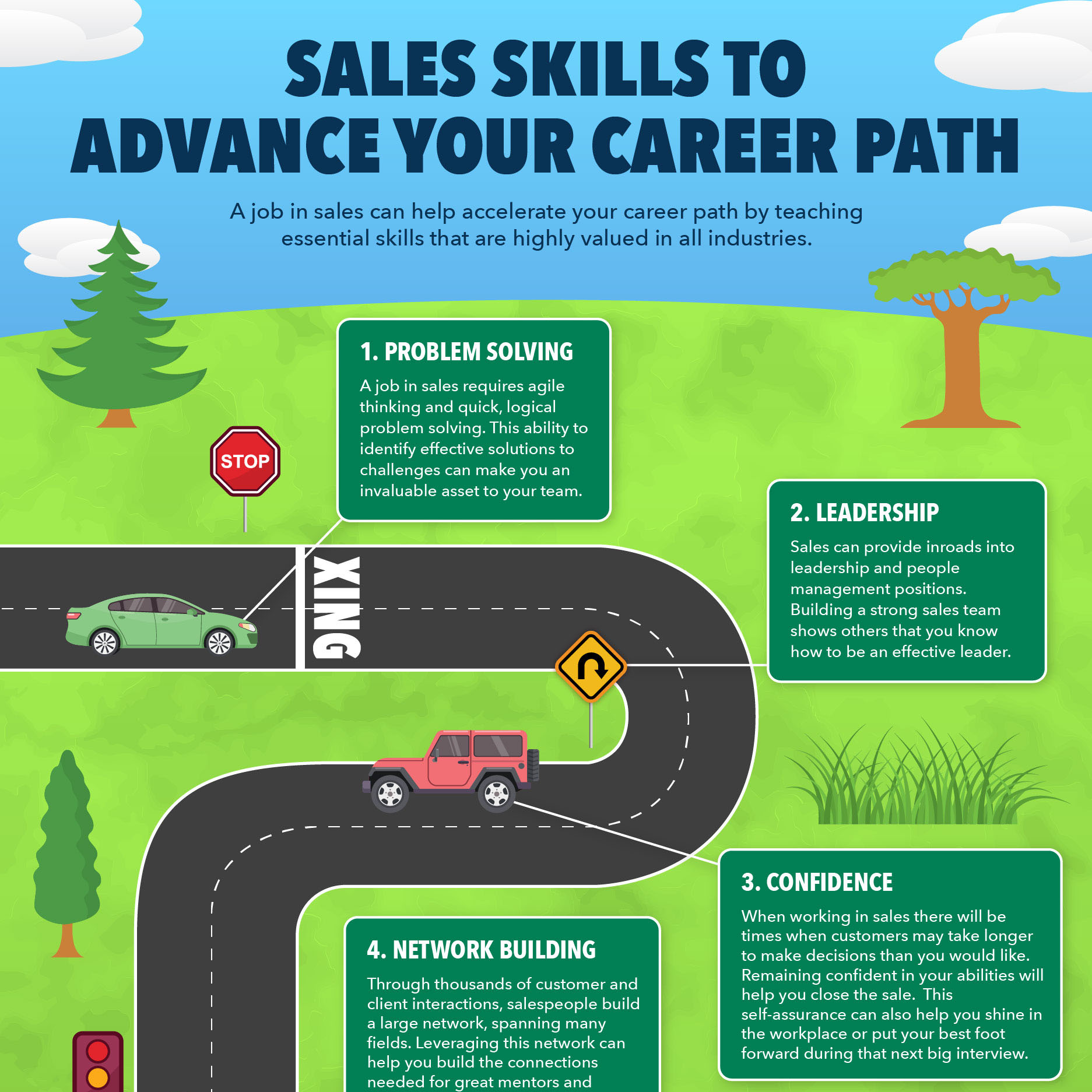
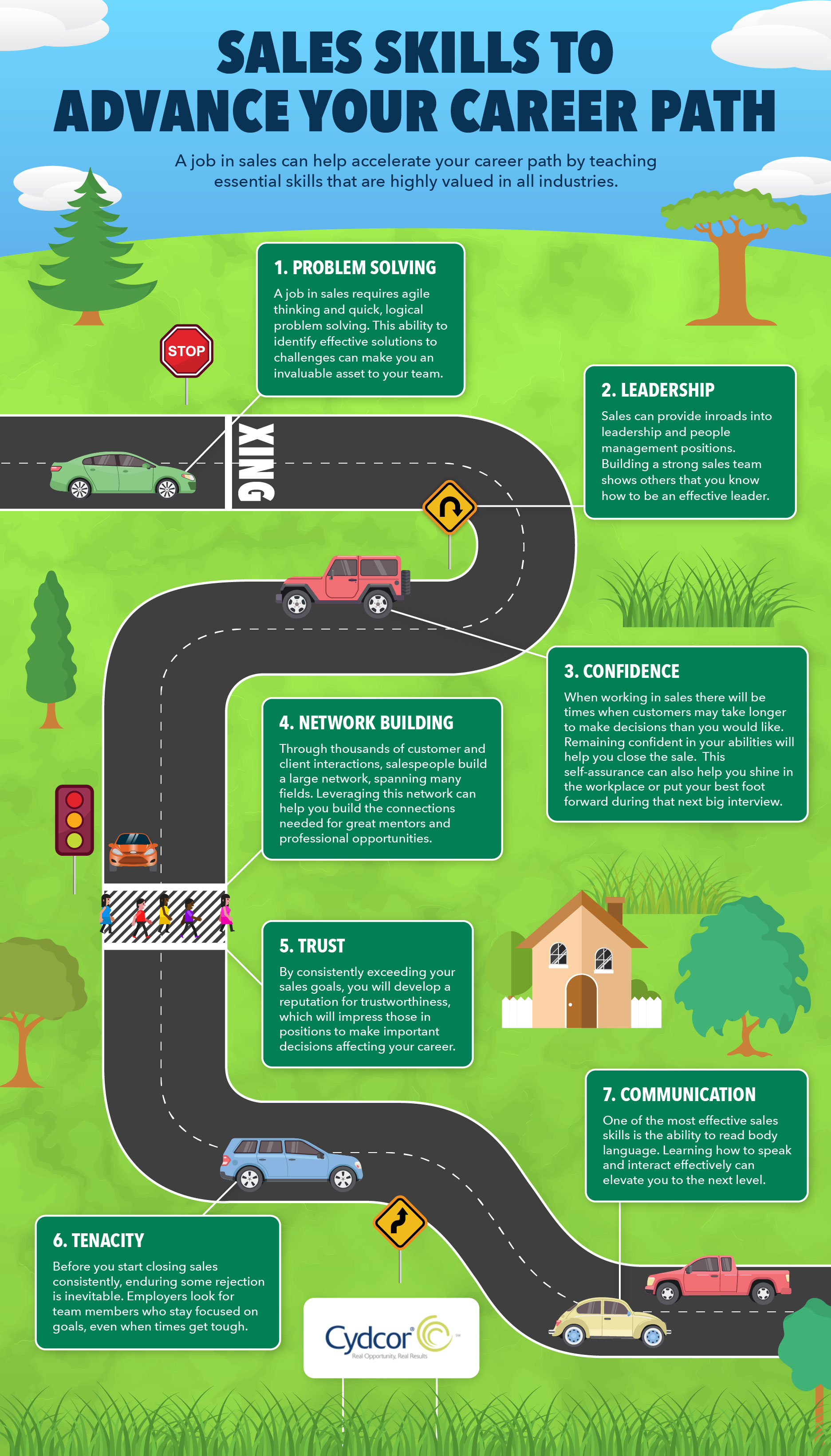
If you’re interested in a job in sales, developing and nurturing skills to catapult your career can help you achieve your career advancement goals. Whether these fall under the umbrella of growing in task-oriented skills or getting to know your strengths, below we show you “the road” to standing out as a leader in your respective role.
Begin by understanding the benefits of problem solving and how that skill can help you become an effective leader. With a leadership position, you’ll also want to hone in on trusting yourself and building confidence as your network grows. Finally, lean into the interpersonal skills developed along the way, such as communication, trust, and your tenacity as you tackle challenges along the way.
These strengths and sales skills can help you in your job and several other disciplines. Perhaps even more important is that they can cross over into your daily life, your personal wellbeing, and state of mind. We hope this infographic on career advancement in sales jobs ultimately helps take your strengths and productivity to the next level!

Knowing what makes a great salesperson is the first step to becoming one. At their core, great salespeople have empathy and drive. They know the prospects’ wants and needs and have the perseverance to win them over. But when you dive deeper, you discover that’s an oversimplification—great salespeople have five actionable qualities that make them superstars: high standards, curiosity, tenacity, passion and consistency.
Take a look at the infographic below and keep these qualities in mind when you’re engaging a prospect, from writing a cold email to knocking on their door. These personality traits are small things that anyone can do to stand out and become a great salesperson.



When it comes to business travel, the stakes are usually high. Whether you are attending an industry conference, meeting with clients, or scoping out a new market, opportunity is at your fingertips.
Your conduct and the decisions you make will ultimately determine whether a business trip is successful and all of that starts with the awareness of certain do’s and don’ts regarding professional etiquette. Check out these four essential tips on business trip etiquette to ensure that your next business trip is the best it can be.
Business Trip Etiquette Tip #1: Your appearance matters – and there are no excuses for that wrinkled shirt.
You should always dress to impress when on the job whether you’re in your regular workplace or out of town. This is especially the case if you know you’re going to be making a first impression on a new client or colleague. The way you look dictates how others perceive you, so take any competitive edge you can get.
Here’s the thing about traveling that’s important to keep in mind: Nobody’s clothes make it from A to B without accumulating some wrinkles – even for expert packers. It may sound silly, but it’s important to actually schedule a chunk of time to iron your clothes. Get all of your ironing out of the way on Day 1 so you don’t have to think about it for the rest of the trip. (Alternatively, if you’re willing to spend the cash, find out if your hotel offers pressing services. Just be careful to take note of turnaround times).
Business Trip Etiquette Tip #2: Don’t be late – even a little.
Tardiness is poor professional etiquette in any situation, but when you’re on a business trip, you should go above and beyond to be on time to meetings and events. Again, first impressions are key. Lateness sends the wrong message – and it can be a lasting one.
Plan your schedule carefully and be sure to allocate enough time to get from one point to the next. Keep an eye on the clock to ensure that unanticipated conversations don’t flow into time where you’re expected elsewhere.
Business Trip Etiquette Tip #3: Watch out for the slippery slope.
The great thing about business trips is that they present the opportunity to spend time with co-workers outside of the regular working hours. This makes for a second-to-none team bonding experience.
That said, be wary of letting happy hour turn into an unhappy tomorrow. Always use your best judgement. Don’t be afraid to call it a night if you sense that professional lines are getting too blurry. No single evening is worth sabotaging your career.
Business Trip Etiquette Tip #4: There’s a time and a place for your phone, tablet, and laptop.
You may be an incredibly talented multitasker, but all that matters in a social setting is that others perceive you to be fully present and engaged. Do your best to make calls, send texts, or respond to emails during designated working sessions or alone time. Show respect and a genuine interest in others by keeping your phone in your pocket or purse, particularly during meals.
When taking notes during a conference or meeting, the old school method of pen and paper is still your best bet. You don’t want others to misconstrue diligent note-taking for texting or updating your Facebook status.
Remember, as with all opportunities, business trips are what you make of them. The next time you get to travel for work, make the most of it by planning, maintaining professionalism, paying attention to social cues and keeping your professional etiquette top of mind.


“I’m not a morning person.” We hear people say this all the time. But guess what? Becoming a morning person might be the extra edge you’ve been looking for to skyrocket your success. With few exceptions, most people who’ve reached high levels in their careers have developed a daily morning routine that they stick to religiously.
An effective morning routine sets you up for a productive and positive day. While hitting the snooze button three times, showering quickly, and rushing out the door might be easier, most top performers will tell you that you’re missing out on a major opportunity to improve your life.
There is no “one size fits all” grouping of successful habits. Certain activities that work wonders for one person might be fruitless for another. It’s important to experiment with what works best for you and to pay attention to what behaviors are and aren’t adding value to your day.
But first, coffee.
Okay, not necessarily first, but certainly before you head to work. Numerous reputable studies have shown the long-term health benefits of drinking coffee; and certainly, the immediate benefits are plentiful as well. Even just one cup can kickstart a healthy morning routine, increasing your energy levels and giving you the boost to follow through on the next steps.
Get the blood flowing.
One of the best things you can do for yourself is get moving in the morning. Whether this means a walk around the block, some light yoga or stretching, or a full-blown work out, you’ll enjoy the benefits of increased energy and focus during the rest of your morning routine—and throughout the rest of your day.
Peaceful solitude.
Give yourself a few minutes (or more!) each morning to enjoy the calm before the storm. Turn off the television, close your laptop, and put your phone away. Perhaps pull out a notepad and jot down what you’re most grateful for. Think about the day ahead and what you’d like to accomplish.
Do something small that makes you happy.
Maybe it’s swinging by Dunkin’ Donuts for your favorite caramel latte on your way to the gym. Maybe it’s snuggling with your kids or tossing the ball for your dog. You know yourself best. Having something to look forward to not only makes it easier to wake up each morning, but it also gives you a major mood boost that will carry through to the rest of your day.
Look good, feel good.
We’ve all had those mornings when all there was time for was a rushed shower, followed by a haphazard “whatever’s clean” outfit selection, and dashing out the door. When our clothes are mismatched or wrinkled and our hair is a mess, it can be hard to feel good about ourselves. Avoid this unnecessary hit to your self-confidence by setting aside sufficient time to look and feel your best, whatever that means for you.
Cue up a podcast or audiobook.
This is a fantastic way to not only awaken your mind in the morning but to ensure that each day you are learning something new. Try listening to an interesting podcast or audiobook while you’re exercising or commuting. It will make the time fly by and might even give you a useful idea to implement in your work day.
As with all new habits, getting started is the hardest. Establishing a healthy morning routine is going to require self-discipline and patience. Facing a few setbacks is normal and shouldn’t keep you from getting back on the horse. The good news is, once you get going, it will become easier and more automatic.
It’s also important to note that your morning routine might evolve over time. Perhaps you’ll start with a 15-minute walk and work up to a longer session in the gym. Maybe you’ll find that you can shower at night instead, skip the coffee run, or add something completely new to your plan. Either way, don’t let the idea of a “perfect” morning schedule keep you from getting started.
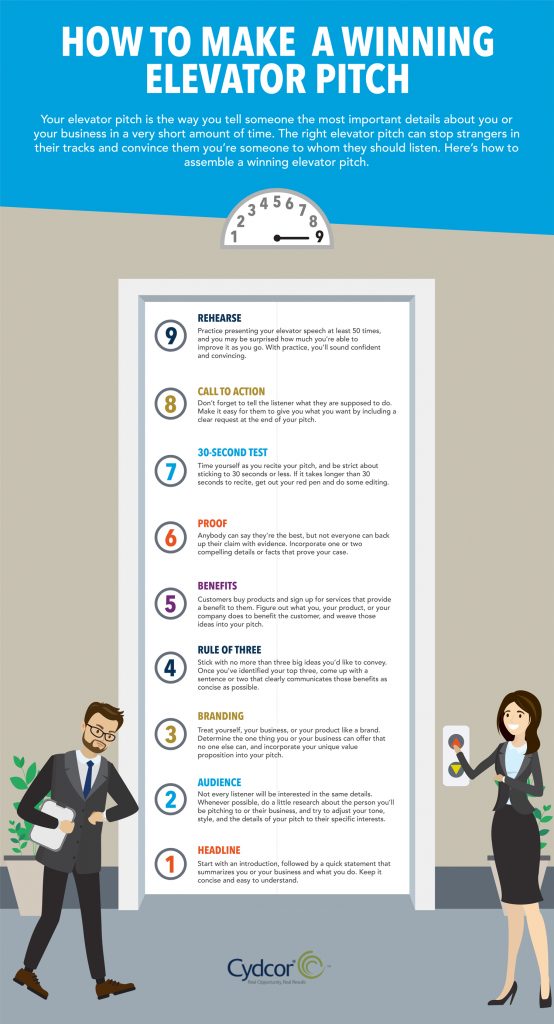
There is no tool to have in your professional arsenal that is more universal than the elevator pitch. No matter your industry, you will always need to be able to sell yourself, your idea, your product or your business at a moment’s notice. That means an elevator pitch, so named because it should tell your would-be client everything they need to know in the 30 seconds or so that they may be riding up an elevator with you.
Crafting the best elevator pitch possible can be tricky. While you may know in advance that you’re going to have a minute of someone’s time and can prepare accordingly, this will not always be the case. You may bump into someone at a social function, on the train, or, quite literally, in an elevator and need to be able to make your elevator pitch to them there and then, or possibly not at all — and do it concisely to boot!
All of this means that your elevator pitch needs to be well-rehearsed and field-tested without being so rigid as not to allow you to adjust on the fly based on your contact’s response. It needs to get immediately to the point while still allowing you to build a narrative. It needs to be so compelling that your contact will want to know more and yet clear enough that they understand the idea then and there.
It can be a balance that’s hard to strike, but don’t be too discouraged. Crafting your best elevator pitch may take you longer than its breezy nature implies, but with the help of these key details from Cydcor, you’ll be well on your way. Don’t sell yourself or your business short and start crafting your best elevator pitch today!