
Found 0 posts
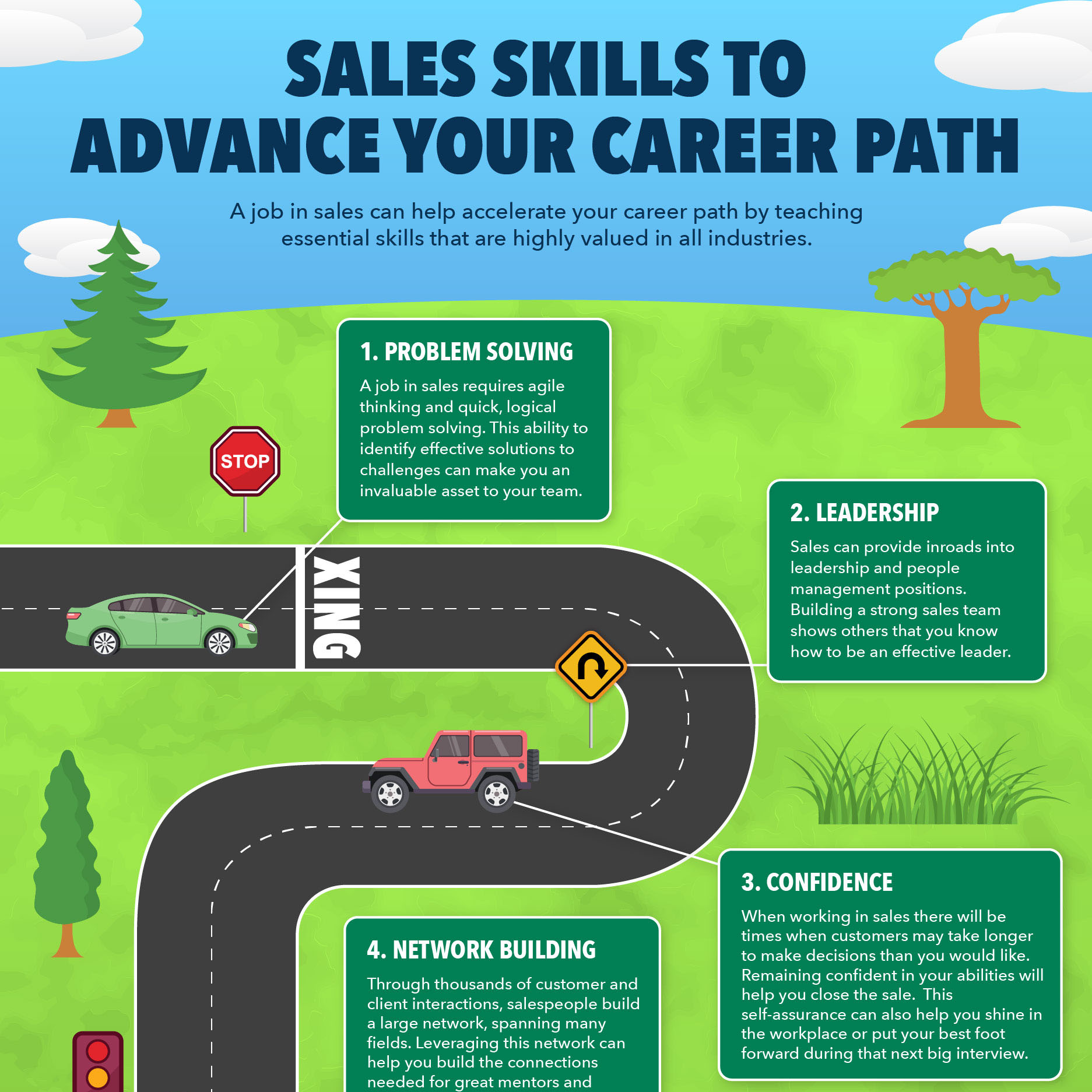
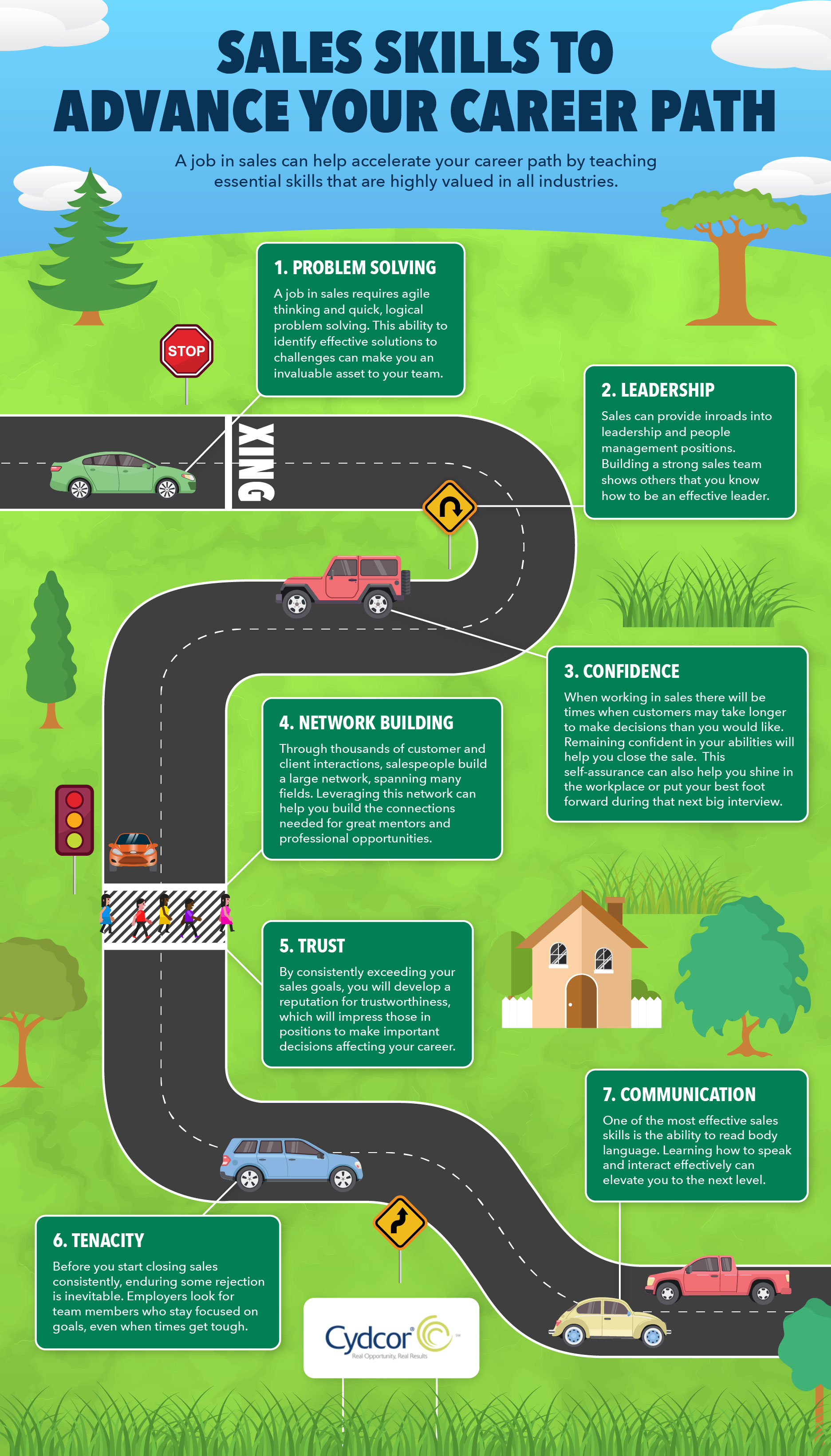
If you’re interested in a job in sales, developing and nurturing skills to catapult your career can help you achieve your career advancement goals. Whether these fall under the umbrella of growing in task-oriented skills or getting to know your strengths, below we show you “the road” to standing out as a leader in your respective role.
Begin by understanding the benefits of problem solving and how that skill can help you become an effective leader. With a leadership position, you’ll also want to hone in on trusting yourself and building confidence as your network grows. Finally, lean into the interpersonal skills developed along the way, such as communication, trust, and your tenacity as you tackle challenges along the way.
These strengths and sales skills can help you in your job and several other disciplines. Perhaps even more important is that they can cross over into your daily life, your personal wellbeing, and state of mind. We hope this infographic on career advancement in sales jobs ultimately helps take your strengths and productivity to the next level!

Just getting started in your career? Chances are, your brother’s new girlfriend, last night’s Uber driver, and your second cousin once-removed have all offered their wisdom. While, certainly, you’re lucky to be surrounded by a well-meaning community, deciphering good career advice from bad career advice is no easy task.
When it comes to making smart career moves, the stakes couldn’t be higher. So, before you follow one of these four pieces of bad advice, be sure to think twice.
“You need work-life balance”
Building a successful career requires long hours; don’t let the popularized “work-life balance” lingo trick you. It doesn’t matter if you’re an athlete, a sales representative, or a scientist: the top achievers in any industry are those who’ve lived unbalanced lives in order to get to where they are today.
This isn’t to say that spending time with loved ones and taking time to recharge aren’t important ― of course they are. That said, if you’re just launching your career, now is the time to grind. Delay gratification. Invest your time and energy into building. Balance will come later.
“Give it a try”
This is another piece of bad career advice often imparted to young people. On one hand, it’s great to keep an open mind to new opportunities. But on the other, “trying something out” is often the same as making the premature decision to quit when challenges arise.
Anything worth doing is going to require an unwavering commitment. This means not giving up at the first sign of discomfort; or in other words, closing your back doors. No matter the career path you choose, if you want to reap the benefits, you have to stay the course.
“Choose a job that doesn’t feel like work”
It probably hasn't been long since you've seen this popular Confucius quote appear on one of your social media feeds: “Choose a job you love and you’ll never work a day in your life.”
While it's certainly great advice to select a career that you’ll find gratifying, don’t be fooled by this oversimplification. As the happiest of employees and entrepreneurs will tell you, even when you love what you do, not every task is intrinsically enjoyable. Even the most rewarding careers require tasks that are unglamorous, monotonous, or simply unpleasant. Sometimes, work just feels like work ― and that’s okay.
There is real danger in continuously looking for the “perfect job.” Be careful not to pass up a great opportunity just because you don’t love every inch of it.
“Follow your passion”
This is often synonymous with “do what you’re good at.” Unfortunately, as you may have noticed, talents don’t necessarily translate into lucrative careers.
But that’s not even the biggest fault in this piece of bad career advice. The problem with telling young people to follow their passions is that in many cases, they’ve yet to develop them. Passion is achieved through mastery of a subject ― which takes years!
Don’t expect that the best career for you is the thing that you are currently the best at doing. Figure out what your goals are, and then do what it takes to achieve them ― even if it doesn’t come naturally to you at first.
What’s some of the worst career advice that you’ve received? Did you know it was bad advice at the time? Tell us in the comments below!

If you’re serious about advancing your career, you have to be willing to take massive action—there’s no way around it. Top performers in any industry are those who know how to push themselves. They are constantly seeking out a new competitive edge, looking for ways to up their game and achieve the next level of results.
Whether you are just beginning your career and want to get off to a strong start, or you are a seasoned veteran looking to kick things up a notch, it’s all about the willingness to take action and put the pedal to the metal. While there will always be factors outside of your control, the ability to be proactive will ultimately determine how far you'll advance in your career and how fast you get there.
1. Don’t wait to shine
A shocking number of professionals fail to reach their full potential because they’re waiting for the people who got there first to succeed. You might be doing this without even realizing it. If you truly want to advance in your career, get rid of this mentality. Never be afraid to set the pace, even when you’re the newest member of the team.
Are you awesome at what you do? Shine. Can you break a record? Do it. Do you have great ideas? Share them. Want more responsibility? Rise to the occasion. Take action and unleash your talents on the world. Outwork the person who started five years before you. Whatever you do, don’t wait for someone else to get promoted first just because you’re the rookie.
2. Be hyper-strategic about where you take action
If you want to advance your career, it’s time to be smart about what activities deserve your time and attention. Yes, there are likely three-dozen things on your to-do list—that’s why you need to strategize.
Start by asking yourself this question, “What is one specific change that I could make that would elevate my game?” (Hint: if you’re having trouble answering this, schedule a chat with your mentor.) Simply knowing the answer to this one question can bring clarity to your plan of attack.
Once you’ve got your mission, put the blinders on. Take deliberate action to advance the specific goal that you’ve defined. Give your freshest, most valiant effort while you’re still on a full tank by avoiding lower priority tasks until you’ve made satisfactory gains. If you catch yourself sending your valuable resources in the wrong direction, be sure to pivot quickly!
3. Spring clean your life
Now is the perfect time to get impeccably organized. Set aside a weekend to dust away anything extraneous in your day-to-day life. Put away your winter clothes. Go through the files you’ve downloaded to your desktop. Get rid of old voicemails. Finally hit inbox zero—and come up with a system to keep it that way. This might mean skipping your normal Netflix-dedicated Sunday, but it will be worth it. Nothing feels better than having your ducks in a row. By cleaning up and simplifying your world, you will eliminate distractions and clear up space to focus on how to take action to advance your career.
Remember, successful careers aren’t built overnight. Little things add up to big things. Keep working hard and never stop asking yourself how you can up your game. Be so good they can’t ignore you. You have the power to increase the pace at which you advance in your career.

Congratulations! Your college career is coming to a close and the future is exciting, but it can also be a little intimidating. Everyone’s either looking for a job or has one lined up, and the college-to-career transition might feel like a race. But the truth is, everyone’s path and pace are different, and finding success after college is about exploring opportunities and discovering where you’d like your journey to lead.
Nobody is ever fully prepared for life after college, but what it takes to succeed remains the same: focus, determination, and confidence. Below are Cydcor’s quintessential tips for success after college.
#1 Have a Focus
Landing your dream job takes time and dedication, but it helps to know where to focus your efforts. To land a job you'll love, research companies whose values align with yours, or where you can learn and grow into that position. When you know your career path, you can focus all your energy on impressing potential employers.
#2 Establish your Personal Brand
Your social media profiles say a lot to recruiters about who you are. Check them for anything you wouldn’t want to come up in an interview, and if you’re not on LinkedIn, make a profile and introduce yourself. LinkedIn allows anyone to self-publish, so seize the opportunity establish your expertise with an informative blog post. Join relevant discussion groups, and instead of asking people where they work, expand the conversation and ask how they got there. You might learn a different approach to landing your dream job and gain a reference who will put in a good word for you when you apply.
#3 Build a Winning Resume
A great resume can be a make-it-or-break-it tool for landing a great post-graduate job. When writing your resume, get plenty of feedback from friends, family, and another professionals in the field, and use language similar to what’s in the job description. Most companies use online resume checkers to filter out job applications based on certain keywords and phrases.
#4 Start Somewhere
When you find a job that interests you and has upward mobility, apply. It might not be your dream job, but landing a job is the first and most important step to getting there. You’ll gain real-world experience and chip away at student debt, but not at the expense of your dreams. It’s also easier to get a job when you have a job.
#5 Keep Learning
Yes, you just spent the last two decades learning and a lot of it wasn’t interesting. But, you also learned how to learn. Take advantage of your student mentality and learn more about what interests you and how to improve your skills. Read blogs about industries that fascinate you and seek out a professional mentor through your alumni network. Did you really enjoy an elective class that was totally outside your major? Look online or at a community college for more specialized classes, sharpen your skills, and turn it into a career. Life after college is all about applying what we know.
The reality is the world probably changed a lot while you were in college: new jobs that you haven’t dreamed of emerged, workplace culture norms evolved, and a job market with different expectations emerged. But don’t let that stop you from diving in. There’s no telling what twists and turns your career might take, but what’s important is to keep growing, keep going, and embrace the journey. Congratulations, and welcome to post-college life! Things may be different now, but if you’re open to them, exciting opportunities are around every corner.

What do you call an accomplishment that isn’t preceded by a set of goals?
A lucky break!
Setting goals is an essential stepping stone leading to any achievement. Goals set direction, allow you to maintain focus, and reflect a reachable destination. But be careful: If you make those stepping stones too slippery with misdirected purpose or too far apart with unrealistic expectations, you won’t get any closer to your dream. In fact, you may fall off the path completely. Here’s a list of common goal setting mistakes—and how to avoid them.
Don't be Unrealistic
While goals should certainly be challenging and effortful to achieve, they should not be completely out of the realm of possibility. For instance, you might set the goal to complete a marathon. On the way to pursuing that goal, however, you need to ramp up your endurance in increments. Attempting to run 26.2 miles without properly training is just setting yourself up for failure. Rather, plan a training schedule that will get you in optimum shape for the race. As motivational speaker Zig Ziglar said, “A goal properly set is halfway reached.”
Don't Overlook the Details
Have a bigger plan. If you’re setting goals to get promoted to manager by next year, there are probably many things you need to accomplish to make that happen, not just one. Think of your goals as part of a larger plan, not just arbitrary numbers. Seeking to become an author? Start by writing shorter pieces, investigating the publishing process, joining a writer’s group, and taking the steps for bigger success.
Don't Give Up After a Few Setbacks
Remember that failures are essential to growth and success. Anything worth accomplishing will probably come with its fair share of hurdles. The key to avoiding this goal setting mistake is how you handle those setbacks and the lessons you take from them.
Don't Stifle Your Passion
Set goals that you truly care to reach. Setting goals is personal, and you shouldn’t set goals solely based on what other people want or expect of you. Accept advice from well-meaning people, but avoid adopting their views as your own without doing some real soul searching. To achieve a significant goal, you’ll need ample passion and commitment, and that comes from setting goals you care about.
Don't Ignore the Journey While Focusing on the End Result
Remember that goals aren’t just about where you end up—they are also about the growth you experience along the way. If you are not paying attention to the progress you’re making against your goal, you could be left scrambling at the last minute—another recipe for failure.
Don't Overfill Your Plate
Setting an abundance of goals can sap your energy. While you want to make sure you’re focusing on all the right things, trying to achieve too many different things within the same period of time can feel scattershot and unfocused. Instead of making this goal setting mistake, and taking on seven or eight goals and then struggling to juggle them, hone in on three or four big goals and crush them.
As best-selling author Seth Godin says, “Everybody has their own Mount Everest they were put on this earth to climb.” So while you aim high, keep this list of DON’Ts close to keep you grounded. Soon, you will find yourself reaching new heights. If you set challenging goals that are right-sized, you will be well on your way to achieving your dreams.


You’ve never dreamt of owning your own business, but that doesn’t mean you don’t fantasize about getting ahead and earning that big corner office. There’s a reason those impassioned entrepreneurs seem to be so good at turning their big dreams into realities: they have an entrepreneurial mindset. They’re confident and driven, and they thrive on the challenges that sometimes keep others from even trying. Embracing and maintaining an entrepreneurial mindset can help you do your job better, allowing you to reach your goals faster, whatever they may be. So, no matter where your career is today, think like someone who rules the world, and someday, you just might.
1. Take Action: Entrepreneurs don’t just talk about the things they want; they go after them. Instead of waiting for fortune to turn your way, find ways to influence what you can in order to encourage the results you want. Being a go getter can help you rise through the ranks faster, and it proves that you’re someone who can be trusted to get a job done.
2. Be Resourceful: Don’t let a limited budget stand in your way. Entrepreneurs find ways to make due and produce incredible results with what they have, and they’re clever about negotiating favors and freebees. Developing skills like these are crucial no matter the job, and finding ways to save the boss money is a great way to earn positive attention from those with the power to help you get ahead.
3. Recognize Opportunities: When entrepreneurs see an opening, they pounce on it. This way of thinking will help you choose the projects that can catapult your career by teaming you up with the right influencers or by demonstrating your ability to take the lead. Paying attention to the opportunities around you could also help you identify the perfect moment to ask for a promotion or a raise.
4. Be Fearless: Don’t let potential obstacles or rejection stop you, and don’t let a “no” scare you off. Entrepreneurs take risks and put themselves out there, which gives them an edge when it comes to sales, pitching ideas, and asking for better tools or more resources. Learning to stand your ground at the negotiating table is a skill that is critical to almost any business transaction.
5. Get Comfortable with Change: Fear of change is something that plagues many professionals, and it can prevent them from taking on new responsibilities, trying for a promotion, or applying for a new job. But don’t let fear of the unknown stop you. Instead, think like an entrepreneur, and decide to thrive on change. Accept being out of your comfort zone as a natural part of growth. Being at ease with uncertainty will empower you to say yes when others say no, helping you find the shortest possible route to success.
6. Love a Challenge: Entrepreneurs think adversity is exciting. Instead of choosing the easy road, point at the highest peak in sight and say, “l’ll conquer that one!” Priding yourself on winning in the face of extreme obstacles can be a major advantage whether you’re an intern, a new business owner, or a department head.
7. Know How to Delegate: Stay focused on the important things, and don’t be afraid to relinquish control to allow others to help lighten your load. Entrepreneurs learn that they must share responsibility and accept help when it’s available. Embracing collaboration can assist you in meeting deadlines and preventing burnout to keep you at the top of your game.
8. Be a Lifelong Learner: Entrepreneurs constantly strive to be better, smarter, and more efficient. Learn to maintain a student mentality, and your hunger for information will help you shine at work by keeping you up-to-date on industry knowledge, critical technical skills, and relevant news you can apply to help your employer outwit the competition.
9. Think Big: Entrepreneurs set challenging goals and are constantly striving to improve themselves. Even if you never hope to run your own company, aiming high is a great way to discover how much you can achieve. Thinking about the future can be an excellent way to stay motivated. Push yourself to think about where you might like your career to be in a year, five years, and beyond, and you just might surprise yourself.
10. Trust Your Instincts: Don’t spend a lot of time doubting yourself. Leading entrepreneurs know that negative thinking gets them nowhere. Trust your decisions, and be confident you will figure it out along the way. A great, entrepreneurial attitude will be your secret weapon against self-doubt, and it will help to remind you that you deserve the opportunity to succeed even when others casts doubts on your potential.
Thinking like an entrepreneur keeps you focused on your goals no matter where you are in your career path. It lends purpose to all the hard work you do, allowing you to set aside fear and ego to get the job done. It can help you remember that it will all pay off in the end. Adopt an entrepreneurial mindset, and the only person who will determine how successful you can be is you.


We all want to get ahead, and figuring out what’s keeping your goals out of reach can be tricky. It takes asking a lot of important questions and making sure all the pieces are in place to ensure your success. You’ll want to be sure you’re getting the right training, connecting with the best possible mentors, and working for a company that positions you for growth. But, don’t forget to take a good hard look where it matters most: yourself. Your attitude and the way you approach life, your job, and the people around you can be the critical factor that decides your fate. Luckily, your workplace attitude is the one piece of the puzzle entirely within your control. All it takes is accepting responsibility for the role your attitude plays, along with a willingness to change.
It’s never fun to admit that you might be the source of your own problems, but taking responsibility for your own workplace attitude is an essential step to overcoming those hurdles. Don’t beat yourself up. Instead, take an honest look at yourself and your interactions with others, and make a list of areas you’d like to improve. Write down tangible actions you can take to avoid being viewed as having a bad attitude at work in the future. You may even want to ask your coworkers how they perceive you. While their impressions may be hard to hear, their outside perspective is likely to offer insight into behaviors you weren’t even aware of. Understanding the problem is the first step toward being able to fix it.


I believe that you may belong to one of the greatest generations of our time. You follow in the footsteps of other individuals who accomplished amazing things before they were 30. Steve Jobs co-founded Apple at age 21. Bill Gates co-founded Microsoft at age 20, and fellow Millennial Mark Zuckerberg co-founded Facebook at age 19.
So be proud of your considerable talents and ambition. Use your mastery of technology, your competitive spirit and intensity, your creativity and your aptitude for collaboration and communication. These gifts prepare you well for success in life and work.
It is important to remember, too, that all great people have had great mentors who have inspired and guided them. Bill Gates views legendary investor, Warren Buffet, as a mentor, and Gates himself has been an important influence on Mark Zuckerberg. Similarly, you should find people from whose knowledge and wisdom you could learn. Buffet said the key to success is to know who to be the batboy for. Good mentors can teach you how to avoid the mistakes and landmines that can harm your reputation and career prospects. Additionally, they can arm you with the knowledge and skills to perform at your best.
Certain concepts are timeless: sacrifice and struggle for long-term success; going the extra mile to reach your goals; if you get knocked down seven times, get back up eight; and so on. Mentors can help you with these vital lessons, especially when you are struggling. They can give you the support and guidance to help you get back on your feet and embrace something Abraham Lincoln once said: “Things may come to those who wait, but only the things left by those who hustle.”


In my previous post, I wrote about the great potential of Millennials. How do we help them reach this potential and motivate them to perform at their best? I think it starts with respect. They have lots of ideas that they will want to share. They are not afraid to go to the CEO during their first week of work and to make suggestions. This happened to me recently, and the suggestions were good. Listen to them. Hear them out. You may need to advise them on the “how” and “when,” but do not dismiss them. Keep them engaged.
Another thing to keep in mind is that Millennials are not patient. They want a lot of responsibility fast, so give it to them. They will surprise you with what they can do. Empower them or risk losing them to another employer or losing their full commitment and energy. Approaches like Ken Blanchard’s Situational Leadership® II and Situational Self Leadership are structured ways that can help both managers and their Millennial team members. Managers can learn how best to lead and develop their people according to their needs. And Millennial team members can learn to develop effective self-leadership and self-reliance.
Here are a few tips for mentoring and coaching your Millennial team members:


We have been blessed with some incredible generations that have built and maintained our country. The founding fathers fought for our independence and constituted the great federal and state governmental institutions that are still the engine of our country. The Civil War generation gave its life and blood to preserve our country and end slavery. The WWII generation toiled through a horrible Great Depression and led the defeat of Hitler’s Nazi regime and of Japanese imperialism.
The Millennial generation, which includes those born between 1981 and 2000, seems to get bad press. “Entitled,” “lazy” and having “unrealistic expectations” are words often used to describe Millennials. Indeed, every generation seems to underestimate the next. Plato wrote 2,500 years ago how his contemporaries worried that the next generation of Athenians were too soft, not hard working and wanted success without effort. Every generation since then has likely expressed the same judgments about the generation following it.
Yet, the young can do amazing things. Alexander the Great conquered most of the civilized world by age 26. Alexander Hamilton was 32, and James Madison was 36 when they led the writing and adoption of the United States Constitution. Albert Einstein was under 30 when he published the great theories that sparked a quantum leap in science and technology. We should never underestimate the next generation of talent.
I believe that Millennials could turn out to be one of the greatest generations of our time. They have three advantages instrumental to their success.
One, they have grown up during the tech revolution, making them the most technologically savvy and information-intensive generation of all time. The world is changing dramatically because of the Internet and digital technology, and Millennials understand it best.
Two, Millennials are achievement-oriented and used to working under pressure. Although this notion contradicts the popular view, Millennials study harder in middle and high school. Many take a plethora of advanced academic classes and study longer hours than did the baby boomer generation to which I belong. Today, getting into college is more competitive and puts greater importance on class work and test scores. In addition, many participate in intense, performance-based activities, such as club sports and dance, a fact that prepares them well for the highly competitive work world.
Three, Millennials know how to collaborate and communicate effectively with their peers to get work done. This skill is vitally needed in the real world and can make the difference between productive results and failure. I noticed my oldest would do school work with her classmates. I asked her if that was allowed since it had been considered cheating when I was in school; work was always done on your own. She said that the teacher encouraged them to study together. I realized the brilliance of this idea since one of the biggest difficulties at work is to practice open collaboration.
So here is a generation that is equipped with the skills to succeed today and tomorrow: superior in technology, competitive, high achieving and adept at collaboration and communication. The Millennial generation will lead the way to solving the most pressing economic, social, political and environmental issues in our history. And those of us from earlier generations who work with Millennials should not only encourage them, but also should collaborate and learn from them.