
Found 0 posts

Whether you’re seeking to advance your career or grow your business, making progress toward your goals can come down to your ability to enlist the help of others—often through activating one’s personal power bases. Perhaps you need to ask for a raise or a promotion, or maybe you need to request funding to kick off an exciting new project or cover the cost of new hires. Whatever the case, understanding how to get others on board is critical to achieving the outcome you’re hoping for. But if you’re low on the totem pole or just beginning to establish your fledgling business, asking others to reward you with money, time, or increased responsibility can feel like a David vs. Goliath scenario.
Don’t underestimate yourself, though: you may have a lot more personal power than you think. A person’s power bases are the sources from which they draw credibility, influence, and character, traits that can be assets when asking others to help your cause. Power bases can come in many forms, and you may have more than one effective power base to draw from. You simply need to learn how to identify your power bases and use them to your advantage. By recognizing the sources of your power, you can feel more confident as you ask for the things you need to achieve your goals.
Recognizing your personal sources of power is critical to your ability to collaborate with others and ask for the resources and opportunities you’ll need to grow your company and advance your career. It’s easy to underestimate oneself and overlook how much you have to bring to the table. Success in business requires constant negotiation, and by understanding your own power to get others on your side, you improve your chances of achieving the results you’re hoping for and reaching your goals.


We all have a comfort zone, and we like it there. It’s true. Even naturally adventurous, risk-takers have a comfort zone and are susceptible to falling into familiar patterns. Why? Because it’s natural, normal, and sometimes necessary. What is a comfort zone anyway? Your personal comfort zone is a state of being that protects you from risk, stress, and anxiety through habit and familiarity. When we are in our comfort zone, we are most at ease. So, what’s wrong with that? After all, isn’t being stress-free a good thing? Yes, too much stress and anxiety can have sometimes extreme negative consequences like illness, reduced productivity, and anxiety. Staying in your comfort zone too often, however, can put you at risk for becoming complacent, unproductive, and unmotivated. Studies have shown that a small amount of stress, like the kind that comes from learning something new, setting a deadline, or doing something out of the ordinary, can boost productivity. We perform at our best when we allow ourselves to get just a little bit uncomfortable, and breaking away from our usual routines can have other benefits too.
It Motivates You: Accepting an ambitious deadline or taking on a new job duty can help you get more done. There’s that healthy dose of extra pressure to deliver what you’ve promised, and there’s also the potential for reward if you succeed.
It Educates You: Trying new things can help you learn and grow by exposing you to new information and new approaches, while also adding to your skills and abilities.
Gets You Ahead: By taking on more responsibility or by speaking up to share ideas and propose solutions to problems, you can bring positive attention to yourself in the workplace, which can help you climb the corporate ladder faster.
Provides Inspiration: Doing uncomfortable things like meeting new people, trying new things, and taking risks can help to boost your creativity by changing your way of thinking and exposing you to new ideas and experiences.
Builds Confidence: When you get out of your comfort zone to try something new or take on a new responsibility, it can boost your confidence by helping you discover that you’re capable of more than you think you are.
Keeps You Flexible: Getting out of your comfort zone by facing new challenges can improve your problem-solving skills as well as your adaptability.
Give Yourself Permission to Be Imperfect: Fear of making a mistake, embarrassing ourselves, or looking foolish is one of the leading reasons we prefer to stay in our comfort zones. We get so caught up in appearances that we stop putting ourselves out there. Remind yourself that absolutely no one is perfect. It’s better to look a little bit silly than to never try at all.
Remember that a Little Stress is a Good Thing: It’s called a comfort zone for a reason: because stepping outside of it doesn’t always feel good. Accept that growth and learning are going to feel a little bit weird, and those experiences make cause a bit of unease or anxiety, but remember that small doses of anxiety can help you accomplish more and perform at your best.
Think the Worst: Getting out of your comfort zone is all about fear of the unknown. What if things go wrong? But what are those mysterious consequences? Instead of getting caught up in worry, force yourself to think of the worst possible outcome, and label it. Many times, the worst-case-scenario turns out to not really be that bad. Once you realize that you’ll survive, even if everything goes wrong, it makes the idea of taking that risk just a little bit easier.
Face a Fear: We all have things we’re afraid of, but when we let those fears keep us from accepting offers or trying new things, we risk missing out on some of the most exciting opportunities life brings. Decide that you are going to overcome one of your fears. Don’t try to conquer them all at once. Instead, choose one thing you’re afraid of, like public speaking, and decide that next time you’re offered a chance to speak in front of a crowd, you’ll take it. It will be a challenge, but you may be surprised by where the new experience takes you.
Take Pleasure in the Unknown: One of the biggest reasons people avoid getting out of their comfort zones is a fear of the unknown. Because we don’t know what might happen if we try something new, we simply don’t do it. But, what if you decide to think of the unknown as a surprise, an adventure, a gift? The beautiful thing about the unknown is that it’s limitless, and that means it can sometimes provide new and exciting opportunities we haven’t even imagined.
Start Small: Getting out of your comfort zone doesn’t always require a huge leap of faith. There are little ways you can challenge yourself to get uncomfortable on a daily basis. Simple changes like trying an unfamiliar food, taking public transportation instead of driving, or introducing yourself to a stranger can help you get into the habit of disrupting your usual routine.
Make a Snap Decision: Staying in our comfort zones helps us feel in control, and that’s why making decisions can sometimes be such a lengthy, deliberative process. We think that if we spend enough time weighting the pros and cons of each choice, we can control the outcome. What but what would happen if you just quickly make a choice and stick with it? Try it and see what happens. The results may be a pleasant surprise.
Feel Free to Fail: Some of the greatest learning opportunities, innovations, and achievements have come from flat-out failures. Failing is sometimes the best way to force yourself to think differently and come up with new solutions. Stop running from and obsessing over the idea of failing, and start seeing it as just another route to success.
Getting out of our comfort zones is something we all must constantly work on. That’s because even people who tend to be more open to new experiences and challenges can find themselves slowing down and getting comfortable once the unfamiliar becomes routine. The more often you push yourself out of your comfort zone, however, the less afraid you’ll be of the process and the more likely you’ll be to develop a habit of doing so. There’s nothing wrong with allowing yourself to fall into a comfortable routine every occasionally, because it can give your mind a much-needed rest, and it can provide room for you to absorb the lessons of recent challenges you’ve faced. It’s when comfort turns into complacency, slowed growth, and low productivity that it’s time to shake things up and get uncomfortable.
Visit Cydcor Media for additional business blogs from the leader in outsourced sales services.
Confidence breeds success. A healthy self-esteem and positive outlook on your accomplishments and talents does wonders for your career. Confidence is a cornerstone in what makes a leader. If you’ve ever suffered from low self-esteem, you know exactly how hard it is to function as your own worst enemy, and all too often those self-fulfilling prophecies become a reality with dire consequences.
Here are five reasons why confident people succeed:
They surround themselves with positive people.
The people you bring into your inner circle will impact both your personal and professional lives. Successful people have peers, mentors and teammates that boost their confidence, not take away from it. If you know a “Hoover person” — someone who sucks all the positivity out of life—reevaluate your relationship and end it if need be. You don’t have time for people who want to see you fail.
They invest in themselves.
Learning never ends, and neither does fine tuning your skills. Confident people invest in their own growth, both personally and professionally. If there is a skill you want to improve to strengthen your business (marketing, developing, sales), invest in books, seminars, classes, anything that will keep your mind sharp and your skills ahead of the game.
They are their own biggest competitor.
Competition is healthy, but not when you take it personally. Successful, confident people know that someone else’s achievements do not negate their own. Be happy for those who do well and strive for the same professional outcomes. When you meet your goals, set new ones. Continued success comes from beating your own records—not anyone else’s.
They know their weaknesses—and accept them.
Believe it or not, understanding and embracing your weaknesses boosts your confidence. Accept that you will never be perfect and you will be able to focus on your strengths and your accomplishments. Successful people don’t dwell on the “what-ifs” or the obstacles because it’s pointless. Your weaknesses do not dictate your prosperity; your strengths do.
It’s all in their heads.
The term “fake it until you make it” actually holds some weight. Confident people never let others see them sweat, especially when they aren’t at their best. Positive thinking and self-talk are highly effective in changing your mood and your confidence. “I’ve got this.” “I can do this.” “People want to hear what I have to say.” Keep telling yourself these things and you will eventually believe them. Remember: perception is reality.
What other areas of business require confidence? Share with Cydcor on Twitter! https://twitter.com/cydcor
We are Cydcor, the recognized leader in outsourced sales services located in Agoura Hills, CA. From our humble beginnings as an independent sales company based in Canada to garnering a reputation as the global leader in outsourced sales, Cydcor has come a long way. We’ve done this by having exceptional sales professionals and providing our clients with proven sales and marketing strategies that get results.

Don't forget to follow Cydcor's channel on YouTube for our latest company videos: https://www.youtube.com/user/Cydcor
Some people believe that a great salesperson is born, not made: that the ability to close a sale is a gift that one must be blessed with at birth. Well, those people are wrong.
Certain people might have an outgoing personality that gives them a bit of an advantage when it comes to networking or closing a deal but the true qualities of a great salesperson aren’t genetic—they’re learned and improved upon with practice.
What qualities does a great salesperson possess? A great salesperson looks just like you. But in order to release the successful salesperson within, you need to identify the qualities a good salesperson must possess in order to achieve success.
As you review this list of qualities a great salesperson must possess begin to make a list of the qualities that you believe you lack or need to develop. Be honest in your self-assessment. If possible, get input from your team, supervisor or sales manager.
Doing this exercise on your own is a powerful technique for improving your sales skills. Including your team members or manager in this process lets them know that you’re motivated and committed to continuous improvement.
You need a plan if you are going to succeed in sales. A great salesperson identifies their goals and keep them in the center of their vision: obstacles never sidetrack them.
You’re not just interested in making a sale. You’re building a long-term relationship with your colleagues and clients. A great salesperson cares about the person as well as the sale.
You always make a great first impression and you enjoy meeting people and hearing about their job, the obstacles they face, and the values that are important to them. A great salesperson listens and remembers.
You know that you have the skills required to get the job done. If you encounter rejection you keep moving forward, understanding that it’s part of the process. A great salesperson never gives up.
You have all of your materials ready whenever you need them. You have internalized your company’s message and methodology. A great salesperson provides solutions for all of their clients’ pain points.
You build your interactions with your customers by developing positive interrogative engagement. Questions are specialized tools you use to identify your customers’ obstacles and objectives. A great salesperson is curious and insightful.
You have a friendly personality and you bring positive energy to all of your encounters. Your customers look forward to working with you because you leave a positive impression upon them. A great salesperson leaves people smiling.
You must get the job done. You understand that making a sale is an urgent problem and that it needs to be solved in a timely manner. Nothing will get in your way because you’re determined to solve the problem in front of you. A great salesperson gets results.
You might hear a no but you don’t accept no as an answer. You’re equipped with the ability to control conversations and will not give up on your pitch. A great salesperson is a gifted storyteller who engages his or her audience.
You understand that success in sales is not won; it’s earned through hard work. You recognize the importance of competition and know that you have to seek opportunities—they won’t come to you. A great salesperson shows up and does their job every day, despite disruptions and without delays.
As you review this list of qualities that make a good salesperson you may identify areas for improvement. Recognizing the need to improve is not a sign of failure. It’s an indicator that you have what it takes to succeed as a salesperson. Are you ready to become the best salesperson you can be?
What qualities make you a great at your job? Did we leave anything out of this list? We want to learn from your experience. Please share your thoughts on our Facebook page and post this article on your social media. Let’s start a great conversation.
We are Cydcor, the recognized leader in outsourced sales services. From our humble beginnings as an independent sales company based in Canada, to garnering a reputation as the global leader in outsourced sales, Cydcor has come a long way. We've done this by having exceptional sales professionals and providing our clients with proven sales and marketing strategies that get results.


“Most people live and die with their music still unplayed. They never dare to try.”
– Mary Kay Ash, Sales Leader and Founder of Mary Kay Cosmetics
Initially, an entrepreneur was a confident man or woman with a deep vision of business. They were convinced that their idea was going to be the solution thousands of customers needed. That’s still a valid definition of the word today or, at least, up to a point.
You know this type of entrepreneur if you’ve ever watched the television program Shark Tank. On each episode intrepid innovators make the pitch of their lifetime to a group of business experts—the sharks. Sometimes an idea that sounds a bit whacky when you first hear about it actually makes sense during the pitch. At other times a sensible idea falls apart fast when the people making the presentation haven’t done their homework.
But these entrepreneurs have an impulse: they want to do or make something better. They have professional insight that makes them believe in their ideas.
Learn more about Cydcor on our business profile on D&B's Hoovers.
Entrepreneurial spirit isn’t limited to billion dollar startups or someone working in their garage on the next-big-digital-thing. It’s possible to embrace an entrepreneurial spirit while you’re working just about anywhere. The key to developing one is to be open-minded, curious, and committed.
Developing your entrepreneurial spirit requires the correct mental motivation. You have to bring the right attitude to your work in order to develop the ability to see opportunity instead of obstacles.
Entrepreneurs work in a competitive space that requires courage. Many people are afraid of competing in business, but don’t back away from a struggle. Use the fear as a catalyst to awaken and engage your inner entrepreneur.
Here are some tips to help you find your entrepreneurial spirit:
You Get Things Done
An entrepreneur tests ideas and learns from the feedback. Act on your inspiration. Make a presentation that explains a new process. Share it with your team or your supervisor. If there is an extra assignment available take it on: an entrepreneur has the drive required to get it done, no matter what the obstacles may be.
You Take Thoughtful Risks
You’ve nurtured the ability to be agile and adaptable. You’re able to produce as part of a team but can also work on a project by yourself and frequently make strategic decisions. Understand that taking risks delivers rewards if you’re successful, but there could be problems if you fail. You’ve developed ease with risk because you’ve done the research. You don’t guess. You make thoughtful decisions that are integrated into your plan.
You Always Ask Questions
You’re uncomfortable with the status quo. There is always a way to improve processes and methods for doing routine things more effectively. You question accepted wisdom and aren’t afraid to speak out against the traditional way of doing things because your ideas will improve the process.
You Emphasize the Positive
You get excited when you face a challenge and enjoy pushing boundaries when you’re in pursuit of a goal. You never think about what you can’t do. You focus on the positive and get other people who work with you excited, too. If one approach doesn’t work, you have another option to try. You don’t find blame—you find solutions.
You Give Voice to Your Passion
Your enthusiasm for your work is captivating. It reveals your passion and the depth of your commitment to reaching your goals. You have a deep understanding of your industry and bring your energy and expertise to all phases of problem solving. When in doubt, remember these powerful words from Warren Buffet: “Without passion you don’t have energy. Without energy, you have nothing.”
Go ahead. Embrace the entrepreneur within. It’s time you did.
How have you developed your inner entrepreneur? What strategies do you use when you decide to turn obstacles into opportunities? We would love to hear your thoughts about this topic. Please comment on our Facebook page and share this article on your social media.
We are Cydcor, the recognized leader in outsourced sales services. From our humble beginnings as an independent sales company based in Canada, to garnering a reputation as the global leader in outsourced sales, Cydcor has come a long way. We've done this by having exceptional sales professionals and providing our clients with proven sales and marketing strategies that get results.

Learn more information about Cydcor by heading to our website at https://www.cydcor.com/
Here is Cydcor's review of Confidence: How Winning Streaks and Losing Streaks Begin and End by Rosabeth Moss Kanter.
About Confidence: The book’s title, Confidence, is a tad misleading, as the author focuses more broadly on how to capitalize on a winning streak and how to work around a losing one. Kanter talks of how confidence is only a part of a true leadership formula.
Kanter examines in detail the collective strategies and behaviors of companies and sports franchises. She has traveled around the world to interview leaders of great corporations, as well as observe and interact with them at their most basic operative levels.
Why Cydcor Reviews recommends this book to future leaders: The author acknowledges that leading a turnaround in regards to a company can be a tremendously complex task. However, she identifies and provides the framework to reverse the cycle of potential failures.
1. Invest in people and their work environment. Show confidence in the future, set attainable goals and start winning one step at a time.
2. Promote collaboration and free flow of information and decision-making. (Winning teams are data rich)
3. As the first two improve the ethos of the group/individual, risk taking (innovation) potential is released which further helps build successful products and fuel cycles of growth.
Confidence is a great book for all leaders committed to their personal growth and the success of their organization's mission.
Our favorite part: Kanter speaks at length regarding baseball, by using sports examples and analogies in regards to the business world. She tells the story of the Chicago Cubs during the 2003 pennant race. This was the infamous moment in baseball where a Cubs fan wearing a hat and headphones reached out over the railing and caught a baseball that an outfielder was attempting to reach. The fan inadvertently knocked the ball out of the player’s glove and perpetuated the idea of a “demon curse” which left the Cubs out of the World Series in 2003.
This caused the fan to become a pariah among Cubs supporters; however, Kanter states that there is something far deeper in the losing mentality of the Chicago Cubs, and it can’t be chalked up to one misstep by a fan. She demonstrates how a team can’t throw off decades of losing in one season, as it’s a long struggle that takes time and the correct approach.
Take a look at these Team Testimonials regarding what it's like to work at Cydcor to get a bigger picture of our company.

Motivation, despite our best intentions, is never a constant state. Everyone wants to achieve something in their life, but sometimes one can struggle with the desire to stay committed or to make the changes they know they need. Cydcor is a firm believer that getting your motivation back is key to achieving any goal. Here are five tips to help you whenever you feel stuck:
Inspiration. Find the source of your drive. Figure out what gets you fired up and in tune with yourself. It can be family, friends, music, exercise or even inspiring stories of others who have achieved a similar goal. Once you identify your source of inspiration, you can be assured in times of doubt that you know what can get you going again.
Realistic goals. One of the biggest reasons people find themselves setting up goals and not achieving them is that they set the bar too high. Don’t sabotage yourself by not being realistic. Set your major objective and have smaller steps along the way that can help you get there. Breaking it down into smaller, more manageable goals will help motivate you. There’s nothing quite like the feeling of being able check off a goal from your list and track the progress you’ve made.
Anticipate. When setting your objective, anticipate potential pitfalls that might occur and create solutions before the problem arises. A study done in 2009 regarding goals found that those who were taught to foresee obstacles were able to quickly find workarounds by having a back up plan already in place. By knowing in advance of potential hurdles, those who anticipated were then mentally committed to following their backup plan instead of becoming discouraged and giving up.
Step Back. While you move forward with your goal, sometimes stepping back can help you. You can gain clarity by stopping to re-evaluating your goals and remembering why you set them. This can help motivate you to move forward, and you’ll make better progress.
Find encouragement. Make a commitment to those around you by letting them in on what you’re trying to achieve. Telling others can get them excited for you and keep you accountable. Friends and family are excellent sources of motivation because they generate enthusiasm for your project. Most people are better at keeping promises and commitments to others than they are to themselves. Committing to others can make it more likely that you will reach your goals even when faced with challenges along the way.

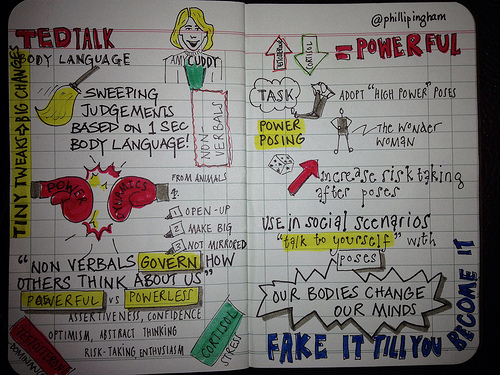
In sales, people have to have to interact with each other all day. Success in sales comes from being able to feel confident and comfortable in most situations. At Cydcor, we do our best to present the most effective sales teams around. One way to easily improve your sales confidence can be as simple as taking two minutes to stand powerfully.
Nonverbal communication has a lot of value in society. How we interact with each other can lead to very important decisions in life, such as whether someone is hired, sued, or accepted for a date. One second of political candidate facial expressions can predict election outcomes 70% of the time.

In addition to using body language to judge others, social psychologist Amy Cuddy has reported research that the way we move and carry ourselves also affects the way we judge ourselves. Further, many body expressions and postures reflect similar positions in the animal kingdom. When we are afraid we make ourselves small and meek, trying to appear insignificant. When we want to display power, we make ourselves big and open.
Power stances are known across the animal kingdom. Also, that powerful people express power chronically as well as in moments of victory. Even people who were born blind have been showed to display the upward v shape with the arms after winning something, the way racers do when they cross a finish line.
When powerful people and fearful people interact, body language reflects this as well. People unaware of fear will often shrink in the face of an open power stance without realizing it. Professor Cuddy realized the difference in power stances in the classroom, and decided to try an experiment to see if grades would improve on students she trained to stand powerfully.
The results were stunning. It turns out that powerful stances for two minutes actually increase hormones that contribute to self-confidence and assertion. So the fake-it-till-you-make-it strategy actually has a physiological affect that helps people be more confident and assertive. See the amazing talking by Professor Cuddy below:
Health and wellness are an important part of Cydcor company culture. We value our team and want them to the be the best fleet of sales people in the business. We also want Cydcor team members to feel like their best selves.
Confidence and good moods are key building successful sales relationships. There are some good personal exercises to build confidence, but the best practice for mood boosting is to incorporate foods that will energize and provide balance. We all know nutrition and exercise play a huge role in our overall health, but did you know that eating for good moods is possible as well?
Getting essential nutrients like B vitamins, magnesium, antioxidants and omega fats are great for feeling good and getting out into the world. While they may not provide super powers right away, some great foods to keep on hand might just give that competitive edge in the world of sales.
Avocados are high in fiber, vitamin K, and folic acid. Fiber and the healthy fat in an avocado will make you feel invigorated and full. Vitamin K keeps your skin fresh and bright, and folic acid is helpful for mood boosting. These green fruits are ideal for bringing out your best self.
Hazelnuts are also rich in fiber and good fats, but their secret ingredient is their high magnesium level. Magnesium helps to keep stress levels low by regulating blood pressure and helping with calcium absorption. It can also help regulate heart beats.
Eggs are an excellent source of choline, protein and omega-3 fats. Choline is a micronutrient that helps to regulate the brain. They are also one of the few foods that contains vitamin D, which helps fight against depression and ward off disease.
What are your power up foods to get you ready for the sales floor?