
Found 0 posts


A strong personal brand is one of the most valuable assets an entrepreneur can build. It helps attract opportunities, establish credibility and inspire trust. But brand-building doesn’t happen by chance – it’s the result of deliberate actions. Here are three personal branding moves, inspired by top entrepreneurs, that can elevate your visibility and influence.
“Too many people overvalue what they are not and undervalue what they are.”
– Malcolm Forbes
“Your brand is not what you sell; it’s the experience you deliver.”
– Tony Hsieh
“If people like you they will listen to you, but if they trust you, they’ll do business with you.”
– Zig Ziglar
Personal branding is less about self-promotion and more about showing up with clarity, consistency and value. By defining your voice, showing up consistently, and turning expertise into influence, entrepreneurs can create brands that are more likely to attract opportunity and inspire confidence.

Looking to save a bit of money in the year ahead? As a business owner, the more money you save, the more of your money you can put back into your business. But where do you start? Finding ways to save money on a tight budget can be challenging when you’re already living a pretty frugal lifestyle, but you might be surprised how quickly small changes can add up to big savings by the end of the year.
Here are 10 easy ways to save money on a tight budget and make an extra $5,000 or more every year:
Even a small step can lead to big changes and, in this case, even bigger savings. Many of these money saving ideas are easy to implement, and they could provide benefits that go well beyond the money you’ll save, such as financial freedom for you and your family. Most importantly, living within your means can reduce the additional stress you have to manage as you work to keep your growing business healthy. Every cent you save is just one more penny you can use to help your company reach its goals.
There are no better examples of leadership than the legacies of our great historical leaders. While they achieved tremendous fame, they did not do so without facing the occasional failure and enduring hardship. As we strive to become better leaders and learn how to inspire others, we would do well to reflect on the greatest leaders from history to see the characteristics, mentality, and habits that allowed these most revered leaders challenge norms, empower the oppressed, galvanize action, and spark change.
Lesson One: Learn from the Past
The best sources for what works in leadership are the lessons of the past. The trials and tribulations of historical leaders, while sometimes on a grander scale than our own lives, can teach us how to succeed or fail. We can learn how to lead effectively from reading about or watching movies on history, and anyone hoping to become a better leader should make a habit of it. Why make your own mistakes when you can benefit from the lessons learned by those who eventually achieved greatness? Study their lives, follow in their footsteps, and apply their leadership approaches as you drive your own team to reach its goals.
Lesson Two: Character Matters
The greatest historical leaders knew that character can often matter even more than ideas when it comes to leading others to find the greatness in themselves. Benjamin Franklin identified Thirteen Critical Virtues necessary for a successful live and vowed to exemplify them. George Washington is admired for his honesty, and Gandhi demonstrated remarkable restraint and self-discipline in his use of non-violent protest to drive change. Whether reading about George Washington, Ben Franklin, Mahatma Gandhi, Martin Luther King or Nelson Mandela, their character stood out and earned them respect, built trust with others, and translated to a highly-regarded reputation.
Lesson Three: Take Risks
You must be bold, and you must accept that you will sometimes fail. Failing can be an important stop on route to success. Lincoln lost a number of elections, including the Illinois Senate race in 1858, yet he ran for President in 1860. Washington struggled to win a major battle against the British for years, yet he had the courage to stay the course. Gandhi, King and Mandela were humiliated for many years on their paths toward civil rights and representation. Facing the occasional failure is a sign that you took on challenges, pushed yourself outside of your comfort zone, and it is an opportunity to prove your resilience and willingness to learn from your mistakes.
Lesson Four: You are Not a Victim of Your Circumstances
We can rise above poverty, lack of education, or lack of support to achieve greatness. Charlie Chaplin grew up in the direst circumstances, reminiscent of a Dickens novel, yet he revolutionized silent film. Men and women who had once been slaves and peasants, overcame the odds to become generals, emperors, and queens. While challenges can sometimes feel insurmountable, the stories of remarkable historical leaders prove that even when things seem hopeless, determination, passion, and grit can overcome the odds.
Lesson Five: Self Discipline is a Must
Lincoln had just one year of formal education, but he read constantly to feed his curiosity and continued to expand his knowledge. Franklin devised ways to improve his character by evaluating himself daily, assessing one character trait each day. Michael Jordan and Kobe Bryant were relentless in their routines to develop their skills and conditioning. The stories of great leaders of the past up to the present teach that our potential is boundless if we are willing to push ourselves. Achieving greatness as a leader means having the passion and drive to continuously transform yourself and expand your boundaries. Nobody will do that for you. To become a leader that can inspire others and provoke action, you must first be willing to lead yourself.
History is full of incredible stories of leaders who rose above their circumstances, exemplified character, and endured and overcame setbacks on their path to success. By studying their stories and seeking to understand which qualities and actions allowed them to achieve greatness, you can improve your own chances of doing the same. The stories of historical leaders are a goldmine from which I have learned so much about the kind of leader I hope to be.
To find out more about Cydcor, check us out on Facebook, LinkedIn, Instagram, and Twitter.
Gary Polson is Chief Executive Officer and Chairman at Cydcor, the market leader in outsourced sales. With more than 25 years of business operations experience in accounting, legal and senior management, Gary has propelled Cydcor to unprecedented achievement with clients, culture and philanthropy since 2001. Under his leadership, Cydcor has increased its revenue more than six-fold since 2001 and has been recognized as “…the most respected sales outsourcing company in the world” by Datamonitor and The Black Book of Outsourcing, one of the “Best Places to Work” by the Los Angeles Business Journal for eight consecutive years. Gary’s passion for excellence and never-satisfied approach has led Cydcor to earn both industry and employer recognition. With Gary at its helm, Cydcor has built its reputation on maintaining long term relationships with clients by consistently delivering results and by going above and beyond to help Cydcor’s clients gain market share and grow.
Entrepreneurship is an exciting opportunity for those, with the right attitude and pioneering spirit, to build something from the ground up, take ownership of their time and decisions, and potentially, achieve financial independence. But what are the characteristic of successful entrepreneurs? Why do some succeed while some don't?
Becoming a successful entrepreneur requires unwavering focus and commitment to your craft, strong relationships, and an open mind to new perspectives. We asked a group of entrepreneurs about what drives them and what they believe it takes to achieve success. What we discovered, is that even when you do everything right, success is not guaranteed, but the thrill of the journey, the chance to influence and support others, and the potential payoff are what drive daring entrepreneurs to venture down this career path time and again.
COMMON CHARACTERISTICS OF SUCCESSFUL ENTREPRENEURS
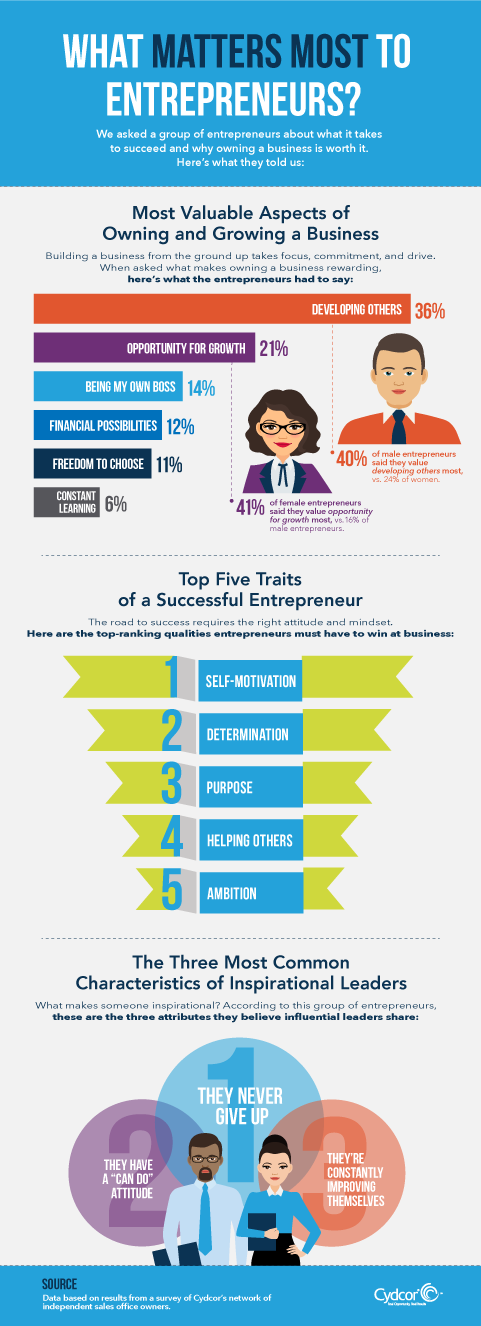
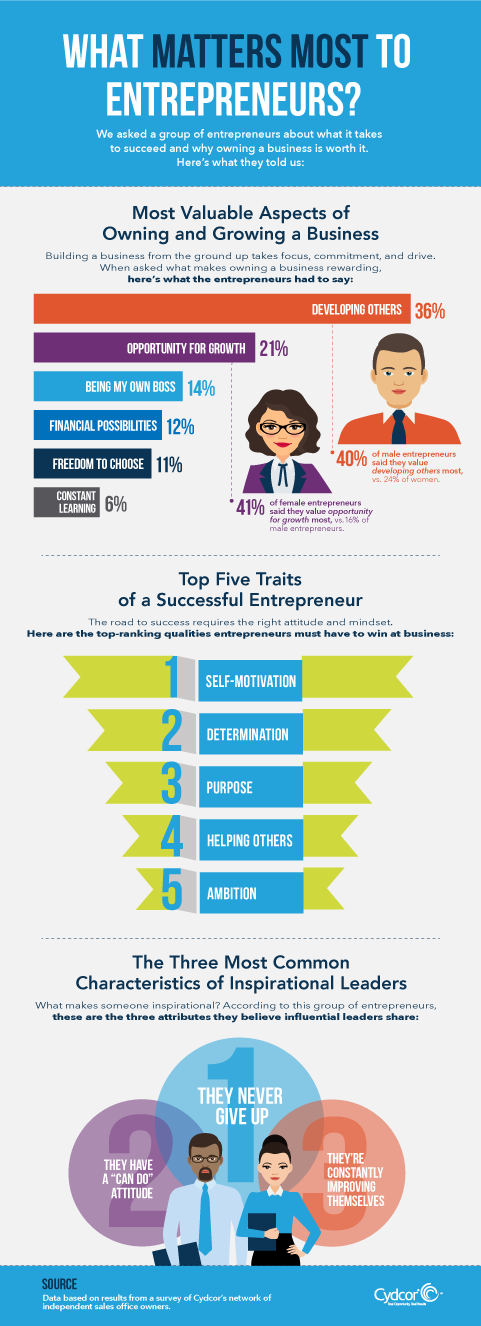
What sets entrepreneurs apart is not their mastery of specific hard skills such as writing, programming, or public speaking. From our discussions with independent business owners, we learned that the top characteristics of successful entrepreneurs are rooted in soft skills shaped by the right attitude and mindset, seen in the infographic below.
Self-Motivation
It’s easy to talk about building a business, but it’s entirely another thing to do it. The number one characteristic of successful entrepreneurs is self-motivation—the ability to put ideas into action. Think about some of the best-known entrepreneurs. Steve Jobs, for instance, didn’t wait for a company to come looking for him to build a new kind of personal computer. Instead, he partnered with the right people, turned his ideas into real-life products, and convinced the public that they needed the Apple Computer. Self-motivation can mean the difference between dreaming and achieving.
Determination
Our business owners identified determination as another major characteristic of successful entrepreneurs. This important trait is the drive that helps us follow through once we start. It’s what pushes us back up when we fall, and keeps us moving through uncertainty until we reach our long term goal.
THE BENEFITS OF ENTREPRENEURSHIP
Going from ideas to great products or startup to corporation is a remarkable feat that requires passion, focus, and resilience. It’s not a straight path, and there will often be twists, turns, and moments of uncertainty. We wanted to understand what makes it all worth it? What is it about the life of an entrepreneur that continues to drive so many to brave those, sometimes, stormy waters?
Developing Others
The majority of entrepreneurs said the most valuable benefit of entrepreneurship is the opportunity to help others grow and develop. Think about it. At one point, these entrepreneurs were employees, too. At the helm of a business, an entrepreneur has the experience to recognize greatness in others, and the leadership expertise to inspire them to get there.
Opportunity for Growth
Have you ever felt like you’re not getting anywhere in your current role, or looked up the organizational chart and didn’t like what you saw? Another major benefit of entrepreneurship is the opportunity for growth. And not just career growth, but personal growth, as well. Taking a chance on yourself and pursuing your passions will test your comfort zone, but the freedom to be your own boss and do what you love is an unparalleled experience and a unique benefit of entrepreneurship.
See what else entrepreneurs had to say about why owning and growing your own business is worth it.
Building a successful business of your own is not something that happens overnight. It takes unwavering dedication, unshakable focus, and a healthy dose of endurance. It’s an accomplishment, much like a marathon, that is achieved one step at a time. But for those who stick with it and embrace the adventure, the benefits of entrepreneurship can be life-changing.

As an entrepreneur without a set schedule, it may be hard to put together a routine to keep you in the habit of efficiency and productivity. Here are seven tips from top entrepreneurs on how they structure their days.
Start early
Most entrepreneurs start their day early in the morning. Doing so gives them time to attend to personal routines such as exercise, meditation, or reading the news. It also allows you time to ease into your day, which will make you more productive and happier in the long run.
Eat a good breakfast
A good breakfast doesn’t necessarily have to be a huge production number. In fact, you can even prepare parts of your breakfast over the weekend: Boil some eggs the day before you begin your week and pull them out of the refrigerator in the morning for a quick protein boost. Buy quick-cooking oatmeal that you can microwave in just a few minutes, and stay stocked up on fresh fruit, which makes a great addition to any breakfast.
Exercise daily
Exercise gets your blood flowing and can stimulate your creativity. You can make time for your exercise routine in the morning, take a lunch break to go for a walk or do some yoga, or hit the gym in the evening for a good workout. Getting and staying fit will give you the energy and stamina you need to build your business.
Plan ahead
Take time at the beginning of your day to plan your activities. Set three most important things to accomplish and be sure that your day includes time to accomplish those tasks. Schedule your creative work, exercise, and meetings around the hours that you perform best at those tasks. It might not be a bad idea to also schedule time for skill development.
Visualize future achievements
One of the best ways to help yourself become successful is to decide what “successful” means for you and spend time visualizing yourself achieving not just that level of success, but even greater achievements as well.
Don’t forget family time
It’s easy to get caught up in the mentality that you have to work constantly, but it’s crucial to take the time to sit down and have dinner with your family. If you don’t have family nearby, use that time to do things you like to do, whether it’s walking your dog or playing with your cat, watching a movie, or going to happy hour with a group of friends.
“Unplug” at night
Put away your phone, laptop, or tablet at least half an hour before you plan to go to bed, then keep all those devices away from you—and on silent—while you’re sleeping. Disconnecting from your business and social media will ensure that you have more restful sleep, which will leave you feeling refreshed when you wake up in the morning.
What routines do you use to stay focused and efficient throughout the day? Please share your tips in the comments!
For additional blogs from Cydcor, be sure to check out https://www.cydcor.com/media.
We are Cydcor, the recognized leader in outsourced sales services located in Agoura Hills, CA. From our humble beginnings as an independent sales company based in Canada to garnering a reputation as the global leader in outsourced sales, Cydcor has come a long way. We’ve done this by having exceptional sales professionals and providing our clients with proven sales and marketing strategies that get results.
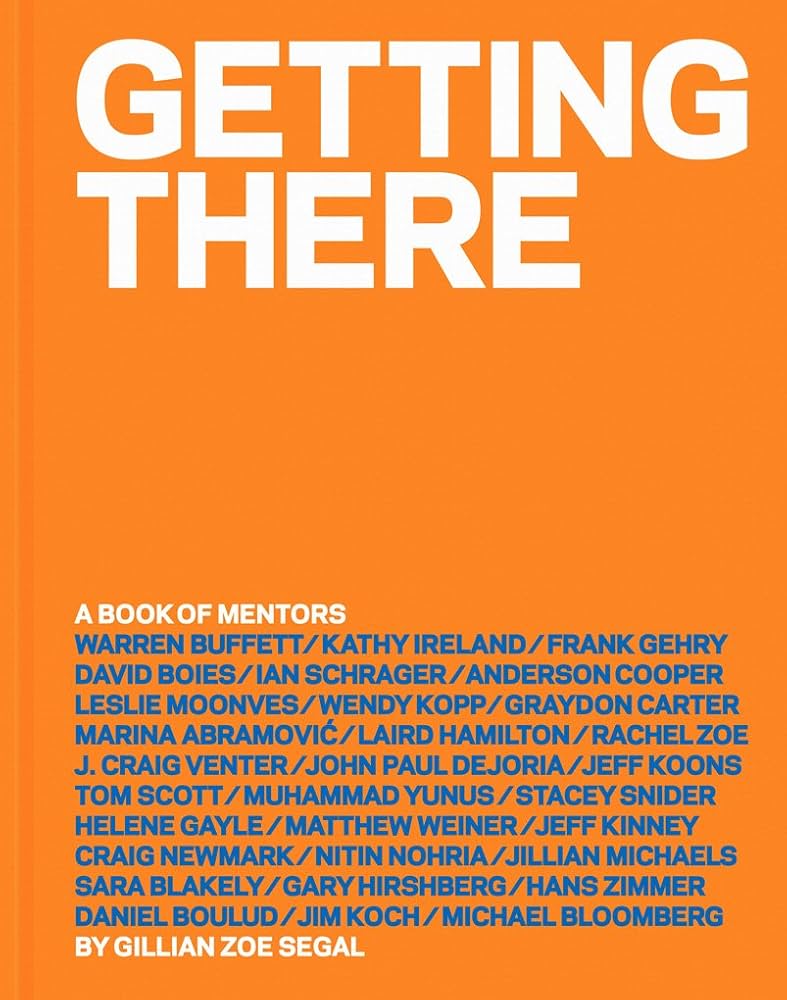
About Getting There: A Book of Mentors by Gillian Zoe Segal
What makes a good mentor? In Getting There: A Book of Mentors, Gillian Zoe Segal interviews thirty leaders in their fields to provide tips and tricks on how they were able to make it to the top. These potential role models describe hurdles they had to overcome in life, setbacks they had to handle, and the lessons they learned even in their lowest moments. The mentors give practical career advice as well as wisdom they’ve acquired over the years. Getting There is the perfect read for anyone attentively focused on their future or facing challenges in getting to the next level in their career. Finding success is never easy, but a great mentor can make the path toward achievement easier to navigate.
Cydcor decided to review this book after discovering an excellent Forbes.com article on door-to-door selling as the first step to billions.
Why Cydcor Reviews Recommends This Book:
Segal interviews people from many different fields: art, politics, science, and business. Each mentor walks the reader through their journey of making it big, explaining that the path isn’t always easy. Failures happen and difficulties arise, but it’s not impossible to outlast these complications. Almost all of the mentors in this book have experienced a moment that let them transcend these challenges.
This isn’t a book filled with research or studies. Instead, it offers narratives that put an emphasis on being human, and how that allows people to face anything. The advice the book Getting There offers is top quality, from real people who started out ordinary and became extraordinary. Although these people may all be from different fields, the advice is still sound and applicable for anyone looking to make something of themselves. It’s truly a great and inspirational read.
Our Favorite Part
Of all the different mentors interviewed in the book, John Paul DeJoria (co-owner of Patron Spirits and Paul Mitchell US), Sara Blakely (owner of @SPANX), , and worldwide recognized artist Jeff Koons have the most insights applicable to the business and sales industries. All three began their careers as door-to-door salespeople, and that experience made an impact that affected them permanently. Like the rest of the book, these chapters feel like an intimate one-on-one talk where wisdom is easily absorbed. The struggles these mentors faced can help shed light on many of the challenges everyone faces while trying to build a successful professional life.
What do you look for in a mentor? Tell us about the qualities you value when searching for a role model. Share a photo on Instagram and follow us @Cydcor
We are Cydcor, the recognized leader in outsourced sales services. From our humble beginnings as an independent sales company based in Canada to garnering a reputation as the global leader in outsourced sales, Cydcor has come a long way. We’ve done this by having exceptional sales professionals and providing our clients with proven sales and marketing strategies that get results.


Written by Nia Bowers
Some leaders arrive at the top of a company. Vera Quinn built her way there.
She got her start over 25 years ago as a door-to-door sales representative within the outsourced sales industry. What followed was an impressive ascent in business leadership when she joined Cydcor (a leader in the outsourced sales arena): VP of Operations, Senior VP of Sales Operations, Chief Operating Officer, President, and finally CEO in 2020.
Founded in 1994 and headquartered in Agoura Hills, California, Cydcor is a trusted provider of outsourced customer acquisition solutions. Through its network of independently owned and operated sales companies, Cydcor offers Fortune 500 and emerging brands a blend of personal connection and technology that has kept clients coming back year after year.
When Quinn took over as CEO, the world was six weeks into a pandemic that had effectively outlawed the face-to-face sales model Cydcor’s business was built on. Many companies in that position played defense. Quinn led Cydcor’s corporate team to develop and launch touchless selling technologies, equipping the network of independent sales companies with entirely new strategies for customer acquisition and enabling the business to evolve and thrive.
It wasn't a pivot born of desperation. It was the kind of move that only happens when a leader knows the machinery well enough to rebuild it under pressure.
Since becoming CEO, Quinn has led Cydcor through consistent revenue growth, expansion into new industry verticals, and recognition on the Inc. 5000 list of America’s fastest-growing private companies. In 2025, Cydcor posted double-digit revenue growth for the fourth consecutive year, continued to serve long-standing clients, and saw its network scale their own businesses and develop new entrepreneurs.
Quinn talks about culture the way most executives talk about strategy as the thing everything else depends on.
"If you want great results, you have to invest in the people around you," she says. "It’s about giving them the tools, the clarity, and the belief that they can achieve more than they thought possible."
That belief isn’t decorative. At Cydcor, it operates as a management principle, one that runs through how the corporate team functions, how Cydcor approaches its relationship with the network of independently owned and operated sales companies that carry out field execution, and how it maintains the client relationships that have, in many cases, lasted decades.
"Clients stay with us because we’re consistent and because we do what we say we’ll do," Quinn explains. "They trust the integrity of our team and the strength of our network."
Cydcor has earned the DIRECTV Dealer of the Year Revolution Award for nine consecutive years. That kind of sustained recognition is less about any single campaign and more about what happens when accountability is baked into how a company operates at every level.
Under Quinn’s leadership, Cydcor has also been named a Best Place to Work in Los Angeles 13 times, a reflection of a corporate culture that doesn’t treat growth and team investment as competing priorities.
The accolades of the past few years read less like a peak and more like a confirmation of something that's been compounding for a long time.
Quinn was honored by Comerica and the Los Angeles Lakers with their Women of Business Award, named CEO of the Year by the Los Angeles Business Journal Valley Women's Leadership Awards, and was an honoree of the LA Times Studios Inspirational Women Forum & Leadership Awards - recognized for her focus on driving sustained business growth and building a high-performance, opportunity-based culture.
The Valley Women's Leadership Symposium spotlights influential leaders across the San Fernando Valley and greater Los Angeles who are driving innovation, cultivating inclusive workplaces, and shaping the future of business. Quinn's inclusion wasn't a lifetime achievement moment, it was a recognition of something actively in motion.
Quinn also serves as Executive Director of Liberty Children’s Home in Belize extending the same investment-in-people philosophy that defines her leadership at Cydcor into work that has nothing to do with revenue targets. Through Cydcor and its network, the company’s relationship with Operation Smile has helped fund nearly 4,000 smile-restoration surgeries for children, with over $1,000,000 raised.
It's a pattern worth noting: the leaders who build durable companies tend to be the ones who aren't only building companies.
Quinn has spent more than two decades learning within the industry and leading through a period that would have broken a less prepared successor. The numbers reflect it. So does the culture. And so, increasingly, does the industry recognition that keeps finding her, not because she's chasing it, but because the results keep demanding it.
Vera Quinn is the President and CEO of Cydcor, a leader in outsourced sales headquartered in Agoura Hills, California. Learn more at cydcor.com.