
Discover practical advice, inspiration, and insights to help you succeed in business and grow both personally and professionally.
Found 0 posts

By: Gary Polson, CEO
I was so inspired by Senator John McCain’s life and death. His life is a reminder of America’s greatest values: service, devotion, sacrifice and honor. He is a real American hero.
Actually, he was more than a hero. He was a loving father. In her eulogy, Meghan McCain shared how she loved her father and felt his love. John McCain committed to Washington, DC and traveled the world in his role as a Senator. Yet, he found a way to be a wonderful father. He is a role model of how you can make a big contribution in your career AND have a meaningful family life. Rest in peace.
Gary Polson is Chief Executive Officer and Chairman at Cydcor, the market leader in outsourced sales. With more than 25 years of business operations experience in accounting, legal and senior management, Gary has propelled Cydcor to unprecedented achievement with clients, culture and philanthropy since 2001. Under his leadership, Cydcor has increased its revenue more than six-fold since 2001 and has been recognized as “…the most respected sales outsourcing company in the world” by Datamonitor and The Black Book of Outsourcing, and one of the “Best Places to Work” by the Los Angeles Business Journal for eight consecutive years. Gary’s passion for excellence and never-satisfied approach has led Cydcor to earn both industry and employer recognition. With Gary at its helm, Cydcor has built its reputation on maintaining long term relationships with clients by consistently delivering results and by going above and beyond to help Cydcor’s clients gain market share and grow.

Rejection is a natural part of the sales process. It’s hard to avoid, and even harder to face. However, have you ever considered the silver lining of rejection? Maybe all of those “nos” have made you who you are today. Hearing “no” forces salespeople to climb out of their shell, think outside of the box, and reach for new horizons. Working in sales and facing “no” on a daily basis can help you build critical skills that can prepare you to withstand and excel against the rigors and challenges of the business world. Enduring a little rejection now can train you to be resilient, flexible, and mentally strong – all skills that can benefit you greatly as you grow your career.
You Learn
In order for someone to grow as a sales professional, he or she has to understand what works and what doesn’t work. When you recognize that some part your pitch, approach, or presentation isn’t working, you learn how to make critical decisions to correct the problem and get back on track. You discover how to do better, so that it does work the next time around. Salespeople are constantly learning, trying to improve the process. Only with a “no” can you get that much closer to a “yes.” Since business is an ever-changing landscape, as you progress through your career, having the ability to learn will make you a more desirable hire. It’s what fuels your personal growth.
You Develop Patience
We all know the saying: patience is a virtue. Boy, is that true, especially in the world of sales. The sales business is a numbers game that teaches you to accept that if the first customer says “no,” you just have move to the next one and keep going. There is no room or time to throw up your hands in exasperation. The best salespeople understand that a successful sales day is a marathon, not a sprint. Over time, sales professionals learn how to maintain a patient, positive mindset no matter what. Developing this kind of unwavering resilience will also prepare you for managerial positions, even owning a company. Things will go wrong, people will quit, rejection will befall you, and unfair things will happen. Maintaining your patient disposition through it all is what will set you apart from the competition.
You Learn How to Be Flexible
Salespeople can’t afford to be stuck in their ways. Sales is a process of experimentation and refinement. When good salespeople face rejection, they learn how to rethink their approach to avoid a sales blunder in the future. Overtime, sales teaches you how to apply self-discipline to correct course, test new approaches, and perfect your pitch until you can consistently deliver results.
You Communicate Better
Sometimes, you face rejection because your communication skills weren’t up to par. Perhaps you misspoke, failed to listen, or just delivered a message without any energy. Communication is the cornerstone of every business interaction. Hearing “no” can inspire you to do what it takes to hear that “yes” next time. You’ll refine your messaging and communication approach. Within business, communication is how critical information about sales, services, and products is relayed to key stakeholders. You need to know how to communicate quickly, effectively, and with authority. It’s time to get started.
You Toughen Up
Finally, it’s inevitable that rejection is going to force you to develop thicker skin. However, that’s not a bad thing. In the world of professional sales, it’s an incredibly important attribute. You’ll learn to listen to your gut and intuition, rising above rejection to focus on what you need to do to get the job done. You’ll develop your own personal shield that keeps you protected. As you climb towards the top, this internal toughness will better prepare you for the obstacles and stakes ahead, like hiring/firing decisions, expansions, acquisitions, and the list goes on.
We all know the time-old adage, “what doesn’t kill you makes you stronger.” In sales, this saying proves true. A healthy amount of rejection is necessary for personal growth and advancement. The next time you’re faced with a “no,” smile, for it is another opportunity to grow and flourish as an individual and a professional; it’s another opportunity to see things in a new light and appreciate a new way of doing things; and it’s another opportunity to become wiser, stronger, and better.
What have you learned from rejection in the past, and how has that helped to accelerate your personal growth? Share them with Cydcor in the comments below.

Cydcor has done it again! This year marks the 9th time Cydcor has been named to LA Business Journal’s Best Places to Work list. The list, compiled by the Best Companies Group, an independent research firm, is created based on employee responses to a survey that takes into account employee satisfaction and engagement across a broad spectrum of categories including Leadership and Planning, Corporate Culture and Communications, Training, Development and Resources, Pay and Benefits, and more. Read more about Cydcor’s ninth Best Places to Work win.
Cydcor is a company that continues to evolve, maintaining focus on helping team members develop, grow, and succeed. Cydcor offers a wide variety of programs, events, processes, and benefits to enrich team members’ professional lives and provide them with the resources they need to maintain their personal, mental, and financial health as well.
But the reasons Cydcor deserves to be named among the Best Places to Work go far beyond benefits. Cydcor has a rich corporate culture that begins with a strong set of company values, including The Behavior We Value, that permeates throughout the business, touching every aspect of its operations from hiring and onboarding, to robust training and development resources, to team and cultural events, to ongoing corporate philanthropy projects. Check out even more of the reasons Cydcor’s “People Helping People” philosophy is the embodiment of a great place to work.
Over the years, Cydcor has demonstrated continued commitment to investing in its team members, because people are the heart and soul of the business and its is their hard work, passion, and drive that enable Cydcor to succeed. But the best testament to why Cydcor deserves to be on the Best Places to Work list comes from team members themselves. See team members share, in their own words, how working at Cydcor has enriched their own personal and professional lives.

Mobile devices are more than just modern conveniences. In today’s business climate, having the right mobile tools at your disposal is critical to your professional survival. Staying connected around the clock is the accepted norm, not the exception and remaining competitive means keeping yourself up-to-date on the best apps to help you work smarter, faster, and better.
As thousands of new apps are released into the market every day, staying current on the best and most effective apps for improving productivity and performance can feel like a very daunting task. Luckily, Cydcor has created a shortcut to help you wade through this vast ocean of available apps. We’ve compiled a list of some of most useful apps to help busy professionals stay organized, communicate better and more efficiently, quickly get where they need to go, and be more productive.

Beast mode isn’t a permanent state; it has to be turned on with self-motivation. Don’t let the success stories fool you: No matter how much you love what you do, even the best of the best struggle to get up and go sometimes.
The first thing to know is that there’s no “right” way to spring into action. Each of us is motivated differently, and to make matters even more complicated, what's empowering in one scenario might actually be de-motivating in another!
So how do you go from waking up on the wrong side of the bed to crushing your goals? It starts with knowing whether you’re positively or negatively motivated, so you can determine which self-motivating tips will work effectively for you.
Here’s what that means.
Positive motivation is reward-centric: the impetus for action is visualizing a desirable result. Negative motivation, on the other hand, is driven by the anticipation of pain or fear.
How do you know which self-motivating tips will work best for you? This is where the ability to self-reflect is key. Think about what scenarios and conversations have given you that extra boost in the past. Have you been more excited by moving toward pleasure or by avoiding pain? Ask your mentor and closest friends for additional insight.
Let’s dive into a list of self-motivation activities to try—each with a positive or negative twist.
Phone a Friend
If you’re positively motivated: Call (or sit down with) your biggest fan. Sometimes, all you need to get pumped up is to hear encouraging words from someone who believes in you.
If you’re negatively motivated: Do you get fired up when someone says you can't do something? If so, this approach to this self-motivating tip might be for you. Mentally prepare. Inhale deeply, buckle your seatbelt—this might not be pretty. Call that one person who gets your blood boiling, the person who doesn’t believe you can achieve your goals. Cut the conversation off once you’re charged up and ready to get going!
Reflect on Past Results
If you’re positively motivated: Even if you didn’t hit all of your goals last week, there are things you undoubtedly did well. Write them down. Take a few moments to acknowledge where you thrived; give yourself a pat on the back.
You can also try this on a larger scale and look back to a high point in your career, a time when you were on top of the world. Perhaps you had just beat your own best, received a compliment from your manager, or earned a promotion. Try to step back into this positive frame of mind. Remind yourself that you’re awesome and that you’ve got this!
If you’re negatively motivated: If you let yourself down last week, come face to face with what went wrong. Remind yourself, for example, that if you continue to have a low sense of urgency, you’ll only delay the promotion you’re after.
Want to go even bigger with this approach to self-motivation? Think about what happened the last time you stopped giving 100% in your career. Maybe you lost your job, struggled in your relationships, or regretted not getting back on the horse sooner. Visualize your fears and use them as fuel to get going.
Set Consequences
If you’re positively motivated: Choose a “carrot” for getting the job done. For example, on Monday, tell yourself, “If I accomplish x, y, and z this week, I will treat myself to a manicure on Friday.” Focus on working toward this short-term goal and visualize how great you’ll feel at the end of the week when you’ve hit your goals using this self-motivating tip.
If you’re negatively motivated: Choose your punishment. “If I don’t accomplish x, y, and z this week, I'll have to work through the weekend and miss the camping trip with my friends.” If you catch yourself slacking at any point during the week, remind yourself how regretful you’ll feel about missing all the fun.
As you discover and try new self-motivating tips, be patient with yourself. Experiment with blending pieces of positive and negative self-motivation—this doesn't have to be black and white. Again, there’s no “correct” way to get going. Figure out what works for you and share your experience with Cydcor on social media!

Ah, productivity. It seems so simple, doesn’t it? Make a to-do list, prioritize it, then get to work! In reality, we all know this is much easier said than done. Thankfully, there are several surprisingly simple productivity tips and tricks that we can implement to make the most of our time. Check out the four productivity tips below.
1. Implement a Daily Drink and Think
Let’s kick off this list with a productivity tip that’s sure to sound counter-intuitive: Sit down and do nothing.
Yes, really!
One of the best things you can do for yourself is to take 10 minutes a day to just think. Sit down in the morning with your coffee or tea, or at night after a relaxing bath or tucking in the kids. Find somewhere relatively quiet where no one will bother you. Put away your devices. Ponder your day, think about what’s important, and pay attention to what rises to the surface. When you’re done, revise your to-do list as you see fit.
2. Empty your Brain
If you’ve ever watched a survivalist competition on TV, you’ve seen how important it is to conserve resources and be strategic about energy expenditure. Navigating through daily life is no different.
One of the best ways to conserve mental energy is to write everything down, rather than holding thoughts in the back of your mind. Did you just remember that a report is due at the end of the week? Add it to your calendar. Did a great idea just pop into your head? Jot it down. Doing so will make it easier to focus on the task in front of you, upping your productivity.
3. Set a Series of Timers
Depending on your style of working, this productivity tip has the potential to skyrocket your efficiency. This can be particularly effective when there’s an item on your to-do list that you’ve been dreading or if you’re a person who works best under pressure.
Start small. Set a timer for 20 minutes. Force yourself to use every millisecond of the time block to do focused work. Zero funny business allowed while the clock is ticking. Challenge yourself to see how much you can get done in this window. Then, when the timer goes off, set another one for 5 minutes. This time is your reward. Use it to grab a snack, check Instagram, text your mom, or do anything that will register in the pleasure center of your brain. Then repeat. Try playing around with longer working blocks.
4. Create a Must-Do List
Different from your to-do list, this should contain 3 to 5 items that absolutely, no matter what, need to be completed today. You can vary the length of the list based on the heft of the tasks, but the key is to identify which activities are non-negotiable. Tell yourself that you can’t leave work or even go to bed until they are done.
There are a few reasons this works so well. First, the commitment to yourself alone is very powerful. No one wants to let themselves down. Second, human nature is to avoid pain. If you don’t want to work all night, you’ll put the pressure on yourself to ramp up your productivity during the day. Your Must-Do list will serve as an anchor to stay focused on your priorities when you’re tempted to stray.
How do you make the most out of your day? Share your favorite productivity tips with Cydcor on social media!

The difference between successful and unsuccessful salespeople has less to do with what they say, and more to do with how they frame the situations in front of them. Emulate the greats by getting into the habit of doing these 3 things.
Success in Sales Tip #1: Be a regular person
If you think of yourself as a salesperson, your customer is going to treat you like a salesperson—and guess what: Most people don’t like salespeople! Instead, frame your interactions as regular conversations between two people. Don’t put on an act; don’t speak in a tone of voice you wouldn’t normally use. Focus on listening carefully, displaying genuine empathy, and making the other person feel as comfortable as possible.
When customers view you as just a salesperson—rather than a fellow human being—they’re more inclined to believe you don’t have their best interests at heart. However, when you’re able to behave naturally and be relatable, it becomes much easier to establish natural rapport, which in turn makes it possible to build trust and work toward your success in sales.
Success in Sales Tip #2: Get to the bottom of “no”
Even if this is your first day selling, you know that you’re supposed to overcome objections. But there are alternative ways to think of this.
Issue the following challenge to yourself: Always walk away from a prospect with 1 of 2 things—a sale or a true understanding of why the customer didn’t buy. (Hint: There’s a difference between a reason and an excuse.)
When someone says they don’t want to buy, simply set out to learn more. Successful salespeople don’t just move on, and they don’t lead with trying to change the person’s mind, either. Remember the advice in tip number 1: Be a regular person. Step into the other person’s shoes. Focus on asking great questions and actively listening to the customer’s responses.
By digging deeper when you get a shallow no, you’ll end up uncovering a lot about a customer’s motivations—their problems, challenges, what they’re looking for, what they’re not looking for, and maybe even past experiences with other vendors. The result? You’ll start turning many would-be nos into yeses—and success in sales.
Success In Sales Tip #3: Master your own body language
Successful salespeople are hyper-aware of their body language and tone of voice. They have a sense of how they’re being perceived, and they’re strategic about using their physical presence to advance a conversation.
Amateurs, on the other hand, don’t necessarily realize that their hands are in their pockets or that they shifted their weight when asked a difficult question. They aren’t aware, per se, that they’re swaying while speaking, that their eye contact is inconsistent, that they're frowning or over-smiling. Folks with less success in sales are generally unaware of how they are coming across.
If you want to become maximally successful in sales, you need to develop an extreme sense of self-awareness and the ability to quickly adapt your body language to the customer and situation. (Hint: Try videoing yourself practice-pitching or ask a colleague for feedback.) It’s important to realize that simply saying all of the right things isn’t enough to become great. It’s up to you to master your own body language so that it becomes a controllable part of the sales process.
What habits have helped you see more success in sales? Share them with Cydcor on social media

Demonstrating excellence isn’t just about doing what is expected; it’s also about achieving goals that may seem impossible. At Cydcor, we take our goals seriously. We don’t just set big goals because we like to impress clients and sound ambitious. We set big goals because we expect to achieve them, because we believe that going above and beyond should be the norm—not the exception. We like being good at what we do, but we aren’t satisfied until we’re great and producing real results. So, what does it take to deliver what you’ve promised, even when the goal feels out of reach? The secret is digging deeper to find that little bit extra you didn’t realize you had. It’s there, in all of us, and when we decide that the only option is success, it shows up just in time to prove that your potential to achieve is truly limitless!
Lean on Your Strengths
Find what you’re great at and make the most of it. Everybody has his or her own talents, areas of expertise, or skill sets in which they excel. Identify yours and use them to your advantage to produce results. Focus on those areas where you can bring even more to the table, because you know that’s where you have the most to offer.
Work Smarter
You’re passionate, dedicated, determined, and you don’t give up, so nobody can say you’re not working hard. Producing outstanding results isn’t just about the amount of effort you put in, it’s also about the approach. Start asking yourself and the members of your team what you can be doing differently, better, faster, or cheaper to help achieve goals.
Gather Honest Feedback
You can’t expect to get better at achieving your goals if you can’t be real with yourself and embrace all feedback, both good and bad. Reaching that next level and crushing huge goals takes having the courage to accept that you’re not perfect. Every single one of us has room for improvement and honest, constructive feedback is a gift we should embrace, because it helps shed light on our own personal path to growth.
Tackle the Biggest Hurdles First
You’re determined to move mountains, but you can’t and shouldn’t move all of them at once. Decide what matters most to you and your business, and go after those things first. You’re more likely to achieve goals if you’re focused on the things that will bring you closest to the goal line.
Assume the Sale
Know with all your heart and mind that you can do it, and you will! Achieving big goals is as much about how you think as it is about how you perform. Overcoming seemingly insurmountable odds takes a winning mindset. There is no room for self-doubt on the path to producing extraordinary results.
There is no such thing as an unreachable goal. Most of the greatest success stories in the world start with someone who said it couldn’t be done—but somehow, it was! Even when the task seems impossible, there is no excuse for giving up. Dig deeper, find a solution, and deliver on your promises, because the opportunity to “be so good you can’t be ignored” is yours for the taking.

There are several advantages to having a mentor, especially in your professional life. The experience, knowledge, and contacts you stand to inherit from a mentor are immeasurable, but how do you get to that point? Follow these simple tips, and you’ll learn how to find a mentor that’s right for you.
Know Yourself
The first, and perhaps most challenging, part of finding a career mentor that fits your needs is to really understand what you are looking for. Take the time to figure out where you want to take your career. Set goals for yourself. Figure out what your strengths and weaknesses are. What are you particularly good at? What are the areas of your life that you could stand to improve? What are things you can do to actively work on shoring up the areas of your professional life that you aren’t fully satisfied with? It may help to sit down and write out all of these things. Something almost magical happens when you set down abstract concepts in writing. Insights become more palpable and goals feel more obtainable. Define who you are and what you are working towards.
While these are all exercises that are good in and of themselves, what do they have to do with finding a career mentor? Part of figuring out how to find a mentor is realizing that a mentor-mentee relationship requires participation from both parties. You can’t expect your mentor to do all the heavy lifting. By clearly defining who you are and what you want for yourself, you can express that clearly to your future mentor. You can demonstrate that you are an active participant in the relationship, and you can get exactly what you are looking for.
Build Your Network
The only way to find the right mentor is to get out into the world and meet the people in the field you want to master. The stronger your network is, the more likely you are to find the people with whom you truly click. Attend professional events and industry meetups in your field. Seek out volunteer and membership opportunities with professional organizations that are relevant to your career path. Inquire at your alma mater if there are any formal mentorship programs available. Failing that, you may discover that there are alumni events that are great opportunities to build your network. Also, you should make it known that you are seeking out a mentor amongst the individuals in your network. Someone whom you trust could very well provide an introduction that changes your career.
Let It Happen
You are unlikely to find the career mentor you need by asking total strangers to devote their time and energy into a relationship with someone they do not know. Your primary focus as you unravel how to find a mentor should be to focus on your own value and process. You need to be someone who is both enjoyable to mentor and someone worthy of your mentor’s expertise. Be the best version of yourself every day. Bring that best self into your network and let yourself be seen. As long as your remain actively working to better yourself and continue to seek out the mentorship you want, the foundations of the relationship will begin to form of their own accord.
Seek out people who you admire, people who align with your values. Be on the lookout for potential mentors with unimpeachable integrity, and then study how they deal with the challenges in their own careers. Stay open. Stay Honest. Stay seeking. The right relationship will eventually present itself, and you need to be ready for it.
Solidify the Relationship
Once you have found someone with whom you connect well and you feel would be a good fit for you as a career mentor, you need to define what that relationship will look like. Be clear about what you are seeking and what you are willing to bring to the relationship. Schedule regular meetings and check-ins with your mentor. Hold yourself accountable for reaching your goals. Be ready with questions and voice them appropriately. Also, be open to what your mentor has to share with you. Straight talk and honesty are like gold in the mentor-mentee relationship. It may not be always be easy to accept words that are critical, but they are invaluable to your development. A good mentor will tell you what you need to hear, not what you want to hear. Be receptive and attentive. Well-defined roles with accountability for follow-through are the cornerstones of your relationship with your mentor.
A good career mentor can make a gigantic difference in getting all you want out of your professional life. You can benefit from years of industry insight and knowledge about how to navigate that sector, and how to build yourself up. Now that you have figured out how to find a mentor, be sure to explore additional professional advice on the Cydcor blog.
Companies have many options when it comes to how to build and structure their sales strategies and approaches, and one important decision they will have to make will be whether to invest in inside sales or outside sales. To weigh the benefits and advantages of each sales approach, it’s important to clearly identify what each option entails.
Inside sales are generally done “inside,” from a single location. Inside sales do not take place in person, and they can include interactions ranging from phone calls to emails, chats, social media, and even texts.
Outside sales refers to situations in which a sales rep makes in-person, face-to-face contact with the customer. This can include door-to-door sales, sales made through visits to customers’ homes, offices and local businesses, or retail sales.
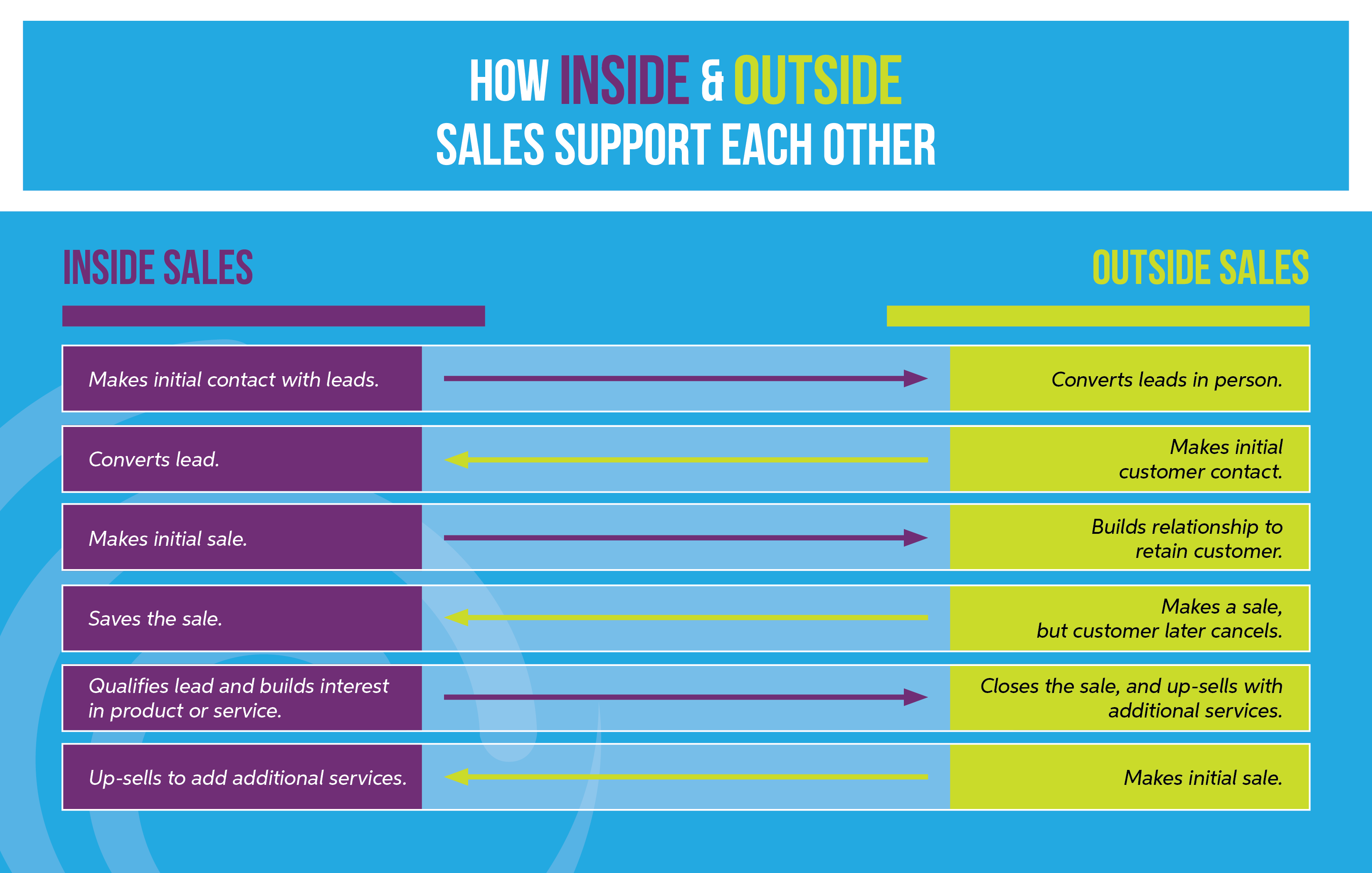
Both inside and outside sales can offer advantages to companies wanting to maximize revenue and keep costs manageable. To achieve the absolute best sales and customer acquisition results, companies should pursue a mixture of both. When optimized, inside and outside sales can support each other, helping companies acquire more customers, improve their overall conversion rate, earn greater revenue from customers, and build stronger relationships with the customers that could support better customer retention.
How do inside and outside sales teams work together? Customers who are first contacted by an outside field rep, for example, may have some interest in a product or service, but he or she may ultimately decide against making a purchase. In cases like this, an inside sales rep may be able to follow up with this customer by phone or email to find out why he or she decided against the product or service, and by offering additional information, the sales rep may be able to change the customer’s mind. The inside sales rep may also be able to present alternative products to the customer, such as a different service package, that might better fit the customer’s needs.
Alternatively, the inside sales rep might be able to refer customers to outside sales reps after making initial contact. This customer now has some awareness of a product or service and has built a relationship with the brand. The outside sales rep may then be able to work one-on-one with the customer to find a product or service solution that fits their needs.
These are just a few ways inside and outside sales teams can work in partnership to drive better overall sales results for your company.
Other ways inside and outside sales may be able to work together are:
Customers are individuals, and not all customers will respond the same way to the same sales approach. By enlisting both inside and outside sales, you give your company more flexibility to communicate with the customer at a variety of touchpoints and in a variety of ways. By incorporating both sales channels, you can acquire more customers, more easily address weaknesses in your sales funnel, gather more valuable data and customer insights, and boost revenue by giving the customer more information and more options.
Below is a breakdown of the advantages each sale method offers:
Both inside and outside sales offer major benefits, and a winning strategy for sales revenue growth is one that combines the two, allowing them to work in partnership to deliver the best possible results. A sales program that includes both inside and outside sales can interact with the customer at multiple stages of the sales cycle, building product knowledge, strengthening the relationship with the customer, growing trust, fostering interest, and gaining valuable insights about what the customer needs and wants.
To reap the advantages of both inside and outside sales, the smartest organizations are partnering with companies like Cydcor, a leader in outsourced sales and marketing. Cydcor has experience building full-service sales and customer acquisition programs that combine effective outside sales, with inside sales techniques. Cydcor drives high sales volume using traditional feet on the street sales methods, and it supports these efforts through multi-channel and tele-sales techniques to capture, retain, or upsell leads with which the outside sales team has already made contact. By entrusting a company like Cydcor, with expertise and experience in both outside and inside sales tactics, companies benefit from a tested, disruptive, and winning formula that consistently delivers results.


Shirley Levine was an incredible educator that I had the pleasure to work with and learn from. She once asked some teachers, “What is your job?”
The teachers responded, “Teach the kids.”
Shirley said, “That is not it.”
The teachers responded with, “Educate the kids,” and similar concepts.
Shirley said, “That is not it either.”
After a while, when the teachers were perplexed, she said, “Your job is to get the kids to learn. There is a big difference. If your job is to teach, once you deliver your great lesson, you are done. If your job is to get them to learn, you are not done after the lesson. You are only done when they learn the material. Also, kids can learn a variety of ways. They can learn on their own, from their peers, from a book.”
I frequently need to remind myself of this concept. I too often get into teaching mode. My eldest daughter reminded me of this hearing me go over one of my presentations. She thought it was bad. I asked why. She said, “I felt like you were talking at me, not involving me. Millennials like to be involved to learn.”
After the initial shock of her dissatisfaction with a presentation I have given for over 25 years, I remembered this quote frequently attributed to Benjamin Franklin: “Tell me and I forget. Teach me and I remember. Involve me and I learn.”
Did Benjamin Franklin know about millennials 250 years ago? Or, is it always that we learn best when we are involved? It is much easier to teach than find a way to involve. But who wants easy?

Gary Polson is Chief Executive Officer and Chairman at Cydcor, the market leader in outsourced sales. With more than 25 years of business operations experience in accounting, legal and senior management, Gary has propelled Cydcor to unprecedented achievement with clients, culture and philanthropy since 2001. Under his leadership, Cydcor has increased its revenue more than six-fold since 2001 and has been recognized as “…the most respected sales outsourcing company in the world” by Datamonitor and The Black Book of Outsourcing, and one of the “Best Places to Work” by the Los Angeles Business Journal for eight consecutive years. Gary’s passion for excellence and never-satisfied approach has led Cydcor to earn both industry and employer recognition. With Gary at its helm, Cydcor has built its reputation on maintaining long term relationships with clients by consistently delivering results and by going above and beyond to help Cydcor’s clients gain market share and grow.