
Discover practical advice, inspiration, and insights to help you succeed in business and grow both personally and professionally.
Found 0 posts
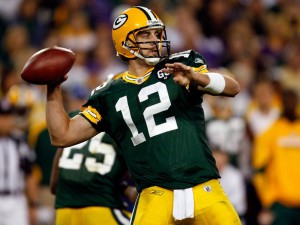
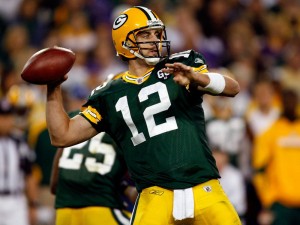
Aaron Rodgers, the Super Bowl MVP, is an example of the tortoise beating the hare. Rodgers was not recruited by any Division I universities. He had to start his college career at an obscure junior college. Cal was recruiting a tight end at that junior college when they happened to notice Rodgers. They gave a scholarship to both players. But Rodgers was not the reason why they made the recruiting visit.
After a stellar career at Cal, experts predicted that Rodgers would be the first or second pick in the NFL draft. Excruciatingly and humiliatingly, he was snubbed and dropped all the way down to the 24th pick. For many of us who watched this on television, it was painful to see.
Rodgers was drafted by the Green Bay Packers and had to sit on the bench behind legend, Brett Favre. Other young quarterbacks were getting more playing time and accolades. Rodgers was patient, diligent and hard working. He finally got his chance when Favre was traded and a few years later, he is a Super Bowl champion.
He was not recruited out of high school, he was snubbed in the NFL draft, he had to wait patiently on the bench, but he finally got his chance and succeeded. It is not how fast you start, but where you end up. As Aesop fabled, “slow and steady wins the race.”
- Gary

How many of us have had days where we can’t quite see eye to eye with anyone? A fight with our spouse or kids. A confrontation with the boss or a coworker. A business deal gone sour.
In my experience, it often boils down to communication or rather, poor communication. We talk at or over each other. Or if we can’t get a word in edgewise, we bide our time to interject our opinions and tit-for-tat responses. Or in anger and frustration, we say or do things we later regret and can’t take back.
But who really wins here? No one. As Habit 4 points out, adversarial conflict without a mutually beneficial resolution can quickly become a “lose-lose” proposition and a sure way to fail.
To reach “win-win” solutions in our interpersonal relations, we should look to Covey’s fifth habit: “Seek first to understand, then to be understood.”
Habit 5 teaches us how to listen with the intent to understand, not to listen with the intent to reply. Effective listening is not simply echoing what the other person has said through the lens of our own experiences. Rather, it’s listening sincerely with our ears, eyes and heart. It’s listening with empathy to understand the other person emotionally and intellectually. Only then can we seek to be understood.
Covey uses the Greek philosophy of ethos, pathos and logos to describe the sequence for effective communication at the heart of Habit 5:
Following this sequence allows us to present our ideas clearly, specifically, visually and in the context of the other person’s perspective and concerns. And in doing so, we significantly increase not only the credibility of our ideas, but also their positive influence and impact.
– Jim
In business and in life, we talk a lot about winning in the context of competition or contests—of beating others to show we’re better at something. Winning means that someone else loses. It’s a “zero sum game.”
While a “win-lose” proposition has its time and place, I’ve found that most situations require a different approach. I recall something Coach John Wooden, a great man and influence in my life, once said: “Winning takes talent, to repeat takes character.”
Sure, winning can prove that we’re good or even the best at what we do. But to win in a meaningful and lasting way, we need to have character. For me, this means finding “win-win” opportunities that rely on cooperation and collaboration, rather than on competition and contests.
Covey’s fourth habit tells us just this—to “think win-win” by seeking mutual benefit from our interactions. While the first three habits are about mastering the “private victory” of independence, Habit 4 moves us into the realm of “public victories” or interdependence. It’s about developing effective interpersonal leadership, which is fundamental to all successful relationships.
Covey, like Coach Wooden, says that character is the foundation of winning. People and organizations with a “win-win” attitude have three key traits:
By practicing Habit 4, we can be true winners who work cooperatively with others to achieve mutual solutions, satisfaction and success. In situations where we can’t achieve a “win-win,” we must have the integrity, maturity and conviction—the character—to walk away agreeably without burning bridges. “Win-win” or no deals, rather than “win-lose” or “lose-lose” deals, are the best ways to be effective in our lives, work and most valued relationships.
– Gary
New Year‘s is a time to reflect on things we want (or need) to change, from getting fit or quitting smoking to getting a better job or spending more time with family. It’s a time to replace bad habits with good ones and to follow through on them.
How many of us, however, have made our resolutions with the best of intentions, only to break them weeks or months later? Perhaps more urgent matters crop up that consume our energies, leaving us too exhausted for anything else. Or perhaps we get discouraged with our progress and lose our desire and resolve to carry on. Whenever I face just such a dilemma, I look to Covey’s third habit, “Put First Things First,” for perspective and guidance.
While Habit 2 is about self-leadership, Habit 3 is about self-management. Leadership defines the "first things,” and management is the discipline to carry them out in accordance with our core principles. “Putting first things first” means we have the will to do something when we don't want to; to say “no” to some things (even seemingly urgent things); and to act on our values, rather than on impulse. Simply, it means focusing our time on what’s truly important.
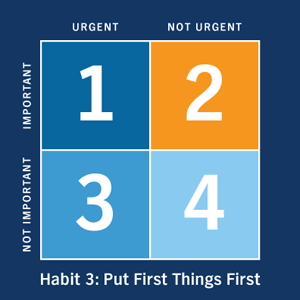
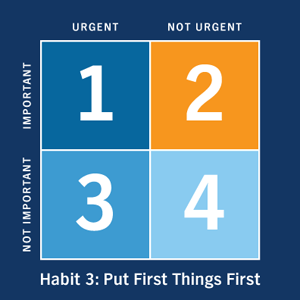
According to Covey, we can spend our time in four ways:
Habit 3 tells us to spend most of our time in Quadrant 2, to minimize our time spent in Quadrant 1 and to stay out of Quadrants 3 and 4 altogether. In doing so, we pursue our highest priorities—the relationships and results that matter. Our crises would then become more manageable because we’re proactively doing the things that prevent them from happening in the first place.
For me, “putting first things first” is not only a habit of effectiveness, but also an act of integrity to our commitments and purpose. By honoring both, we position ourselves to seize the right opportunities at the right time—ones that can enrich our lives and livelihoods in the New Year and beyond.
- Vera Quinn

“To Begin with the End in Mind means to start with a clear understanding of your destination. It means to know where you're going so that you better understand where you are now and so that the steps you take are always in the right direction.”

The second habit of effectiveness, “Begin with the End in Mind,” is a favorite of mine. Covey points out how easy it is to get caught up in climbing the ladder of success only to discover that it’s leaning against the wrong wall. Effectiveness doesn’t depend solely on how much effort we expend, but on whether we expend the effort on the right things—something I’ve tried to remember in my personal and professional life.
To be effective, we must first be self-aware and critically examine how we view others and ourselves. Then, we must imagine or visualize our life’s purpose, which must be centered on a core of unchanging, “correct” principles. Finally, we must bring it into physical being, guided by our conscience and values. Doing so successfully allows us to demonstrate personal leadership, which means we take control and responsibility for our own lives.
My involvement with charities is one example of how I’ve applied Habit 2. The core principles of family, community and philanthropy underpin a personal mission to help those who are less fortunate, to give back to the community and to inspire compassion in others.
According to Covey, developing just such a mission is one way to begin with the end in mind. It focuses us on what we want to be (character) and do (contributions and achievements) and on the principles that guide our being and doing. When we ensure every decision and action is congruent with that mission, we practice Habit 2 successfully and become more effective people—and leaders.
Jim Majeski
There are a lot of aspects to Habit 1, Be Proactive. The most important aspect to me is that “if there is a will, there is a way;” whatever I need to improve about myself, I can with discipline and humbleness.
Constant self-improvement has been vital for me to be successful in my business and personal life. I had to improve on a lot of things. Many of them were quite hard.
Initially, my biggest obstacle was my speech. I had a speech issue as a child and went to speech therapy until I was about thirteen years old. When I quit, the doctor was concerned that by quitting it would jeopardize my ability to get a job which required speaking.
If I let myself believe that limit on myself, I would have been too afraid to go for my business dreams. My mentality was that no one can put limits on me, but me. I was dedicated to improving my speech and building my confidence in conversing with people.
Everyone has things to improve about ourselves. Proactive mentality and action will do it.
Gary
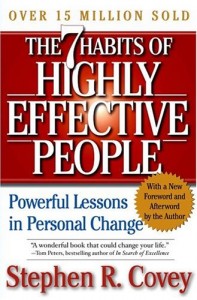
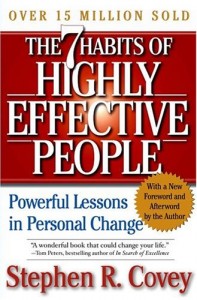
My copy of Stephen R. Covey’s The Seven Habits of Highly Effective People is signed by the author and constantly referenced. Most noticeable is that it is dog-eared, and well worn,—a sign not of neglect, but rather of its indispensability and enduring appeal over the years. I find its ideas as relevant and meaningful today, as when they were first introduced over 20 years ago.
One passage in particular always strikes a chord:
“…[I]f you want to have a happy marriage, be the kind of person who generates positive energy and sidesteps negative energy rather than empowering it. If you want to have a more pleasant, cooperative teenager, be a more understanding, empathic, consistent, loving parent. If you want to have more freedom, more latitude in your job, be a more responsible, a more helpful, a more contributing employee. If you want to be trusted, be trustworthy. If you want the secondary greatness of recognized talent, focus first on primary greatness of character.”
What resonates is the premise that we must look within to find the change we seek and to become our best selves. We must first earn self-mastery and develop great character—what Covey calls achieving the “private victories.” Only then, can we achieve the "public victories" of teamwork, cooperation, communication, social recognition and influence. And to sustain this success, we must internalize “Seven Habits” that embody fundamental principles at the foundation of true effectiveness, such as fairness, integrity, honesty, dignity, service, quality, potential and growth.
These “Seven Habits” express a simple yet compelling idea: To be effective, we must adopt a principle-centered, character-based approach. We must work from the “inside-out,” guided by the habits that correspond with each stage along the “Maturity Continuum.”
Habits 1 (Be Proactive), 2 (Begin with the End in Mind) and 3 (Put First Things First) make up the private victories that move us from dependence on circumstances and other people to greater independence, self-reliance and personal accountability. These first three habits help us build the character base from which we can progress to interdependence, the stage when we cooperate and work successfully with others to attain “public victories” that are greater than anything we could accomplish independently. All of the Habits are just that, habits and principles that we can incorporate in our daily lives through discipline.
Habit 7, “Sharpen the Saw,” makes all the other habits possible through self-renewal and continuous improvement. This habit focuses on balancing the doing with our ability and capacity to do, so we preserve and enhance our most valuable asset—us.
At whatever stage along the path to maturity we may be, the “Seven Habits” offer us a powerful framework to solve problems, maximize opportunities, enrich relationships and continually learn and grow. For over two decades, the “Seven Habits” have given us the tools to create the lives, livelihoods and relationships we most desire—effective, productive and purposeful.
Each of the Seven Habits will be the topic of our blog for the next several weeks. Focusing on these is in itself a good habit.
- Vera Quinn
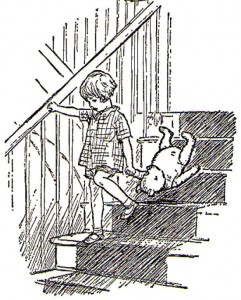
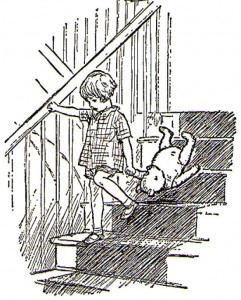
The book begins, “Here is Edward Bear, coming downstairs now, bump, bump, bump, on the back of his head, behind Christopher Robin. It is, as far as he knows, the only way of coming downstairs, but sometimes he feels that there really is a another way, if only he could stop bumping for a moment and think of it. And then he feels perhaps there isn’t.”
When I read this seventeen years ago to my daughter, I thought “I am Edward Bear.” I felt that I was not getting the business results that I wanted, yet I kept doing the same things over and over. I realized that I need to approach my work week differently.
This probably happens to most business people at some point. What do you do about it? One suggestion is to talk to a mentor or to key people on your team to get their perspective. Another suggestion is to spend more time on your weekly planning challenging yourself as to what is one or two things that you can do, besides the normal maintenance, that would get the business to a different level.
Does your head feel like Edward Bear’s?
Gary


Rescue efforts for the 33 men trapped in Chile’s San Jose Mine have come to a triumphant close with the recovery of the last miner, Luis Alberto Urzua, the 54-year-old foreman credited with helping the men survive 17 days before they were discovered. Their 69-day ordeal—the longest entrapment in human history—is finally over.
I marvel at how the world has united behind these brave men and the Chileans determined to save them. Live video from within the mine and hourly news feeds have brought us closer to them—and to our own humanity. As we’ve grown to care about these 33 strangers, their plight and dignity despite it compels us to imagine the unimaginable: How would we cope, cut off from light and our loved ones, possibly forever?
But, who among us can truly understand what these men have endured while entombed 2,050 feet underground? One thing, however, is certain. They’ve survived the unthinkable, demonstrating an indomitable spirit that 700,000 tons of rock failed to crush.
Quoted in The Guardian, rescued miner, Mario Antonio Sepulveda, explains: “I was with God, and I was with the devil; they fought me, but God won. He took me by my best hand … and I held on to him. I never thought for one minute that God wouldn't get me out of there. I believe that I had extraordinary luck. I believe this was a test ... and I believe that we have the possibility to confront things in life ... But I'm very happy that it happened to me because I believe it was the moment in which to make changes. The professionals who do all this publicity and television, the only personal thing I ask is for you not to treat us as celebrities or journalists. I want you to continue treating me like Mario Antonio Sepulveda, a worker, a miner.”
Free at last, Mario and his fellow miners have inspired us from the depths with their courage, fortitude and grace. Now safely home, they bring back these poignant lessons:
Just believe.
Our capacity for hope, faith and love can sustain us in our darkest hour.
Have purpose.
Working together toward a just and common end can move mountains—truly.
Never surrender.
Adversity can make us stronger by drawing out the best in us.
Be grateful.
We must cherish what and who really matters in our lives—always.
I was deeply moved when I heard the story about Victor Perez, a Fresno man who rescued an eight-year-old girl from the clutches of a kidnapper last week. After spotting a pickup that fit a description aired on the morning news, quick-thinking Victor gave persistent chase, eventually forced the suspect to stop and helped free the young victim.
We can learn from Victor’s decisive actions that fateful morning. An unemployed construction carpenter, Victor had seen hard times, laboring in the local grape fields to support his family. His own difficult circumstances, however, were no reflection of his integrity or character, nor did they deter him from rising to the occasion when the stakes were high. Despite the inherent dangers, Victor performed a selfless act of courage that saved a child’s life, reunited a family and inspired a community.
Why did he do it? He just wanted to do the right thing. "It feels good to know that at least in my part, we still do care out there,” Victor said in a recent Good Morning America interview. “We don't just close our doors and say forget about it. We actually go out there and see what we can do."
Victor’s story shows the human spirit at its finest, and this humble hero sets the example to which we should all aspire:


Sales is an extremely competitive industry with customer loyalty being the end goal. That's why it so important to treat each interaction with a current or potential customer as an investment in that relationship. Did you know that 87% of customer said they would stop doing business with a company after a negative experience? And of those 84% said they would share their negative experience with others. On the other hand, 58% said they would recommend you to others after a positive experience.
This is why it is so important to treat each interaction with a customer as an opportunity to create positive experiences and thus build customer loyalty. In doing so you create more opportunities not just for yourself, but for your team and company as well.
So what steps will you take this week to ensure you are building a better relationship with your customers?