
Found 0 posts

I recently spoke with someone who just opened his business but has lost his confidence. He feels that his people do not respect him because of mistakes he has made and because he no longer believes in himself. He asked me:
I, too, have experienced doubt and difficulty, as has every successful entrepreneur. All of us have had times in our careers when we have questioned our abilities and lost our confidence. These moments that test us, however, can strengthen our character and ability to lead, if we do not let them defeat us.
Experience has taught me the following lessons to weather adversity and emerge a more effective and inspiring leader:
When things are not going as well as we have planned, we should remember what Jack Welch said in his book, Winning: “Whatever you will accomplish is restricted by your ability to lead others.” We measure our success by the effectiveness of our leadership, which takes hard work and skillful practice of the fundamentals.
Exude the right energy; teams take their cue from you.
Your team feeds off your energy, so demonstrate confidence, enthusiasm, passion and vision in everything you do. Uphold clear standards and expectations while providing knowledge, coaching and guidance.
Build a strong relationship with your team.
Determine how well you are connecting with your team. Do people feel that you care about them and have their backs? Do they feel their lives are better by being on your team? Are they engaged and motivated?
Be tough and consistent.
At times, you need to be tough in a relationship. Firmly holding people accountable to a high but achievable standard drives them to succeed. Teams lose confidence in leaders who appear inconsistent and allow them to become stagnant.
Lead by example.
Your example and intensity sets the bar for the team. Your character, integrity and follow-through create trust and bind the team together.
When I entered the workforce, I sought experiences that would teach me vital skills for the future and build my confidence. Although many of my peers wanted to find jobs at companies that would carry them to retirement, I wanted to rely on myself and become a successful entrepreneur.
During the first ten years of my career, I focused on honing the skills that would make me a successful business owner. Ultimately, I learned that I needed to excel at two things: sales and relationships.
In the beginning stages of a business, the owner is usually the number-one sales person, as I was during the first five years of my commercial printing business and during all three years of my financial recruiting business. Successful entrepreneurs are savvy sales people who understand their customers’ needs and offer the most effective, compelling solutions to meet them.
Good sales people also have good people skills. Unless you want to be the only person in your business, you need to be able to work cooperatively with others and build strong relationships based on trust and respect. The more people you can successfully recruit, develop, manage and lead, the more you can accomplish and the more economic value you can generate.
The most important lesson I have learned in my career is this: Choose work experiences not for their prestige or short-term gain, but rather for their ability to equip you with the skills for success and the opportunities to practice them.
Do what you say you are going to do, when you say you will do it. Following through on your commitments demonstrates integrity, builds credibility and earns people’s trust. Follow-through is one of the building blocks of success.
Conversely, you cannot respect or count on those who do not meet their commitments. They are not the ones with whom we will have lasting relationships, nor are they the ones we think of first when there is opportunity. We should make sure that we follow through, so we can be the ones on whom people rely.
Consistent follow-through requires not only the right attitude, but also the right skills. Planning systems like FranklinCovey’s® can help you become more effective at organizing and managing important activities and events. Your focus and discipline, bolstered by such tools, can help you become adept at prioritizing and accomplishing the toughest tasks under the most challenging conditions.
There are times, however, when things may slip through the cracks. It happens to the best of us. Do not get discouraged. Just be accountable and go the extra mile not just to finish the task, but also to excel at it.
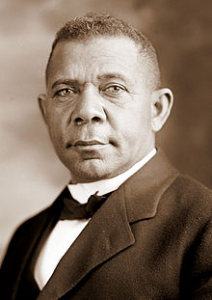
April 5 recently marked the birthday of Booker T. Washington, acclaimed African-American educator, author, political leader and civil rights pioneer. On this day, I’m reminded of his inspirational 1901 autobiography, Up From Slavery, in which he recounts his rise from early adversity to success later in life, driven by his commitment to a singular goal: getting an education.
Born into slavery in 1856, Washington spent his early years after the Emancipation in poverty working in the salt furnaces and coal mines. Determined to get an education, a 16-year old Washington arrived at the Hampton Normal and Agricultural Institute (now Hampton University) in 1872 with little more than the clothes on his back. The assistant principal was suspicious of his ragged appearance and asked him to sweep the recitation room as a condition of enrollment. Desiring to prove himself, Washington swept and dusted the room until it was spotless. The assistant principal was so impressed with the results that she admitted him to the Institute, where he worked his way through school and later became an instructor. He then moved on to greater distinction, culminating in his founding of the Tuskegee Institute (now Tuskegee University) in 1881.
Washington’s story demonstrates the importance of embracing every challenge, no matter how difficult, to achieve our goals. With ego in check, he kept his eye on the ultimate prize to excel at each task placed before him. He carried this attitude throughout his life and became the foremost black educator and leader, working with the era’s most powerful businessmen and politicians to advance the cause of education.
Many times we must endure hardship and perform humbling tasks, but we must remember that they may be short lived in the scheme of things. Booker T. Washington’s example reminds us to focus on the big picture in pursuit of our goals. In doing so, we adopt the determination and grace needed to fulfill our greatest dreams—and potential.
Gary
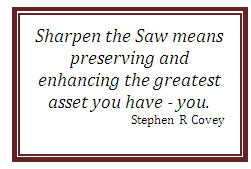

Spring is a season of renewal and growth—and with that season nearly upon us – now is a perfect setting in which to reflect on our progress during the first few months of the New Year: how we’re tracking on our personal and professional goals, commitments and development plans.
At this timely moment, we’ve reached Covey’s seventh habit of effectiveness, “Sharpen the Saw.” In the spirit of reflection, it seems fitting to consider this final habit in the context of all the others before it.
“Sharpen the Saw” is a Quadrant 2 activity (important but not urgent) requiring time, initiative and pro-activity. It makes all the other habits possible when we practice self-renewal and self-improvement in four areas.
The first three are closely related to Habits 1, 2 and 3—the principles of personal vision, leadership and management. The fourth focuses on Habits 4, 5 and 6—the principles of interpersonal leadership, empathy and creative cooperation:
Physical: Caring effectively for our physical bodies through exercise, nutrition and stress-management
Spiritual: Renewing our commitment to our core values through spiritual reading, study and meditation
Mental: Honing and expanding our minds and discipline through education, reading, visualization, planning and writing
Social/emotional: Strengthening our relationships through service, empathy, synergy and good character
Habit 7 teaches us how to maintain a balance among these dimensions so that we can reach higher levels of understanding and effectiveness in our lives and relationships. According to Covey, it's all about preserving and enhancing our most important asset—ourselves—so that we can do and be our best:
By centering our lives on correct principles and creating a balanced focus between doing and increasing our ability to do, we become empowered in the task of creating effective, useful, and peaceful lives...for ourselves, and for our posterity.
Exercising the 7 Habits on a path of continuous growth and renewal helps us become more principled, more purposeful and more productive in ways that make a positive impact not only in our lives, but also in the lives of those around us. It’s a powerful lesson and aspiration for all of us—one I hope you’ll embrace, as I do.
– Vera
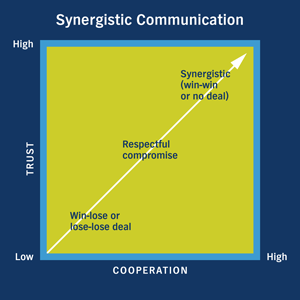
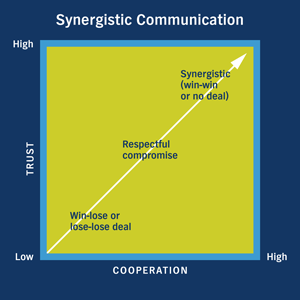
The term “synergy” is often the fodder for jokes, ridiculed as corporate jargon that’s overused and abused in offices everywhere. But I hope you’ll suspend cynicism for a moment and consider the word’s intended meaning, as described in Covey’s sixth habit, “Synergize”:
“Synergy works; it's a correct principle. It is the crowning achievement of all the previous habits. It is effectiveness in an interdependent reality—it is teamwork, team building, the development of unity and creativity with other human beings.”
Jargon aside, there’s nothing more thrilling than the feeling that comes with belonging to a team that’s totally in sync, whether in sports, at work or at home. Together, we’re stronger, better, more creative and more productive. We understand and value our individual differences, strengths and perspectives and use them to create something greater and richer. We solve problems cooperatively by focusing on common goals. At our best, we find a third “win-win” alternative—a better solution than we could have ever obtained on our own. And when we just can’t agree, we compromise out of mutual respect, rather than become angry, defensive, manipulative or vindictive—the surest way to lose. Finally, we can weather the ups and downs in our relationship, having built enough trust and good in our emotional bank accounts with one another.
If you think this all sounds naïve or too good to be true, I assure you it’s not. I’ve seen it. I’ve experienced it. It’s magical when it all clicks, and everything just flows—communication, ideas, insights and opportunities. You feel powerful and empowered—as if you could accomplish anything with the people to whom you’re emotionally and intellectually connected.
All the other habits have prepared us for the sixth habit of “synergy.” Habit 6 also teaches us that just as true effectiveness lies in our relationships—where creativity is the most potent—the power of the habits lies in their “synergistic” relationships to each other. We should use them together not only to expand our effectiveness, but also to open new possibilities in every aspect of our lives.
– Vera


Aaron Rodgers, the Super Bowl MVP, is an example of the tortoise beating the hare. Rodgers was not recruited by any Division I universities. He had to start his college career at an obscure junior college. Cal was recruiting a tight end at that junior college when they happened to notice Rodgers. They gave a scholarship to both players. But Rodgers was not the reason why they made the recruiting visit.
After a stellar career at Cal, experts predicted that Rodgers would be the first or second pick in the NFL draft. Excruciatingly and humiliatingly, he was snubbed and dropped all the way down to the 24th pick. For many of us who watched this on television, it was painful to see.
Rodgers was drafted by the Green Bay Packers and had to sit on the bench behind legend, Brett Favre. Other young quarterbacks were getting more playing time and accolades. Rodgers was patient, diligent and hard working. He finally got his chance when Favre was traded and a few years later, he is a Super Bowl champion.
He was not recruited out of high school, he was snubbed in the NFL draft, he had to wait patiently on the bench, but he finally got his chance and succeeded. It is not how fast you start, but where you end up. As Aesop fabled, “slow and steady wins the race.”
- Gary
How many of us have had days where we can’t quite see eye to eye with anyone? A fight with our spouse or kids. A confrontation with the boss or a coworker. A business deal gone sour.
In my experience, it often boils down to communication or rather, poor communication. We talk at or over each other. Or if we can’t get a word in edgewise, we bide our time to interject our opinions and tit-for-tat responses. Or in anger and frustration, we say or do things we later regret and can’t take back.
But who really wins here? No one. As Habit 4 points out, adversarial conflict without a mutually beneficial resolution can quickly become a “lose-lose” proposition and a sure way to fail.
To reach “win-win” solutions in our interpersonal relations, we should look to Covey’s fifth habit: “Seek first to understand, then to be understood.”
Habit 5 teaches us how to listen with the intent to understand, not to listen with the intent to reply. Effective listening is not simply echoing what the other person has said through the lens of our own experiences. Rather, it’s listening sincerely with our ears, eyes and heart. It’s listening with empathy to understand the other person emotionally and intellectually. Only then can we seek to be understood.
Covey uses the Greek philosophy of ethos, pathos and logos to describe the sequence for effective communication at the heart of Habit 5:
Following this sequence allows us to present our ideas clearly, specifically, visually and in the context of the other person’s perspective and concerns. And in doing so, we significantly increase not only the credibility of our ideas, but also their positive influence and impact.
– Jim
In business and in life, we talk a lot about winning in the context of competition or contests—of beating others to show we’re better at something. Winning means that someone else loses. It’s a “zero sum game.”
While a “win-lose” proposition has its time and place, I’ve found that most situations require a different approach. I recall something Coach John Wooden, a great man and influence in my life, once said: “Winning takes talent, to repeat takes character.”
Sure, winning can prove that we’re good or even the best at what we do. But to win in a meaningful and lasting way, we need to have character. For me, this means finding “win-win” opportunities that rely on cooperation and collaboration, rather than on competition and contests.
Covey’s fourth habit tells us just this—to “think win-win” by seeking mutual benefit from our interactions. While the first three habits are about mastering the “private victory” of independence, Habit 4 moves us into the realm of “public victories” or interdependence. It’s about developing effective interpersonal leadership, which is fundamental to all successful relationships.
Covey, like Coach Wooden, says that character is the foundation of winning. People and organizations with a “win-win” attitude have three key traits:
By practicing Habit 4, we can be true winners who work cooperatively with others to achieve mutual solutions, satisfaction and success. In situations where we can’t achieve a “win-win,” we must have the integrity, maturity and conviction—the character—to walk away agreeably without burning bridges. “Win-win” or no deals, rather than “win-lose” or “lose-lose” deals, are the best ways to be effective in our lives, work and most valued relationships.
– Gary
New Year‘s is a time to reflect on things we want (or need) to change, from getting fit or quitting smoking to getting a better job or spending more time with family. It’s a time to replace bad habits with good ones and to follow through on them.
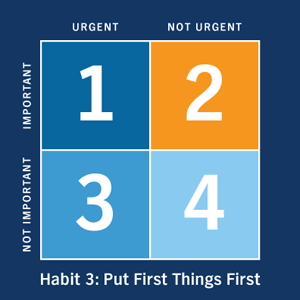
How many of us, however, have made our resolutions with the best of intentions, only to break them weeks or months later? Perhaps more urgent matters crop up that consume our energies, leaving us too exhausted for anything else. Or perhaps we get discouraged with our progress and lose our desire and resolve to carry on. Whenever I face just such a dilemma, I look to Covey’s third habit, “Put First Things First,” for perspective and guidance.
While Habit 2 is about self-leadership, Habit 3 is about self-management. Leadership defines the "first things,” and management is the discipline to carry them out in accordance with our core principles. “Putting first things first” means we have the will to do something when we don't want to; to say “no” to some things (even seemingly urgent things); and to act on our values, rather than on impulse. Simply, it means focusing our time on what’s truly important.
According to Covey, we can spend our time in four ways:
Habit 3 tells us to spend most of our time in Quadrant 2, to minimize our time spent in Quadrant 1 and to stay out of Quadrants 3 and 4 altogether. In doing so, we pursue our highest priorities—the relationships and results that matter. Our crises would then become more manageable because we’re proactively doing the things that prevent them from happening in the first place.
For me, “putting first things first” is not only a habit of effectiveness, but also an act of integrity to our commitments and purpose. By honoring both, we position ourselves to seize the right opportunities at the right time—ones that can enrich our lives and livelihoods in the New Year and beyond.
- Vera Quinn