
Found 0 posts

Great leaders aren’t defined by how well they speak—they’re defined by how well they listen. Listening builds trust, reduces conflict, and unlocks the real information you need to make better decisions. Yet most people only listen at a surface level: waiting for their turn, rehearsing responses, or half-multitasking while someone shares something important.
These three listening habits help leaders create clarity, strengthen relationships, and inspire people to follow them—not because they “command” influence, but because people feel heard.
Why it works
Most people communicate in layers. The first layer is the headline. The second layer is the context. The third layer—the real insight—comes out only if the leader shows patience and curiosity.
When leaders ask one thoughtful follow-up question, they often uncover the actual issue, motivation, or barrier.
How to do it
After someone finishes speaking, ask:
This unlocks clarity without interrogating the person. It simply signals: I’m here. Keep going.
Quick Win (today):
Pick one conversation and intentionally ask one “layer deeper” question. Write down what you learned that you would have otherwise missed.
Why it works
People rarely feel understood unless they hear their own message reflected back. Summarizing builds trust, reduces miscommunication, and creates alignment before decisions are made.
This is especially powerful in moments of tension, change, or uncertainty.
How to do it
Use this simple 10-second structure:
The final question—“Did I get that right?”—is where trust is built. It shows humility and openness rather than assumption.
Quick Win (today):
In your next meeting, summarize the final 30 seconds of what someone said. Watch how quickly alignment improves.
Why it works
Distraction is the enemy of leadership presence. People can immediately sense when your mind is elsewhere, and it breaks psychological safety. Full presence—eye contact, stillness, and undivided attention—tells others they matter.
Leaders who practice presence consistently see higher engagement, fewer misfires, and faster problem resolution.
How to do it
Before any conversation, silently ask yourself:
Then:
Presence costs nothing and changes everything.
Quick Win (today):
Choose one conversation and commit to giving full presence—no multitasking, no glancing at screens. Notice the difference in tone and quality.
Use this routine to sharpen your leadership presence:
Better listening isn’t about techniques—it’s about the leadership identity you build every day.
This article provides general leadership-development guidance. It does not constitute legal, employment, HR, or professional advice. Apply these concepts within your organization’s policies and applicable regulations. No outcome is guaranteed.

Leaders don’t earn followership with a title. People choose to follow leaders who make them better—clearer, braver, more capable. These four mindset shifts help you create that kind of pull, not push.
Old reflex: “Because I said so.”
New reflex: “Because this is the problem, these are the constraints, and that is success.”
When people understand the why, they act with more ownership and better judgment. Control caps capacity; clarity multiplies it.
Try this (5 minutes): Before your next assignment, answer three prompts in writing and share them with your team:
One‑liner you can use:
“Here’s the intent, here are the edges—inside the edges, you decide.”
Watch‑out: Clarity ≠ micromanaging the how. If you prescribe every step, you’ve given instructions, not intent.
Old reflex: Jump in with the solution.
New reflex: Ask better questions so your team builds the solution.
High‑performing teams don’t wait for the leader’s brain; they scale the leader’s thinking.
Coaching script (3 questions):
Try this (5 minutes): In your next 1:1, ask your direct report to bring three options. Commit to choosing among their options—not yours—unless there’s a safety or integrity risk.
Watch‑out: Coaching isn’t abdication. If stakes are high and time is low, be explicit: “Coaching mode” vs. “Call‑it mode.”
Old reflex: Wait for perfect, launch once.
New reflex: Learn in tight loops: decide → act → review → improve.
Teams trust leaders who let them ship and learn.
After‑Action Review (AAR) in 10 minutes):
Capture two improvements, schedule them, and move on. Perfection isn’t a deliverable—progress is.
Watch‑out: Don’t weaponize AARs. Keep them blameless and specific: focus on systems, signals, and skills—not on personalities.
Old reflex: “Follow me because I’m the boss.”
New reflex: “Follow me because I keep promises, share credit, and carry weight when it’s heavy.”
Credibility compounds when people see you…
Try this (5 minutes): End your weekly meeting with two commitments:
Watch‑out: Service ≠ saying yes to everything. Say no to protect priorities, then explain the tradeoff.
If you put clarity, coaching, cadence, and accountability into practice, people won’t just comply—they’ll choose to follow you.
Keep going: Explore how we develop leaders and entrepreneurs across our network—workshops, playbooks, and field‑tested cadences built for real‑world execution.

It’s summer now – and you can probably look outside right now and see nature at its fullest. What was just some buds a few short months ago, are now plants in their complete brilliance.
In our last two blogs we’ve been focused on growth: both for people starting a new career and for those looking to expand on their current role in the workplace. If you’ve been following along, you may be wondering what the final form of this growth looks like.
Those eager to advance their career will no doubt be called upon to be a leader. This is the end result of growth – when a person takes what they’ve learned from their journey and builds on it by empowering those around them.
So how do we grow into leadership? Let’s explore.
Be Humble
It all starts with humility. If you have the experience necessary to start taking the lead at work, it can be difficult to remain modest about all you have accomplished. Yes, it is important to take pride in the road that got you to where you are today, but it’s important to keep yourself grounded.
Remember, you’re just getting started – and there is so much more you have left to achieve!
Humility won’t just allow your team to relate to you better (and make you an easier person to be around), it will help you remain open to the innovative ideas and perspectives that every single person has to offer (more on that later).
Staying modest will also help you avoid complacency. There is always room for your own improvement and there is always something new to learn. In living this out, you will be setting an excellent example of constant growth that your team can be inspired by.
Take Accountability
Being a leader means that if a member of your team has a problem, you have one, too. The buck stops with you – and you have to take responsibility for the success or failure of your department.
This is one of the more difficult lessons to learn as a leader – as there are factors that will be outside of your control. But instead of pointing fingers when something goes pear shaped, taking accountability for what has happened will have a great impact on your ability to lead. When your team sees that you have their back, they will grow more motivated to move forward with better diligence.
This accountability ties into our next tip for growing your leadership skills: start using the word “we.”
Use The Word “We”
We is a powerful word. Imagine someone who has just completed a successful project. Their colleagues have had some input into the process, but it’s them who has put in the heavy lifting.
When presenting the results, they can either say “look what I’ve accomplished,” or “look what we’ve accomplished.” See the difference? If you were sitting in on the presentation, which line would make you more inclined to do further work with and for that person?
Leaders invite everyone into the process and are the first to give credit (even when they are shining a light on small-yet-impactful contributions). If you want to start being viewed as a leader in your workplace and beyond, start paying attention to and being quick to praise.
That starts when you adopt the word “we” into your vocabulary. Individuals speak for themselves, whereas leaders speak for their teams.
Teach Others
No matter what setting you find them in, leaders are teachers and coaches. They have risen to a high standard in their field – and are now tasked with fostering the same growth in the team around them.
Growth is not a zero-sum game. Be generous with what you know. Someone who rises to the top then pulls the ladder up behind them is no leader. Instead, think of where you started, what you had to learn, and the challenges you used to face, and think of ways that you can create the best environment for your team to thrive.
This environment is created with mentorship, knowledge, and
The best leader is one who doesn’t hide behind their own glory, but instead knows that the greatest honor is watching their team win. With the right mentorship, someone can even exceed the accomplishments of their teacher. This – for a leader – is something to be proud of and celebrate.
Keep Growing
There’s a old joke that goes something like this:
Two people go duck hunting. They bring along the second person’s hunting dog.
As the afternoon goes on, the first person says to the second:
“I don’t get it. Your dog used to be the best hunting dog there ever was. You could shoot a duck and he’d have it back to you before you could even blink. Today, he’s just sat around and barked. What happened?”
The second hunter replies:
“I changed his name to manager.”
Just because you’ve become a leader, that doesn’t mean that you don’t have room to still be growing. As you challenge your team to work hard, expand their horizons, and continue learning, you should be sure to be setting an example and putting what you preach into practice.

As a sales leader, motivation is your secret weapon to igniting your team’s passion and performance. Motivated sales teams are energized and engaged at work. They deliver results and take on challenges because they want to, not because they have to. Great leaders understand the power of motivation to spark enthusiasm, drive, and bold action within their teams, not just meet deadlines and targets. Being an effective leader means tapping into the internal motivators that inspire — and keep inspiring — high levels of employee engagement and performance.
So, how can you boost sales team motivation and sustain momentum?
The key is to understand what really motivates people in a meaningful and lasting way. According to the 2018 Gallup Employee Engagement Report, 34 percent of U.S. workers are engaged. This finding suggests that the traditional carrot-and-stick approach of rewards and punishment to motivate employees just isn’t working. It appears that high performing employees are driven by something deeper than just monetary rewards. In Drive: The Surprising Truth About What Motivates Us, author Daniel Pink draws on decades of scientific research to propose an upgraded model. He defines three elements of true motivation that drive success and employee satisfaction beyond external incentives like fame or fortune:
“(1) Autonomy — the desire to direct our own lives; (2) Mastery — the urge to make progress and get better at something that matters; and (3) Purpose — the yearning to do what we do in the service of something larger than ourselves.”
Applying these concepts, you can enhance sales team motivation with three easy strategies:
1. Autonomy: Empower your people to thrive on their own.
Giving employees a level of independence and the space to unleash their creativity and ambition is a great internal motivator. Equip your sales team with the tools, resources, and information needed to make decisions and solve problems on their own. Then let your people know that their path to success truly lies in their hands. They have the freedom to personalize their pitch, adjust their approach, and optimize solutions to reach and win more customers. They can decide what sales process works best for them, helping them close deals and meat sales quotas. The smarter and harder they work, the more they can make and advance their career — even becoming business owners someday. The sky’s the limit!
Employees also want a say in how they can contribute and add value. Rather than forcing them to fit into a narrow mold, listen to their ideas and understand what they find personally motivating. Let them play a part in shaping their role and offer opportunities to have influence and make an impact.
2. Mastery: Encourage your people to learn and grow — and make it fun!
Be a mentor and show your people that you’re invested in helping them achieve their career goals. Encourage team members to stretch and take risks that can accelerate their personal and professional growth. In sales, rejection is unavoidable, and some may become dejected or hold back due to the fear of failure. Find ways to turn these short-term setbacks into coaching opportunities. Help team members remain positive and not take a “no” personally, identify roadblocks and potential solutions, and think long-term beyond a single pitch. It’s easier to stay motivated through a sales rut and demonstrate resilience if people can learn from failure, improve, and make progress toward their sales goals and their personal goals.
To make learning fun, use gamification to add competitive elements and turn training and development activities into sport-like challenges. Let’s face it — salespeople like to win, so try these ideas to stoke their inner drive and improve employee engagement:
· Break up training into short modules or game levels that are progressively challenging.
· Create sales contests and offer rewards — badges, points, or power-ups — when they master a challenge and move up a level.
· Provide feedback during gameplay like timed quizzes to provide positive reinforcement or steer them in the right direction.
· Foster friendly competition through player rankings, leaderboards, progress bars, goal tracking statistics, milestone setting and tracking, and so on.
· Immerse participants in an entertaining story-like scenario to test them on skills they’ve learned.
3. Purpose: Ask each team member, “What is your why?”
There are many ways sales managers can motivate from the outside, but none are as powerful as helping team members discover their “why” — their internal motivation to pursue a goal regardless of the odds or obstacles. Employees who know their “why” gain deep satisfaction from doing meaningful work that brings them closer to achieving their dreams or making a difference in their own lives or the lives of those closest to them. Your role is to create a culture that focuses on the “why” and motivates your team to do work that matters, do it well, and keep doing it — even when things are tough. Team members who are internally motivated and focused on their personal goals are most likely to stay highly engaged, positioning them to become top performers.
By using these three strategies, you can boost sales team motivation to new heights, unleashing your people’s passion, purpose, and performance. The right internal motivators can yield profound benefits that last — higher employee engagement, more discretionary effort, greater productivity, better business outcomes, and employees feeling a deeper emotional commitment to their work and team.
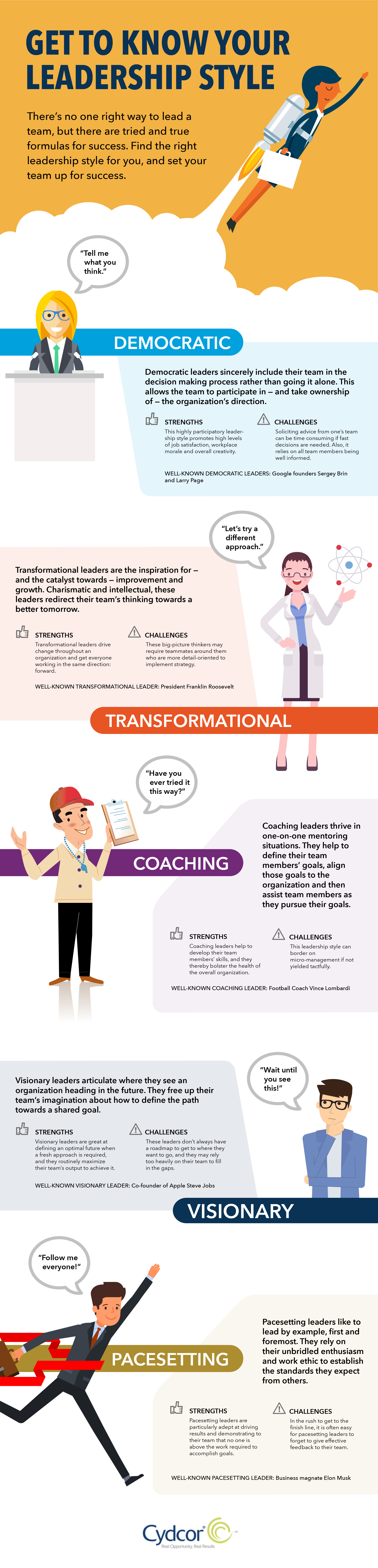
There’s no one right way to lead a team, but there are tried and true formulas for success. As you grow in your career, you’ll get more and more experience leading people. An understanding of different well-known and proven types of leadership can help you find the right path that resonates for you. Find the right leadership style for you, and set your team up for success.
Democratic Leadership Style
Democratic leaders strive to sincerely include their team in the decision making process rather than going it alone. This type of leadership allows the whole team to participate in―and take ownership of―the organization’s direction. This highly participatory style promotes high levels of job satisfaction, workplace morale and creativity. Everyone feels connected to the overall health and well-being of the organization. However, just like any leadership style, it does have its drawbacks. Soliciting advice from one’s team can be time consuming if decisions are needed quickly. Also, it relies on all team members being well informed. Democratic leaders need to strike a balance within their team of both decisive action and rich participation.
Transformational Leadership Style
Transformational leaders work with their team to implement improvement and growth. Charismatic and intellectual, these leaders redirect their team’s thinking towards a better tomorrow. The transformational leader solicits input from her team to identify what areas of the organization require change, creates the vision to guide that change, and then works with her team to execute the redirection. These big-picture thinkers may require teammates around them who are more detail-oriented to implement processes, and they need to develop strategies for soliciting their teammates’ assistance.
Coaching Leadership Style
Coaching leaders thrive in one-on-one mentoring situations. They help to define their team members’ goals, align those goals to the organization and then assist team members as they pursue their goals. The coaching style of leadership can be thought of as a sort of win-win relationship between the leader and her teammates. Coaching leaders help their team members to develop professionally, and they also thereby bolster the health of the overall organization. However, it can be easy to go overboard with this type of leadership and engage in behaviors that border on micromanagement. Coaching leaders need to yield their influence tactfully.
Visionary Leadership Style
Visionary leaders articulate where they see an organization heading in the future. They craft compelling―and often unheard-of―visions of what an organization can become. This style of leadership acts to inspire the team towards a shared goal. The internal drive they spark in their team members frees up creativity, and that freedom allows all the team members to delve into innovative strategies on how to get from Point A to Point B. However, visionary leaders need to keep in close contact with their team and stay involved in the team’s progression. Such an approach keeps everyone grounded as they strive towards the future.
Pacesetting Leadership Style
Pacesetting leaders like to lead by example, first and foremost. They rely on their unbridled enthusiasm and work ethic to establish the standards they expect from others. They are the roll-up-the-sleeves-and-get-dirty types. Pacesetting leaders are particularly adept at driving results, because they set the bar so high. They demonstrate to their team that no one is above the work required to accomplish goals. Pacesetting leaders should be cautious, however, and strive not to become single-minded. Narrowing one’s vision down to a single goal―or several―can mean that effective feedback and mentoring get neglected. Pacesetting leaders need to check in with their team members or a regular basis.
It is likely that you recognize one or more of these types of leadership in your own style. It’s rare that any one individual engenders just one leadership style. Explore which styles resonate with you. By cultivating a dynamic leadership style that encompasses a number of different approaches, you can find the right tools within yourself to tackle even the largest challenges.


No one likes conflict, but the good news is that the toughest conversations can also be the most fruitful. If you’re struggling to deliver negative feedback, there are lots of things you can do to minimize tension and achieve a positive result. Check out Cydcor’s tips for making your next difficult conversation go more smoothly.
Listen and Acknowledge
When emotions are running high, it helps to remind yourself to take a step back and just listen. Make an effort to hear the other person out. Resist the urge to interject. Show that you’re listening by maintaining eye contact, nodding and reflecting back what was said. You don’t have to be in agreement in order to make the other person feel like he or she has been heard.
Stay Focused on the Issue at Hand
Don’t make a difficult conversation even harder to navigate by bringing up unrelated grievances. Keep the focus of your discussion as narrow as possible, and avoid airing out other frustrations that come into your mind while you’re talking.
Make Sure Your Words Match your Intentions
Never go into a tough conversation without putting some serious thought into how you want the other person to feel -- and ultimately, what you’d like them to do. Assuming your intention is to influence new positive behavior rather than to cut ties, you’ll want to steer clear of any language that is discouraging, accusatory or hurtful. Be careful not to sabotage what you really want to accomplish by saying what feels good in the moment.
Watch Your Tone of Voice and Body Language
Remember, it’s not just what you say, it’s how you say it. Set the stage for a constructive conversation by keeping your tone of voice positive and your body language neutral. Avoid speaking too loudly, sounding irritated, sighing out loud, rolling your eyes or crossing your arms.
Don’t Exaggerate
This is where it helps to be prepared! Make your next difficult conversation go more smoothly by citing specific facts and instances, rather than making generalizations or referring to vague circumstances in the past. Avoid embellishing or using words like “always” or “never,” which are bound to trigger a defensive response.
Keep an Open Mind
This one’s tough. As human beings, we’re not generally good at realizing we’re wrong. But do the best you can to consider the merits of the other person’s point of view. Perhaps there are circumstances you didn’t know about or facts that weren’t clear before. You never know, maybe you’ll see things differently by the end of the conversation.
Focus on What’s Next
Once you’ve addressed where you’d like to see change, shift the focus of the conversation to the future. Put on your problem-solving hat and delve into a constructive conversation about how both parties will behave moving forward, and ideally, how you can work together to achieve a positive outcome.
Do you have your own tips for tackling tough conversations? We’d love to hear! Share them with Cydcor on social media.

Leadership is a popular topic in business, which means leadership myths abound. After all, a company cannot survive for very long without strong, consistent, visionary leadership providing direction to the team. Good leaders affect everything from big-picture growth to the daily details of operations. So, what constitutes good leadership? You may be surprised to learn that conventional thinking has shifted in the office environment. The following outmoded leadership mantras are counterproductive to building an effective, cohesive team. Being aware of these team-leading myths—and correcting them—can have considerable impact on your bottom line over time. How many of these leadership myths are still accepted as fact at your company?
Leadership Myth #1: A Leader Directs
While this statement is true to a certain degree, it’s just the tip of the iceberg. This team-leading myth evokes the distant, hands-off approach that is increasingly seen as out of touch by the workforce of today. To define effective, well-rounded leadership, the sentence should read: A leader directs by encouraging active communication and engaging employees in coming up with solutions.
Leadership Myth #2: Strong Leaders Must Always Be Right
Being able to admit when you’re wrong shows those around you that you are not unreasonably rigid and are able to adjust your views when new information becomes available. Mistakes are part of the journey, and good leaders grow into great leaders by acknowledging mistakes and improving because of them. Infallibility is not a quality that defines effective leadership.
Leadership Myth #3: Winning Leaders Motivate Through Fear
Using intimidation as a means for obtaining results is one of the fastest ways to lose the engagement of your staff. While you may have their full attention while you’re wildly gesticulating, issuing ultimatums, or otherwise creating emotional mayhem in the office, what you’re really doing is undermining your own authority by losing your employees’ respect. Instead, lead by example, with empathy.
Leadership Myth #4: Natural Leaders Command Attention
This leadership myth presupposes that leaders must be in the spotlight—getting or seeking attention—to operate effectively. In fact, effective leadership recognizes that the spotlight is best and most valuable when shared. Attention should naturally shift to various members of a well-balanced team as circumstances dictate to give each team member their moment to shine and have a unique impact on results.
Leadership Myth #5: True Leaders Are Extroverts
This fallacy incorrectly assumes that only extroverts can be natural leaders. Some of the top names in tech, such as Bill Gates, Marissa Mayer, and Elon Musk (admitted introverts all), shoot that team-leading myth right out of orbit.
Leadership Myth #6: Legitimate Leaders Have a Certain Position or Job Title
Leadership is an attitude, not a specific position. Employees at any level within an organization can demonstrate leadership, and their efforts to provide guidance to their teams should be valued. The best, most effective companies help employees hone and grow those skills to turn budding leaders into the results-driving executives of tomorrow.
Want to be a more effective leader? Start by rejecting false assumptions about the true meaning of leadership. Everyone wins when leaders encourage, challenge, and acknowledge their team in the effort to motivate them to be the best they can be. Effective leaders seek balance, learning from and admitting their mistakes. They work hard while also delegating wisely, and they lead by example. So, what are you waiting for? The most important trait of an effective leader is the willingness to step up and try.

By Dwight Coates, Chief Information Officer | Cydcor
Building a department’s strategy, holding meetings, and orchestrating the delivery of technology to our business are not the only ways people can build leadership skills. In fact, one of the most effective ways for team members to learn critical leadership skills is by helping others. There is a myriad of benefits to volunteering. Volunteering takes team members out of their everyday routines and out of the office environment. It shakes up typical work groups, team structure, and processes and it challenges team members to think differently, look to each other for input and guidance, and unite behind a shared purpose. While volunteering, team members aren’t focused on getting ahead; they are focused on completing tasks, overcoming obstacles, and accomplishing goals—which is exactly why community service projects are such powerful teaching experiences.
1.Volunteers Connect with the Whys of Life: While serving others or working on behalf of the environment, volunteering can remind team members of their own values and help them reflect on the things that are most important to them. This process helps build more empathetic future leaders, and encourages team members to engage their hearts, not just their minds, in their work. It also helps team members see the bigger picture, to realize that thier work can have an impact far beyond any single project.
2. Enables Networking: Volunteering can have an equalizing effect, mixing high-level executives with employees fresh out of college. These volunteer activities give employees the opportunity to break out of their typical work circles and meet people from whom they may be able to learn valuable leadership skills or who may be able to offer support to help them grow their careers. While volunteering, team members often form lasting friendships and partnerships.
3. Teaches the Importance of Having a Vision: When teams volunteer, they unite behind a shared vision and commit, as a team, to shared goals. Because the stakes are often so high, it is easy to create alignment within the team, and team members can see how that level of alignment can pay off in the form of rapid results. When people band together behind ideas and trust in a single vision, it is astounding how much they can accomplish, and this experience can translate back to how a team works together on behalf of company goals as well.
4.Volunteer Work Energizes: When employees are stressed, doing work that benefits others, the community, or the planet releases endorphins and lifts spirits better than any sports game or team wine night. Volunteering reinvigorates overworked employees, reignites their passion for their work, repairs bonds between team members, and makes them more efficient and productive by challenging them to solve new kinds of problems and follow different processes.
5.Trains Great Mentors: As volunteers, team members benefit by offering guidance and support to each other in different ways than they might as part of their everyday role.Volunteer work gives team members a voice who may not always have one, and allows them to step up and show leadership skills and benefits they can offer the team that may not be as easy to recognize while at the office.
6.Exposes Employees to Other Cultures and Other Ways of Working: While volunteering, teams may have to follow new systems or processes than they do as part of their daily work, and this helps to challenge their thinking and adaptability. Team members are sometimes also asked to work with people who come from different countries, cultures, and backgrounds, and this helps team members learn new skills and improve their abilities to bridge communication gaps and relate to others regardless of differences.
7. Fosters Collaboration: Volunteering encourages partnerships between those who may not normally work together. While participating in philanthropy projects with my teams, I often intentionally assign employees to tasks that force them to work alongside team members they’re not used to working with to help bridge those communication gaps and force employees to break through barriers to find solutions together.
Besides the leadership skills volunteering imparts, spending time helping others can change the way team members feel about their work. Employees want to work for organizations that stand for something, and showing a dedication to service may help to improve employees’ outlook on the company as a whole, which may support team member retention. An additional benefit of volunteering includes strengthened bonds between team members, helping them to function better as a team and produce better results. Community service and philanthropy, beyond their clear benefit to the community, are invaluable team member development experiences that no department head should overlook as you strive to help your people be their best.

Dwight Coates, Chief Information Officer, Cydcor
Dwight Coates is the technology driver for Cydcor’s customer relationship management solutions. With more than two decades of leadership experience, Dwight has had the opportunity to see, first-hand the impact community service activities can have on IT and other professional teams as they work together to achieve outstanding results.

Helping employees perform at their best is exciting, but it isn’t always easy. Well-meaning mangers can sometimes counteract their own efforts by approaching employee coaching the wrong way. Giving feedback constructively can be invaluable to employees' career growth and can help them develop critical skills they will carry with them as they ascend toward roles of greater responsibility. Through thoughtful coaching—and by avoiding the leadership pitfalls below—you can help set up your employees for long-term success.
Mistake #1: Not Giving Feedback at All
It’s human nature to want to be nice and avoid rocking the boat. Few of us relish conflict, but giving feedback directly is critical for your employees to be able to improve themselves. They need your help recognizing where they have fallen short, as well as their areas of success, in order to grow and reach their potential. Without that information, they are likely to continue along the same path.
Mistake #2: Letting it Pile Up
Because providing constructive criticism is uncomfortable, some managers wait until there is a laundry list of issues that need to be corrected before they set up meetings to coach employees. This is unfair to the employee, because he or she may have no idea that they were doing anything wrong, and now they face a long and overwhelming list of errors they must correct. Delays in giving feedback set up employees for failure. Instead, check in frequently with your employees to let them know how they are performing and how they are pacing against the objectives for their role.
Mistake #3: Not Setting Clear Expectations
Employees should not have to be mind readers when it comes to what is expected of them. Coaching employees effectively includes working with them to clearly define what success looks like for their role. Having well-defined goals and expectations gives the employee the opportunity to plan ahead and maintain control of their own progress. With increased clarity comes faster, better results.
Mistake #4: Giving Vague Feedback
When offering your employees constructive criticism, make sure to always be specific and offer examples. If you tell your employee, “I really need you to learn to write better,” it will be very hard for the employee to correct or improve the behavior—what exactly does “better” mean? Instead, say something like, "Before you turn in reports, please make sure to proofread for spelling and punctuation errors. Your last report had several errors, which could have been avoided with a little more time and attention paid to accuracy.” Giving feedback of this kind lets the employee know exactly what you are referring to and what they can do to improve.
Mistake #5: Doing All the Talking
Mentoring and coaching employees should be a two-way process. Employees should be given the opportunity to explain themselves, ask questions, and provide ideas. By speaking with, rather than at, employees, leaders gain perspective and allow employees the opportunity to clarify feedback and solutions necessary to correct their performance missteps.
Mistake #6: Prescribing Solutions
You’ve been around the block, and you probably have great ideas to help your employee improve his or her performance. At the same time, no one solution is right for everyone. While your ideas will certainly be helpful, they should be offered as suggestions rather than directives. Allowing employees to devise their own plans of action also helps them learn to be more self-sufficient going forward, and enlisting their help encourages them to look at problems from a different angle.
When employee coaching is done in a positive and collaborative way, managers find that employees become eager for feedback rather than fearful of it. Great coaching empowers employees by providing clear paths to success and opportunities to build on their strengths.

For many, the idea of speaking in public is daunting. While a little nervous energy is healthy, excessive public speaking anxiety can be crippling. Being charismatic and engaging doesn’t necessarily come naturally, even to successful business people and world leaders. Whether it’s a keynote speech for hundreds of people or a simple team meeting, it takes a lot of effort to be a great speaker, starting with controlling your nerves.
Learn how to manage your nerves and boost your confidence so you can confidently conquer public speaking.
1. Get into the Zone
Focusing mentally before a public speaking event will allow you to give your best quality output. Make sure you’re comfortable with the venue by arriving a little early to get a feel for the set up. If possible, do a brief run through with the microphone. Whether it’s a small breakaway room or even the parking lot, find a quiet place where you won’t be disturbed and take a moment to focus. Different people need different things, so you’ll need to learn what works best for you.
2. Warm Up
Public speaking can feel like a workout. Get yourself physically ready by doing some vocal exercises, which will help you project your voice and come across more confident in your delivery. Now, strike a power pose. Amy Cuddy, a body language researcher at Harvard Business School, suggests power posing to ease nerves before a presentation or public speaking engagement. According to Cuddy’s research, simply putting your hands on your hips or striking the CEO or Superman pose for two minutes will reduce your levels of cortisol, the stress hormone. This will give you a boost and make you look and feel powerful.
3. Work on Your Body Language
Public speaking isn’t just about what you’re saying, it’s also about how you’re saying it. The way you convey yourself—your body language, your facial expressions, and even your gestures—can affect the impact of your delivery. It’s important to be mindful of these nonverbal cues. Simple things like keeping your posture upright and expanding your chest helps. Smiling and making eye contact will put your audience at ease even if you’re speaking about a more serious topic.
You can read more body language dos and don’ts in our blog, 8 Common Professional Body Language Mistakes to Avoid.
4. Memorize Your Content
Memorizing the sequence of your slides or your note cards—whatever you’re using to prepare or presenting visually—will help you to feel in control and allow you to anticipate which slide comes next, making you look more professional. Start by memorizing key points and you’ll slowly begin to weave a story line. It will also reduce the likelihood of you getting off track should you feel overcome with your public speaking anxiety.
5. Tell a Story
The more data-driven your content, the harder it is to keep your audience engaged. Telling a story with your content is a good way to connect with your audience. It will help them understand where the concept comes from and what it means. The key is making sure you have a thread that links the different ideas and concepts throughout your presentation.
Structure your material so you start and end strong. Don’t waste time with a longwinded introduction, especially if you have a time limit. You may even consider starting with a personal anecdote or provocative question—something that will make the audience feel they can relate to and connect with you.
6. Rehearse
The best way to boost your confidence is to rehearse, rehearse, rehearse. This will also help you memorize the material. Ideally, rehearse in front of someone. If that’s not possible, you can use a mirror. Always time yourself while rehearsing to ensure you don’t exceed the time you’ve been allocated. If your presentation includes a question-and-answer session, you can prepare some model questions and answers ahead of time to help ease your public speaking anxiety.
7. Pace Yourself
Be mindful not to lose your audience. There’s a fine line between speaking too fast and too slow. Speaking too fast can make you come across as nervous. You can manage the pace of your public speaking by including pauses before or after key statements. This will make them stand out and have the added benefit of giving you a breather.
8. Stay Hydrated
Drinking warm drinks before your engagement will soothe your throat. Nerves can make your mouth go dry, so keep a bottle of water nearby to keep hydrated.
Like most things in life, practice makes perfect when it comes to combating public speaking anxiety. The best way to build your confidence is to take up every opportunity you can to speak, no matter how small the audience. The more experience you have, the more confident you’ll be and the better you’ll become at managing your nerves.

Looking to save a bit of money in the year ahead? As a business owner, the more money you save, the more of your money you can put back into your business. But where do you start? Finding ways to save money on a tight budget can be challenging when you’re already living a pretty frugal lifestyle, but you might be surprised how quickly small changes can add up to big savings by the end of the year.
Here are 10 easy ways to save money on a tight budget and make an extra $5,000 or more every year:
Even a small step can lead to big changes and, in this case, even bigger savings. Many of these money saving ideas are easy to implement, and they could provide benefits that go well beyond the money you’ll save, such as financial freedom for you and your family. Most importantly, living within your means can reduce the additional stress you have to manage as you work to keep your growing business healthy. Every cent you save is just one more penny you can use to help your company reach its goals.


Written by Nia Bowers
Some leaders arrive at the top of a company. Vera Quinn built her way there.
She got her start over 25 years ago as a door-to-door sales representative within the outsourced sales industry. What followed was an impressive ascent in business leadership when she joined Cydcor (a leader in the outsourced sales arena): VP of Operations, Senior VP of Sales Operations, Chief Operating Officer, President, and finally CEO in 2020.
Founded in 1994 and headquartered in Agoura Hills, California, Cydcor is a trusted provider of outsourced customer acquisition solutions. Through its network of independently owned and operated sales companies, Cydcor offers Fortune 500 and emerging brands a blend of personal connection and technology that has kept clients coming back year after year.
When Quinn took over as CEO, the world was six weeks into a pandemic that had effectively outlawed the face-to-face sales model Cydcor’s business was built on. Many companies in that position played defense. Quinn led Cydcor’s corporate team to develop and launch touchless selling technologies, equipping the network of independent sales companies with entirely new strategies for customer acquisition and enabling the business to evolve and thrive.
It wasn't a pivot born of desperation. It was the kind of move that only happens when a leader knows the machinery well enough to rebuild it under pressure.
Since becoming CEO, Quinn has led Cydcor through consistent revenue growth, expansion into new industry verticals, and recognition on the Inc. 5000 list of America’s fastest-growing private companies. In 2025, Cydcor posted double-digit revenue growth for the fourth consecutive year, continued to serve long-standing clients, and saw its network scale their own businesses and develop new entrepreneurs.
Quinn talks about culture the way most executives talk about strategy as the thing everything else depends on.
"If you want great results, you have to invest in the people around you," she says. "It’s about giving them the tools, the clarity, and the belief that they can achieve more than they thought possible."
That belief isn’t decorative. At Cydcor, it operates as a management principle, one that runs through how the corporate team functions, how Cydcor approaches its relationship with the network of independently owned and operated sales companies that carry out field execution, and how it maintains the client relationships that have, in many cases, lasted decades.
"Clients stay with us because we’re consistent and because we do what we say we’ll do," Quinn explains. "They trust the integrity of our team and the strength of our network."
Cydcor has earned the DIRECTV Dealer of the Year Revolution Award for nine consecutive years. That kind of sustained recognition is less about any single campaign and more about what happens when accountability is baked into how a company operates at every level.
Under Quinn’s leadership, Cydcor has also been named a Best Place to Work in Los Angeles 13 times, a reflection of a corporate culture that doesn’t treat growth and team investment as competing priorities.
The accolades of the past few years read less like a peak and more like a confirmation of something that's been compounding for a long time.
Quinn was honored by Comerica and the Los Angeles Lakers with their Women of Business Award, named CEO of the Year by the Los Angeles Business Journal Valley Women's Leadership Awards, and was an honoree of the LA Times Studios Inspirational Women Forum & Leadership Awards - recognized for her focus on driving sustained business growth and building a high-performance, opportunity-based culture.
The Valley Women's Leadership Symposium spotlights influential leaders across the San Fernando Valley and greater Los Angeles who are driving innovation, cultivating inclusive workplaces, and shaping the future of business. Quinn's inclusion wasn't a lifetime achievement moment, it was a recognition of something actively in motion.
Quinn also serves as Executive Director of Liberty Children’s Home in Belize extending the same investment-in-people philosophy that defines her leadership at Cydcor into work that has nothing to do with revenue targets. Through Cydcor and its network, the company’s relationship with Operation Smile has helped fund nearly 4,000 smile-restoration surgeries for children, with over $1,000,000 raised.
It's a pattern worth noting: the leaders who build durable companies tend to be the ones who aren't only building companies.
Quinn has spent more than two decades learning within the industry and leading through a period that would have broken a less prepared successor. The numbers reflect it. So does the culture. And so, increasingly, does the industry recognition that keeps finding her, not because she's chasing it, but because the results keep demanding it.
Vera Quinn is the President and CEO of Cydcor, a leader in outsourced sales headquartered in Agoura Hills, California. Learn more at cydcor.com.