
Discover practical advice, inspiration, and insights to help you succeed in business and grow both personally and professionally.
Found 0 posts


Being an entrepreneur takes passion, persistence and perseverance to weather the highs and lows of starting and growing a successful business. The journey can grueling but rewarding if you have the will and stamina to go the distance. When you feel like you’ve hit a wall, dig deep to stay motivated and keep putting one foot in front of the other until you reach your goal.
Need a mental boost? Whether you’re a seasoned pro or an aspiring business owner, check out these inspirational quotes for entrepreneurs to refuel your inner reserves and kick your performance up a notch.
– Vera Quinn, President, Cydcor
Your success lies entirely in your hands. The world’s most accomplished people have the capacity to thrive despite setbacks and attain ambitious goals. Understand what it takes to achieve the success you desire and put in real effort to earn it. Every decision you make and action you take can get you to where you want to be. The only person who can determine how far you go, is you.
– Walt Disney, founder Disney
Successful entrepreneurs don’t wait around for opportunities; they seek and seize them. They possess a confident and driven mindset, act decisively, and fearlessly take on challenges that may keep others from even trying. Thinking and acting like an entrepreneur can help you do better, aim higher, and go further on the path to success.Resilience, the mental toughness and emotional strength to recover quickly from adversity, is a trait of exceptional achievers. So, worry less about doing things the safe way and focus more on finding your own way to break new ground. CLICK TO TWEET
– Richard Branson, founder Virgin Group
Entrepreneurs understand that falling flat on your face and getting right back up is the secret to success. People afraid of failing may rely on rules and tried-and-true methods in the search for a surefire recipe for success. But anyone who has won big knows that there’s no reward without risk. Resilience, the mental toughness and emotional strength to recover quickly from adversity, is a trait of exceptional achievers. So, worry less about doing things the safe way and focus more on finding your own way to break new ground.
– Adam Osborne, innovator of the first portable computer
Every great discovery, invention, or achievement has countless failed experiments behind it. Making big, bold bets that could fall short and are vital to succeeding in business at every level. If you embrace them, hardships and mistakes along the way can make you stronger and smarter — and your success that much sweeter.
– Reid Hoffman, co-founder LinkedIn
If you want to be successful, surround yourself with successful people. We tend to mirror the energy, attitude and demeanor of those around us. Watch and learn from people who set a positive tone and demonstrate the mindset for success through confidence, mental fortitude, emotional maturity, and perseverance when things get tough.Whatever distractions and difficulties come your way, remember why you get up every morning and focus on what truly matters. The payoff is worth it. CLICK TO TWEET
– Bo Bennett, founder eBookit.com
Success isn’t just how much you earn or what title you hold, but also how much you’ve learned, grown, and moved closer to fulfilling your “why” — that unshakeable inner purpose that motivates and drives you. Whatever distractions and difficulties come your way, remember why you get up every morning and focus on what truly matters. The payoff is worth it.
– Gary Polson, CEO, Cydcor
Doing the right thing is a sign of character and the foundation of any success worth having. Character means not compromising your integrity to win at all costs. It means keeping your word and delivering what you promise. It also means telling the truth, rather than embellishing facts or withholding information, and taking responsibility for mistakes. Finally, it means caring about people and lending a hand when they need help. With character, you’ll gain respect, trust, and influence that can win friends and fans for life.
If you need a spark of motivation, just remember these inspiring entrepreneur quotes on what it takes to succeed — empathy for others, decisive action, resilience, courage to fail, a mindset for success, inner purpose, and strong character.

At the heart of Cydcor’s culture is the tenet of “people helping people.” Cydcor stands behind this idea by fostering a work environment that promotes both personal and corporate philanthropy and by offering team members a paid volunteer day each year to serve a cause that matters to them. Our service mindset is grounded in the concept of servant leadership, which focuses on empowering and developing our people, building a better company, and giving back to the community.
One example of how we’ve put this mindset into practice is Cydcor’s Philanthropy Club, founded by team members to provide employees with corporate philanthropy and volunteering opportunities throughout the year. Here are just some of the ways Cydcor’s Philanthropy Club has made a meaningful impact on the community in 2019:
March: Pizza Sale — Liberty Children’s Home
Liberty Children’s Home is a sanctuary in Belize that offers a safe, loving environment to more than 40 abused, abandoned, and neglected children — some with special needs or suffering from HIV or AIDS. At a Leaders Meeting in March, team members sold Costco pizza with all proceeds donated to Liberty to support learning, activities, medical care, facility improvements, and basic needs like electricity, clothes, and food.
April: Crayfish Removal
Team members partnered with Mountains Restoration Trust to help preserve and protect the streams and creeks of the Malibu Creek Watershed by removing invasive, non-native crayfish. Harmful to the ecosystem of the Santa Monica Mountains, crayfish prey on native species, reduce water quality, and worsen creek bed erosion. Prior to our arrival, scientists set more than 100 traps along a stream bed in Oak Park. Cydcor volunteers removed crayfish caught in these traps and cleaned up trash along the banks. Additionally, they measured the size of caught crayfish to help record and collect data.
May: Special Olympics Regional Spring Games
Special Olympics of Southern California provides year-round sports training and athletic competition in a variety of Olympic-type sports for children and adults with intellectual disabilities. Philanthropy Club participants volunteered at the Ventura County Special Olympics Spring Games held at Oaks Christian Highschool, featuring swimming and flag football competitions. Responsibilities included coaching, time keeping, score keeping, and cheering in the stands to show Cydcor spirit and support for local athletes.
June: Heal the Bay
For 35 years, Heal the Bay has been mobilizing communities across Los Angeles to protect the California coastline, restore waterways, and advocate smart water policies. Cydcor volunteers gave time at a monthly Heal the Bay event to pick up trash along a Santa Monica beach. After a full morning of cleanup, the team enjoyed a group lunch in Venice, a popular beachfront community.
July: Learn Earn Return
Learn Earn Return is a nonprofit organization focused on providing students and teachers with the necessary school supplies for a successful school year. Team members collected and donated items that might otherwise have been a heavy financial burden to students and their families, such as backpacks, composition notebooks, wide-ruled paper, glut sticks, scissors, rulers, and more.
September: Operation Blankets of Love
The Philanthropy Club held a volunteer event for Operation Blankets of Love, a leading animal welfare and emergency relief nonprofit organization that provides food and critical supplies for more than 12,000 animals a year in shelters, in rescue groups, and with pet owners experiencing homelessness or another hardship. Cydcor volunteers collected blankets, towels, toys, and other badly needed pet supplies donated during the event.
September: Pet Adoptions
Team members partnered with L.I.F.E. Animal Rescue, a nonprofit organization that rescues homeless or abandoned dogs and cats and places them in permanent, responsible, and loving homes. Cydcor volunteers supported L.I.F.E.’s weekly animal adoption event at a local PetSmart to help pets find their forever home.
October: Alzheimer’s 5K
Team members joined their local Walk to End Alzheimer’s® 5K, an Alzheimer Association event held annually in more than 600 communities nationwide to raise awareness and funds for Alzheimer’s care, support, and research. Participants walking in the Westlake Village, California 5K surpassed their goal of $500 by raising $1,788. Cydcor matched donations of $500.
November: EARTHS Thanksgiving Food Drive
Cydcor volunteers supported the annual Thanksgiving Food Drive of the Environmental Academy of Research Technology and Earth Sciences (EARTHS) Magnet School in Newbury Park, California. Individual and department donations provided holiday favorites, canned food staples, and grocery gift cards to help 100 local families in need enjoy a Thanksgiving meal.
The contributions of Cydcor’s Philanthropy Club show the positive difference that employee-driven corporate philanthropy and volunteering can make on our schools, neighborhoods, and charities. Through community service, our team members embody Cydcor’s culture of “people helping people” by uniting behind a shared purpose, collaborating to overcome challenges and accomplish goals, and serving causes that matter.
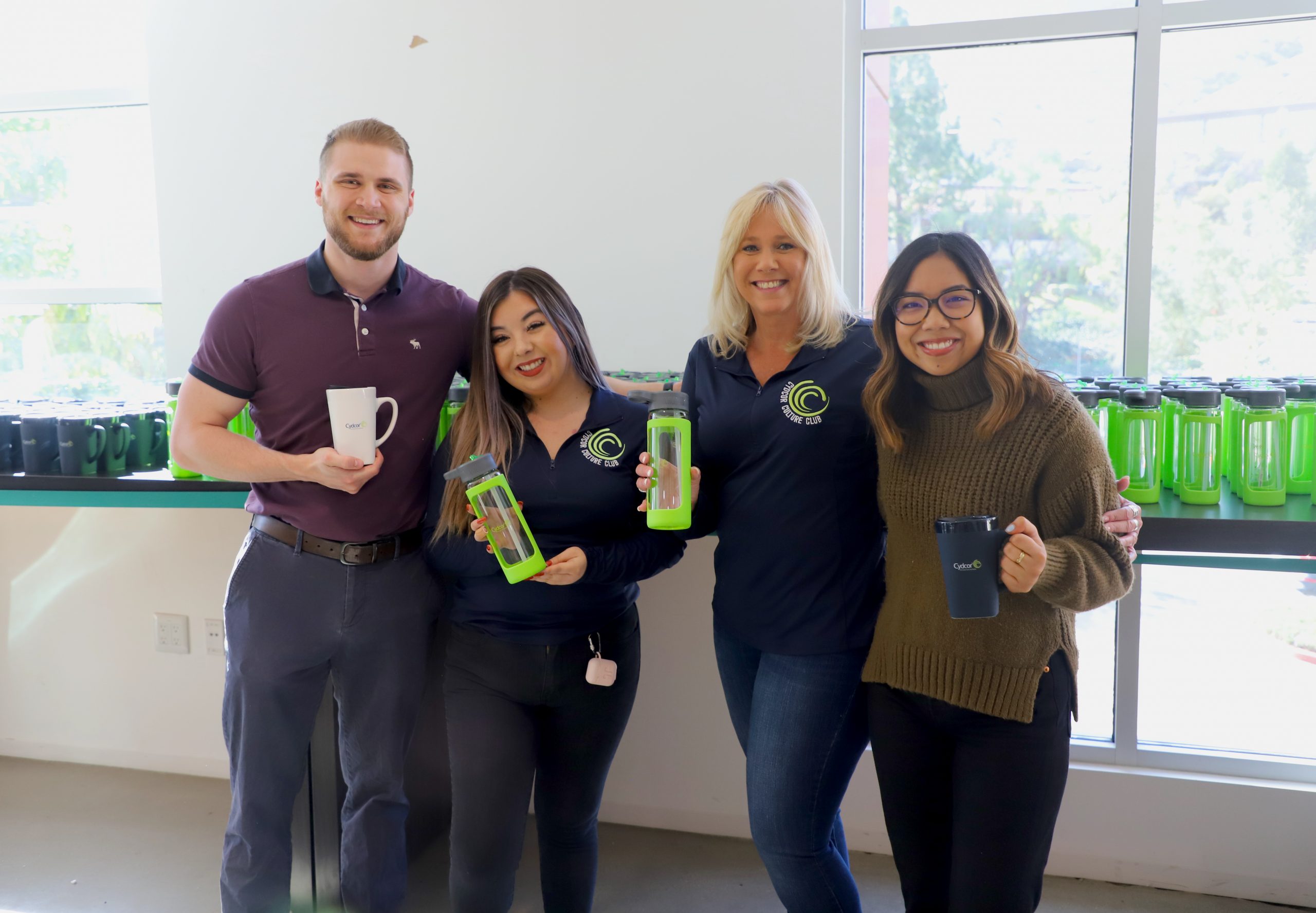
Cydcor is taking steps to reduce its impact on the environment. In keeping with one of Cydcor’s core values “to do what’s right, not what’s easy”, the company has made a commitment to adopting greener practices to reduce the amount of daily waste its team members produce.
Team members gave up individual desk trash cans, turning instead to new centralized receptacles with sorted options for paper, plastics and aluminum, composting, and traditional waste. The new receptacles help team members be more thoughtful about how much they consume and increase recycling.
Gone also are all disposable coffee pods, paper cups and lids, and disposable plastic water bottles. Cydcor replaced them by gifting team members with more environmentally friendly reusable ceramic coffee mugs and glass water bottles.
Cydcor kicked off its new initiative with a green ribbon cutting ceremony to unveil new beverage machines to replace all single use machines. With these moves, Cydcor seeks to reduce what it estimates as 4.4 pounds of waste per person per day. Multiplied by Cydcor’s approximately 200 team members, that’s 880 pounds of waste per day. By implementing a recycling and waste reduction program, Cydcor believes it can reduce that number to 264 pounds, a 70% decrease!
Cydcor’s leadership fully backed the adoption of greener practices, and the company sees these as some exciting first steps toward reducing Cydcor’s carbon footprint and doing more to protect the Earth. Cydcor continues to look for new opportunities to become even more environmentally friendly and the company plans to make additional moves toward sustainability in the future.

Sales is a critical part of your marketing mix, and the goal has always been to grow your fledgling sales pilot into a fully optimized arm of your business. Things look like they’re going well, and you’re anxious to take your sales growth to the next level. But, where do you begin? What are the steps to successfully grow your sales operation, and how do you know if and when it’s even the right time to scale? Check out Cydcor’s guide on how to scale your sales program below to ensure your sales pilot can grow along with your long term business goals.
Reduce Ramp Up Time So You Can Start Earning:
Scaling any sales program, be it face-to-face, digital, or telesales, can be a slow and tedious process, especially if it isn’t well-planned. Instead of addressing issues as they arise, make sure to have all your ducks in a row with thorough strategic planning and testing. This upfront work can save you a lot of time and heartache on the backend and ensure your new program can become profitable as soon as possible.
Define your implementation plan, accounting for getting any needed software systems and equipment in place and running well prior to launch, hiring and training staff, and testing for glitches.
Create a good launch timeline that’s realistic, noting specific benchmarks you’ll need to hit before moving to the next stage. Trust, but verify things are on target by revisiting and adjusting this timeline as needed to ensure you’re on pace.
Document all your current processes so they can easily be repeated by new teams. Make sure your sales pitches and scripts are solid, well-tested, and formatted for distribution as part of training materials for new sales managers and sales reps. Create a roadmap for training new sales people or account executives so that the process can be easily repeated. Meet frequently with all teams to ensure everyone is on the same page.
Make Certain You’ve Got the Right Tools:
As your company builds and perfects its inside sales or outside sales programs, software and hardware needs will most likely begin to reveal themselves along the way. Sales organizations should be sure to document these needs as they go. You can also partner with an experienced sales service provider like Cydcor, whose experts can recommend software, data analysis tools, and equipment, as well as help your organization test, build, and scale a custom sales strategy and program to meet your needs.
As you’re mulling over software and hardware options, be sure to invest in systems that has the flexibility to grow as your program grows so you will not need to shift platforms to accommodate your expanding business requirements.
Be Sure It’s the Right Time to Scale:
It’s easy for fast-growing organizations to get so caught up in the momentum that their leadership forgets to consider whether they’re ready and prepared to scale up. Before your company starts investing in scaling its inside sales programs, the marketing team and sales leaders should examine whether certain KPIs are there to suggest that scaling will be successful and a deliver ROI.
Is your sales program profitable? If it is not, or if it is not hitting a reasonable target, such as a certain number of transactions or new customers acquired per week, it may be a better choice to keep the program small until results have been proven and are likely to be sustainable.
If your sales teams are selling on behalf of a third party, do you have the client’s commitment to scale? Ensure your growth plans are in line with your clients needs, expectations, and willingness to invest in new growth.
Hire the Right Team:
Before you scale up, you’ll want to feel confident you have the best possible team in place as a well as a plan to maintain the quality of service and high level of performance you expect. To put together a great team, you’ll need to implement a hiring process that sets clear expectations of the job task and ensures team members fully understand what they are being hired to do.
Hire based on personality. Sales skills can be taught, but you’ll need to find people who can work well with each other and the customer and who have the desire to perform and succeed. Finally, compensate your team fairly but appropriately, and make certain to set clear career path expectations for team members and make sure they understand what success looks like.
An effective sales program can play a critical role in your customer acquisition and revenue growth efforts, but scaling your sales program is a complex process, and it must be done right in order to ensure success. Careful planning, research, acquiring the right tools, and an effective people management approach can help bring your organization closer to achieving its goals. But juggling all these essential components can be extremely challenging. That’s why many organizations look to experts in building and growing successful sales programs like Cydcor. Find out how Cydcor can create and scale a customized outside sales program designed specifically to achieve your organizations customer acquisition and revenue goals.

Find out how Cydcor created an exclusive, reward trip attendees would never forget. By setting an exceptionally high performance-bar for those who would earn a spot, Cydcor’s Chairman’s Club event provided the ultimate reason for sales managers to deliver next-level results. Learn how Cydcor’s events team pulled out all the stops to create a dream getaway worthy of the exceptional work and immense effort put forth by those invited.

First impressions matter.
In sales, a positive first impression can determine whether a customer decides to buy from you or a competitor. A negative one can cost you both money and the opportunity to establish a relationship with a new customer. The key to making a good impression and building rapport in sales is by applying the SEE factors — Smile, Eye Contact, and Enthusiasm. Non-verbal cues through facial expressions and body language can make the difference between success and failure — even before you say a single word.
First impressions are fast, but they last.
Countless studies, surveys, and experts vary in their claims on how long it takes to form an impression of someone — from 27 seconds to seven seconds to even as little as one-tenth of a second. Further research from an international team of psychologists shows that a first impression persists, even if a new experience contradicts it. People view the contradictory experience as a one-off occurrence tied to a specific context — a perception that’s difficult to change. The takeaway is that you won’t have a second chance to make a great first impression, so make every second — or millisecond — count.
Here are five tips for making a good impression and why they’re important:
1. Perfect your handshake.
A handshake is more than an initial greeting. It’s often the first connection with the customer and can set the tone for the rest of the sales conversation or meeting.
A good handshake should be:
2. Smile.
A smile is contagious. It communicates warmth and approachability, instantly putting the other person at ease and in a better mood. A genuine, inviting smile can improve your likeability and get the other person to respond more positively to you. When smiling, make eye contact to transmit openness, trustworthiness, and interest in what they have to say. People love doing business with those they like and trust. It's human nature.
3. Be confident.
Research shows that people who are confident appear more competent, credible, and trustworthy. They exude confidence through their expertise, attitude, presence, and demeanor. So, when meeting people, do your research and be prepared with relevant talking points and smart questions. Be calm and self-assured, not cocky or arrogant. Be articulate and speak deliberately and clearly. Stand in an open, relaxed posture with your chin up, back straight, and arms at your side. Finally, dress to impress because when you look sharp, you feel sharp. Being confident makes people comfortable around you and more receptive to what you have to say.
4. Be thoughtful.
Thoughtfulness is grounded in empathy, so tune into the other person, listen more, and say less. When someone speaks, show genuine interest and understanding by summarizing what you’ve heard and asking follow-up questions. Choose your words carefully and speak with honesty and sincerity. Read the room and modulate your tone and approach appropriately. Thoughtfulness creates an emotional connection that elevates the conversation and builds rapport and trust with the customer.
5. Be energetic.
Positive energy and enthusiasm are infectious. When you’re fired up, it shows you care and passionately believe in your product, service, and company. It engages and motivates the customer and gets them excited too. Just make sure you don’t get carried away. Nothing is more off-putting than over-the-top energy and enthusiasm that feels fake and insincere.
By following these five simple tips, you’re making a good first impression that’s a lasting good impression. You’ll connect with the customer, start building rapport, and improve your odds for success in any sales interaction.

Everything old is new again – at least when it comes to marketing strategy. While you might think of door-to-door sales as a thing of the past, it’s actually a highly effective method for acquiring new customers in today’s modern climate. Many thriving corporations are seeing the benefits of adding door-to-door selling to their marketing mix, and here’s why:
Advertisements are easily tuned out.
Commercials are everywhere these days. From billboards and TV commercials, to social media and mobile advertising, we're flooded with so many advertising messages that it’s easy for all of it to blend together into one ocean of noise that easily fades into the background.
This is why door-to-door sales should be part of your marketing strategy. Unlike any other advertising medium, in-person sales reps create real connections with potential customers. They communicate from one human to another, customizing their sales pitch and even their body language and tone in a way that even the most sophisticated digital advertising and artificial intelligence can’t. Well-trained salespeople are able make the potential buyer feel comfortable, attracting their interest and initiating a discussion, which is the first and most important step of acquiring new customers.
The competition is fierce.
With so many companies vying for consumers’ attention, it’s extraordinarily difficult to stand out. Even the most creative billboards and eye-catching social media strategies are bound to get lost in the mix.
Door-to-door marketing is a secret weapon for any company looking to carve out space in a crowded market. Not only is it a less common approach to customer acquisition, but it is highly effective at reaching people who have been unresponsive to other forms of customer outreach. Actively engaging face-to-face provides the opportunity to first, inform customers about products they might not have otherwise known about; and second, influence their decision-making process.
People buy from people.
As much as technology has changed over the years, human nature has not. There is no digital replacement for connecting face-to-face, human-to-human. A commercial can’t ask a business owner to describe the challenges facing his business. An internet ad can’t inquire about the needs of a growing family, make eye contact, or interpret facial expressions. But a skilled salesperson can.
Through door-to-door sales, companies are able to localize their marketing efforts and connect with customers on a personal level. By engaging one-on-one, salespeople are able to learn about the needs, wants, and concerns of their customers throughout the sales process. By building rapport, they are able to establish trust, which in turn translates not only to the consumer’s decision to buy – but to remain loyal to the respective brand.
It’s highly adaptable.
The launch of a new product or service is expensive and time-consuming through most marketing channels. Whether you’re paying for market research, air time, graphic design, public relations, or anything in between, the expenses add up quickly.
This is another key differentiator of door-to-door marketing. Not only is it more cost-effective, but it’s dramatically faster to implement changes and market new products. When you already have an outside sales team in place, launching a new product is as simple as educating the salespeople about your new offering. The right door-to-door sales team should be able to start selling immediately and at no added cost to your company.
Success is 100% measurable.
The tricky part about most forms of marketing is that the success or failure of a campaign is often a gray area. While a given ad might enhance brand recognition or contribute to the buzz about a new product, results are difficult to quantify.
Unlike advertising campaigns, there is no doubt as to whether a door-to-door sales strategy has been successful. The number of new customers acquired is crystal clear, allowing companies to track progress, calculate ROI, and make changes accordingly.
There is a reason one of the oldest professions, face-to-face sales has seen a resurgence over the past decade: it works! No matter how advanced digital marketing becomes, people will always prefer to buy from people. It’s human nature. While the smartest sales strategy is diversify your sale and marketing tactics, including a door-to-door element to your marketing mix remains a highly effective way to increase revenue and drive consistent sales results.

As a sales leader, motivation is your secret weapon to igniting your team’s passion and performance. Motivated sales teams are energized and engaged at work. They deliver results and take on challenges because they want to, not because they have to. Great leaders understand the power of motivation to spark enthusiasm, drive, and bold action within their teams, not just meet deadlines and targets. Being an effective leader means tapping into the internal motivators that inspire — and keep inspiring — high levels of employee engagement and performance.
So, how can you boost sales team motivation and sustain momentum?
The key is to understand what really motivates people in a meaningful and lasting way. According to the 2018 Gallup Employee Engagement Report, 34 percent of U.S. workers are engaged. This finding suggests that the traditional carrot-and-stick approach of rewards and punishment to motivate employees just isn’t working. It appears that high performing employees are driven by something deeper than just monetary rewards. In Drive: The Surprising Truth About What Motivates Us, author Daniel Pink draws on decades of scientific research to propose an upgraded model. He defines three elements of true motivation that drive success and employee satisfaction beyond external incentives like fame or fortune:
“(1) Autonomy — the desire to direct our own lives; (2) Mastery — the urge to make progress and get better at something that matters; and (3) Purpose — the yearning to do what we do in the service of something larger than ourselves.”
Applying these concepts, you can enhance sales team motivation with three easy strategies:
1. Autonomy: Empower your people to thrive on their own.
Giving employees a level of independence and the space to unleash their creativity and ambition is a great internal motivator. Equip your sales team with the tools, resources, and information needed to make decisions and solve problems on their own. Then let your people know that their path to success truly lies in their hands. They have the freedom to personalize their pitch, adjust their approach, and optimize solutions to reach and win more customers. They can decide what sales process works best for them, helping them close deals and meat sales quotas. The smarter and harder they work, the more they can make and advance their career — even becoming business owners someday. The sky’s the limit!
Employees also want a say in how they can contribute and add value. Rather than forcing them to fit into a narrow mold, listen to their ideas and understand what they find personally motivating. Let them play a part in shaping their role and offer opportunities to have influence and make an impact.
2. Mastery: Encourage your people to learn and grow — and make it fun!
Be a mentor and show your people that you’re invested in helping them achieve their career goals. Encourage team members to stretch and take risks that can accelerate their personal and professional growth. In sales, rejection is unavoidable, and some may become dejected or hold back due to the fear of failure. Find ways to turn these short-term setbacks into coaching opportunities. Help team members remain positive and not take a “no” personally, identify roadblocks and potential solutions, and think long-term beyond a single pitch. It’s easier to stay motivated through a sales rut and demonstrate resilience if people can learn from failure, improve, and make progress toward their sales goals and their personal goals.
To make learning fun, use gamification to add competitive elements and turn training and development activities into sport-like challenges. Let’s face it — salespeople like to win, so try these ideas to stoke their inner drive and improve employee engagement:
· Break up training into short modules or game levels that are progressively challenging.
· Create sales contests and offer rewards — badges, points, or power-ups — when they master a challenge and move up a level.
· Provide feedback during gameplay like timed quizzes to provide positive reinforcement or steer them in the right direction.
· Foster friendly competition through player rankings, leaderboards, progress bars, goal tracking statistics, milestone setting and tracking, and so on.
· Immerse participants in an entertaining story-like scenario to test them on skills they’ve learned.
3. Purpose: Ask each team member, “What is your why?”
There are many ways sales managers can motivate from the outside, but none are as powerful as helping team members discover their “why” — their internal motivation to pursue a goal regardless of the odds or obstacles. Employees who know their “why” gain deep satisfaction from doing meaningful work that brings them closer to achieving their dreams or making a difference in their own lives or the lives of those closest to them. Your role is to create a culture that focuses on the “why” and motivates your team to do work that matters, do it well, and keep doing it — even when things are tough. Team members who are internally motivated and focused on their personal goals are most likely to stay highly engaged, positioning them to become top performers.
By using these three strategies, you can boost sales team motivation to new heights, unleashing your people’s passion, purpose, and performance. The right internal motivators can yield profound benefits that last — higher employee engagement, more discretionary effort, greater productivity, better business outcomes, and employees feeling a deeper emotional commitment to their work and team.

The holiday season is a perfect time to reflect on what really matters and strengthen bonds with not only family and friends, but also the people with whom you work closely every day. In the spirit of people helping people, why not celebrate the season by giving back to your community and building camaraderie on your team? Forgoing the office holiday party or secret Santa gift exchange to spend the time helping others instead, is a great way to bring your team together, promote problem solving, and foster team bonding. Nothing is more energizing and motivating than uniting behind a worthy cause, collaborating on solutions, and making a positive difference — together.
Here are five rewarding holiday team building activities to help your team give back, get closer, and have fun!
1. Celebrate the holidays with seniors.
According to the Institute for Family Studies, more than 60 percent of seniors in nursing homes don’t have visitors and experience loneliness that can intensify during the holidays. Bring a sense of family and friendship to seniors who may be alone this season by volunteering at a local nursing home or hosting a holiday event for residents. Many senior care facilities also organize and plan activities for the holidays, inviting families, volunteers and the community to share food, fun and festivities.
2. Bring cheer to hospitalized kids with heartfelt holiday cards.
Many children battling serious illnesses remain in hospital care for a long time, making this time of year especially difficult for these young patients and their families. For an inspiring team building activity, plan and organize holiday card and care package donations for your local children’s hospital, or send handmade cards with an uplifting message of hope to brighten their rooms and their spirits while they recover. Set up a design station in the company break room where team members can create and decorate their customized holiday greetings.
3. Give a gift to a child in need.
Spread holiday joy to children in vulnerable communities through the gift of a new toy. The Marine Toys for Tots Foundation is one of the best-known charities that has been collecting and distributing toys to America’s disadvantaged children since 1947. Instead of a holiday party, build a holiday themed team building activity around a Toys for Tots event at your office, become a toy drop-off site, or volunteer at a local warehouse. Connect with your local Toys for Tots program or another organization in your community to donate holiday gifts to children in need. Don’t forget to think about the larger, world-wide community as well. Consider running a toy drive event for one of the thousands of shelters or orphanages supporting children in need around the globe.
4. Volunteer together for a local cause.
Use a service like VolunteerMatch to find great ideas for local organizations and causes your team can support as part of your next holiday team building activity. Whether you volunteer at a local food bank to serve holiday meals, donate time and goods to a homeless shelter, or support an organization like Baby2Baby to provide basic necessities to children living in poverty — giving back as a team creates opportunities to bond with each other and make a real impact on your community.
5. Lend a hand to a local animal shelter.
Don’t forget to show our furry friends some love during the holidays. Give back to a local animal shelter or a service like Pets of the Homeless by hosting a donation drive to collect much-needed pet food and supplies. To take your support to the next level, partner with a shelter or rescue organization to organize a local pet adoption event in your community. Your team can also spend time volunteering together at a local shelter to help orphan pets find their forever home this holiday season.
Whether you stage a food drive, volunteer with the local fire department, help rebuild a local small business after a disaster or participate in any of other community activities on this list, working together for a greater purpose is at the heart of building a strong corporate culture. Finding meaningful ways to give back during the holidays promotes team building by boosting engagement, fostering collaboration and rallying people around a common cause. It also brings our culture and values to life by demonstrating our dedication to serving others and making a positive difference in the communities where we live and work.

With the right combination of work ethic, people skills, and self-discipline, working on commission is an extremely rewarding way to earn a living and build a successful career. Sales teams that work on a sales compensation plan earn more when the company sells more, making these pay structures a win win for both sales professionals and their employers. There are many types of sales commissions, but taking a job that offers commission either on top of or instead of a base salary can pay off for motivated employees looking to maximize their earning potential.
Let’s take a look at six benefits of commission work.
You control what you earn.
One of the best things about commission based work is that you can make as much money as you want. If you’ve ever had an hourly or salaried position, you know how frustrating it can be to have to wait for a raise in order to see a bigger paycheck. When you earn sales commission, however, you get to determine this yourself. This is especially great when you’ve got your heart set on a big purchase: in addition to saving up over time, you can increase your income and speed up the process.
It’s the best preparation for running your own business.
Have you ever realized that business owners are technically working on 100% commission? If their companies aren’t making money, they aren’t either. There is no better practice for an aspiring entrepreneur than a job that pays commission rather than a fixed salary. Whether working as a sales rep, a real estate agent, or earning another type of commission based pay, working on commission will teach you self-reliance, a no excuses mentality, organization, money management, and resilience -- all of which are essential for survival when you’re running your own show.
You aren’t micromanaged.
Another huge perk of being paid on commission is having a high degree of autonomy, which means that your boss isn’t looking over your shoulder all day. This is great for people who enjoy making their own decisions or who prefer working independently. With most commission jobs, it’s up to you to determine exactly how to structure your day to maximize success.
You can’t become stagnant.
When you’re picking up an automatic weekly paycheck, it’s easy to take your foot off the gas from time to time, especially if you know a co-worker is getting away with doing less work for the same pay. Jobs with a commission structure force you to stay on your toes, which is great for your professional growth. When you’re always on your A-game, career success is inevitable.
Your effort is rewarded.
As much as delayed gratification is crucial for long-term success, we all love a good immediate reward. One of the perks of commission work is the direct relationship between working hard and seeing results. Doing that little bit extra -- visiting that one additional customer, asking that one extra question, putting in that extra hour -- has the potential to pay off, literally. Each individual sale matters, and typically when the employee works harder the employee earns more too.
It’s fun.
There’s something to be said for ‘the thrill of the hunt’. Successful salespeople will even tell you that there’s something addicting about it. Nothing feels better than working hard, earning a sale, and seeing a happy customer. Since no two days are exactly alike, working on commission is always an exciting adventure.
If you’ve never earned sales commission before, the idea might sound intimidating. But, as anyone who has tried it for themselves will tell you, if you possess a student mentality, a strong work ethic, and an internal drive to succeed, you’ll find that the rewards of a sales commission plan are plentiful.

Having a well-chosen, fully trained, sales team with the right attitude is essential if your organization is trying to increase sales. The sales team is the last line of defense. After all the investment your company has made toward developing, testing, and perfecting the product, branding, and promotional campaigns, it is the sales team who will ultimately make or break efforts to increase sales because they are the ones who will have direct contact with the customers. At Cydcor, a leader in outsourced sales, we’ve had more than 25 years’ experience building and growing great sales teams fully prepared to increase sales and achieve clients’ revenue growth goals.
Be Selective
Take the time to hire the right people. Be sure everyone on the team has clear expectations of what’s expected of them, simple goals, and ambitious but achievable targets – both for the team as a whole and for each individual salesperson. It’s okay (even great!) to have high standards, just make sure both sides are clear on those standards, nobody likes that kind of surprise.
Don’t be a stranger. Building a sales team positioned to increase sales is not a set it and forget it process. Hiring well is just the first step. Get to know your people. Talk to them. See them as individuals who bring their own individual strengths to the overall team. This will allow you to use them most effectively.
Get Everyone Trained Up to Speed
Once you have the right team in place, it’s important that they’re well trained and up-to-date on all sales strategies. Keep it simple, train your team only on what’s necessary to improve sales without added fluff, twists or turns. Since turnover is inevitable, make sure you have frequent trainings that are easily repeatable.
Also, remember that not everyone learns the same way. Some people learn better through presentations, others through reading materials. Some people have no problem just learning things conceptually and can then repeat them, but others may need to take a more hands-on approach with training. Have the most successful reps train the others and pay attention to make sure they’re getting it. You may even ask your team how they prefer to be taught. By involving them in the process you will get more buy in and participation.
Keep the Team Motivated
A team that’s eager to succeed is a must if you want to optimize your sales program. By keeping goals simple, clear and refreshed, you can always make sure your sales team knows what’s expected of them. Talk about goals daily. Reward and recognize those who increase sales and meet goals frequently. Healthy competition is good, but a collaborative environment where people are willing to help each other serves everyone, and that comes if everyone feels like their hard work is being rewarded.
Much like with training, different individual sales people will respond to different things. Everyone has their own carrot. Some are looking for recognition and respect, a star on the wall with their name on it. For others, bonuses and financial incentives may be the way for them to meet their full potential. Again, ask your team their preference. Get them involved in the process!
Ensure They’ve Got the Right Stuff
You’ll want to be sure to review your strategies to increase sales with the team to make sure all essential steps and needed communications are present in the sales process. Does the customer understand the product and service? Do they understand when they will receive the product or service? Will they need to do any follow-up? Don’t walk out the door until all of the customer’s questions are answered or, at least, until there’s a plan in place to get them answered.
Make sure your sales teams have the right tools, they need to be efficient. Making sure they have the right product information including pricing, a snapshot of the product or service benefits, pricing, and offer information is essential to help them improve sales and succeed.
There’s no one way to improve sales, but these strategies to build and maintain a great sales team should set you up for success. Hire the right people, train them well and keep them motivated, learn your customer and your product backwards and forward, and you should be well on your way to increase sales and achieve your business goals.