
Found 0 posts
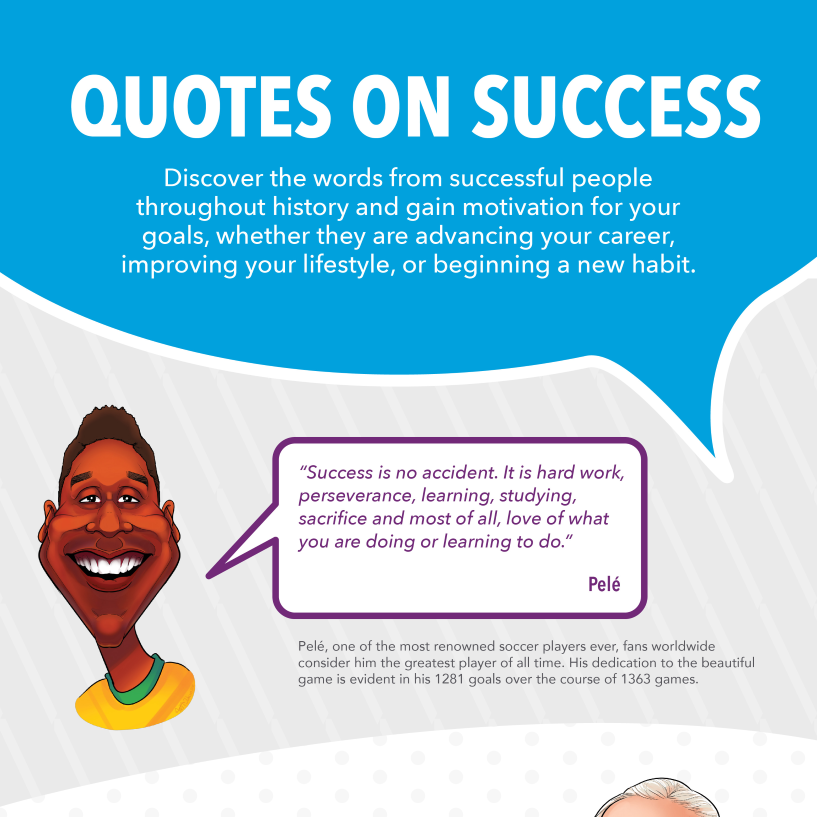
It can be easy to look at the life of Bill Gates or Oprah Winfrey or Thomas Edison – geniuses in business, media and technology— and think their success was innate, something they were born with and were always destined to have. This isn’t true. The fact is, every person who’s ever built something or accomplished anything in their life started somewhere, and often it was at the bottom. Famous quotes about success from people who have found it themselves may seem like platitudes, but often they’re the keenest insights we have into how their success was achieved.
Inspirational quotes on success have likely been decorating the walls of your classrooms and offices your entire life, but to dismiss them would be a mistake. They can change the way you see the pitfalls in your own life, the failures and false-starts, and reveal them for what they are: opportunities to grow, to start again — smarter and stronger this time, determined to achieve where you never have before.
The way you think about your own life and career, the challenges and opportunities it brings, will determine what you can accomplish. If you don’t believe success is possible for you, then it won’t be. It’s that simple. These 11 famous quotes about success represent just a small sample of all the wisdom that is out there from those who have come before you, but they can serve as motivation to achieve something of what they did. Consider each of them carefully and find something to take from them.

While you’re at it, consider what your own personal quotes on success might sound like. Because one day, someone may be reading them too.

What would have happened if Walt Disney gave up animation after being fired from one of his first jobs? What if J.K. Rowling let depression keep her from picking up a pen? What if Steven Spielberg let self-doubt stop him from making Jaws? While we’ve all heard the expression “overnight success,” but stories of instant fame and wealth are the exception, not the rule. More often than not, the most successful celebrities and entrepreneurs in the world endured at least one, if not a string, of setbacks, failures, and blows to their egos before hitting it big. Remarkably, they all kept at it, and went from failure to fame, achieving success beyond anyone’s expectations, even their own. Had they let those temporary roadblocks hold them back, however, they might have allowed those failures to define them. Most of us will fail at some point in our lives, and we’ll probably do it more than once. But, letting the occasional defeat stop you from pursuing your passion could mean denying yourself the opportunity to achieve more than you ever dreamed possible. Each of these, now famous, celebrities started out just like you.

It’s hard to imagine now that he’s one of the richest and most powerful entrepreneurs in the world, but those who met Gates right after his first company, Traf-O-Data failed in 1980, might not have been too impressed with his business acumen. The company, which he created while he was in his senior year of high school with business partner Paul Allen, seemed like a clever solution for gathering traffic-flow data, except for one problem, they didn’t have any customers. Gates and Allen got so caught up in the technology, they forgot to do any market research. Don’t feel too bad for Gates though, as of September 2017, the Microsoft Corporation cofounder is the richest person in the word, with an estimated net worth of $84.8 billion, according to Wikipedia.

He may be the father of the world’s most beloved animated mouse and the founder of what would grow into a multi-billion-dollar, mega-empire, but as a young cartoonist, not everyone could see his potential. In 1919, the Kansas City Star newspaper fired Disney because, according to his editor, he “lacked imagination and had no good ideas.” Lucky for Disney, his creative drought would eventually end, allowing him to go from failure to fame after coming up with a few good ideas that just happened to change entertainment forever, including Mickey Mouse, the multi-plane camera, and Disneyland. This one-time labeled, “creative dunce” also holds the record for most Academy Awards as a film producer.

He might be the most recognizable and best-know scientific genius of all time, but as a child, Albert Einstein was so far behind developmentally, that teachers were concerned he might have been mentally disabled. The Nobel-prize-winning physicist didn’t speak until he was four years old and didn’t read until he was seven. He would later be expelled from one school and refused admittance to another one in the years before he took the physics world by storm.

She may be mom to the world’s favorite boy wizard, but before that, Rowling was a broke mom. Recently divorced, on welfare, and clinically depressed, she struggled for five years to complete the first Harry Potter book, writing while her new baby napped. The book was rejected twelve times before finding a publisher, and the rest is history. Fighting her way from failure to fame, today, J.K. Rowling is wealthiest author of all time, and one of the richest women in the world.

While women all over the world fantasize about their dream wedding, themselves picture-perfect in a designer, Vera Wang gown, Wang herself dreamed of representing the United States as part of the 1968 US Olympic figure-skating team. But, after years of intense training, she failed to make the team. Later, after serving 15 years as a senior editor at Vogue magazine, she was overlooked when it came time to name the magazine’s new editor-in-chief. It wasn’t until she was 40 years old that she began her designing career, and the rest is history. Today, Vera Wang’s brand is worth over $1 billion, and the average Vera Wang wedding gown can sell for upwards of $13,000.

Before becoming the master of suspense he is today, Stephen King had more than a little trouble getting his writing career off the ground. A few publishers apparently thought Kings first novel, Carrie, wasn’t up to par – 30 to be exact. King got so fed up with the constant string of rejections that he threw the manuscript for Carrie in the trash. Lucky for horror fans around the world, King’s wife, confident in her husband’s talent, retrieved the book and encouraged him to keep going. Eventually, the writer would discover that one or two people were actually interested in what he had to say; King has published more than 50 novels and has sold more than 350 million copies of his books. His work has also been transformed into dozens of award winning movies and series including The Shining, The Shawshank Redemption, Misery, and the story he, himself, once trashed, Carrie.

Jaws. E.T. Close Encounters of the Third Kind. Jurassic Park. They’re probably some of your favorites, and you’re not alone. Steven Spielberg’s movies include some of the highest grossing blockbusters of all time. In fact, he is said to have invented the concept of summer blockbuster with the release of Jaws, for the first time, creating the kind of fan fervor, and lines around the block, we often see today. He’s won multiple academy awards, and he is possibly the most recognizable film director in the world. As a young, aspiring director and film student, however, Spielberg was rejected from USC’s top-ranked film school three times, because of his mediocre grades. Don’t feel too bad for poor Steven though, the school would eventually award him an honorary degree in 1994, after making some generous donations, that most likely didn’t put a dent in his $3 billion estimated net worth.
The next time someone tells you to give up, calls you untalented, or rejects your idea, remember you know best what you are capable of. Take your failures in stride and realize that each one is just bringing you one step closer to your destiny. You can become your own success story. Don’t give up on you dreams, Instead, use those naysayers to fuel your desire to persevere and make your dreams a reality. Give it everything you’ve got, and remember that today you might feel like a failure, but the only way you truly fail is by giving up. Brush yourself off, stay committed, and live to fight another day, and you might be surprised what you can achieve.
Entrepreneurship is an exciting opportunity for those, with the right attitude and pioneering spirit, to build something from the ground up, take ownership of their time and decisions, and potentially, achieve financial independence. But what are the characteristic of successful entrepreneurs? Why do some succeed while some don't?
Becoming a successful entrepreneur requires unwavering focus and commitment to your craft, strong relationships, and an open mind to new perspectives. We asked a group of entrepreneurs about what drives them and what they believe it takes to achieve success. What we discovered, is that even when you do everything right, success is not guaranteed, but the thrill of the journey, the chance to influence and support others, and the potential payoff are what drive daring entrepreneurs to venture down this career path time and again.
COMMON CHARACTERISTICS OF SUCCESSFUL ENTREPRENEURS
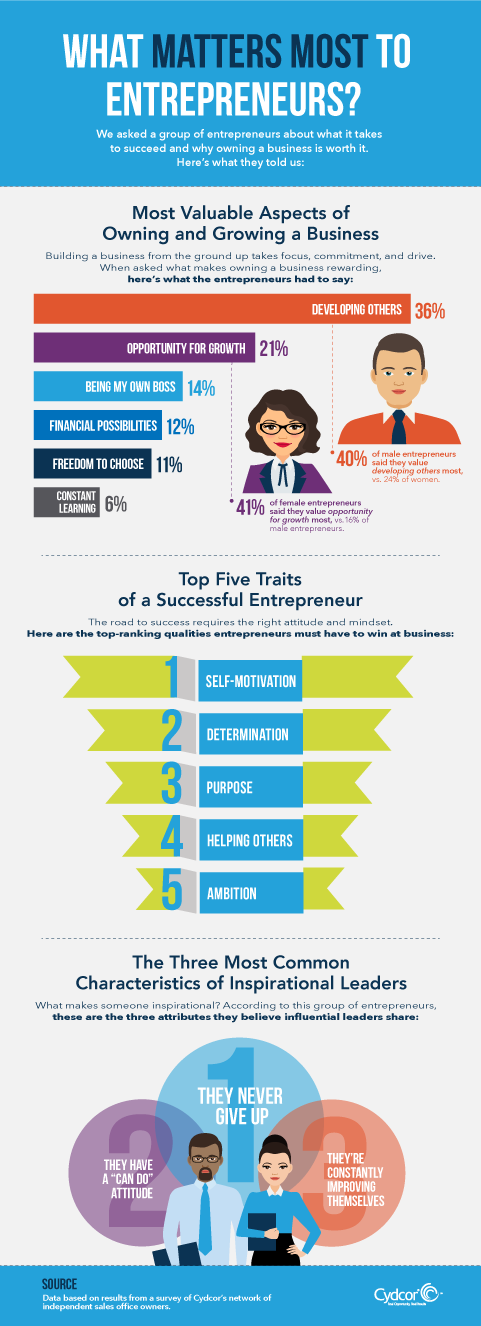
What sets entrepreneurs apart is not their mastery of specific hard skills such as writing, programming, or public speaking. From our discussions with independent business owners, we learned that the top characteristics of successful entrepreneurs are rooted in soft skills shaped by the right attitude and mindset, seen in the infographic below.
Self-Motivation
It’s easy to talk about building a business, but it’s entirely another thing to do it. The number one characteristic of successful entrepreneurs is self-motivation—the ability to put ideas into action. Think about some of the best-known entrepreneurs. Steve Jobs, for instance, didn’t wait for a company to come looking for him to build a new kind of personal computer. Instead, he partnered with the right people, turned his ideas into real-life products, and convinced the public that they needed the Apple Computer. Self-motivation can mean the difference between dreaming and achieving.
Determination
Our business owners identified determination as another major characteristic of successful entrepreneurs. This important trait is the drive that helps us follow through once we start. It’s what pushes us back up when we fall, and keeps us moving through uncertainty until we reach our long term goal.
THE BENEFITS OF ENTREPRENEURSHIP
Going from ideas to great products or startup to corporation is a remarkable feat that requires passion, focus, and resilience. It’s not a straight path, and there will often be twists, turns, and moments of uncertainty. We wanted to understand what makes it all worth it? What is it about the life of an entrepreneur that continues to drive so many to brave those, sometimes, stormy waters?
Developing Others
The majority of entrepreneurs said the most valuable benefit of entrepreneurship is the opportunity to help others grow and develop. Think about it. At one point, these entrepreneurs were employees, too. At the helm of a business, an entrepreneur has the experience to recognize greatness in others, and the leadership expertise to inspire them to get there.
Opportunity for Growth
Have you ever felt like you’re not getting anywhere in your current role, or looked up the organizational chart and didn’t like what you saw? Another major benefit of entrepreneurship is the opportunity for growth. And not just career growth, but personal growth, as well. Taking a chance on yourself and pursuing your passions will test your comfort zone, but the freedom to be your own boss and do what you love is an unparalleled experience and a unique benefit of entrepreneurship.
See what else entrepreneurs had to say about why owning and growing your own business is worth it.
Building a successful business of your own is not something that happens overnight. It takes unwavering dedication, unshakable focus, and a healthy dose of endurance. It’s an accomplishment, much like a marathon, that is achieved one step at a time. But for those who stick with it and embrace the adventure, the benefits of entrepreneurship can be life-changing.

Grit is a mysterious and powerful mix of passion and perseverance that gives some the strength to keep going where so many others before them have given up. In fact, studies have shown that grit may outrank either intelligence or talent as an indicator of future success. Salespeople know a lot about grit. They work in a competitive business, but for those with the grit to stick with it, the rewards can be huge. The best salespeople know that grit can be the secret ingredient that makes the difference between success and failure.
Intelligence and talent are huge advantages in business that can help you innovate, perform well, or solve problems. Without the grit to stay the course even when it gets bumpy, those advantages can be fleeting. Brains and natural ability are the reason many people are good at their jobs, but without the grit to overcome challenges, bounce back from stumbles, and the drive to push themselves further, they may never truly be great.


You’ve never dreamt of owning your own business, but that doesn’t mean you don’t fantasize about getting ahead and earning that big corner office. There’s a reason those impassioned entrepreneurs seem to be so good at turning their big dreams into realities: they have an entrepreneurial mindset. They’re confident and driven, and they thrive on the challenges that sometimes keep others from even trying. Embracing and maintaining an entrepreneurial mindset can help you do your job better, allowing you to reach your goals faster, whatever they may be. So, no matter where your career is today, think like someone who rules the world, and someday, you just might.
1. Take Action: Entrepreneurs don’t just talk about the things they want; they go after them. Instead of waiting for fortune to turn your way, find ways to influence what you can in order to encourage the results you want. Being a go getter can help you rise through the ranks faster, and it proves that you’re someone who can be trusted to get a job done.
2. Be Resourceful: Don’t let a limited budget stand in your way. Entrepreneurs find ways to make due and produce incredible results with what they have, and they’re clever about negotiating favors and freebees. Developing skills like these are crucial no matter the job, and finding ways to save the boss money is a great way to earn positive attention from those with the power to help you get ahead.
3. Recognize Opportunities: When entrepreneurs see an opening, they pounce on it. This way of thinking will help you choose the projects that can catapult your career by teaming you up with the right influencers or by demonstrating your ability to take the lead. Paying attention to the opportunities around you could also help you identify the perfect moment to ask for a promotion or a raise.
4. Be Fearless: Don’t let potential obstacles or rejection stop you, and don’t let a “no” scare you off. Entrepreneurs take risks and put themselves out there, which gives them an edge when it comes to sales, pitching ideas, and asking for better tools or more resources. Learning to stand your ground at the negotiating table is a skill that is critical to almost any business transaction.
5. Get Comfortable with Change: Fear of change is something that plagues many professionals, and it can prevent them from taking on new responsibilities, trying for a promotion, or applying for a new job. But don’t let fear of the unknown stop you. Instead, think like an entrepreneur, and decide to thrive on change. Accept being out of your comfort zone as a natural part of growth. Being at ease with uncertainty will empower you to say yes when others say no, helping you find the shortest possible route to success.
6. Love a Challenge: Entrepreneurs think adversity is exciting. Instead of choosing the easy road, point at the highest peak in sight and say, “l’ll conquer that one!” Priding yourself on winning in the face of extreme obstacles can be a major advantage whether you’re an intern, a new business owner, or a department head.
7. Know How to Delegate: Stay focused on the important things, and don’t be afraid to relinquish control to allow others to help lighten your load. Entrepreneurs learn that they must share responsibility and accept help when it’s available. Embracing collaboration can assist you in meeting deadlines and preventing burnout to keep you at the top of your game.
8. Be a Lifelong Learner: Entrepreneurs constantly strive to be better, smarter, and more efficient. Learn to maintain a student mentality, and your hunger for information will help you shine at work by keeping you up-to-date on industry knowledge, critical technical skills, and relevant news you can apply to help your employer outwit the competition.
9. Think Big: Entrepreneurs set challenging goals and are constantly striving to improve themselves. Even if you never hope to run your own company, aiming high is a great way to discover how much you can achieve. Thinking about the future can be an excellent way to stay motivated. Push yourself to think about where you might like your career to be in a year, five years, and beyond, and you just might surprise yourself.
10. Trust Your Instincts: Don’t spend a lot of time doubting yourself. Leading entrepreneurs know that negative thinking gets them nowhere. Trust your decisions, and be confident you will figure it out along the way. A great, entrepreneurial attitude will be your secret weapon against self-doubt, and it will help to remind you that you deserve the opportunity to succeed even when others casts doubts on your potential.
Thinking like an entrepreneur keeps you focused on your goals no matter where you are in your career path. It lends purpose to all the hard work you do, allowing you to set aside fear and ego to get the job done. It can help you remember that it will all pay off in the end. Adopt an entrepreneurial mindset, and the only person who will determine how successful you can be is you.


Working in sales can feel like the career equivalent of boot camp. It puts your mental toughness and endurance to the test, but if you’re brave enough to give it your all, working in sales can transform you from a career weakling to a business powerhouse. Whether you're interested in a sales career or not, taking a job in the sales industry build critical skills that are necessary for success whether you’re a recent graduate, trying for a big promotion, a small business owner, or a top executive.
1. Knocking on Doors…Literally and Figuratively
The scariest part of a job in sales is approaching people you don’t know and asking something of them. What if they slam the door in your face? What if they get mad? What if everyone you talk to says no? But succeeding in business is all about hearing no. You have to learn to deal with rejection if you ever hope to succeed in the real world. Working in sales is the perfect training ground for building that thick skin you need to apply for a job, ask for a promotion, close the deal, or solicit new clients.
2. Becoming a Master of Improvisation
Working in sales teaches you to think on your feet. You never know exactly what the customer might throw at you, and you have to learn how to listen and adapt to their objections and concerns on the fly. Entry level sales experience teaches you to be nimble minded and improves your public speaking skills, so you can help pitch a new idea to a team, respond to a real-time public relations crisis, or scramble for options when project funding falls through.
3. Relating to Others
In order to make the sale, you have to learn how to build rapport and find common ground with people you’ve never met before. The ability to understand where others are coming from and relate to them on their level is handy in almost any work scenario. Customers prefer to do business with people they like and they tend to trust people they relate to. This skill can help you in your job search too as you meet prospective employers and try to impress hiring managers.
4. Asking the Right Questions
Great salesmen know how to find peoples’ hot button issues. Not everyone will tell you what their objection is; sometimes you have to probe a bit and do some investigating to find what’s really holding them back. Being a good detective and understanding how to do research are sales skills that are critical to overcoming roadblocks and achieving success in business.
5. Highlighting Benefits
Whether you’re selling something door to door or selling yourself on a blind date, the fact remains the same, people want products, companies, and people who will make their lives better in some way. Learning how to appeal to people’s needs and wants is a powerful tool that can help any time you need to make a case for something, whether it’s donating to a great cause, investing in your feature film, or offering you the salary of your dreams.
6. Sounding Like an Expert
The best sales people understand that people want to buy from someone who knows what they’re talking about. But as important as it is to thoroughly know your product; it isn’t really what you say that matters, but how you say it. Being confident and sounding like you know what you’re talking about is the secret to building trust and gaining consensus. Work experience in sales is the perfect way to practice sounding like an expert, even when you’re not.
7. Talking Numbers
Negotiating makes a lot of people uncomfortable. We feel like we’re being impolite when we ask people to pay for something, especially when the price is higher than they’d prefer to pay. Working in sales forces you to face that fear, and learning to stand your ground at the negotiating table can help you finally get that big pay bump, large investment, or executive title you’ve wanted.
8. Capturing and Keeping Attention
To be a good sales representative, you have to know how to turn it on when you enter a room. Entertaining your audience and telling a good story is one of the most effective ways to build rapport and get the customer on board with your message. Learning how to engage others can be invaluable for public speaking, networking, or pitching ideas.
9. Earning Trust
People are naturally suspicious of strangers, and they’re especially suspicious of salespeople. That’s what makes earning a customer’s trust such an impressive feat. It’s also a powerful tool. People buy from people they trust. Learning how to convince others to put their faith in you has limitless benefits in business and in life.
10. Setting and Achieving Goals
The life of a sales person is all about setting targets and hitting them. You learn how to dig deep, stay self-motivated, and set challenging, yet achievable goals because achieving them can often mean the difference between having a great week and struggling to pay your rent. And strategizing how to meet them is key to succeeding at almost anything.
Sure, working in sales can be tough, but as anyone who has tried their hand as a sales rep will tell you, it’s also worth it. Sales experience hones indispensable career skills that can help you get ahead and overcome challenges for years to come.


Discover how student mentality breeds success, and personal development, for employees in this article from Cydcor. Lifelong learning helps exceed goals.
When you’re a student, your whole job is to learn. That’s why companies like their employees to maintain a student mentality. And while organizations want to hire expert talent, employees who think of themselves as experts may miss the opportunity to continue growing and improving. By encouraging employees to think of themselves as students, employers foster a culture of ongoing personal development, inspiring employees to seek out valuable lessons in every task they’re given.
Here’s how a student mentality creates better employees:
1. Teaches Them to Listen
Unlike seasoned veterans who may be less open-minded to new ideas and approaches, students are in a constant state of openness. They pay attention to people and experiences, absorbing information and searching for valuable takeaways. Staying on the lookout for new ideas creates a fertile breeding ground for innovation.
2. Keeps Them Humble
There is no employee, no matter how senior, who can’t improve in some way. Adopting a student mentality reminds even executive level employees that they always have more to learn.
3. Keeps Them Focused on Growth
Students have a hunger for information and a drive toward personal development that people often lose as they move ahead in their careers. A student mentality challenges employees to set the bar higher. It pushes them to perform at their best and continue redefining what their best might be.
4. Reminds Them to Study
Encouraging employees to think like students reminds them that it’s important to stay abreast of the latest industry trends and take advantage of resources such as trade journals, white papers, blogs, and events for their own personal development.
5. Forces Them to Question
Being a student means admitting that you don’t know all the answers. Employees who think like students become attuned problem solvers. They’re willing to challenge assumptions, and they learn to probe for new approaches that are better, faster, and more cost effective.
6. Keeps Them Competitive
Students are constantly learning and applying new skills, maintaining a student mentality urges employees to keep their abilities and knowledge finely tuned and up to date with industry trends. This may mean learning new software, attending seminars, or taking online training courses.
7. Makes Them Better Leaders
Students often make the best teachers because they learn how to effectively communicate with others. By asking employees to think like students, employers also provide opportunities for employees to mentor each other, which helps them become even better leaders.
8. Keeps Them Open Minded
As employees advance in their careers, it’s easy for them to become rigid and set in their ways. After all, doing things the old way got them this far. But an environment that values constant learning pushes them to consider new ways of thinking and reminds them to stay flexible and open to change.
Employees who maintain a student mentality don’t assume they already know everything. They understand that useful new ideas can come from anywhere and anyone. By staying open to innovative thinking, and constantly striving to learn more and improve, employees who think of themselves as lifelong students have the kind of forward thinking that helps organizations reach their goals and beyond.

About Grit: The Power of Passion and Perseverance
Renowned psychologist Angela Duckworth shows through her own personal history and stories of others that success doesn’t just come from natural talent or people who can help you get where you want to go in your career. Instead, she says, the secret to success is a blend of passion and persistence that she refers to as “grit.”
Duckworth developed this hypothesis through years of teaching and business consulting. She saw that people who found their passion and kept trying were ultimately more successful than those who had a natural talent but lacked the perseverance to follow through.
Why Cydcor Recommends This Book
Duckworth offers a concrete path to developing grit. It starts with identifying a burning interest, practicing it a lot, developing a sense of higher purpose, and finally, overcoming pessimism by developing what psychologist and author Carol Dweck calls a growth mindset. She tells us that any effort you make counts twice toward your goal.
Some of us come into adulthood already having learned grit through dealing with difficult times and getting through them. But, Duckworth says, grit can be learned regardless of IQ or circumstances, and shows you how you can do it. Anyone can become gritty. By learning grit and making effort to grow your passion, you too can achieve more than you might have thought possible.
Our Favorite Part
In Grit, Duckworth shares specific examples of people who exhibited grit in their own lives—whether those people are West Point cadets going through grueling initiation rituals, a young national spelling bee champion, or teachers working in some of the toughest schools in the country. By sharing these real-life examples, Duckworth shows us how her formula of passion, practice, and persistence can lead to success.
Check out this book and let us know what you think. Share with us on Twitter and follow us @Cydcor.
We are Cydcor, the recognized leader in outsourced sales services. From our humble beginnings as an independent sales company based in Canada to garnering a reputation as the global leader in outsourced sales, Cydcor has come a long way. We’ve done this by having exceptional sales professionals and providing our clients with proven sales and marketing strategies that get results.
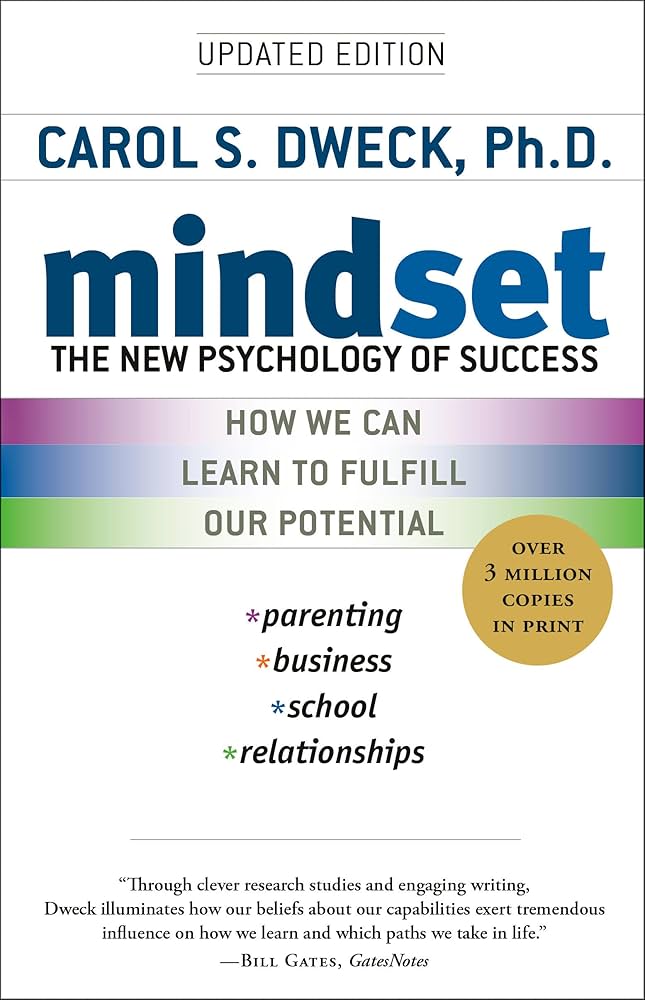
About Mindset: The New Psychology of Success by Carol S. Dweck
Stanford University psychologist Carol S. Dweck, Ph.D., did decades of research on gifted children and adults and discovered a simple but groundbreaking idea: the power of mindset. A mindset is either fixed or growth-oriented; if you have a fixed mindset, you believe you have certain innate talents or weaknesses that can’t be changed. On the other hand, if you have a growth mindset, you believe that abilities can be developed through learning and hard work.
Mindset shows how to use a growth mindset to foster great accomplishments in yourself and in your direct reports.
Why Cydcor Recommends This Book
It gives you the opportunity to explore your own mindset: Do you have a fixed mindset or a growth mindset? It also gives you the tools to adopt a growth mindset and avoid the trap of a “false growth mindset.”
Mindset can also help you understand that you’re not necessarily born with certain talents, but they can be learned. Do you think you’re naturally bad at math? Maybe you’ve been told that so many times you believe it. The truth is that it’s possible to learn and excel at any task if you take the time to develop your skills.
A growth mindset can also help you love what you do, increase your sense of success and fulfillment, and even improve your relationships with other people, whether those individuals are your colleagues, your friends, or your family.
Our Favorite Part
In this new edition of Mindset, Dweck introduces the “false growth mindset” and guides people toward adopting a deeper, truer growth mindset. Cydcor encourages its employees to adopt a growth mindset and break out of self-limiting thought patterns.
This is a great read for managers and mentors because it expands the mindset concept beyond the individual to corporate culture and other groups. This crucial update will help supervisors to motivate those they lead, and to transform their lives at work and at home.
Mindset is well organized and easy to read. It’s serious but provides practical information on how to cultivate a growth mindset.
Our team members are continually reminded to improve their professional development and keep growing. Learn how you can join the Cydcor team on CareerBuilder!
We are Cydcor, the recognized leader in outsourced sales services. From our humble beginnings as an independent sales company based in Canada to garnering a reputation as the global leader in outsourced sales, Cydcor has come a long way. We’ve done this by having exceptional sales professionals and providing our clients with proven sales and marketing strategies that get results.

Everybody wants to be successful, but not everybody is. What’s the difference between those who achieve success in their field and those who don’t? It all begins with success-oriented beliefs.
Here are some beliefs from Cydcor that the most successful people hold. If you incorporate them into your life, you will go far toward achieving success in your career.
“I create my own future.”
You are the agent of your success. If you feel you’re at the mercy of others’ actions or you rely on others to create the path to success, it will show in your behavior. If you believe in your heart that you are responsible for your own future and take actions that speak to that, you’ll achieve success.
“I’m grateful for what I have.”
It’s easy to fall into the trap of believing that what you already have in life is not enough, especially if you’re struggling to meet your personal and professional goals. Successful people take time to appreciate the good things in their lives, no matter how small or simple. Cultivate an attitude of gratitude, and that will help you achieve your goals.
“It’s okay to fail.”
All successful people have had failures. The difference between successful and unsuccessful people is that successful people don’t give up. They learn from their failures, pick themselves up, and move on with greater wisdom and determination.
“I’m willing to take big risks.”
Success is difficult to achieve if you’re afraid to go beyond your comfort zone. Great risk brings great reward. Set a really lofty goal for yourself. Try a new method of interacting with potential customers. Learn about and practice some of the keys to professional success.
“I live in the present.”
When you’re caught up in rehashing past mistakes or obsessing over what you hope to achieve in the future, you’re not being in the moment with your customers or team. If you’re mentally present, you’ll listen better and go farther toward achieving your goals.
“I focus on what matters.”
It’s tempting to spend time checking your phone or getting distracted by office chatter, but that’s not going to get you to success. Set a few goals and a timeline for achieving them, then make a commitment to spend your time working toward that. Use the phone or water cooler time as a reward for working diligently toward your goals.
“I love my job!”
Every job has elements that are less than fun. But if you embrace the good things about your job, you’ll cultivate an attitude of success. Even when your work is hard and you’re feeling disheartened, remember there was something about this job that appealed to you when you first started; focus on that.
In short, “your attitude determines your altitude,” as the old saying goes. If you focus on the positive, set challenging goals, and understand that you are the one responsible for your success, you will be able to achieve more than you ever imagined.
For additional blogs from Cydcor, be sure to check out https://www.cydcor.com/media.
We are Cydcor, the recognized leader in outsourced sales services located in Agoura Hills, CA. From our humble beginnings as an independent sales company based in Canada to garnering a reputation as the global leader in outsourced sales, Cydcor has come a long way. We’ve done this by having exceptional sales professionals and providing our clients with proven sales and marketing strategies that get results.

About Outliers: The Story of Success by Malcolm Gladwell
What makes high achievers different from you or me? Malcolm Gladwell answers that question with his book, Outliers. Many overachievers believe in one of the core concepts in the book: the “10,000-hour rule.” Gladwell suggests that to be the best at something, you need to study it for 10,000 hours. In this book, he finds the outliers—men and women who do things that are out of the ordinary.
Outliers is a good read because of Gladwell’s fascination with psychology, law, statistics, and sociology. His colorful writing provides a powerful and personal analysis of why some people become outliers and some don’t. Despite its quirky characters and lofty critiques, you’ll find echoes of your life in his writing.
Like Gladwell, at Cydcor, we encourage our employees and sales associates to set challenging goals that inspire achievement. We provide determined individuals opportunities to excel, work hard, and build successful careers.
Why Cydcor Reviews Recommends This Book:
Gladwell worked as a journalist at the Washington Post and as a writer for the New Yorker magazine. Instead of writing simple biographies of successful people, he investigates the communities where these exceptional people developed. He also examines the cultures that influenced them during their formative years and up to today.
Gladwell is passionate about social sciences and statistics. This interest led him to figure out why Canada’s star hockey players are consistently born in January, February, and March. But Gladwell isn’t just revealing cold facts and figures. He uses the book to examine his own life as an outlier.
Cydcor recommends this book because the author provides profoundly inspirational insights into how ordinary men and women achieve greatness. Gladwell suggests that everyone who is exceptional at something—like sales—has practiced for about 10,000 hours. Gladwell’s theory endorses Cydcor’s belief that professional achievement, recognition, and advancement is available for anyone who works hard and pursues each opportunity they find.
Our Favorite Part
Our favorite part of Outliers is Gladwell’s talent for revealing the unique twists and turns that influence someone’s life. For example, when Bill Gates was in the eighth grade, the mothers’ group at his school used the proceeds of their annual bake sale to purchase a personal computer for the students.
No software was available for the computer, so Gates learned how to program it by punching holes into computer cards—a very outdated practice today. After many hours of hard work, he got the computer to work. By the time he was a sophomore in high school, Gates had exhausted his school’s computer resources and sought further instruction at the University of Washington, where he met his future business partner, Paul Allen. Gates certainly had a gift for computing, but ultimately his achievements were powered by his 10,000 hours of hard work.
If we follow Gates’ example, if we pay attention and begin to see obstacles as opportunities, we will improve our chances for success.
As you read this book, you may remember the lessons you learned from teachers and mentors who taught you how to overcome obstacles. This book reminds us that the opportunity to succeed is always present; you just need to have a positive outlook and the determination to meet each challenge. You may not become a billionaire after reading Outliers, but your personal and professional life will become rich with possibility.
Who are the outliers that influenced your career path? Let us know about the men and women who inspire you to succeed. Share your ideas on Twitter and follow us @Cydcor.
We are Cydcor, the recognized leader in outsourced sales services. From our humble beginnings as an independent sales company based in Canada to garnering a reputation as the global leader in outsourced sales, Cydcor has come a long way. We’ve done this by having exceptional sales professionals and providing our clients with proven sales and marketing strategies that get results.