
Discover practical advice, inspiration, and insights to help you succeed in business and grow both personally and professionally.

Found 0 posts

Having a well-chosen, fully trained, sales team with the right attitude is essential if your organization is trying to increase sales. The sales team is the last line of defense. After all the investment your company has made toward developing, testing, and perfecting the product, branding, and promotional campaigns, it is the sales team who will ultimately make or break efforts to increase sales because they are the ones who will have direct contact with the customers. At Cydcor, a leader in outsourced sales, we’ve had more than 25 years’ experience building and growing great sales teams fully prepared to increase sales and achieve clients’ revenue growth goals.
Be Selective
Take the time to hire the right people. Be sure everyone on the team has clear expectations of what’s expected of them, simple goals, and ambitious but achievable targets – both for the team as a whole and for each individual salesperson. It’s okay (even great!) to have high standards, just make sure both sides are clear on those standards, nobody likes that kind of surprise.
Don’t be a stranger. Building a sales team positioned to increase sales is not a set it and forget it process. Hiring well is just the first step. Get to know your people. Talk to them. See them as individuals who bring their own individual strengths to the overall team. This will allow you to use them most effectively.
Get Everyone Trained Up to Speed
Once you have the right team in place, it’s important that they’re well trained and up-to-date on all sales strategies. Keep it simple, train your team only on what’s necessary to improve sales without added fluff, twists or turns. Since turnover is inevitable, make sure you have frequent trainings that are easily repeatable.
Also, remember that not everyone learns the same way. Some people learn better through presentations, others through reading materials. Some people have no problem just learning things conceptually and can then repeat them, but others may need to take a more hands-on approach with training. Have the most successful reps train the others and pay attention to make sure they’re getting it. You may even ask your team how they prefer to be taught. By involving them in the process you will get more buy in and participation.
Keep the Team Motivated
A team that’s eager to succeed is a must if you want to optimize your sales program. By keeping goals simple, clear and refreshed, you can always make sure your sales team knows what’s expected of them. Talk about goals daily. Reward and recognize those who increase sales and meet goals frequently. Healthy competition is good, but a collaborative environment where people are willing to help each other serves everyone, and that comes if everyone feels like their hard work is being rewarded.
Much like with training, different individual sales people will respond to different things. Everyone has their own carrot. Some are looking for recognition and respect, a star on the wall with their name on it. For others, bonuses and financial incentives may be the way for them to meet their full potential. Again, ask your team their preference. Get them involved in the process!
Ensure They’ve Got the Right Stuff
You’ll want to be sure to review your strategies to increase sales with the team to make sure all essential steps and needed communications are present in the sales process. Does the customer understand the product and service? Do they understand when they will receive the product or service? Will they need to do any follow-up? Don’t walk out the door until all of the customer’s questions are answered or, at least, until there’s a plan in place to get them answered.
Make sure your sales teams have the right tools, they need to be efficient. Making sure they have the right product information including pricing, a snapshot of the product or service benefits, pricing, and offer information is essential to help them improve sales and succeed.
There’s no one way to improve sales, but these strategies to build and maintain a great sales team should set you up for success. Hire the right people, train them well and keep them motivated, learn your customer and your product backwards and forward, and you should be well on your way to increase sales and achieve your business goals.

Cydcor offers employees more than just health insurance and a 401K. We know employees today are looking for benefits that provide more than the standard offerings. In this article, read more about some of the unique and nontraditional benefits Cydcor has to offer.

A fun holiday party doesn’t have to break the bank. Read creative ideas about how companies can make their festive gatherings exciting and economical. Quick tip: Cooler weather can mean cooler things to do. Get more tips here.

How many famous people can you name who started their careers in sales? Before becoming well-known actors, musicians, comedians, and CEOs, quite a few of today’s celebrity’s early jobs meant going door to door, working in retail, serving in restaurants, and telemarketing. Not only did these soon-to-be celebrities who once had sales jobs eventually hit it big, but their history in sales seems to have taught them some valuable lessons as well. Perhaps there is something to be said for a sales gig as the ultimate crash course in communication!
Check out this list of six celebrities who had sales jobs before they were famous.

Would you believe it if we told you that Johnny Depp was once a telemarketer? It’s true! Using made-up names, Depp phoned people asking if they’d like to buy pens. He only ever made one sale, but he considered the experience to be his first foray into acting.

This now-billionaire founder of the shapewear company Spanx spent nine hours a day for eight years selling fax machines door to door. She credits the experience with developing an immunity to rejection and teaching her that the best way to be persuasive is face to face -- both of which served her well in starting Spanx.

It’s kind of hard to picture this now award-winning rapper working at a chain retailer like the Gap. Indeed, he was a part-time sales assistant there during high school. In retrospect, West believes that this early job working with clothes sparked his inspiration to become a fashion designer many years later.

Billionaire entrepreneur Mark Cuban’s first job as a pre-teen was selling garbage bags door to door. Coveting a pair of sneakers that his father wouldn’t fund, Cuban took matters into his own hands by selling boxes of garbage bags at a profit of three bucks a pop.
This well-known comedian and talk show host used to live quite the different life! After dropping out of college, DeGeneres held a variety of sales positions, which included selling clothing, demonstrating Hoover vacuums in front of customers, serving, and bartending. Perhaps the celebrity’s early jobs in sales contributed to her talent for thinking on her feet and quickly getting people to like her.

Years before adopting this pseudonym, Stefani Germanotta was raking in the tip money as a waitress at a diner – which as most servers will tell you, is essentially commission sales! She made conversation with customers by telling stories and always kept it stylish in high heels. Maybe she translated some of her talent for earning tips into her later penchant for earning lifelong fans.
Like these stories of salespeople turned celebs? Check out this list of CEOs who got started in sales before striking it rich. To find out more about Cydcor, check us out on Facebook, LinkedIn, Instagram, and Twitter.
We are Cydcor, the recognized leader in outsourced sales and marketing services located in Agoura Hills, California. From our humble beginnings as an independent sales company to garnering a reputation for consistently exceeding client expectations and driving outstanding revenue growth, Cydcor has been helping Fortune 500 and emerging companies achieve their customer acquisition, retention, and business goals since 1994. Cydcor takes pride in the unique combination of in-person sales, call center, and digital marketing services we offer to provide our clients with proven sales and marketing strategies that get results.

How do you engage employees in learning?
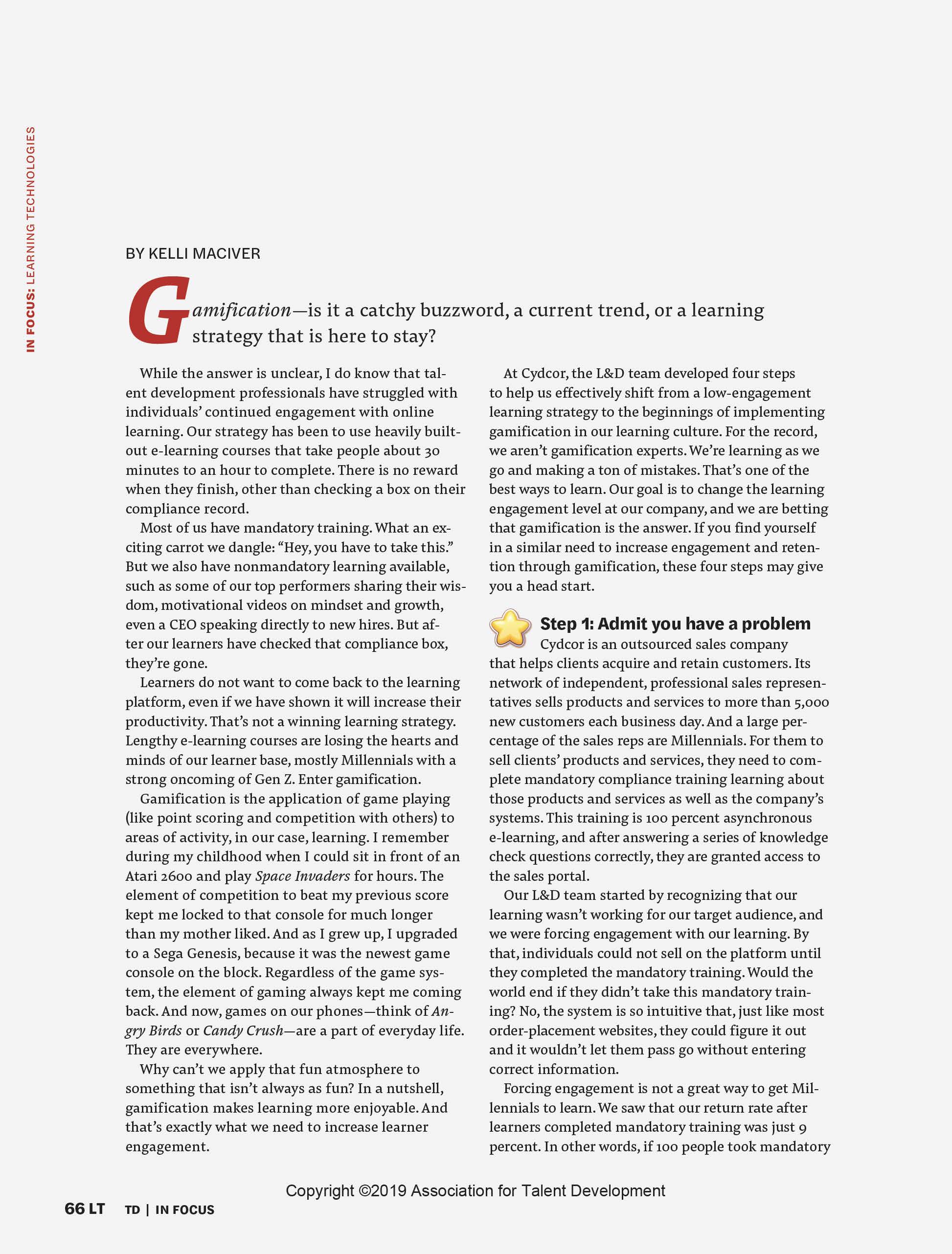
Cydcor’s Director of Learning and Development, Kelli MacIver recently sat down with TD Magazine to weigh in on the topic of employee engagement in corporate training. She and her team recently set out to discover ways to drive team members back to online training programs without making trainings mandatory. What they discovered was that through gamification, adding competitive elements to training and development programs, learning could be refashioned into a sport-like challenge employees would be eager to win!
Leading the way in corporate training and development has always been a top priority for Cydcor, an organization which prides itself of providing outstanding sales performance to its clients via a network of independent sales companies whose employees act as expert brand ambassadors for Cydcor’s client products and services. In March 2019, Cydcor earned a prestigious recognition from the Association for Talent Development, taking top honors in its Training Delivery category for demonstrating creativity and innovation in its rollout of technical training.
To ensure Cydcor continues its record of excellence and leadership in training, Kelli MacIver and her team build and distribute ongoing compliance training programs to help campaign teams sell on behalf of Cydcor’s clients.
Traditionally, these trainings have been required viewing, but making the sessions mandatory made users less interested in returning to take advantage of the other optional training content offered, reducing employee engagement. Even at Cydcor, where maintaining a student mentality is deeply engrained in the business culture, requisite learning proved to be a motivation killer for young professionals drawn to the sales industry by the promise of action and excitement.
“Forcing engagement is not a great way to get Millennials to learn,” says MacIver, “We saw that our return rate after learners completed mandatory training was just nine percent.” The Learning and Development team knew there had to be a better solution engage participants in learning and keep them coming back for more.
Enter gamification. But rethinking and reworking Cydcor’s entire approach to building training content wouldn’t be easy. It would require accepting that there was a problem in the first place. It would mean gaining alignment, approval, and feedback from multiple members of the leadership. Finally, it would require extensive hours of research by Kelli’s team to learn everything they could about gamification and how adding game-like, competitive, social, and reward elements to learning programs might help keep learners engaged, motivated, and hungry for more. After a comprehensive process of information gathering, testing, and perfecting new programs, what the team discovered will transform Cydcor’s approach to training and development for decades to come.
Read the full article below.

In our increasingly digital world, door-to-door residential sales continue to thrive. Why? Because door-to-door sales is highly effective, generates higher value sales, boosts brand loyalty, and provides excellent customer experiences. The reason, you’ll discover, is simple. At the core of door-to-door sales is people connecting with people. Face-to-face communication, though more and more rare, remains the most effective means of connecting with a consumer base. It is the most reliable way to establish trust, assist in decision-making, and forge new relationships with decision makers. This sales approach benefits customers as well by providing personalized service, helping them find solutions to fit their unique needs, and giving them opportunities to ask specific questions.
With the right outsourced sales partner, corporations large and small can reap higher ROIs by getting back to basics. Let’s dive in and take a look at why door-to-door residential sales still works.
In more than 25 years outsourced sales experience, Cydcor has found that customers are often already familiar with our clients’ products and services before the sales representative arrives at their doors. They’ve seen the billboards, listened to the radio ads, and watched the commercials. Yet, they haven’t taken action to buy. Why? For many people, researching cable or energy options is simply one of many dozens of items on their to do lists – and it rarely takes priority.
That’s where a door-to-door sales team comes in. Sales professionals can reach consumers who haven’t responded to mainstream marketing initiatives. They can convert them into paying customers by personally responding to their questions and concerns and by helping them find the right products to address their needs. An effective salesperson is able to approach a homeowner, quickly establish rapport, and provide an informative sales pitch and personalized presentation. At the very least, the interaction succeeds in educating the consumer about his or her options. Even better, after painting the picture, answering questions, and addressing lingering concerns, skilled door-to-door salespeople create positive brand experiences for consumers. These face-to-face interactions increase the chances they’ll remain customers longer, or if they aren't already, improves they’ll decide to become customers in the future. In other words, door-to-door residential sales is not just effective at generating sales, but it also boosts brand loyalty by making the consumer feel important, valued, and well-served.
When executed by the right sales team, door-to-door sales is an incredibly effective secret weapon for increasing market share and making incremental sales. Not only do sales representatives reach the unreachable, but once they do, they often uncover needs that the customer wasn’t even thinking about. By asking the right questions, reps can recommend the right packages, often providing the customer higher-value products and services they’ll be happier with in the long-run.
The customer wins by getting exactly the services they want and need at the best possible price, and the client wins by acquiring lasting customers with a high lifetime value. Not only do residential customers who purchase at the door buy better packages, but they tend to cancel less and stay with the service longer.
The best predictor of brand loyalty is a positive customer experience – and the face-to-face communication is the best possible way to provide one.
By meeting in person, sales representatives can use friendly body language, make eye contact, and shake hands, building trust in a way that phone calls and advertisements can't. The door-to-door sales process leaves customers feeling confident in their decision to buy. They've have had their questions answered, and they feel warm and fuzzy about the enjoyable interaction they had with the sales rep.
All of this leads to happy customers who are fans for life. It’s no surprise that according to Net Promoter scores, potential buyers have overwhelmingly better experiences through the face-to-face sales channel. Thanks to its ability to offer a personalized and connected experience, in-person selling leads to more successful sales and benefits clients and customers alike.
As experts in outsourced, door-to-door residential sales, Cydcor understands the impact generating great face-to-face sales experiences, whether in the residential, B2B, or retail channels, can have on the long-term revenue growth of its clients. Learn more about Cydcor’s services, or become a client to see how Cydcor can help your organization achieve its customer acquisition goals.
Do you agree that door-to-door residential sales still work? If so, share this post on your favorite social media network!
Did we miss anything on our list? Tweet us @Cydcor and let us know why you believe direct sales is a win-win for companies and their customers alike!