
Discover practical advice, inspiration, and insights to help you succeed in business and grow both personally and professionally.

Found 0 posts

Why be average in business when you can be authentic? If you ask us, average is overrated, and the importance of being yourself far outweighs fitting the mold. True authenticity allows you to shine. You set yourself up for opportunity. You surprise people. You’re memorable. You’re relatable. You’re happier. You get to create your own unique story. Ultimately, you thrive.
Let’s take a look at a few specific ways that being yourself at work can be your very own secret weapon in your growing career.
Being yourself is a powerful way to attract the right people. When you are transparent with your intentions and open about your goals, it’s easier to find people who are aligned with your vision. In building a team, this minimizes turnover and ensures that you are spending your time and energy with the right people.
Authenticity is crucial in winning hearts and minds. When you’re true to yourself as a leader, you stick to your principles no matter the time, place, or circumstance. For the most part, you behave the same in your professional capacity as you do in your personal life. You say what you mean and you mean what you say. Your consistency, trustworthiness, and strength of character make people want to follow you.
There is power in vulnerability. Openness and transparency are qualities that make you magnetic as a leader. Your team members want to know that you’re fallible, like they are, and that you can admit to your mistakes. They want the assurance that you’re in this together; and by being yourself, you show them that you are. Not only does your realness earn you the respect of your team members, but it inspires them to make mistakes and keep going too.
Being genuine is essential to being persuasive. Whether or not you’re in a ‘sales’ role in the traditional sense of the word, sincerity is the most effective way to convince another person to act. Many salespeople believe they have to speak in a special tone of voice or adopt a sugary demeanor to be effective – but it’s exactly the opposite. Customers hate a cliché sales pitch – and they can tell when you’re not comfortable in your own skin. Being your (professionally mannered) self reduces skepticism and allows for natural conversation to flow, which in turn, sets the stage for a sale.
When you’re comfortable being yourself, you’re less sensitive to the opinions of others. While you appreciate the well-intentioned advice of your loved ones, you don’t feel the need to please everyone. You have the confidence to make tough decisions about what’s best for your future – even if those decisions are unpopular with your family members and friends. The ability to follow your own path is a super power that will take you far in your career.
Being yourself increases positivity. Why? Well, firstly, because embracing your individuality just feels good! It is incredibly freeing to stop trying to be someone you’re not. But secondly, instead of wasting your precious energy trying to fit in, you get to focus on building a life that has meaning to you. Tackling your authentic “why,” rather than emulating what’s popular, gives you purpose. This purpose transcends whatever bumps you face along the road and inspires you to get back on the horse after facing a setback. When you’re honest with yourself about what you really want in life and you’re actively taking steps to achieve your goals, you can’t help but to be .
Do you have a story about how being yourself at work has paid off in your own career? Tweet us at @Cydcor. We’d love to hear it!
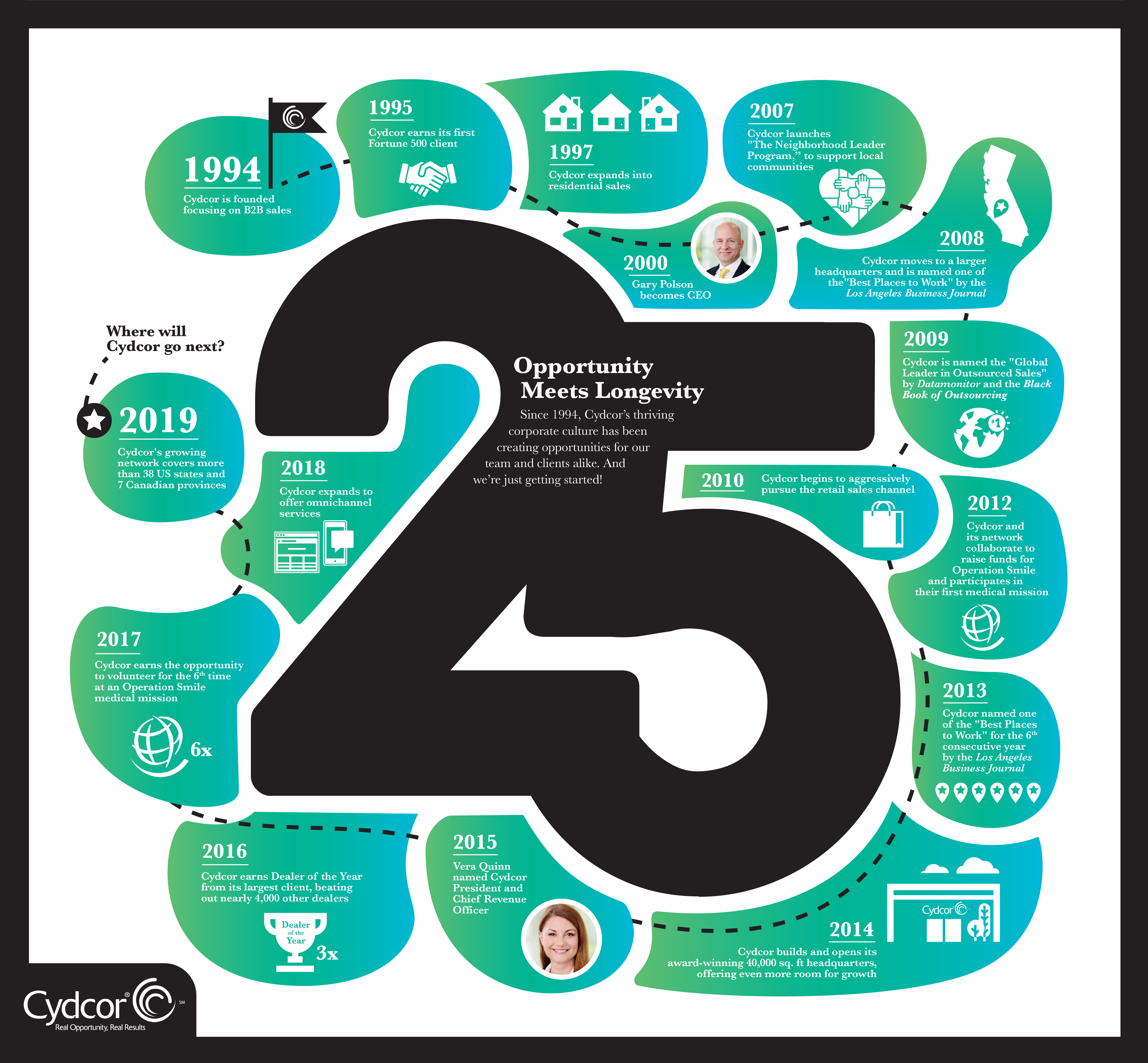
Since 1994, Cydcor has been delivering outstanding customer acquisition results for clients. The company has come a long way since its founding, earning well-known clients, growing its team, evolving its business strategy and service offerings, and perfecting a vibrant corporate culture that is second to none. And Cydcor is just getting started!
In the Beginning
Cydcor, which started with a small network of just six independently owned sales companies, employing 140 sales representatives, now boasts a sales network of more than 375 independent sales companies that covers 38 states and seven Canadian provinces.
Industry Leader
Winning its first major client in 1995, Cydcor now represents some of the most recognized and fastest growing names in telecommunications, cable, internet, office supplies, energy, and more. Cydcor has been repeatedly recognized as a sales leader by clients, raking in dozens of industry awards for outstanding performance and exceptional customer acquisition, market share, and revenue results year after year.
Unique Corporate Culture
Keeping pace with its rapid growth, Cydcor has relocated several times, finally settling into a custom-designed 40,000sq foot, state of the art headquarters in Agoura Hills, CA in 2014. The vibrant work space lives up to Cydcor’s rich corporate culture, built around “The Behaviors We Value,” and Cydcor’s mission to provide opportunities for its team members and clients. From development opportunities and training to social events and health and wellness resources, Cydcor ensures team members have what they need to help them thrive physically, financially, and professionally. This dedication to supporting its team is the reason Cydcor has been named nine times as one of the “Best Places to Work” by the Los Angeles Business Journal.
Helping Others
Cydcor prides itself on being a “people helping people” business, and its commitment to corporate philanthropy has remained a cornerstone of the company’s corporate values as well. Together with its network of independently owned sales companies, Cydcor has helped raise nearly $1,000,000 for Operation Smile, which provides free, life-changing surgeries to children around the globe suffering from cleft lip and cleft palate conditions. Cydcor also encourages team members to support their communities by offering one paid volunteer day a year as well as many other company-sponsored philanthropic opportunities.
Cydcor Today
Cydcor continues to grow at breakneck speeds, consistently outperforming itself, and proving time and time again why it deserves its reputation as a leader in outsourced sales and marketing. In recent years, Cydcor has continued to evolve and boasts a fully tech-enabled team, expanded service offerings, and new customer acquisition channels to build on Cydcor’s foundation of in-person sales.
In just 25 years, Cydcor has seen astounding growth and success, and you won’t believe what Cydcor does next!
Read more news about Cydcor's milestone year, or check us out on Facebook, LinkedIn, Instagram, and Twitter.
We are Cydcor, the recognized leader in outsourced sales and marketing services located in Agoura Hills, California. From our humble beginnings as an independent sales company to garnering a reputation for consistently exceeding client expectations and driving outstanding revenue growth, Cydcor has been helping Fortune 500 and emerging companies achieve their customer acquisition, retention, and business goals since 1994. Cydcor takes pride in the unique combination of in-person sales, call center, and digital marketing services we offer to provide our clients with proven sales and marketing strategies that get results.

You’re not alone if you have a love/hate relationship with email. As much as we’ve come to rely on it for efficient communication, no one enjoys an overwhelming pileup of messages to read. Thankfully, learning how to manage your email inbox can be quite simple. Let’s start by taking a look at the six inbox management tips listed below.
It’s 9am. You sit down at your desk, power up your computer, and you’re greeted with three dozen new emails. What should you do? Should you start at the top and just work your way down? Should you pick up where you left off yesterday? No and no.
The best way to tackle your inbox in the morning is to start by opening emails from a specific set of people. In most cases, this will be your manager or a small list of high-priority business associates. Though it may require some will power, leave all of your other messages unread until you’ve at least taken preliminary action (more on this in #2) on what’s most important.
Do not use your inbox in place of a schedule or to do list. We repeat. Do not use your inbox in place of a schedule or to do list. This widely used practice is one of the main reasons that so many people struggle to control their inboxes.
Instead, think of checking your email as a time to get organized. Start by creating a sorting system that allows you to easily keep track of your emails by either subject matter or priority level. Then, come up with a plan for swiftly tackling new messages. If a response will take you two minutes or less, go ahead and handle it right away. But, if a new email requires more extensive action on your part, move it to its respective folder, and block out time on your calendar to handle it.
One of the easiest ways to simplify the sorting process, and in turn, control your inbox, is to use descriptive subject lines. For example, instead of the ambiguous title, “Question,” write, “Question About XYZ Project.” This way, when you get a response, you won’t have to open the email to remember what the exchange was about. Not only will this make it faster to sort your messages, but it will also ensure that the email is easily discoverable if you’re searching for it again later.
Another simple way to manage inbox clutter is to simply reduce what’s cluttering it. This starts with the obvious: hitting the “unsubscribe” button. While it might seem faster to archive or delete promotional emails as they come in, it’s better to avoid future distractions altogether by yanking weeds from the root.
As for the subscriptions that you actually want to receive, set up a dedicated email for this very purpose—one that’s safe to check much less frequently. Use this email address for social media notifications, newsletters, online shopping, or in any instance where you expect to receive follow-ups, such as when making a donation or engaging in a political cause.
Speaking of reducing distractions, you’ll make your life much easier by using each of your email accounts solely for their intended purposes. While this sounds obvious, many people, especially the self-employed, end up intermingling their communications. The result is a daunting “Unread” number and an unnecessarily long sorting process. Keep things simple by using your work email strictly for work. Don’t share it with your friends or family, and never use it to subscribe to anything, unless it’s truly necessary to do your job.
Even if you do a phenomenal job staying on top of your emails, it’s a great idea to dedicate time each week to dealing with messages that might have slipped through the cracks. Many people like to do this at the end of the week so they can start the following week fresh. Schedule an hour on Friday, or however long you need, to delete, archive, unsubscribe, sort, schedule, or respond to whatever remains in your inbox.
Did we miss any of your go-to inbox management tips? Tweet us @Cydcor and let us know how you manage your email inbox!

We all wish we had more hours in the day; that’s pretty much universal. After all, time is a finite resource and once it’s gone it never comes back again. How can you make sure you’re making the most of the 6,720 waking minutes you get a week? Time tracking! That’s right, tracking your time is an invaluable tool to help you maximize your productivity and help you craft the ideal life for yourself.
Time tracking isn’t a new phenomenon. But have you ever tried it for yourself? Looking at how, when and where you devote time and energy can give you an objective view of your days and a baseline from which to make positive adjustments.
Choose Your Time Buckets
Designate different categories―or buckets―for tasks you perform throughout the day. For example, they may have headers like Client Meetings, Administrative, Professional Development, Fun, Relationships, Distractions and so on. Aim to have no more than ten different time buckets. This will help to give you a strong and easy-to-digest data format to work from while you are tracking your time. Also, be sure to record how exactly you are spending your time within those buckets. It helps to know that the specific thing you were doing in the Relationships time bucket last week was making dinner with your partner.
Envision Your Ideal Schedule
Next plot out how much time you would ideally like to devote to each of your categories by percentage. If career growth is a big goal of yours, you may want to devote a larger percentage of your time each week to your professional development time bucket than you currently are. If you are looking to increase your sales number, maybe you add a bit more to your client meetings time bucket. Remember, this schedule should represent what you want your life to look like, not how your time is currently spent. Turn this data into a spread sheet so it can be transformed into a pie chart. (It’s helps to have visual aids when time tracking!)
Track that Time
There’s no one right way to track time. Rather, you need to find an approach that works for you. You can simply jot your records down in a pocket notebook, or you can use a high-tech solution like the app Toggl. It really depends on what your personal preference is. You also need to decide when you are going to track your time. Some people find it easiest to check in every hour or 15 minutes. Some prefer to log the exact time they start a task and then when they switch to another task. Again, find what works for you. The most important thing is to make tracking your time a habit, so find an approach you feel you can stick with. Remember to be honest with yourself. Your data is only as good as it is thorough. Track you time for at least two weeks to a month. This will help account for any normal day-to-day fluctuations.
Analyze
After you finish the time tracking period you decided on at the start, it’s time to dig into all that important data you unearthed. You can also make a pie graph out of this data to compare against your ideal. What you find may be surprising. Everyone is different, but there are some common time tracking insights that you may see in your own life. They include:
Placing your time tracking data side-by-side with what you envision as your ideal time management structure will give you a solid understanding of how you spend the limited amount of time that you have each week. This baseline knowledge is helpful in moving yourself in a positive direction and achieving your life goals.

A face-to-face sales force is the secret weapon of many thriving corporations. There are many benefits of direct sales, and with the right team interacting with their business-class customers, Fortune 500 companies are able to drive revenue and increase market share exponentially.
Let’s take a look at the advantages of direct selling and 5 reasons why in-person B2B sales is so effective.
Let’s face it, businesspeople are busy! With packed schedules and to-do lists a mile long, they often don’t have time to research new office supply vendors or stay up to date on the latest telecom deals. They also don’t have time for a complicated sales process that takes their attention away from running their businesses.
Business-to-business direct sales representatives solve both of these problems. One of the advantages of direct selling is that reps are able to efficiently educate business owners about specific products and services, leaving out superfluous details and highlighting what might be of real use. Then, with a high sense of urgency and an underlying respect for the customer’s time, customers are able to sign sales agreements on the spot.
Skilled B2B sales representatives do much more than their titles suggest. Rather than simply peddling products and services, they serve as trained consultants with an eye for increasing profits. Another advantage of direct selling is that by sitting down with a customer face-to-face, sales reps are able to ask open-ended questions and suggest solutions that will increase efficiency or provide bottom-line cost savings.
Interactions between B2B direct sales reps and their customers tend to be discussions about strategy, rather than one party “pitching” another. For example, armed with product and industry knowledge, an in-person sales representative might help a business owner determine whether breaking an existing contract might be advantageous in the long-run.
Everyone is bombarded on a daily basis with phone calls and emails – but businesspeople get the brunt of it. This means that marketers’ attempts to reach a commercial market are all the more likely to be ignored. As a result, many business owners remain in the dark about the products and services that might actually be of value to them.
It’s easy for business owners and their employees to screen telemarketers and delete promotional emails. But turning away a friendly human being visiting their place of business is different. By connecting face-to-face, not only do sales reps capture the attention of busy businesspeople, they also get them thinking about cost-saving or revenue-enhancing opportunities that might not have been on their priority lists.
As a whole, business owners are thoughtful, intelligent, and inquisitive people. They shoulder great responsibility and are accustomed to weighing decisions carefully. This is why a knowledgeable in-person sales representative can be extremely helpful. Sales reps are able to guide their customers through the buying process -- answering questions, addressing concerns, and adapting to the pace of the customer. Ultimately, they are able to provide any information or assurances a business owner requires to make a confident decision.
Furthermore, even in today’s digital age, most businesses are accustomed to conducting business face-to-face – which makes this form of outsourced sales a natural fit. The right B2B sales team is professional in appearance and demeanor and is able to effectively connect with their customers in their own place of business.
Last, but certainly not least, direct sales is effective in the B2B channel because as with any channel, relationships built in person are the most authentic and long-lasting. Nothing can replace eye contact, a firm handshake, and a shared laugh.
Interacting face to face ensures an optimized customer experience, which business owners appreciate more than anyone. After a positive, completely customized interaction with a brand, everyone from mom-and-pop shop owners to the heads of large corporations can’t help but to become loyal customers.
Do you agree that direct sales is an effective revenue-driver in the B2B channel? Do you know more advantages of direct selling? We’d love to hear your thoughts! Tweet us @Cydcor and tell us what you think.
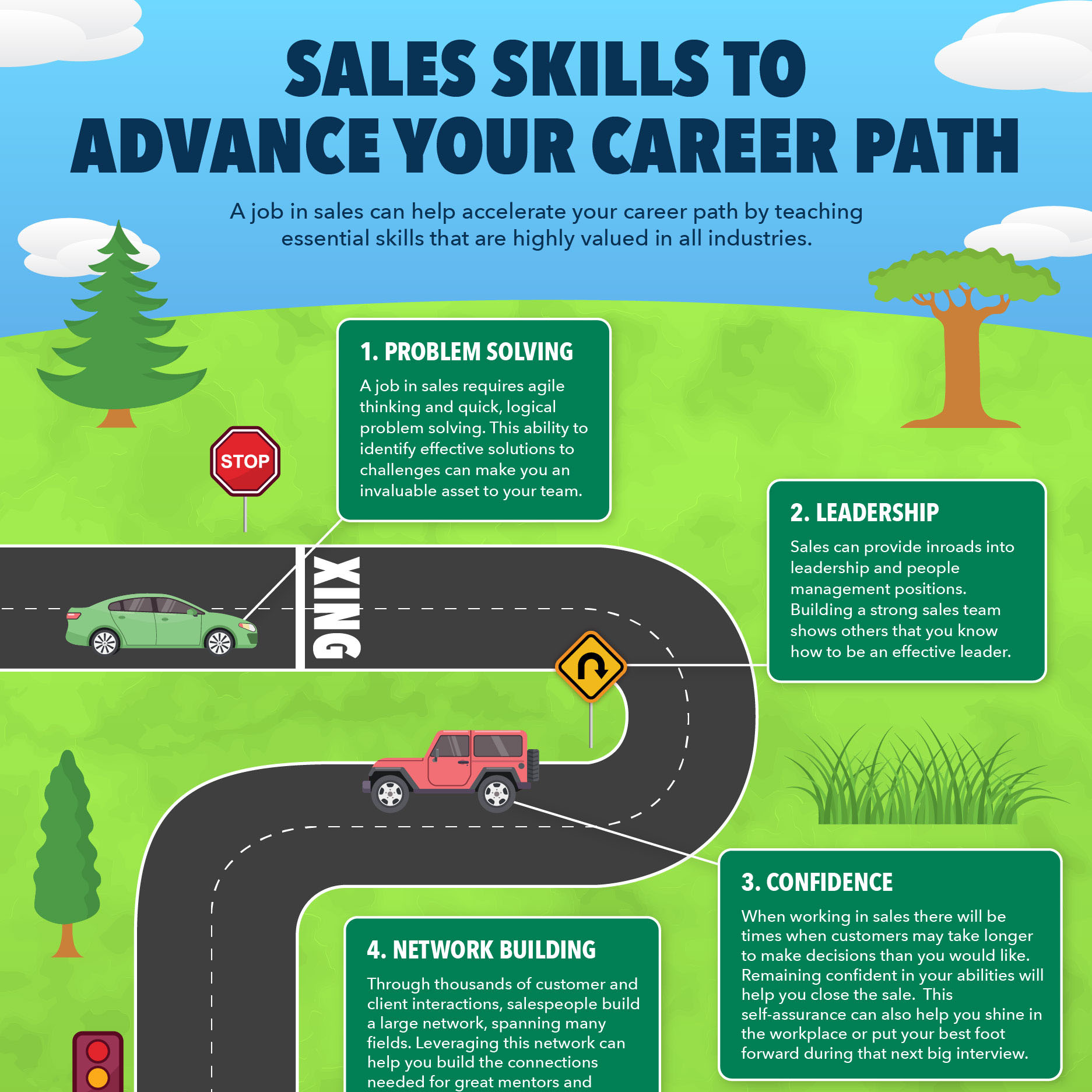
If you’re interested in a job in sales, developing and nurturing skills to catapult your career can help you achieve your career advancement goals. Whether these fall under the umbrella of growing in task-oriented skills or getting to know your strengths, below we show you “the road” to standing out as a leader in your respective role.
Begin by understanding the benefits of problem solving and how that skill can help you become an effective leader. With a leadership position, you’ll also want to hone in on trusting yourself and building confidence as your network grows. Finally, lean into the interpersonal skills developed along the way, such as communication, trust, and your tenacity as you tackle challenges along the way.
These strengths and sales skills can help you in your job and several other disciplines. Perhaps even more important is that they can cross over into your daily life, your personal wellbeing, and state of mind. We hope this infographic on career advancement in sales jobs ultimately helps take your strengths and productivity to the next level!