
Discover practical advice, inspiration, and insights to help you succeed in business and grow both personally and professionally.

Found 0 posts
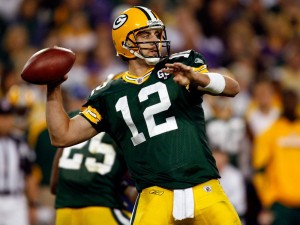
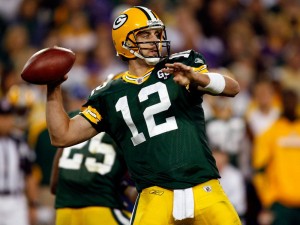
Aaron Rodgers, the Super Bowl MVP, is an example of the tortoise beating the hare. Rodgers was not recruited by any Division I universities. He had to start his college career at an obscure junior college. Cal was recruiting a tight end at that junior college when they happened to notice Rodgers. They gave a scholarship to both players. But Rodgers was not the reason why they made the recruiting visit.
After a stellar career at Cal, experts predicted that Rodgers would be the first or second pick in the NFL draft. Excruciatingly and humiliatingly, he was snubbed and dropped all the way down to the 24th pick. For many of us who watched this on television, it was painful to see.
Rodgers was drafted by the Green Bay Packers and had to sit on the bench behind legend, Brett Favre. Other young quarterbacks were getting more playing time and accolades. Rodgers was patient, diligent and hard working. He finally got his chance when Favre was traded and a few years later, he is a Super Bowl champion.
He was not recruited out of high school, he was snubbed in the NFL draft, he had to wait patiently on the bench, but he finally got his chance and succeeded. It is not how fast you start, but where you end up. As Aesop fabled, “slow and steady wins the race.”
- Gary

How many of us have had days where we can’t quite see eye to eye with anyone? A fight with our spouse or kids. A confrontation with the boss or a coworker. A business deal gone sour.
In my experience, it often boils down to communication or rather, poor communication. We talk at or over each other. Or if we can’t get a word in edgewise, we bide our time to interject our opinions and tit-for-tat responses. Or in anger and frustration, we say or do things we later regret and can’t take back.
But who really wins here? No one. As Habit 4 points out, adversarial conflict without a mutually beneficial resolution can quickly become a “lose-lose” proposition and a sure way to fail.
To reach “win-win” solutions in our interpersonal relations, we should look to Covey’s fifth habit: “Seek first to understand, then to be understood.”
Habit 5 teaches us how to listen with the intent to understand, not to listen with the intent to reply. Effective listening is not simply echoing what the other person has said through the lens of our own experiences. Rather, it’s listening sincerely with our ears, eyes and heart. It’s listening with empathy to understand the other person emotionally and intellectually. Only then can we seek to be understood.
Covey uses the Greek philosophy of ethos, pathos and logos to describe the sequence for effective communication at the heart of Habit 5:
Following this sequence allows us to present our ideas clearly, specifically, visually and in the context of the other person’s perspective and concerns. And in doing so, we significantly increase not only the credibility of our ideas, but also their positive influence and impact.
– Jim
In business and in life, we talk a lot about winning in the context of competition or contests—of beating others to show we’re better at something. Winning means that someone else loses. It’s a “zero sum game.”
While a “win-lose” proposition has its time and place, I’ve found that most situations require a different approach. I recall something Coach John Wooden, a great man and influence in my life, once said: “Winning takes talent, to repeat takes character.”
Sure, winning can prove that we’re good or even the best at what we do. But to win in a meaningful and lasting way, we need to have character. For me, this means finding “win-win” opportunities that rely on cooperation and collaboration, rather than on competition and contests.
Covey’s fourth habit tells us just this—to “think win-win” by seeking mutual benefit from our interactions. While the first three habits are about mastering the “private victory” of independence, Habit 4 moves us into the realm of “public victories” or interdependence. It’s about developing effective interpersonal leadership, which is fundamental to all successful relationships.
Covey, like Coach Wooden, says that character is the foundation of winning. People and organizations with a “win-win” attitude have three key traits:
By practicing Habit 4, we can be true winners who work cooperatively with others to achieve mutual solutions, satisfaction and success. In situations where we can’t achieve a “win-win,” we must have the integrity, maturity and conviction—the character—to walk away agreeably without burning bridges. “Win-win” or no deals, rather than “win-lose” or “lose-lose” deals, are the best ways to be effective in our lives, work and most valued relationships.
– Gary
New Year‘s is a time to reflect on things we want (or need) to change, from getting fit or quitting smoking to getting a better job or spending more time with family. It’s a time to replace bad habits with good ones and to follow through on them.
How many of us, however, have made our resolutions with the best of intentions, only to break them weeks or months later? Perhaps more urgent matters crop up that consume our energies, leaving us too exhausted for anything else. Or perhaps we get discouraged with our progress and lose our desire and resolve to carry on. Whenever I face just such a dilemma, I look to Covey’s third habit, “Put First Things First,” for perspective and guidance.
While Habit 2 is about self-leadership, Habit 3 is about self-management. Leadership defines the "first things,” and management is the discipline to carry them out in accordance with our core principles. “Putting first things first” means we have the will to do something when we don't want to; to say “no” to some things (even seemingly urgent things); and to act on our values, rather than on impulse. Simply, it means focusing our time on what’s truly important.
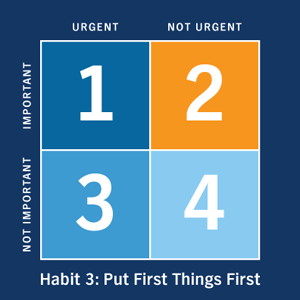
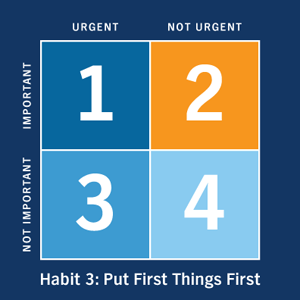
According to Covey, we can spend our time in four ways:
Habit 3 tells us to spend most of our time in Quadrant 2, to minimize our time spent in Quadrant 1 and to stay out of Quadrants 3 and 4 altogether. In doing so, we pursue our highest priorities—the relationships and results that matter. Our crises would then become more manageable because we’re proactively doing the things that prevent them from happening in the first place.
For me, “putting first things first” is not only a habit of effectiveness, but also an act of integrity to our commitments and purpose. By honoring both, we position ourselves to seize the right opportunities at the right time—ones that can enrich our lives and livelihoods in the New Year and beyond.
- Vera Quinn
“To Begin with the End in Mind means to start with a clear understanding of your destination. It means to know where you're going so that you better understand where you are now and so that the steps you take are always in the right direction.”
The second habit of effectiveness, “Begin with the End in Mind,” is a favorite of mine. Covey points out how easy it is to get caught up in climbing the ladder of success only to discover that it’s leaning against the wrong wall. Effectiveness doesn’t depend solely on how much effort we expend, but on whether we expend the effort on the right things—something I’ve tried to remember in my personal and professional life.
To be effective, we must first be self-aware and critically examine how we view others and ourselves. Then, we must imagine or visualize our life’s purpose, which must be centered on a core of unchanging, “correct” principles. Finally, we must bring it into physical being, guided by our conscience and values. Doing so successfully allows us to demonstrate personal leadership, which means we take control and responsibility for our own lives.
My involvement with charities is one example of how I’ve applied Habit 2. The core principles of family, community and philanthropy underpin a personal mission to help those who are less fortunate, to give back to the community and to inspire compassion in others.
According to Covey, developing just such a mission is one way to begin with the end in mind. It focuses us on what we want to be (character) and do (contributions and achievements) and on the principles that guide our being and doing. When we ensure every decision and action is congruent with that mission, we practice Habit 2 successfully and become more effective people—and leaders.
Jim Majeski
There are a lot of aspects to Habit 1, Be Proactive. The most important aspect to me is that “if there is a will, there is a way;” whatever I need to improve about myself, I can with discipline and humbleness.
Constant self-improvement has been vital for me to be successful in my business and personal life. I had to improve on a lot of things. Many of them were quite hard.
Initially, my biggest obstacle was my speech. I had a speech issue as a child and went to speech therapy until I was about thirteen years old. When I quit, the doctor was concerned that by quitting it would jeopardize my ability to get a job which required speaking.
If I let myself believe that limit on myself, I would have been too afraid to go for my business dreams. My mentality was that no one can put limits on me, but me. I was dedicated to improving my speech and building my confidence in conversing with people.
Everyone has things to improve about ourselves. Proactive mentality and action will do it.
Gary