
Found 0 posts

Don't forget to follow Cydcor's channel on YouTube for our latest company videos: https://www.youtube.com/user/Cydcor
Some people believe that a great salesperson is born, not made: that the ability to close a sale is a gift that one must be blessed with at birth. Well, those people are wrong.
Certain people might have an outgoing personality that gives them a bit of an advantage when it comes to networking or closing a deal but the true qualities of a great salesperson aren’t genetic—they’re learned and improved upon with practice.
What qualities does a great salesperson possess? A great salesperson looks just like you. But in order to release the successful salesperson within, you need to identify the qualities a good salesperson must possess in order to achieve success.
As you review this list of qualities a great salesperson must possess begin to make a list of the qualities that you believe you lack or need to develop. Be honest in your self-assessment. If possible, get input from your team, supervisor or sales manager.
Doing this exercise on your own is a powerful technique for improving your sales skills. Including your team members or manager in this process lets them know that you’re motivated and committed to continuous improvement.
You need a plan if you are going to succeed in sales. A great salesperson identifies their goals and keep them in the center of their vision: obstacles never sidetrack them.
You’re not just interested in making a sale. You’re building a long-term relationship with your colleagues and clients. A great salesperson cares about the person as well as the sale.
You always make a great first impression and you enjoy meeting people and hearing about their job, the obstacles they face, and the values that are important to them. A great salesperson listens and remembers.
You know that you have the skills required to get the job done. If you encounter rejection you keep moving forward, understanding that it’s part of the process. A great salesperson never gives up.
You have all of your materials ready whenever you need them. You have internalized your company’s message and methodology. A great salesperson provides solutions for all of their clients’ pain points.
You build your interactions with your customers by developing positive interrogative engagement. Questions are specialized tools you use to identify your customers’ obstacles and objectives. A great salesperson is curious and insightful.
You have a friendly personality and you bring positive energy to all of your encounters. Your customers look forward to working with you because you leave a positive impression upon them. A great salesperson leaves people smiling.
You must get the job done. You understand that making a sale is an urgent problem and that it needs to be solved in a timely manner. Nothing will get in your way because you’re determined to solve the problem in front of you. A great salesperson gets results.
You might hear a no but you don’t accept no as an answer. You’re equipped with the ability to control conversations and will not give up on your pitch. A great salesperson is a gifted storyteller who engages his or her audience.
You understand that success in sales is not won; it’s earned through hard work. You recognize the importance of competition and know that you have to seek opportunities—they won’t come to you. A great salesperson shows up and does their job every day, despite disruptions and without delays.
As you review this list of qualities that make a good salesperson you may identify areas for improvement. Recognizing the need to improve is not a sign of failure. It’s an indicator that you have what it takes to succeed as a salesperson. Are you ready to become the best salesperson you can be?
What qualities make you a great at your job? Did we leave anything out of this list? We want to learn from your experience. Please share your thoughts on our Facebook page and post this article on your social media. Let’s start a great conversation.
We are Cydcor, the recognized leader in outsourced sales services. From our humble beginnings as an independent sales company based in Canada, to garnering a reputation as the global leader in outsourced sales, Cydcor has come a long way. We've done this by having exceptional sales professionals and providing our clients with proven sales and marketing strategies that get results.


“Most people live and die with their music still unplayed. They never dare to try.”
– Mary Kay Ash, Sales Leader and Founder of Mary Kay Cosmetics
Initially, an entrepreneur was a confident man or woman with a deep vision of business. They were convinced that their idea was going to be the solution thousands of customers needed. That’s still a valid definition of the word today or, at least, up to a point.
You know this type of entrepreneur if you’ve ever watched the television program Shark Tank. On each episode intrepid innovators make the pitch of their lifetime to a group of business experts—the sharks. Sometimes an idea that sounds a bit whacky when you first hear about it actually makes sense during the pitch. At other times a sensible idea falls apart fast when the people making the presentation haven’t done their homework.
But these entrepreneurs have an impulse: they want to do or make something better. They have professional insight that makes them believe in their ideas.
Learn more about Cydcor on our business profile on D&B's Hoovers.
Entrepreneurial spirit isn’t limited to billion dollar startups or someone working in their garage on the next-big-digital-thing. It’s possible to embrace an entrepreneurial spirit while you’re working just about anywhere. The key to developing one is to be open-minded, curious, and committed.
Developing your entrepreneurial spirit requires the correct mental motivation. You have to bring the right attitude to your work in order to develop the ability to see opportunity instead of obstacles.
Entrepreneurs work in a competitive space that requires courage. Many people are afraid of competing in business, but don’t back away from a struggle. Use the fear as a catalyst to awaken and engage your inner entrepreneur.
Here are some tips to help you find your entrepreneurial spirit:
You Get Things Done
An entrepreneur tests ideas and learns from the feedback. Act on your inspiration. Make a presentation that explains a new process. Share it with your team or your supervisor. If there is an extra assignment available take it on: an entrepreneur has the drive required to get it done, no matter what the obstacles may be.
You Take Thoughtful Risks
You’ve nurtured the ability to be agile and adaptable. You’re able to produce as part of a team but can also work on a project by yourself and frequently make strategic decisions. Understand that taking risks delivers rewards if you’re successful, but there could be problems if you fail. You’ve developed ease with risk because you’ve done the research. You don’t guess. You make thoughtful decisions that are integrated into your plan.
You Always Ask Questions
You’re uncomfortable with the status quo. There is always a way to improve processes and methods for doing routine things more effectively. You question accepted wisdom and aren’t afraid to speak out against the traditional way of doing things because your ideas will improve the process.
You Emphasize the Positive
You get excited when you face a challenge and enjoy pushing boundaries when you’re in pursuit of a goal. You never think about what you can’t do. You focus on the positive and get other people who work with you excited, too. If one approach doesn’t work, you have another option to try. You don’t find blame—you find solutions.
You Give Voice to Your Passion
Your enthusiasm for your work is captivating. It reveals your passion and the depth of your commitment to reaching your goals. You have a deep understanding of your industry and bring your energy and expertise to all phases of problem solving. When in doubt, remember these powerful words from Warren Buffet: “Without passion you don’t have energy. Without energy, you have nothing.”
Go ahead. Embrace the entrepreneur within. It’s time you did.
How have you developed your inner entrepreneur? What strategies do you use when you decide to turn obstacles into opportunities? We would love to hear your thoughts about this topic. Please comment on our Facebook page and share this article on your social media.
We are Cydcor, the recognized leader in outsourced sales services. From our humble beginnings as an independent sales company based in Canada, to garnering a reputation as the global leader in outsourced sales, Cydcor has come a long way. We've done this by having exceptional sales professionals and providing our clients with proven sales and marketing strategies that get results.

We reward Olympic athletes with gold medals for setting records. We value the person who is able to compete and win on their own terms. But athletes don’t win races on their own: these exceptional people train every day and work with coaches who teach them how to perform under pressure.
Think of yourself as an athlete in your own life. When you’re entering a time of increased pressure you need to continue to train. You also need to share what’s going on with your team at work and your family and friends.
As we take on more assignments we begin to feel pressure, and that pressure brings on stress that’s bad for your health, destructive to your productivity, and complicates your personal life. Here are some strategies for handling pressure at work and at home from Cydcor. Experiment with these tips, and over time, you will develop your ability to achieve success under pressure.
Cydcor is hiring! Head over to CareerBuilder to learn how you can join the Cydcor team today.
Be a Good Communicator
Alert your supervisor when you’re entering a stressful time. If you decide that you’ll have a problem completing your assignments you must inform your supervisor. If you’re unsure about getting something done you need to be responsible and professional enough to ask for help. Be proactive and raise a red flag when you see trouble on the horizon—not when your ship has started to sink.
Control Your Emotions
Problems will arise and pressure will grow depending on time, resources, and the difficulty of the assignment. We often react emotionally when we start to experience pressure at work. Some of us perceive pressure as a challenge while others might experience it as a threat. While emotions make it hard to think clearly and limit your ability to solve problems, know that it’s okay to feel the emotions. Transform them into the energy required to complete the task.
Make a Plan
Climbing a mountain seems impossible, but taking one-step forward is a much more manageable goal. Get the pressure you’re feeling out of your head and onto paper. Break it down into smaller tasks. Be specific. Assign a time frame for each of the steps. If possible, delegate tasks. Make notes about the process once the task is complete so you’ll have an even better plan the next time a similar situation occurs.
Cultivate Bravery
Sometimes, pressure appears seemingly out of nowhere. When something goes wrong you need to be brave. It’s time to change your thinking. Instead of choosing panic, recognize the problem and then tell yourself, “Well, that’s inconvenient, so it’s a good thing I have my notes and I’ve practiced for this situation.” Bravery comes from practice and experience. Imagine what could go wrong and develop some possible responses. Write them down. Visualize yourself completing the tasks in a calm and relaxed manner.
Take Care of Yourself
During times of high pressure it’s easy to get distracted and forget to take care of yourself. It’s at these times that you need to be most aware of your health. Avoid fast foods or unhealthy comfort foods. Eat a balanced diet, drink lots of water, schedule short breaks during the day, get plenty of sleep, and try to get some type of exercise everyday. It relieves stress, lowers your blood pressure, and improves your mood.
Check out other blogs full of business advice from Cydcor, including Building and Maintaining Customer Relationships.
Learn more about what's going on at the Cydcor office by liking Cydcor on Facebook: https://www.facebook.com/CydcorLLC
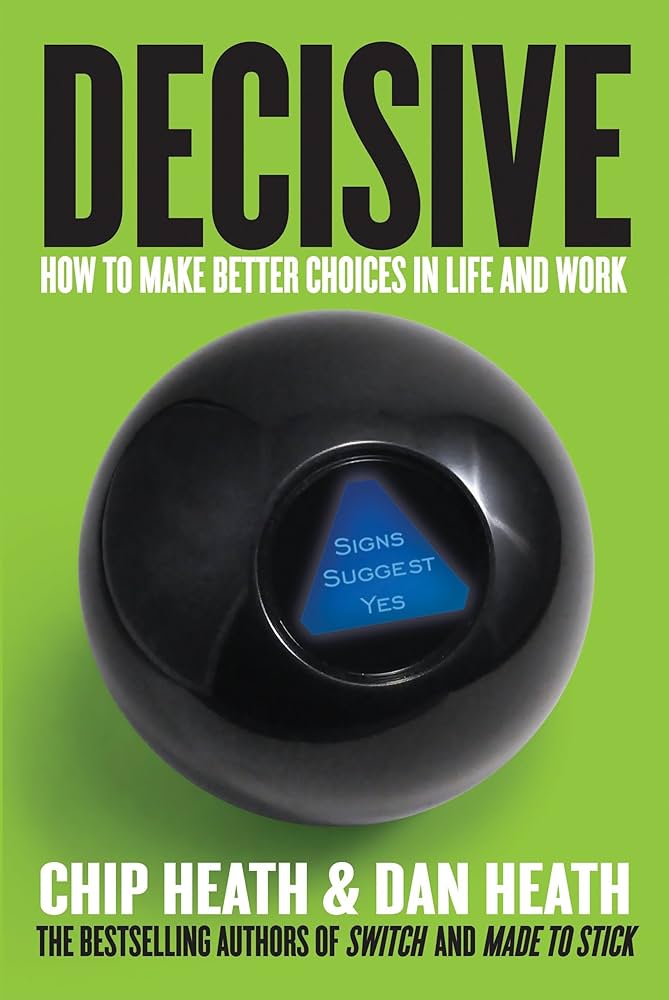
About Decisive: How to Make Better Choices in Life and Work by Chip and Dan Heath
The Heath brothers’ latest book is focused on better decision-making, introduced through a four-step process to ensure we make the right call. Written in an approachable and readable style, Decisive explores how people make decisions, from including a rock star’s decision making system that works to a CEO’s disastrous decision and what they learned from it. Research has revealed that most decisions are made through a variety of biases and irrationalities. From being too confident, to finding information to justify our rationale, our brains are constantly working against us to make the best decision possible. Simply understanding these flaws isn’t the solution; there needs to be a different way to go about it.
Decisive is the Heath brothers’ most powerful and meaningful book yet, offering new strategies and practical tools to make better choices. It’s key to be aware that making the right decision, at the right moment, can make all the difference.
Why Cydcor Reviews recommends this to future leaders:
Decisive is a valuable tool to making objective decisions that will lead to success. The Heaths do an excellent job of presenting a process that works for making decisions, while proving their system with a wide variety of examples. They begin by discussing how the normal decision-making process proceeds in 4 steps, each of which has a "villain" that can negatively impact it. Along the way, readers learn the answers to critical questions, such as: How can we stop the cycle of agonizing over our decisions? How can we ensure that we don’t overlook precious opportunities to change our course? The Heath brothers explain how to navigate the land mines laid by our irrational brains and improve our chances of good outcomes.
Be sure to check out Cydcor's latest videos on our YouTube channel: https://www.youtube.com/user/Cydcor
Our favorite part:
The first part of this book discusses obstacles to good decision-making, and the second part of the book is focused on overcoming them. The book is easy to pick-up, and to understand their system to making better decisions. This is the perfect read for any business professional struggling to make decisions, or knows an important decision is going to be made in the future. The Heaths spend the conclusion of the book detailing a process to make better decisions, which they call the WRAP process: widen your options, reality test your assumptions, attain some distance, and prepare to be wrong. This simple system could be the key to avoiding disastrous decision-making.

Learn more about Cydcor by connecting to us on LinkedIn! https://www.linkedin.com/company/cydcor
Every morning as you prepare for the day you face a simple choice: how are you going to accept the big and the small obstacles that you encounter during the day? Will you let these challenges become impossible obstacles or will you think like an optimist and turn them into opportunities?
Optimism is the tool you need, and the good news is that it can be developed. To engage your optimism, you need to mature the ability to pause for a moment when you encounter an obstacle. During that pause, begin to reframe what you’re seeing. Learn how to see an obstacle as an opportunity. Optimism isn’t a gift you’re born with—you develop it with practice and eventually you will become an authentic optimist, ready for any opportunity.
Consider these 5 ways an optimistic attitude will create positive results in your life. Try one at a time. Remember that becoming an expert with a new tool takes practice.
Acknowledging the good that you already have in your life is the foundation for all abundance. - Eckhart Tolle
It feels good to start your day with a grateful attitude. Your attention moves from the negative to the positive. Consider the good things in your life and your successes; even the small things are important. At the end of the day, before you fall asleep, think of five things that you’re grateful for and feel the happiness they bring to your life.
What matters most is not what these obstacles are but how we see them, how we react to them, and whether we keep our composure.- Ryan Holiday
If you identify something as an obstacle, your mind will respond with ways to make repairs; That means your energy is heading in the wrong direction- toward the negative. When you correctly identify a task, assignment, or a deadline as an opportunity, you begin to activate your optimism and align your skills toward a positive outcome.
Learn more about what Cydcor does for clients and team members by watching our latest video on YouTube.
You do not need to be a victim of worry. Reduced to its simplest form, what is worry? It is simply an unhealthy and destructive mental habit. -Norman Vincent Peale
Low optimism is evident when you’re confronting feelings of anxiety and fear about the future, which often leads to rumination, a negative type of self-talk that imagines everything that could go wrong. An alternative to ruminating is imagining the positive. Create a movie in your head that visualizes your confident self, feeling powerful and achieving success.
People may hear your words, but they feel your attitude.- John C. Maxwell
Language defines our emotional state and creates the space in which we respond to a challenge. Instead of saying, “it’s impossible,” say, “it’s a challenge.” Shift your “no” toward “yes”. Stop complaining about personal problems and things that are getting you down. Greet the people you encounter with an optimistic response. If someone asks, “How are you?” Your response will be, “I’m doing great today.” Optimism is powerfully contagious and will make a great impression on the people you meet.
No one knows more about optimism than a Cubs fan. After waiting 104 years, it's our optimism, and not the winning, that binds us together. We really do believe the next year will be the year. -Grant DePorter
Begin to pay attention to sources of negativity in your life. Does listening to the nightly news lead you to feeling sad? Then find a commentator or writer who answers despair with hope and celebrates positive stories. Volunteer your time working on a cause that helps others. Cydcor provides employees with an opportunity to support Operation Smile. Joining a group that’s doing good means you’re making the choice to be around optimistic people. Eventually, their optimistic view of things will contribute to your success as your optimism also grows.

Cydcor encourages ongoing education and professional development. It’s one of our core values.
Once we’re out of school we often abandon it altogether. And that’s too bad. Because if you want to get noticed at work you need to keep cracking the books—or tablet, smartphone, or headphones—whichever device works for you.
We’ve made personal developmental whole lot easier for you this fall by providing a reading business-focused reading list. There are lots of interesting ideas here that will improve your approach to work and your experiences in life. We’re looking at the big picture and that includes the whole person.
If you don’t like to read alone consider creating a book club at work for those eager to work on their skills too. Invite your coworkers, team members, mentors, bosses, supervisor, manager, and assistants to join the club. Try to arrange a meeting in person before work for coffee and conversation—when everyone is bright eyed.
Now it’s time to start studying. Check out this list:
To Sell Is Human by Daniel Pink
Pink teaches skills that will improve your sales technique and empower you to get others to take action. Develop a better understanding of negotiation, persuasion, and how to pitch.
The Power of Habit: Why We Do What We Do In Life and Business by Charles Duhigg
Duhigg is a New York Times business reporter who investigates scientific research revealing why we have habits and how we can change them. He brings a deep understanding to the study of human nature and personal transformation. Read Cydcor's review of this title here.
The 21.5 Unbreakable Laws of Selling by Jeffery Gitomer
Selling is easy but it takes hard work to be good at it. Gitomer values optimism in his approach to sales. He’ll teach you to craft a positive attitude that wins people over.
Life is What You Make It by Peter Buffet
Warren Buffett’s son, Peter, is an Emmy-winning songwriter and musician. He may have grown up around great wealth but it was never promised to him. He writes about his life journey and the core beliefs about choosing to do good in your work life and in your personal life.
Rework by Jason Fried and David Heinemeier
The authors have some great insight in new strategies for approaching work with a better, faster, easier way to succeed: doing the work and avoid the distractions. It’s a great read for people with an entrepreneurial spirit who want to accomplish great things in their organizations, but also have dreamt of being able to do it on their own.
Jab, Jab, Jab, Right Hook by Gary Vaynerchuk
You need a social media expert like Vaynerchuk to learn how to connect with today’s customers. Your social media message has to be engaging and correctly prepared for specific social media platforms. This book will teach you how tell a good story that wins customers.
Search Inside Yourself by Chade-Meng Tan
Explore the positive power of meditation and learn how to train your attention, develop self-awareness, and form new paths that lead toward wisdom and success. Chade-Meng Tan was one of Google’s first engineers. Not your typical meditation advocate.
The Effective Executive by Peter F. Drucker
Drucker teaches us that an executive has the ability to get the right things done. Learn the importance of innovation, entrepreneurship, and management for the thoughtful executive. It may have been written in the 1960s but its message still rings true.
Cydcor also has a website dedicated to the latest business book reviews. Check out cydcorreviews.com for more recommendations on business books for personal development.