
Found 0 posts
As much as you may want to stay on the clock 24-7, chasing leads and locking down the next deal, it's important to allow yourself time to decompress. Great salespeople know in order to always be closing, sometimes you have to step away for a few. Pulling back from planning and pitching, however, doesn't mean your free time can't be spent putting yourself in position for future sales success.
Discover how to spend free time in ways that don't just help you relax, but also help you continue to sharpen your saw, refine critical skills, and increase your value in the workplace. In this infographic, Cydcor shows you how a few sales titans have used their favorite activities, hobbies and interests to help push themselves to the apex of their industries. You'll meet the man whose sales techniques helped shape modern sales and the woman who turned the color pink into big green. You'll learn the greatest sin in sales and see how the greats have even turned their hobbies into record-breaking achievements.
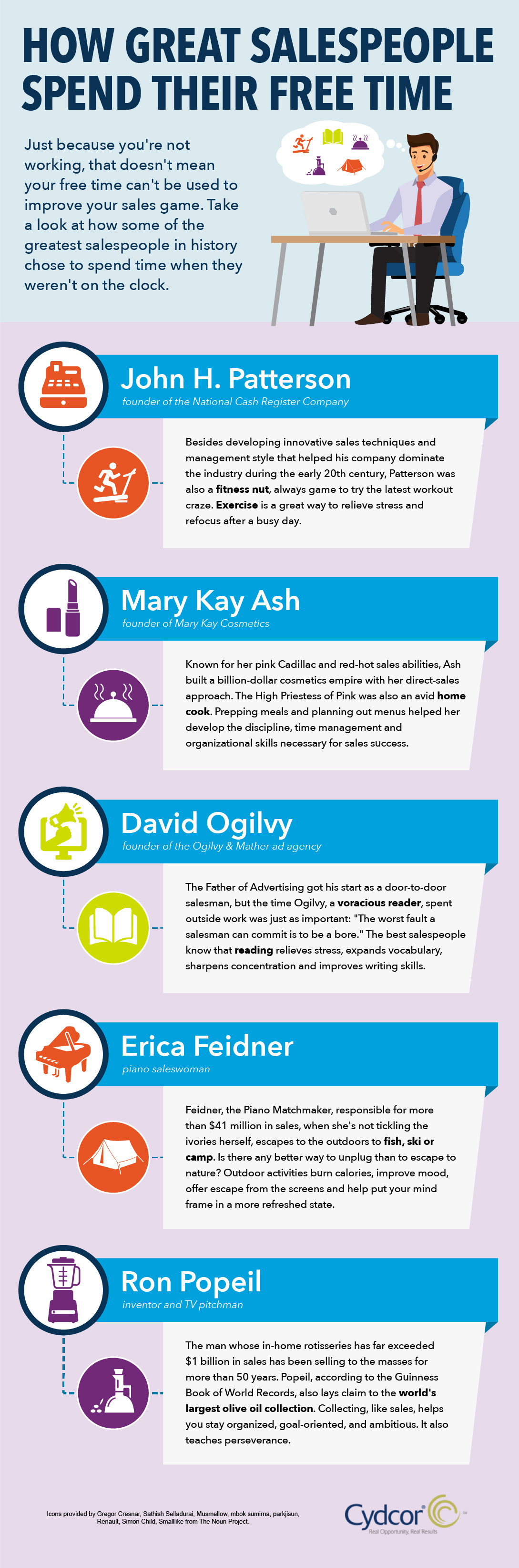
We hope you'll use these examples to help guide how to spend your free time. Print it out and post it at your desk, or use it when you just need a little extra motivation. The next time you're considering working through the weekend, consider instead how you can make the most of your leisure time by finding activities that feed your need to unwind while also fueling your passion for long-term growth.
Share on social media to inspire others. If you're looking for help with time management techniques or productivity tips, we can help in those departments too. Just don't forget to build in some time away for yourself.
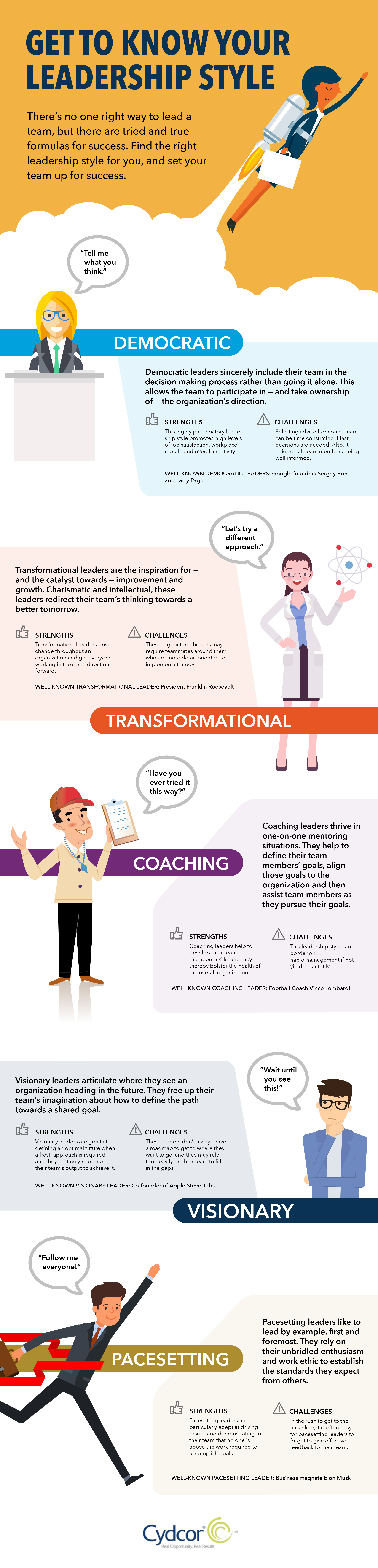
There’s no one right way to lead a team, but there are tried and true formulas for success. As you grow in your career, you’ll get more and more experience leading people. An understanding of different well-known and proven types of leadership can help you find the right path that resonates for you. Find the right leadership style for you, and set your team up for success.
Democratic Leadership Style
Democratic leaders strive to sincerely include their team in the decision making process rather than going it alone. This type of leadership allows the whole team to participate in―and take ownership of―the organization’s direction. This highly participatory style promotes high levels of job satisfaction, workplace morale and creativity. Everyone feels connected to the overall health and well-being of the organization. However, just like any leadership style, it does have its drawbacks. Soliciting advice from one’s team can be time consuming if decisions are needed quickly. Also, it relies on all team members being well informed. Democratic leaders need to strike a balance within their team of both decisive action and rich participation.
Transformational Leadership Style
Transformational leaders work with their team to implement improvement and growth. Charismatic and intellectual, these leaders redirect their team’s thinking towards a better tomorrow. The transformational leader solicits input from her team to identify what areas of the organization require change, creates the vision to guide that change, and then works with her team to execute the redirection. These big-picture thinkers may require teammates around them who are more detail-oriented to implement processes, and they need to develop strategies for soliciting their teammates’ assistance.
Coaching Leadership Style
Coaching leaders thrive in one-on-one mentoring situations. They help to define their team members’ goals, align those goals to the organization and then assist team members as they pursue their goals. The coaching style of leadership can be thought of as a sort of win-win relationship between the leader and her teammates. Coaching leaders help their team members to develop professionally, and they also thereby bolster the health of the overall organization. However, it can be easy to go overboard with this type of leadership and engage in behaviors that border on micromanagement. Coaching leaders need to yield their influence tactfully.
Visionary Leadership Style
Visionary leaders articulate where they see an organization heading in the future. They craft compelling―and often unheard-of―visions of what an organization can become. This style of leadership acts to inspire the team towards a shared goal. The internal drive they spark in their team members frees up creativity, and that freedom allows all the team members to delve into innovative strategies on how to get from Point A to Point B. However, visionary leaders need to keep in close contact with their team and stay involved in the team’s progression. Such an approach keeps everyone grounded as they strive towards the future.
Pacesetting Leadership Style
Pacesetting leaders like to lead by example, first and foremost. They rely on their unbridled enthusiasm and work ethic to establish the standards they expect from others. They are the roll-up-the-sleeves-and-get-dirty types. Pacesetting leaders are particularly adept at driving results, because they set the bar so high. They demonstrate to their team that no one is above the work required to accomplish goals. Pacesetting leaders should be cautious, however, and strive not to become single-minded. Narrowing one’s vision down to a single goal―or several―can mean that effective feedback and mentoring get neglected. Pacesetting leaders need to check in with their team members or a regular basis.
It is likely that you recognize one or more of these types of leadership in your own style. It’s rare that any one individual engenders just one leadership style. Explore which styles resonate with you. By cultivating a dynamic leadership style that encompasses a number of different approaches, you can find the right tools within yourself to tackle even the largest challenges.

Cydcor is thrilled to announce that our 2018, annual Day of Smiles fundraising event is underway! This week, Cydcor team members, along with volunteers from Cydcor's network of independent sales companies will stage a variety of fundraisers around the country. Teams will put their sales talents to work, building awareness and raising funds on behalf of Operation Smile. One of the oldest and largest volunteer-based organizations dedicated to improving the health and lives of children worldwide, through access to surgical care, Operation Smile provides life-changing cleft lip and palate corrective surgeries at no cost, to children in need.
Teams participating in the event will get creative, planning fundraisers that vary from car washes and apparel sales, to bake sales and sporting events. Each year, Cydcor's Day of Smiles event brings in thousands of dollars to support Operation Smile's mission to ensure every child has access to safe surgical care. In addition, Cydcor team members and participants from the network of independent sales companies have had the opportunity to attend five Operation Smile medical missions around the globe that they themselves have helped fund through their outreach efforts. On Operation Smile medical missions, surgical teams comprised of credentialed medical volunteers provide life-changing surgeries for children with cleft lip and cleft palate, as well as free medical assessments, and support for family and loved ones of patients. Recently, Operation Smile’s founder, Dr. Magee personally thanked Cydcor for its ongoing contribution.
Cydcor has been partnering with Operation Smile since 2010, collaborating with the sales company owners in Cydcor’s network in a variety of fundraising projects. To date, Cydcor has raised nearly $1,000,000, to help Operation Smile ensure no child goes without surgical care. That’s enough to heal more than 4,000 smiles. This is an important year for Cydcor’s Day of Smiles, as we have that $1,000,000 mark in our sights and we plan to hit our goal!


Mobile devices are more than just modern conveniences. In today’s business climate, having the right mobile tools at your disposal is critical to your professional survival. Staying connected around the clock is the accepted norm, not the exception and remaining competitive means keeping yourself up-to-date on the best apps to help you work smarter, faster, and better.
As thousands of new apps are released into the market every day, staying current on the best and most effective apps for improving productivity and performance can feel like a very daunting task. Luckily, Cydcor has created a shortcut to help you wade through this vast ocean of available apps. We’ve compiled a list of some of most useful apps to help busy professionals stay organized, communicate better and more efficiently, quickly get where they need to go, and be more productive.
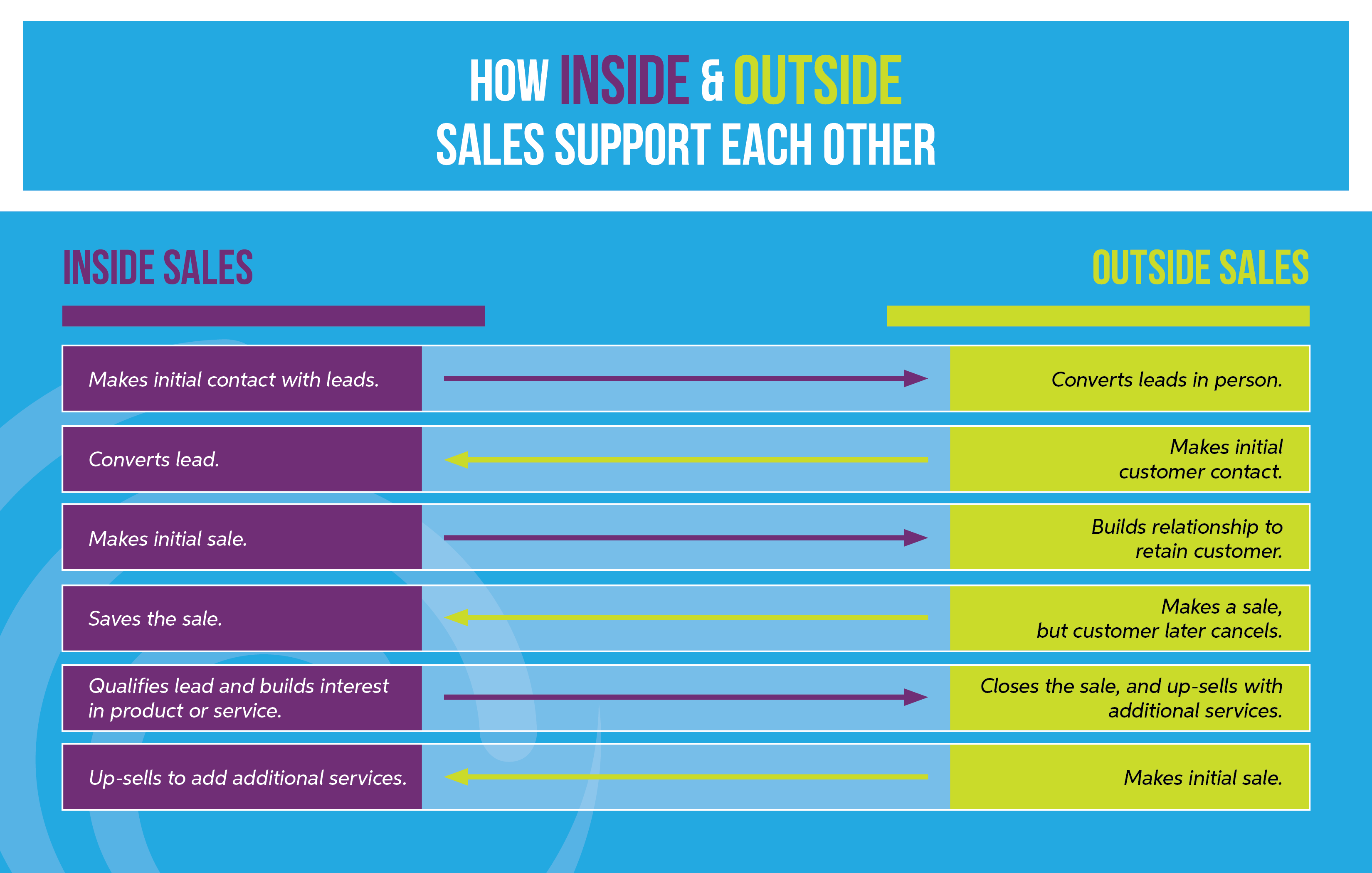
Companies have many options when it comes to how to build and structure their sales strategies and approaches, and one important decision they will have to make will be whether to invest in inside sales or outside sales. To weigh the benefits and advantages of each sales approach, it’s important to clearly identify what each option entails.
Inside sales are generally done “inside,” from a single location. Inside sales do not take place in person, and they can include interactions ranging from phone calls to emails, chats, social media, and even texts.
Outside sales refers to situations in which a sales rep makes in-person, face-to-face contact with the customer. This can include door-to-door sales, sales made through visits to customers’ homes, offices and local businesses, or retail sales.
Both inside and outside sales can offer advantages to companies wanting to maximize revenue and keep costs manageable. To achieve the absolute best sales and customer acquisition results, companies should pursue a mixture of both. When optimized, inside and outside sales can support each other, helping companies acquire more customers, improve their overall conversion rate, earn greater revenue from customers, and build stronger relationships with the customers that could support better customer retention.
How do inside and outside sales teams work together? Customers who are first contacted by an outside field rep, for example, may have some interest in a product or service, but he or she may ultimately decide against making a purchase. In cases like this, an inside sales rep may be able to follow up with this customer by phone or email to find out why he or she decided against the product or service, and by offering additional information, the sales rep may be able to change the customer’s mind. The inside sales rep may also be able to present alternative products to the customer, such as a different service package, that might better fit the customer’s needs.
Alternatively, the inside sales rep might be able to refer customers to outside sales reps after making initial contact. This customer now has some awareness of a product or service and has built a relationship with the brand. The outside sales rep may then be able to work one-on-one with the customer to find a product or service solution that fits their needs.
These are just a few ways inside and outside sales teams can work in partnership to drive better overall sales results for your company.
Other ways inside and outside sales may be able to work together are:
Customers are individuals, and not all customers will respond the same way to the same sales approach. By enlisting both inside and outside sales, you give your company more flexibility to communicate with the customer at a variety of touchpoints and in a variety of ways. By incorporating both sales channels, you can acquire more customers, more easily address weaknesses in your sales funnel, gather more valuable data and customer insights, and boost revenue by giving the customer more information and more options.
Below is a breakdown of the advantages each sale method offers:
Both inside and outside sales offer major benefits, and a winning strategy for sales revenue growth is one that combines the two, allowing them to work in partnership to deliver the best possible results. A sales program that includes both inside and outside sales can interact with the customer at multiple stages of the sales cycle, building product knowledge, strengthening the relationship with the customer, growing trust, fostering interest, and gaining valuable insights about what the customer needs and wants.
To reap the advantages of both inside and outside sales, the smartest organizations are partnering with companies like Cydcor, a leader in outsourced sales and marketing. Cydcor has experience building full-service sales and customer acquisition programs that combine effective outside sales, with inside sales techniques. Cydcor drives high sales volume using traditional feet on the street sales methods, and it supports these efforts through multi-channel and tele-sales techniques to capture, retain, or upsell leads with which the outside sales team has already made contact. By entrusting a company like Cydcor, with expertise and experience in both outside and inside sales tactics, companies benefit from a tested, disruptive, and winning formula that consistently delivers results.
Entrepreneurship is an exciting opportunity for those, with the right attitude and pioneering spirit, to build something from the ground up, take ownership of their time and decisions, and potentially, achieve financial independence. But what are the characteristic of successful entrepreneurs? Why do some succeed while some don't?
Becoming a successful entrepreneur requires unwavering focus and commitment to your craft, strong relationships, and an open mind to new perspectives. We asked a group of entrepreneurs about what drives them and what they believe it takes to achieve success. What we discovered, is that even when you do everything right, success is not guaranteed, but the thrill of the journey, the chance to influence and support others, and the potential payoff are what drive daring entrepreneurs to venture down this career path time and again.
COMMON CHARACTERISTICS OF SUCCESSFUL ENTREPRENEURS
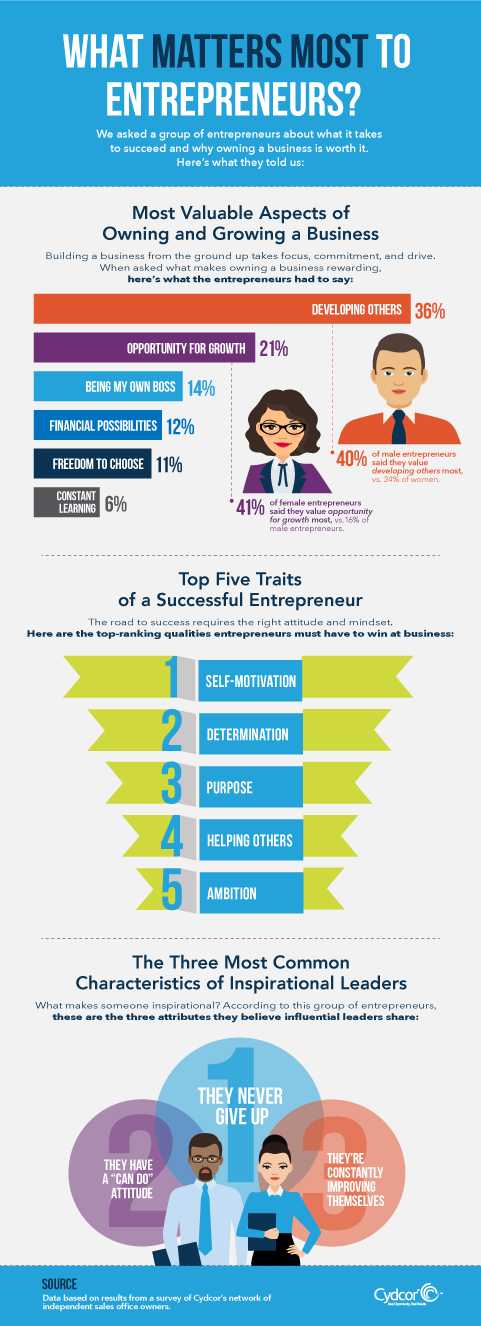
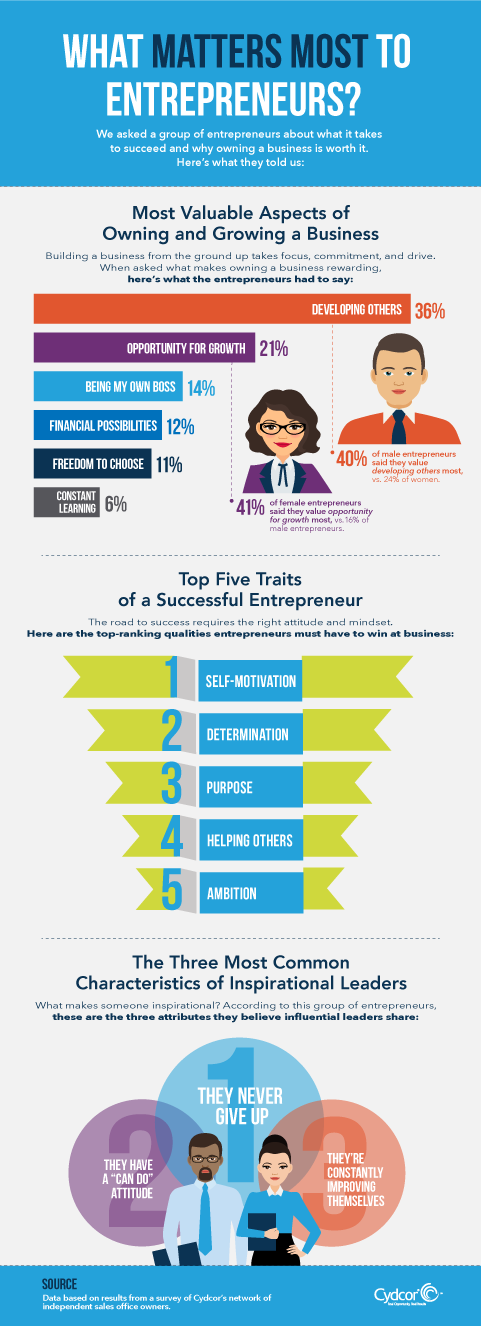
What sets entrepreneurs apart is not their mastery of specific hard skills such as writing, programming, or public speaking. From our discussions with independent business owners, we learned that the top characteristics of successful entrepreneurs are rooted in soft skills shaped by the right attitude and mindset, seen in the infographic below.
Self-Motivation
It’s easy to talk about building a business, but it’s entirely another thing to do it. The number one characteristic of successful entrepreneurs is self-motivation—the ability to put ideas into action. Think about some of the best-known entrepreneurs. Steve Jobs, for instance, didn’t wait for a company to come looking for him to build a new kind of personal computer. Instead, he partnered with the right people, turned his ideas into real-life products, and convinced the public that they needed the Apple Computer. Self-motivation can mean the difference between dreaming and achieving.
Determination
Our business owners identified determination as another major characteristic of successful entrepreneurs. This important trait is the drive that helps us follow through once we start. It’s what pushes us back up when we fall, and keeps us moving through uncertainty until we reach our long term goal.
THE BENEFITS OF ENTREPRENEURSHIP
Going from ideas to great products or startup to corporation is a remarkable feat that requires passion, focus, and resilience. It’s not a straight path, and there will often be twists, turns, and moments of uncertainty. We wanted to understand what makes it all worth it? What is it about the life of an entrepreneur that continues to drive so many to brave those, sometimes, stormy waters?
Developing Others
The majority of entrepreneurs said the most valuable benefit of entrepreneurship is the opportunity to help others grow and develop. Think about it. At one point, these entrepreneurs were employees, too. At the helm of a business, an entrepreneur has the experience to recognize greatness in others, and the leadership expertise to inspire them to get there.
Opportunity for Growth
Have you ever felt like you’re not getting anywhere in your current role, or looked up the organizational chart and didn’t like what you saw? Another major benefit of entrepreneurship is the opportunity for growth. And not just career growth, but personal growth, as well. Taking a chance on yourself and pursuing your passions will test your comfort zone, but the freedom to be your own boss and do what you love is an unparalleled experience and a unique benefit of entrepreneurship.
See what else entrepreneurs had to say about why owning and growing your own business is worth it.
Building a successful business of your own is not something that happens overnight. It takes unwavering dedication, unshakable focus, and a healthy dose of endurance. It’s an accomplishment, much like a marathon, that is achieved one step at a time. But for those who stick with it and embrace the adventure, the benefits of entrepreneurship can be life-changing.