
Discover practical advice, inspiration, and insights to help you succeed in business and grow both personally and professionally.

Found 0 posts

What would have happened if Walt Disney gave up animation after being fired from one of his first jobs? What if J.K. Rowling let depression keep her from picking up a pen? What if Steven Spielberg let self-doubt stop him from making Jaws? While we’ve all heard the expression “overnight success,” but stories of instant fame and wealth are the exception, not the rule. More often than not, the most successful celebrities and entrepreneurs in the world endured at least one, if not a string, of setbacks, failures, and blows to their egos before hitting it big. Remarkably, they all kept at it, and went from failure to fame, achieving success beyond anyone’s expectations, even their own. Had they let those temporary roadblocks hold them back, however, they might have allowed those failures to define them. Most of us will fail at some point in our lives, and we’ll probably do it more than once. But, letting the occasional defeat stop you from pursuing your passion could mean denying yourself the opportunity to achieve more than you ever dreamed possible. Each of these, now famous, celebrities started out just like you.

It’s hard to imagine now that he’s one of the richest and most powerful entrepreneurs in the world, but those who met Gates right after his first company, Traf-O-Data failed in 1980, might not have been too impressed with his business acumen. The company, which he created while he was in his senior year of high school with business partner Paul Allen, seemed like a clever solution for gathering traffic-flow data, except for one problem, they didn’t have any customers. Gates and Allen got so caught up in the technology, they forgot to do any market research. Don’t feel too bad for Gates though, as of September 2017, the Microsoft Corporation cofounder is the richest person in the word, with an estimated net worth of $84.8 billion, according to Wikipedia.

He may be the father of the world’s most beloved animated mouse and the founder of what would grow into a multi-billion-dollar, mega-empire, but as a young cartoonist, not everyone could see his potential. In 1919, the Kansas City Star newspaper fired Disney because, according to his editor, he “lacked imagination and had no good ideas.” Lucky for Disney, his creative drought would eventually end, allowing him to go from failure to fame after coming up with a few good ideas that just happened to change entertainment forever, including Mickey Mouse, the multi-plane camera, and Disneyland. This one-time labeled, “creative dunce” also holds the record for most Academy Awards as a film producer.

He might be the most recognizable and best-know scientific genius of all time, but as a child, Albert Einstein was so far behind developmentally, that teachers were concerned he might have been mentally disabled. The Nobel-prize-winning physicist didn’t speak until he was four years old and didn’t read until he was seven. He would later be expelled from one school and refused admittance to another one in the years before he took the physics world by storm.

She may be mom to the world’s favorite boy wizard, but before that, Rowling was a broke mom. Recently divorced, on welfare, and clinically depressed, she struggled for five years to complete the first Harry Potter book, writing while her new baby napped. The book was rejected twelve times before finding a publisher, and the rest is history. Fighting her way from failure to fame, today, J.K. Rowling is wealthiest author of all time, and one of the richest women in the world.

While women all over the world fantasize about their dream wedding, themselves picture-perfect in a designer, Vera Wang gown, Wang herself dreamed of representing the United States as part of the 1968 US Olympic figure-skating team. But, after years of intense training, she failed to make the team. Later, after serving 15 years as a senior editor at Vogue magazine, she was overlooked when it came time to name the magazine’s new editor-in-chief. It wasn’t until she was 40 years old that she began her designing career, and the rest is history. Today, Vera Wang’s brand is worth over $1 billion, and the average Vera Wang wedding gown can sell for upwards of $13,000.

Before becoming the master of suspense he is today, Stephen King had more than a little trouble getting his writing career off the ground. A few publishers apparently thought Kings first novel, Carrie, wasn’t up to par – 30 to be exact. King got so fed up with the constant string of rejections that he threw the manuscript for Carrie in the trash. Lucky for horror fans around the world, King’s wife, confident in her husband’s talent, retrieved the book and encouraged him to keep going. Eventually, the writer would discover that one or two people were actually interested in what he had to say; King has published more than 50 novels and has sold more than 350 million copies of his books. His work has also been transformed into dozens of award winning movies and series including The Shining, The Shawshank Redemption, Misery, and the story he, himself, once trashed, Carrie.

Jaws. E.T. Close Encounters of the Third Kind. Jurassic Park. They’re probably some of your favorites, and you’re not alone. Steven Spielberg’s movies include some of the highest grossing blockbusters of all time. In fact, he is said to have invented the concept of summer blockbuster with the release of Jaws, for the first time, creating the kind of fan fervor, and lines around the block, we often see today. He’s won multiple academy awards, and he is possibly the most recognizable film director in the world. As a young, aspiring director and film student, however, Spielberg was rejected from USC’s top-ranked film school three times, because of his mediocre grades. Don’t feel too bad for poor Steven though, the school would eventually award him an honorary degree in 1994, after making some generous donations, that most likely didn’t put a dent in his $3 billion estimated net worth.
The next time someone tells you to give up, calls you untalented, or rejects your idea, remember you know best what you are capable of. Take your failures in stride and realize that each one is just bringing you one step closer to your destiny. You can become your own success story. Don’t give up on you dreams, Instead, use those naysayers to fuel your desire to persevere and make your dreams a reality. Give it everything you’ve got, and remember that today you might feel like a failure, but the only way you truly fail is by giving up. Brush yourself off, stay committed, and live to fight another day, and you might be surprised what you can achieve.

There’s the approach. Then the smile of recognition. The beginning of a friendly greeting. Then…a blank. For budding business relationships, there’s nothing quite like that awkward feeling that accompanies a moment of forgetfulness. Remembering people’s names is something that sets relationships on the right path and sets you apart from the crowd. Hone your craft with the help of these five tips for remembering names.
You never know what a new relationship can lead to. Treat each meeting like it could be the beginning of something great. Approach each new interaction with the mindset that it might have an impact on your future. Remember that the conversation you are having and the person you are meeting are important—and that this relationship could turn out to be more significant than you know. With this attitude as your starting point, you will naturally place a higher priority on remembering people’s names.
When meeting new people, remembering names can come down to one simple act: really listening. It may sound obvious, but in the busy reality of our lives, giving our full attention might not always be so easy. When you’re meeting someone, cast aside other tasks and focus on the interaction that’s right in front of you. Instead of thinking about the next thing you’re going to say, focus on the person’s name as they’re saying it to you. If you happen to miss it the first time around, don’t fake it. Instead, show them the importance of your conversation by apologizing and asking to hear it again.
A simple tip for remembering names is using it immediately in conversation. Perhaps the easiest way to accomplish this is to repeat it back to them right away, saying something like, “Nice to meet you, Gail.” Another possible tactic is to ask them which form of their name they prefer. Asking if it’s Dave or David builds in another ordinary repetition of their name to help you remember. After this, using their name naturally—that is, occasionally—in the rest of your conversation will help to make it stick in your mind even more. Just be careful not to overdo it, or you could begin to sound robotic.
For some, associating a name with another concept is a helpful strategy for remembering people’s names. This can take many forms, and it’s entirely up to you to choose which way works best. It can be as simple associating their name with a particular detail they reveal about themselves, like a hobby or interest. You can also come up with a rhyme or a piece of alliteration to help you remember.
After meeting someone, a very effective way to remember their name is to write it down. Whenever possible, write it down by hand, rather than on your phone or computer. Research shows that the act writing things down helps nurture comprehension and retention. What’s more, by jotting down a person’s name and any important details from your meeting you can refer back to these notes in the future to help make the most of your new relationship.
Remembering people’s names isn’t rocket science. In most cases, it just comes down to good habits. To make any new behavior a habit, you must decide that it’s important enough to you and your professional future to do the work it will take to make that behavior a regular part of your routine. While remembering names can sometimes seem insignificant, it could easily give you that edge over a competitor when fighting for a big project, interviewing for a job, or attempting to earn a client’s business.
To get inspired and read other helpful sales and business insights from Cydcor, check us out on Facebook, LinkedIn, Instagram, and Twitter.
We are Cydcor, the recognized leader in outsourced sales services. From our humble beginnings as an independent sales company based in Canada to garnering a reputation as the global leader in outsourced sales, Cydcor has built our name on provide our clients with exceptional sales professionals and proven sales and marketing strategies that get results.


Building resilience is one of the cornerstones of success in business—especially entrepreneurial pursuits. The ability to pick yourself up, dust yourself off, and get right back to the task at hand is paramount to success in business, at every level.
Whether you’re a seasoned sales professional or just starting out on your entrepreneurial journey, these tips for building and maintaining personal resilience will put you on the path toward having the strength and flexibility required for success.
Pick Your Battles
Knowing your strengths is a key component to success in any endeavor; leveraging your strengths in your work will get you farther, faster, than spinning your wheels in areas where you lack knowhow and confidence. No one is good at everything, though, and learning when to power through a difficult course of action versus when to delegate is important. Building resilience includes challenging oneself, but it also means knowing when a task is best given to someone else—and being OK with that.
Build & Maintain Your Self Confidence
Building personal resilience relies heavily on recognizing your strengths and maintaining your confidence in them. You know what you know—make sure others know it too! Personal resilience takes practice and self-reflection. Take some time to honestly consider which facets of your profession you’re best at and make a list you can reference to boost your self-confidence and bolster your self-awareness.
Hone Your Skills
When you know your strengths, you can get to work on improving them. When your areas of expertise and your specialized skills are all second nature, the business of bouncing back from times of difficulty—or even failure—becomes easier. Call on your talents, experience, and knowledge to help you get through tough times, and build on those unique advantages to move on from setbacks. Honing your skills also reinforces your self-confidence, creating a powerful feedback loop for yourself as you maintain your personal resilience.
Be a Team Player
Business is built on relationships. You want—need—to be someone people want to work with. Reliable. Helpful. Trustworthy. Talented. The list of superlatives people want from their teammates and networks can go on and on, but the bottom line is this: being an indispensable member of your professional community is key to building professional and personal resilience. When your network is strong, bouncing back and moving forward—and extending successes—is much easier, because you can call on those relationships as you seek new opportunities, constructive feedback, and emotional support.
Manage Emotions During Losses—and Wins
The most resilient people have a keen understanding of their emotions and are skilled at managing them. This doesn’t mean building resilience requires stoicism—the opposite, in fact. Those who take the time to see the good in things and spread their positive outlook find it easier to work through rough patches. They see each experience, positive or negative, as a way to learn. These are also the people who are self-aware enough to see when things are going well and celebrate them.
What strategies do you use for building your personal resilience? Share your thoughts on Twitter and be sure to follow @Cydcor on Instagram to learn more about our company and our culture.


In business, as in life, building relationships is key. No matter how talented you are or what service you provide, if your customers don’t like you or, worse, don’t trust you, you’re not going to get very far. Networking is a critical part of advancing your career, but making contacts will only serve you if you can foster them into fruitful business relationships.
Whenever you’re meeting with a client or a connection, especially a new one, make time in advance to learn a bit about them. Whether this means speaking to mutual acquaintances or researching online, doing your homework on a prospective customer or contact will allow you to identify common ground and better equip you to answer their questions or provide what they’re looking for. If you want them to give you their business, it’s crucial to come prepared. Coming to meetings well versed on the other party’s needs also assures them you will go the extra mile on their behalf.
Business relationships are investments. We invest time and energy into them with the expectation that they will provide value. Just as you’re hoping to leverage your business relationships to achieve certain goals, so are your colleagues, business partners, and customers. So, consider what value you’re providing back to them. In some cases, it may be helpful to illustrate what you have brought to the relationship by presenting hard numbers and proof of results. By making a strong case for the overwhelming benefits of the relationship, you stack your deck for success, and ensure the business relationship with grow and flourish in the future.
There’s a reason why your parents always said, “Honesty is the best policy.” It is. If you promise your client the sun, moon and stars when networking, then that’s exactly what they’re going to expect. It’s important to set ambitious goals, but it’s just as important to deliver. If you can’t come through, be proactive about letting your client know. Otherwise, any frustration they feel will be compounded by your having mislead them and your business relationship may suffer as a result. To avoid this scenario, set reasonable goals and manage expectations with customers, bosses, and colleagues. Promise only what you are absolutely certain you can deliver. It’s always better to surprise someone by providing more than expected rather than over-promising and under-delivering.
Ultimately, you’re here to serve your customers. If they feel your own agenda is taking priority over theirs, your business relationship will not last very long. You can only meet someone else’s needs if you listen to what those needs are, so always be as ready to hear as you are to speak. Listen to Cydcor President, Vera Quinn on the subject of really hearing your client:
You likely learned about playing “hard to get” in high school. In many ways, the same rules apply when building business relationships. If you appear too interested – contacting them incessantly, coming across as desperate for their business – they may start to suspect that you’re not that hot a commodity. You should seem interested in securing their business and maintaining a fruitful partnership, but make it clear that you have other irons in the fire and will be fine should things not work out. As we said earlier, if you’re clearly demonstrating the value you’ll bring to the relationship, they’ll be interested.
It can be a fine line between projecting confidence and arrogance, but it’s one you’ll have to navigate if you hope to form long-lasting and fruitful business relationships. A client or contact will be impressed by your knowledge and expertise but annoyed if it crosses over into condescension. You demonstrate your value to this business relationship best by doing your job well, not by being your own hype-man. An easy way to avoid sounding arrogant is to continuously show the other party that their thoughts and opinions matter. Remember that all business relationships are partnerships of some kind, meaning that both parties rightly feel that they matter and their ideas have value.
Often we make ourselves most available when we want something, and less so when we don’t. After you complete whatever business you’ve conducted with a client or contact, it can be easy to fall out of touch. Don’t fall into this trap. Make an effort to stay engaged and to continue networking, even when there’s nothing clearly “in it for you.” Business relationships, like fires, require constant kindling, or they can fizzle out. By checking in with clients and contacts on a regular basis, you demonstrate your long-term investment in the relationship and dedication to your customers.
Ultimately, maintaining a real, lasting business relationship is a marathon, not a sprint. It takes time, it takes work, and it takes commitment. By constantly providing value to your client or contact, consistently delivering what you promise, and by taking the time to nurture the relationship, you can build relationships that will continue to pay off for years to come.
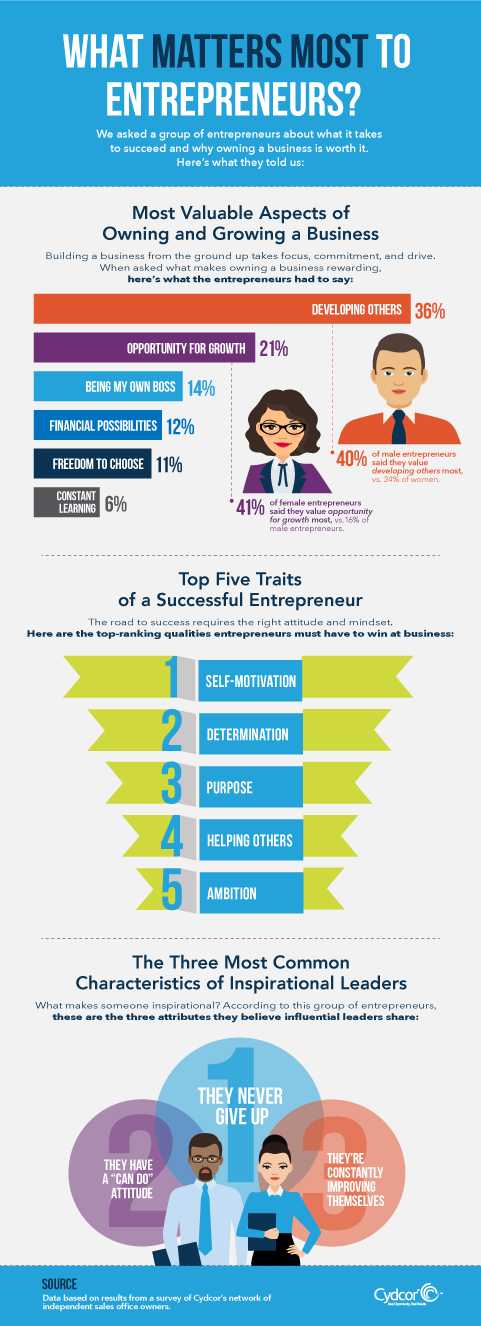
Entrepreneurship is an exciting opportunity for those, with the right attitude and pioneering spirit, to build something from the ground up, take ownership of their time and decisions, and potentially, achieve financial independence. But what are the characteristic of successful entrepreneurs? Why do some succeed while some don't?
Becoming a successful entrepreneur requires unwavering focus and commitment to your craft, strong relationships, and an open mind to new perspectives. We asked a group of entrepreneurs about what drives them and what they believe it takes to achieve success. What we discovered, is that even when you do everything right, success is not guaranteed, but the thrill of the journey, the chance to influence and support others, and the potential payoff are what drive daring entrepreneurs to venture down this career path time and again.
COMMON CHARACTERISTICS OF SUCCESSFUL ENTREPRENEURS
What sets entrepreneurs apart is not their mastery of specific hard skills such as writing, programming, or public speaking. From our discussions with independent business owners, we learned that the top characteristics of successful entrepreneurs are rooted in soft skills shaped by the right attitude and mindset, seen in the infographic below.
Self-Motivation
It’s easy to talk about building a business, but it’s entirely another thing to do it. The number one characteristic of successful entrepreneurs is self-motivation—the ability to put ideas into action. Think about some of the best-known entrepreneurs. Steve Jobs, for instance, didn’t wait for a company to come looking for him to build a new kind of personal computer. Instead, he partnered with the right people, turned his ideas into real-life products, and convinced the public that they needed the Apple Computer. Self-motivation can mean the difference between dreaming and achieving.
Determination
Our business owners identified determination as another major characteristic of successful entrepreneurs. This important trait is the drive that helps us follow through once we start. It’s what pushes us back up when we fall, and keeps us moving through uncertainty until we reach our long term goal.
THE BENEFITS OF ENTREPRENEURSHIP
Going from ideas to great products or startup to corporation is a remarkable feat that requires passion, focus, and resilience. It’s not a straight path, and there will often be twists, turns, and moments of uncertainty. We wanted to understand what makes it all worth it? What is it about the life of an entrepreneur that continues to drive so many to brave those, sometimes, stormy waters?
Developing Others
The majority of entrepreneurs said the most valuable benefit of entrepreneurship is the opportunity to help others grow and develop. Think about it. At one point, these entrepreneurs were employees, too. At the helm of a business, an entrepreneur has the experience to recognize greatness in others, and the leadership expertise to inspire them to get there.
Opportunity for Growth
Have you ever felt like you’re not getting anywhere in your current role, or looked up the organizational chart and didn’t like what you saw? Another major benefit of entrepreneurship is the opportunity for growth. And not just career growth, but personal growth, as well. Taking a chance on yourself and pursuing your passions will test your comfort zone, but the freedom to be your own boss and do what you love is an unparalleled experience and a unique benefit of entrepreneurship.
See what else entrepreneurs had to say about why owning and growing your own business is worth it.
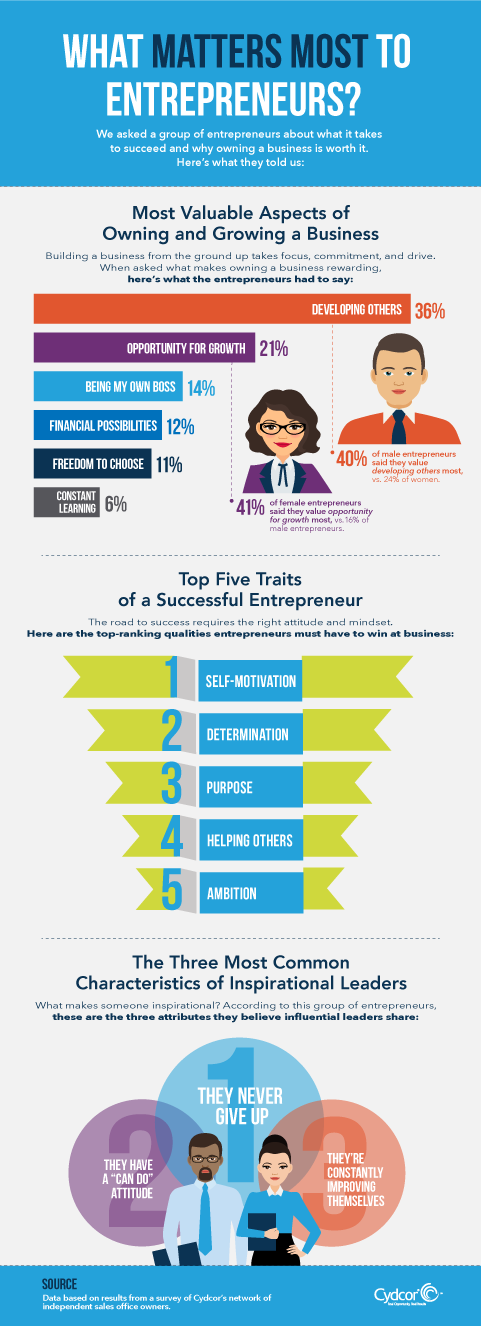
Building a successful business of your own is not something that happens overnight. It takes unwavering dedication, unshakable focus, and a healthy dose of endurance. It’s an accomplishment, much like a marathon, that is achieved one step at a time. But for those who stick with it and embrace the adventure, the benefits of entrepreneurship can be life-changing.


Most highly successful people share one important trait: focus. They know what their purpose is and what they want to achieve, and everything they do and say aims to bring them closer to their goals. But maintaining that intense level of dedication and drive takes effort.
When striving toward any goal, it’s important to find ways to remind yourself why that goal is so important to you so you can stay focused. Creating a personal mission statement gives you a way to identify your values, commit to your goals, and put yourself on a path toward success.
QUESTIONS FOR CREATING A PERSONAL MISSION STATEMENT
To create your own personal mission statement, start by asking yourself these questions:
THE BENEFITS OF HAVING A PERSONAL MISSION STATEMENT
There are many benefits to creating a mission statement to help you reach your goals:
PERSONAL MISSION STATEMENTS FROM NAMES YOU MIGHT RECOGNIZE
High achievers in many industries live by a personal mission statement. Here are a few:
Gary Polson, CEO, Cydcor
“As CEO of Cydcor, I will assure the long-term growth and health of Cydcor and the opportunity by 1) attracting, developing, motivating and recognizing our people; 2) developing a culture of sustainable success; 3) overseeing the strategy; 4) focusing on the financial health of the field; and 5) building relationships with our key people and connecting with the newer people.”
Richard Branson, CEO, The Virgin Group
“To have fun in (my) journey through life and learn from (my) mistakes.” (Motivated Magazine, 2011)
Oprah Winfrey, CEO OWN
“To be a teacher. And to be known for inspiring my students to be more than they thought they could be.” (Oprah.com, 2009)
Amanda Steinberg, CEO, Dailyworth.com
“To use my gifts of intelligence, charisma, and serial optimism to cultivate the self-worth and net-worth of women around the world.” (Forbes, 2014)
Creating a personal mission statement is just one more way you can position yourself to reach your goals. Writing down your goals, values, and vision for your future is a form of commitment in itself, but creating a mission statement does not guarantee success. In order to make your mission statement work to your benefit, you must imbue it with importance. Whether daily, weekly, or monthly, check in with and remind yourself of your mission statement to keep yourself faithful to its message. Consider keeping it by your bedside, taped to your bathroom mirror, or posted at your desk. You could even use your mission statement as part of your social media profile as way to subtly invite others to hold you accountable as well.
While the act of creating a personal mission statement can help you learn a lot, committing to its message could help you transform it from words into reality.