CAC vs LTV: Which Metric Matters More?
While business leaders often ask whether they should lower customer acquisition cost (CAC) or increase customer lifetime value (LTV), the more useful question may be how the two metrics work together.
CAC measures the cost of growth. LTV measures the value that growth creates.
A low CAC can hide weak customer quality, and a high LTV can look attractive if service costs are not included. To accurately track whether a firm is experiencing sustainable growth, tracking both metrics by cohort and channel is often more effective than tracking either one independently.
Now, regarding CAC vs LTV prioritization, there are instances wherein CAC may deserve priority, and others wherein LTV may deserve it. This report breaks down how customer acquisition teams can use both metrics to support durable growth.
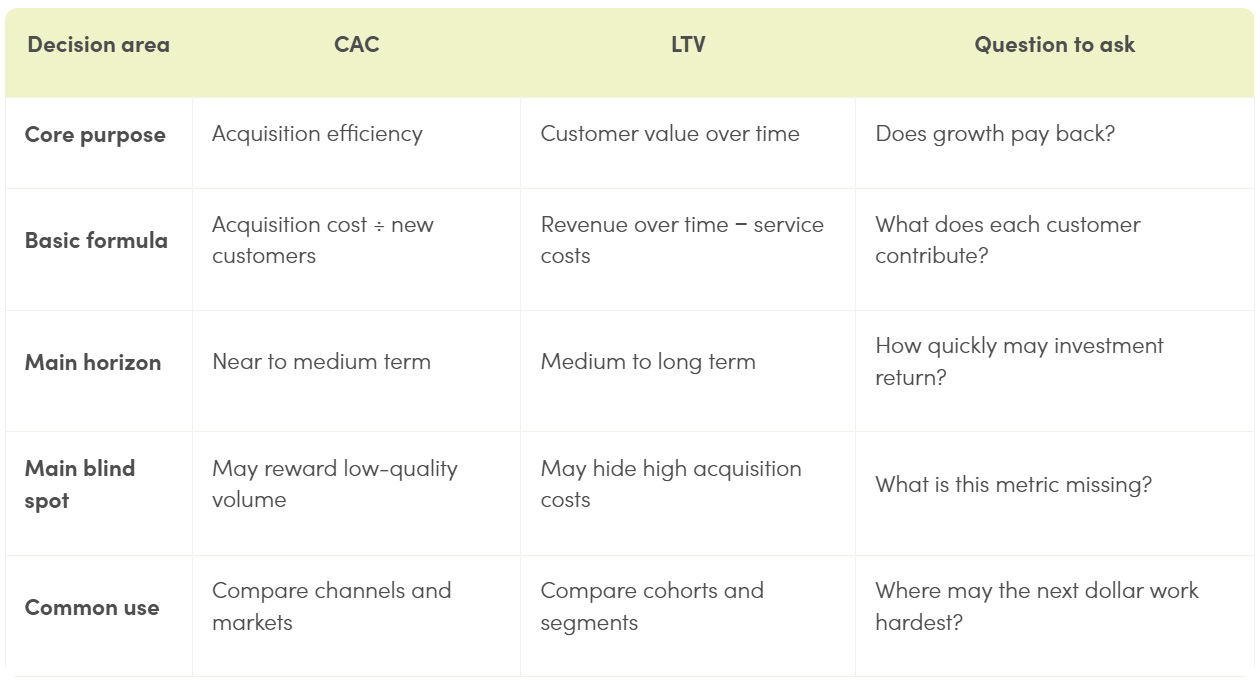
CAC vs LTV: Quick Reference
What CAC and LTV Measure
Customer acquisition cost (CAC) is the total cost of winning a new customer. A standard calculation divides sales and marketing costs by the number of new customers acquired in the same period.¹ CAC can help leaders assess whether a growth channel may be efficient enough to scale, but it’s only one side of the equation.
Customer lifetime value (LTV) is an estimate of what a customer may contribute during the relationship. A practical model can include average revenue, expected lifespan, and the costs required to serve the account.² LTV can therefore reflect retention, adoption, expansion, and service quality, but it is primarily a measure of the amount of money taken in for a single average customer over the entirety of a business relationship.
CAC asks what it costs to create a customer relationship, while LTV estimates what that relationship may be worth over time. Looking at the two metrics together can give leaders a clearer picture of whether growth is creating durable value or simply adding customers who may not stay long enough to pay back what it cost to acquire them.
When CAC May Deserve Priority
CAC may deserve priority when a company is deciding whether it can afford to scale. If acquisition costs rise faster than profit margin, growth may consume cash even while revenue increases. This may be especially important to monitor when a business enters a new market, adds a channel, or increases campaign volume.
A useful starting point may be a “fully loaded” CAC, meaning a calculation that includes both direct and indirect costs associated with acquiring a new customer. These costs may include media, sales labor, commissions, technology, onboarding, partner fees, travel, and other acquisition-related expenses.
A narrow CAC calculation may make one channel appear more efficient than it is if some costs sit with another team. That can overstate ROI and lead to investment decisions based on incomplete information.
These warning signs point to a broader question: Can the company explain how the next customer may pay back the cost of acquiring them? CAC may deserve priority when that answer depends on uncertain assumptions or incomplete cost data.
A higher-CAC channel may still be reasonable if its customers remain longer, require less support, or expand their relationship. Comparing fully loaded CAC with cohort-level LTV can help determine whether the added acquisition cost may be justified.
When LTV May Deserve Priority
LTV may deserve priority when acquisition appears efficient but customers do not stay, adopt, renew, or expand. A customer who leaves before the business recovers its acquisition cost could reduce the value of an otherwise strong campaign. Salesforce describes LTV as a lens into customer satisfaction, adoption, churn risk, and long-term profit.²
Customer quality, therefore, becomes a financial issue. A prospect may convert but still end up appearing like a “weak” customer fit if the offer was unclear, expectations were misaligned, or the handoff was poor.
Retention can also influence profit. Bain has cited research showing that a 5% increase in retention may increase profits by 25% to 95%, depending on the business.³ The range should not be treated as a universal forecast, but it illustrates why retention may belong in acquisition decisions.
Human conversation may also matter when a purchase involves trust, complexity, or a long-term commitment. SurveyMonkey reports that 79% of Americans strongly prefer talking with a human over an AI agent, while 89% believe companies should offer the option to speak with a human.⁴ These findings do not mean every interaction should be manual. They may suggest that removing human access can create a customer-quality risk.
How to Balance CAC and LTV
A successful operating model usually combines acquisition cost, customer value, payback speed, and customer quality to paint a more holistic financial picture. Reviewing these measures by cohort may provide more insight than relying on one company-wide average.
A commonly utilized LTV:CAC benchmark is 3:1, meaning expected customer value is three times acquisition cost.⁵ The ratio is widely used in subscription and SaaS businesses, and it can also serve as a helpful screening tool in other industries. Because margins, sales cycles, service costs, and capital needs vary widely, 3:1 is best treated as a starting point for evaluation rather than a fixed target.
Field sales, residential outreach, and event programs can offer a unique balance between CAC vs LTV. These channels may involve more upfront sales effort than lower-touch acquisition methods, but face-to-face conversations can give representatives more opportunity to explain the offer, answer questions, and assess customer fit before enrollment.
That added context can support LTV by helping reduce mismatched expectations and early drop-off. At the same time, outsourcing in-person acquisition can help brands manage CAC by expanding into new markets without building that capability internally.
Cydcor delivers outsourced, in-person customer acquisition across residential, retail, B2B, and event channels in the US and Canada, with campaign design, client reporting, and compliance oversight built in.⁶ For enterprise brands, this combination may provide a practical way to pursue acquisition volume while keeping customer quality and long-term value in view.
CAC vs LTV: The Bottom Line
“CAC vs LTV” is a false dichotomy. These metrics offer two equally vital perspectives of the same growth analysis. CAC shows what the company spends to create a customer relationship. LTV estimates whether that relationship may generate enough value to justify the investment.
Leaders may consider lowering CAC when acquisition is inefficient, improving LTV when fit is weak, and preserving human connection when trust affects retention. Cydcor’s face-to-face customer acquisition model is designed to help brands balance customer acquisition cost with long-term customer value. Because in-person conversations give customers a chance to ask questions and understand an offer before they enroll, this approach can support stronger customer fit, which may help improve retention over time.⁶
For a customer acquisition strategy built around measurable execution and long-term customer value, Explore a Cydcor Partnership.
Sources
- Zendesk, “Customer acquisition cost formula and tips to improve your CAC,” updated May 11, 2026. https://www.zendesk.com/blog/sales/sales-performance-metrics/customer-acquisition-cost/
- Salesforce, “What Is Customer Lifetime Value (CLV) and How to Calculate?” https://www.salesforce.com/blog/sales/customer-lifetime-value/
- Bain & Company, “Retaining customers is the real challenge.” https://www.bain.com/insights/retaining-customers-is-the-real-challenge/
- SurveyMonkey, “Customer service trends & statistics for 2026: Why consumers still trust humans over AI,” published February 19, 2026. https://www.surveymonkey.com/curiosity/customer-service-statistics/
- Klipfolio, “LTV:CAC Ratio: what it is and how to calculate it.” https://www.klipfolio.com/kpis/saas/customer-lifetime-value-to-customer-acquisition-cost
- Cydcor, “How Cydcor Works.” https://www.cydcor.com/how-cydcor-works
- Cydcor, “Awards & Recognition.” https://www.cydcor.com/about/awards-and-recognition
- Cydcor, “CEO Betting AI Will Never Replace This,” Founder’s Story podcast, July 31, 2026. https://www.cydcor.com/media/podcasts/founders-story-podcast-the-ceo-betting-ai-will-never-replace-this-vera-quinn
To find out more about Cydcor, check us out on Facebook, LinkedIn, Instagram, and X.
We are Cydcor, a recognized leader in outsourced sales and marketing services located in Agoura Hills, California. From our humble beginnings as an independent sales company to garnering a reputation for consistently exceeding client expectations and driving outstanding revenue growth, Cydcor has been helping Fortune 500 and emerging companies achieve their customer acquisition, retention, and business goals since 1994. Cydcor takes pride in the unique combination of in-person sales, call center, and digital marketing services we offer to provide our clients with proven sales and marketing strategies that get results.