Retail Sales Outsourcing: a 2026 Guide
While many smaller brands express some worry when it comes to outsourcing sales, it has proven to be a reliable way to break into new markets, deploy new products, or even just supplement an existing sales team. Retail sales outsourcing can add trained staff and field support without requiring a full internal build, which is made especially effective when you choose an outsourcing partner that knows how to work within retail environments and represent a brand within a store/retailer’s culture.
The key is finding the right outsourcing partner and model, which depends on the customer journey, store setting, compliance needs, and reporting plan. This guide breaks down where an outside team may help, and what to review before choosing a partner.
“Retail growth depends on delivering consistent customer experiences wherever buying decisions happen.”
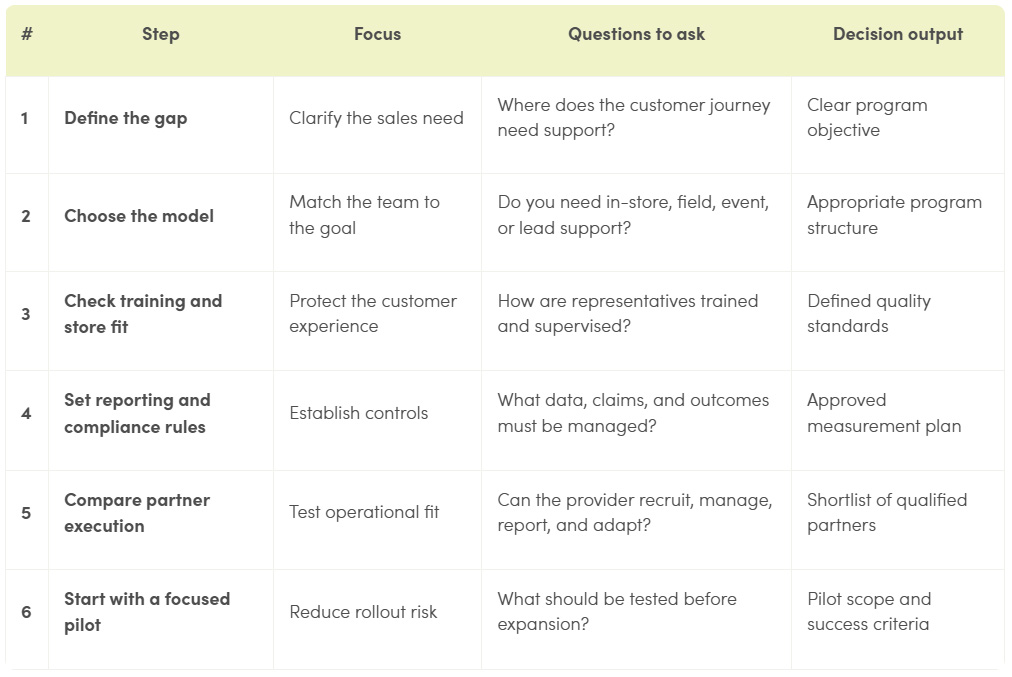
Retail Sales Outsourcing: A Quick Framework
1. Define the Customer-Acquisition Gap
As with any sizable business investment, decision makers should start with the problem. Figure out whether your biggest sales need is getting more product help at the shelf, wider store coverage, help breaking into new markets, or a quick increase in headcount to push a new product.
Outsourcing generally best fits work that is local, specialized, or hard to staff; it doesn’t need to be all of these things at once, though. It may also support an internal team instead of replacing it. In the end, the need must define the role of your outsourced sales partner.
2. Choose the Right Model
Retail sales outsourcing may include in-store teams, field teams, or event teams. In-store staff can explain products, run demos, answer questions, and even sell themselves. Field teams can cover several locations. Event teams can support pop-ups, sampling, trade shows, and launches.
Some programs use more than one model. A launch could use event staff for awareness and in-store staff for product education and sales conversion.
3. Check Training and Store Fit
Representatives are a visible part of the brand whether they are in-house or outsourced. Ask how the outsourced staff are trained on product details, approved claims, store rules, customer questions, and escalation steps to ensure they have enough runway for a successful deployment. It may also be helpful to inquire about what comparable brands they’ve worked with.
Training should fit the store. Staff need a clear message regardless of setting, but they also need room to answer real questions in a way that doesn’t feel rushed or rehearsed if they are in an environment where they’ll be dealing with a low volume of potential customers that want longer or more in-depth engagements. A single script may not work in every store or with every shopper.
Retailers should confirm how training is inspected, updated, and checked in the field. They should also ask how the provider handles product changes, store-specific rules, and customer concerns. Both of these play a key role in ensuring that value is maximized across every sales setting, and working with a quality outsourcing partner that truly understands the important nuances of representing a brand within a retail environment. The best do this by working alongside store employees and management, rather than just taking a post in a designated area and approaching prospects in an isolated manner, disconnected from the rest of the shopping experience.
4. Define Reporting, Data and Compliance Rules
Set a program goal before choosing reporting measures, so you know exactly what it is you’ll be reporting. An education program may track demos, questions, and feedback since the goal is simply to increase awareness or dispel initial customer concerns. A customer-acquisition program is more likely to strictly track leads, purchases, and/or handoffs. An event program may rely more on engagement and follow-up data that is indicative of a future purchase in industries with longer sales cycles.
Ask how data is collected, checked, shared, stored, and deleted. Clarify who owns customer data, and set a process for complaints and hard questions.
Finally, the Federal Trade Commission says advertising claims must be truthful, not misleading, and supported by evidence.¹ Retailers should review claims, disclosures, offers, and data practices with the right legal and compliance teams to avoid unnecessary liability.
5. Compare Partners on Execution
A client list is only one part of the review; you should also ask how the provider recruits, trains, schedules, supervises, and reports on the team and compliance processes. Also, ask how it handles store coordination and program changes.
Compare each provider’s stated services with your campaign's needs by asking for examples that match your store type, customer, sales cycle, and market.
Review whether the partner can support the full operating process. That may include recruiting, training, scheduling, field supervision, reporting, and adjustments during the program.
6. Start With a Focused Pilot
A pilot can test the relationship before a wider rollout. Set the locations, dates, audience, training, reports, and review points in advance. Include a clear way to pause or change the work. Information from the right partner who is in the store can help perfect the pitch and enhance the customer experience with a brand.
The pilot should answer practical questions. Can the team represent the brand clearly? Does the data support decisions? Do store partners accept the model? Can the provider adjust while keeping the message consistent? Your outsourcing partner can help test these and refine them before sales reps are trained.
Goal setting should be part of the first discussion, whether you choose Cydcor or another provider. Define what the team will do, how performance will be reviewed, and what conditions would support expansion.
Final Considerations
Retail sales outsourcing can help add customer-facing capacity for product education, market entry, event work, or customer acquisition. The right approach depends on your customer journey, retail environment, operating needs, and risk controls.
Before choosing a provider, confirm that the program has a clear scope, trained representatives, reliable field oversight, defined reporting, and appropriate compliance controls. A focused pilot can also help your team assess the model before a wider rollout.
Ready to explore whether outsourced retail sales support fits your growth goals? Get in touch with Cydcor about your retail customer-acquisition program.
Sources
- Federal Trade Commission, “Advertising and Marketing,” https://www.ftc.gov/business-guidance/advertising-marketing
To find out more about Cydcor, check us out on Facebook, LinkedIn, Instagram, and X.
We are Cydcor, a recognized leader in outsourced sales and marketing services located in Agoura Hills, California. From our humble beginnings as an independent sales company to garnering a reputation for consistently exceeding client expectations and driving outstanding revenue growth, Cydcor has been helping Fortune 500 and emerging companies achieve their customer acquisition, retention, and business goals since 1994. Cydcor takes pride in the unique combination of in-person sales, call center, and digital marketing services we offer to provide our clients with proven sales and marketing strategies that get results.