Sales Team ROI: Analyzing the Business Impact

Sales team ROI is a complex calculation that involves more than just a revenue booked in a given month. It can be impacted by customer acquisition, market reach, sales productivity, speed to market, and the quality of customer engagement. Understanding the totality of this calculation, and how to apply insights derived from it, can simplify decision-making across entire sales and marketing departments.
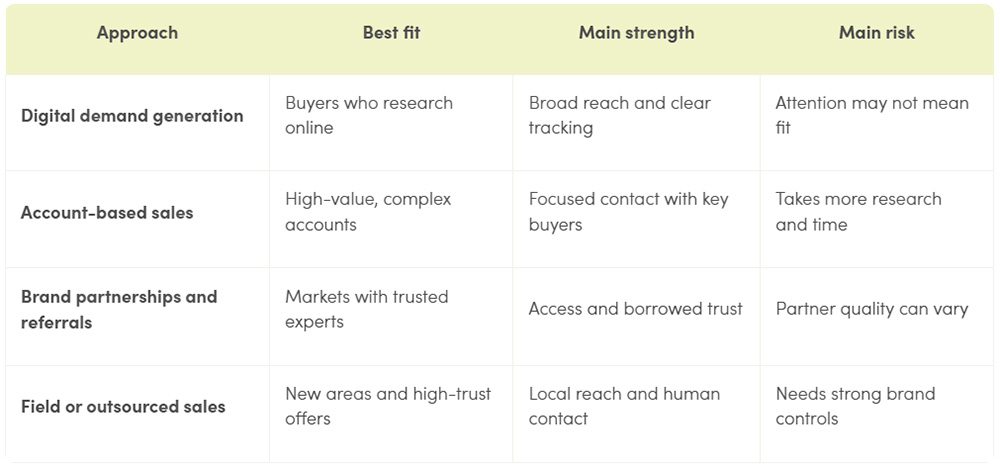
For many brands, the return on a sales investment often depends on how well the team supports the broader go-to-market strategy. That includes aligning in-house teams around shared goals and considering a broader channel mix, such as field residential, retail, business to business and event sales.
Sales Team ROI Is Broader Than Revenue
Revenue remains important, but it is only one output of a sales investment. A sales team can improve access by reaching customers in new territories, channels, or environments while gathering firsthand insight into their needs, questions, objections, and buying behavior. It can also increase product adoption by helping customers understand relevant offerings and create future growth opportunities through repeat purchases, cross-selling, market expansion, and stronger customer relationships.
Sales team ROI reflects the broader business value created through customer acquisition, market reach, sales productivity, and scalable growth.
A useful evaluation should ask what the sales operation makes possible. Does it help the brand reach customers that digital channels miss? Can it support a new territory? Does it uncover product needs that create cross-sell opportunities? Every time leadership asks and answers questions like these, another sales methodology can be either ruled out or moved up in priority. This distillation process adds value to every decision made, and simplifies the decision-making process.
Customer acquisition programs can span business-to-business field sales, retail, events, and residential outreach. That channel mix creates more options for matching the sales environment to the product and audience.
Customer acquisition services can be outsourced as well, with the potential to make it far easier to roll out a new product or bring existing products/services into a new market. When comparing established sales infrastructure with the effort required to build one internally, the central question is whether the operation creates a repeatable way to reach customers, learn from the market, and improve execution. If the capacity isn’t available in-house, or in-house teams are already nearing their bandwidth limitations, working with a trusted sales outsourcing team could be the best way to evaluate new methodology.
Market Reach and Speed Can Change the Return
A sales team can create ROI by helping a brand act while an opportunity is still timely. A company may identify demand in a new market, launch a new offer, or need additional selling capacity during a seasonal push.
A well run field sales program can help businesses capitalize on moments like these by creating a direct feedback loop between the brand and the customer while customer curiosity is peaking. Representatives hear customer needs, questions, objections, and points of confusion in real time, converting that curiosity into a genuine interest. That interest can convert, and when it doesn’t, the information gathered in the process can help marketing, product, and operations teams adjust their approach. Established programs from outsourcing partners often draw on extensive, cross-industry experience and can launch and support campaigns for categories such as wireless, internet, energy, and delivery services.
For example, a telecommunications brand may begin with an internet offer in a defined territory. A representative can turn general curiosity into genuine interest by asking about the customer’s current service, identifying frustrations such as slow speeds or unreliable connectivity, and explaining how the offer could address those needs. Once the customer sees a clear fit, the conversation can expand to related services, such as wireless phones or additional lines, when those options support the customer’s broader communication needs. These relevant cross-sell opportunities can deepen the relationship beyond a single transaction, encourage repeat engagement, increase customer lifetime value, and improve long-term sales team ROI.
An established sales process may include product training, compliance procedures, campaign communication, and performance monitoring. Some outsourced models report launching programs within weeks after finalizing strategy and maintaining networks of thousands of representatives across North America. Sales process overview provides an example of this type of infrastructure.
The strategic value is not speed alone. Faster activation can help a brand gather customer feedback earlier, refine its message, and determine whether a market deserves additional investment.
The Intangible Returns Matter, Too
Some of the most important returns from a sales team do not appear immediately in revenue reports. Face-to-face conversations can reveal objections, customer questions, competitive activity, and local buying patterns, contributing to an underlying data economy that can be hard to measure.
In-person upsell and cross-sell campaigns can help identify opportunities to expand customer relationships, and create a feedback loop that improves messaging, training, and offer design.
These benefits are difficult to assign to a single line item. They still influence the return on a sales investment because they improve the quality of future decisions.
The value of these insights increases when field feedback reaches the teams responsible for marketing, product, customer experience, and operations. Without that internal connection, a company may capture useful information without turning it into action.
For brands that want this kind of insight quickly, outsourced customer acquisition solutions can offer access to an established field sales network and decades of campaign experience without the time and resources need to build that capability from scratch.
Should You Build or Outsource Your Sales Team?
Outsourced sales ROI often comes down to what a brand would otherwise have to build itself. Launching a field sales program in-house means hiring and training a team, setting up compliance processes, planning territory coverage, and waiting for that team to ramp up before it reaches customers at scale. An outsourced model moves much of that work outside the brand, and the right provider brings strategy and accountability that take years to develop internally. Building in-house may make more sense for a brand that needs a permanent, dedicated team in a single market.
Cydcor’s model shows how this can work. Cydcor holds the client relationship and works with each brand to shape the campaign strategy: which customers to reach, which territories and channels to prioritize, which products to lead with, and when to introduce related offers. Cydcor then launches the client campaign with a network of independently owned and operated sales companies that hire, train, and manage their own teams. Accountability is built into the structure. Cydcor compensates the independent sales companies for sales made to real customers, provided those sales meet the client’s quality standards, so the model is tied to results rather than activity. Cydcor also oversees adherence to the client’s compliance and conduct standards in the field and provides reporting that gives the brand visibility into campaign performance.
How to Evaluate an Outsourced or Field Sales Model
Outsourced field sales services are not one-size-fits-all, and it is important to understand how to select the right partner for your intended result. An evaluation should consider the complete operating model. That includes how an outsourced sales provider handles training, compliance, territory management, campaign communication, reporting, and the ability to adjust priorities.
A structured sales process can help clarify how these responsibilities are divided between the brand, sales partner, and field sales representatives. It can also show how the program will respond when the brand adds a new product or enters a new territory.
Sales team ROI improves when the sales operation connects to the broader growth strategy. A team that only delivers transactions may create short-term value. A team that also expands reach, accelerates learning, increases product adoption, and strengthens customer engagement can create a more durable return.
Proven Sales Team ROI with Cydcor
Investing in a sales team is an investment in more than direct revenue. It can create market access, customer intelligence, faster execution, stronger product adoption, and a repeatable path to growth.
For brands evaluating outsourced customer acquisition, Cydcor offers a field sales model built around face-to-face engagement across multiple channels. Its established infrastructure and performance-based approach may be relevant for organizations seeking to expand reach, launch campaigns, or increase customer value.
Explore Cydcor’s Customer Acquisition Programs
To find out more about Cydcor, check us out on Facebook, LinkedIn, Instagram, and X.
We are Cydcor, a recognized leader in outsourced sales and marketing services located in Agoura Hills, California. From our humble beginnings as an independent sales company to garnering a reputation for consistently exceeding client expectations and driving outstanding revenue growth, Cydcor has been helping Fortune 500 and emerging companies achieve their customer acquisition, retention, and business goals since 1994. Cydcor takes pride in the unique combination of in-person sales, call center, and digital marketing services we offer to provide our clients with proven sales and marketing strategies that get results.