Pay-for-Performance Pros and Cons in Sales Outsourcing

Some enterprise brands staff internal field sales teams to handle customer acquisition. Others contract with providers through fixed fees or retainer arrangements. Pay-for-performance sales outsourcing takes a different approach. Here, the brand pays per verified customer acquired, rather than for the headcount or activity that generates those customers. This can help align the interests of both sides: the brand pays for verified results, and the provider earns more as it delivers more qualified sales, giving both parties a shared incentive to grow the program.
For brands deciding how to structure or expand a customer acquisition program, this model changes where financial risk sits from the start of an engagement. This guide covers the pay-for-performance pros and cons in sales outsourcing, what the model requires from the brand before a program launches, and how to assess whether it fits your specific business, goals, and resources.
The Pay-for-Performance Pros and Cons in Sales Outsourcing
Deloitte's 2025 Global Outsourcing Survey found that 50% of the executives surveyed use outsourced services for front-office functions such as sales, marketing, and research and development. The same survey found that 80% plan to maintain or increase their investment in third-party outsourcing.¹ These findings support the case for using an outside provider when a brand needs additional sales capacity, faster market entry, or access to capabilities it does not want to build internally.
However, same evidence also reinforces the limits of the model. Deloitte found that 70% of executives had selectively brought previously outsourced work back in-house during the five years covered by the survey. In addition, 70% said their vendor management office was not yet fully mature.¹
This indicates that while the provider can run the program, the brand still needs clear definitions, reliable reporting, and a process for reviewing customer quality. Without those controls, the pay-for-performance model may produce sales activity without giving the brand a reliable way to judge the customers being acquired.
Pay-for-Performance Outsourcing Compared With Other Customer Acquisition Structures
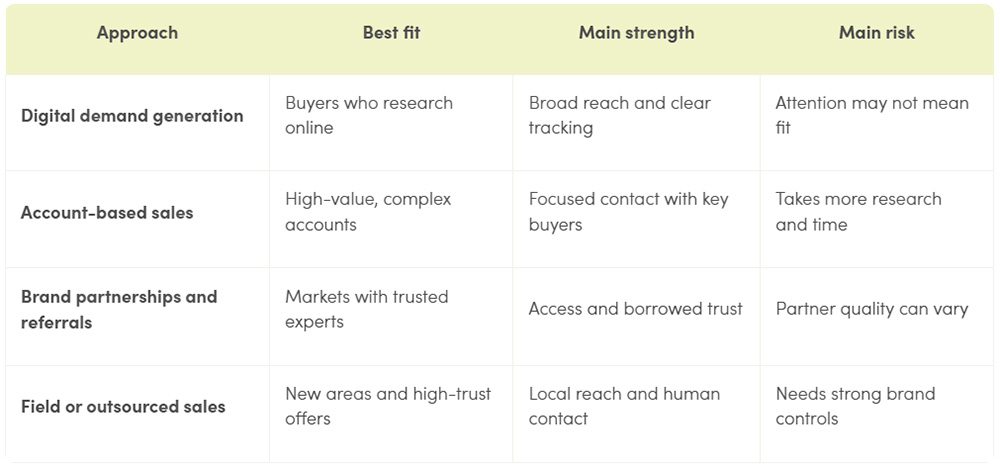
Choosing a customer acquisition method depends on how much control the brand wants to retain, how quickly it needs to launch, and whether it prefers variable or fixed acquisition costs. A pay-for-performance arrangement can suit brands that want to test new markets or expand existing programs without building a separate internal team for each location.
Cydcor uses a pay-for-performance model for some client engagements, with clients paying after sales are made. Its client support process also gives brands a structure for managing reporting, compliance, and ongoing program oversight.
What to Define Before Launching a Pay-for-Performance Program
Before a pay-for-performance program begins, the brand and provider should agree on how a sale is recognized, how customer quality is measured, and how cancellations affect reporting and payment. These terms give both parties the same basis for evaluating results.
These terms should appear in the agreement and be reviewed during program onboarding. Cydcor’s Customer Acquisition RFP Template can help brands compare how providers define performance, reporting, and quality controls.
Assessing Whether This Model Fits Your Program
Pay-for-performance sales outsourcing suits certain customer acquisition programs more than others. It can serve as a brand’s primary acquisition channel in a new market or as an additional resource alongside existing sales and marketing efforts. The following checklist can help brands identify whether this model aligns with their business conditions:
- Your product or service has a clearly definable sale. A single transaction point, signed agreement, or enrollment that can be confirmed and tracked.
- Your brand is entering or piloting a new product or region, or lacks existing field sales coverage in markets where you want to grow. This may also be ideal in situations where you are testing out or piloting a new geography.
- Your program’s timeline prioritizes speed to being first to customer over building a proprietary sales capacity.
- Your digital or existing channels are leveling off and you want to reach customers who respond better to a face-to-face conversation.
- Your business prefers variable acquisition cost over carrying fixed sales overhead.
- Your internal teams can confidently define quality standards before the program launches and review performance data consistently during it.
- The product or service can be clearly explained and purchased through a direct conversation, demonstration, or enrollment process.
If any of these conditions apply, pay-for-performance outsourcing is worth evaluating alongside your current approach. Sales cycles that span several months, involve multiple decision-makers, or require extended technical evaluation can be harder to structure as standard pay-per-acquisition arrangements. In those cases, it may make more sense to compare pay-for-performance to a hybrid model or a different compensation approach to identify which structure delivers the best return.
Pay-for-Performance Pros and Cons: Putting This Into Practice
Pay-for-performance sales outsourcing can help brands enter new markets, test geographic expansion, and add customer acquisition capacity without building a permanent field sales team first. The model works best when the brand defines a qualified sale, sets customer-quality standards, establishes how cancellations are handled, and agrees on reporting before the program begins. Comparing those requirements with the control and cost structure of fixed-fee outsourcing or an in-house team can help determine whether the model fits the business.
As a leading and nationally recognized provider of in-person customer acquisition, Cydcor offers pay-for-performance programs through a network of independently owned and operated sales companies across the U.S. and Canada. Its client support process provides brands with campaign design, compliance oversight, quality control, and reporting while payment remains tied to verified sales.
To discuss pay-for-performance pros and cons, or whether this approach fits your market expansion and customer acquisition goals, Become a client.
Sources
¹ Deloitte. Global Outsourcing Survey 2024: Multidimensional Sourcing — Orchestrating the Extended Workforce Ecosystem. Deloitte Consulting LLP, 2025. deloitte.com/global/en/issues/work/global-outsourcing-survey.html
To find out more about Cydcor, check us out on Facebook, LinkedIn, Instagram, and X.
We are Cydcor, a recognized leader in outsourced sales and marketing services located in Agoura Hills, California. From our humble beginnings as an independent sales company to garnering a reputation for consistently exceeding client expectations and driving outstanding revenue growth, Cydcor has been helping Fortune 500 and emerging companies achieve their customer acquisition, retention, and business goals since 1994. Cydcor takes pride in the unique combination of in-person sales, call center, and digital marketing services we offer to provide our clients with proven sales and marketing strategies that get results.