
Discover practical advice, inspiration, and insights to help you succeed in business and grow both personally and professionally.
Found 0 posts

Some enterprise brands staff internal field sales teams to handle customer acquisition. Others contract with providers through fixed fees or retainer arrangements. Pay-for-performance sales outsourcing takes a different approach. Here, the brand pays per verified customer acquired, rather than for the headcount or activity that generates those customers. This can help align the interests of both sides: the brand pays for verified results, and the provider earns more as it delivers more qualified sales, giving both parties a shared incentive to grow the program.
For brands deciding how to structure or expand a customer acquisition program, this model changes where financial risk sits from the start of an engagement. This guide covers the pay-for-performance pros and cons in sales outsourcing, what the model requires from the brand before a program launches, and how to assess whether it fits your specific business, goals, and resources.
Deloitte's 2025 Global Outsourcing Survey found that 50% of the executives surveyed use outsourced services for front-office functions such as sales, marketing, and research and development. The same survey found that 80% plan to maintain or increase their investment in third-party outsourcing.¹ These findings support the case for using an outside provider when a brand needs additional sales capacity, faster market entry, or access to capabilities it does not want to build internally.
However, same evidence also reinforces the limits of the model. Deloitte found that 70% of executives had selectively brought previously outsourced work back in-house during the five years covered by the survey. In addition, 70% said their vendor management office was not yet fully mature.¹
This indicates that while the provider can run the program, the brand still needs clear definitions, reliable reporting, and a process for reviewing customer quality. Without those controls, the pay-for-performance model may produce sales activity without giving the brand a reliable way to judge the customers being acquired.
Choosing a customer acquisition method depends on how much control the brand wants to retain, how quickly it needs to launch, and whether it prefers variable or fixed acquisition costs. A pay-for-performance arrangement can suit brands that want to test new markets or expand existing programs without building a separate internal team for each location.
Cydcor uses a pay-for-performance model for some client engagements, with clients paying after sales are made. Its client support process also gives brands a structure for managing reporting, compliance, and ongoing program oversight.
Before a pay-for-performance program begins, the brand and provider should agree on how a sale is recognized, how customer quality is measured, and how cancellations affect reporting and payment. These terms give both parties the same basis for evaluating results.
These terms should appear in the agreement and be reviewed during program onboarding. Cydcor’s Customer Acquisition RFP Template can help brands compare how providers define performance, reporting, and quality controls.
Pay-for-performance sales outsourcing suits certain customer acquisition programs more than others. It can serve as a brand’s primary acquisition channel in a new market or as an additional resource alongside existing sales and marketing efforts. The following checklist can help brands identify whether this model aligns with their business conditions:
If any of these conditions apply, pay-for-performance outsourcing is worth evaluating alongside your current approach. Sales cycles that span several months, involve multiple decision-makers, or require extended technical evaluation can be harder to structure as standard pay-per-acquisition arrangements. In those cases, it may make more sense to compare pay-for-performance to a hybrid model or a different compensation approach to identify which structure delivers the best return.
Pay-for-performance sales outsourcing can help brands enter new markets, test geographic expansion, and add customer acquisition capacity without building a permanent field sales team first. The model works best when the brand defines a qualified sale, sets customer-quality standards, establishes how cancellations are handled, and agrees on reporting before the program begins. Comparing those requirements with the control and cost structure of fixed-fee outsourcing or an in-house team can help determine whether the model fits the business.
As a leading and nationally recognized provider of in-person customer acquisition, Cydcor offers pay-for-performance programs through a network of independently owned and operated sales companies across the U.S. and Canada. Its client support process provides brands with campaign design, compliance oversight, quality control, and reporting while payment remains tied to verified sales.
To discuss pay-for-performance pros and cons, or whether this approach fits your market expansion and customer acquisition goals, Become a client.
¹ Deloitte. Global Outsourcing Survey 2024: Multidimensional Sourcing — Orchestrating the Extended Workforce Ecosystem. Deloitte Consulting LLP, 2025. deloitte.com/global/en/issues/work/global-outsourcing-survey.html

Sales team ROI is a complex calculation that involves more than just a revenue booked in a given month. It can be impacted by customer acquisition, market reach, sales productivity, speed to market, and the quality of customer engagement. Understanding the totality of this calculation, and how to apply insights derived from it, can simplify decision-making across entire sales and marketing departments.
For many brands, the return on a sales investment often depends on how well the team supports the broader go-to-market strategy. That includes aligning in-house teams around shared goals and considering a broader channel mix, such as field residential, retail, business to business and event sales.
Revenue remains important, but it is only one output of a sales investment. A sales team can improve access by reaching customers in new territories, channels, or environments while gathering firsthand insight into their needs, questions, objections, and buying behavior. It can also increase product adoption by helping customers understand relevant offerings and create future growth opportunities through repeat purchases, cross-selling, market expansion, and stronger customer relationships.
Sales team ROI reflects the broader business value created through customer acquisition, market reach, sales productivity, and scalable growth.
A useful evaluation should ask what the sales operation makes possible. Does it help the brand reach customers that digital channels miss? Can it support a new territory? Does it uncover product needs that create cross-sell opportunities? Every time leadership asks and answers questions like these, another sales methodology can be either ruled out or moved up in priority. This distillation process adds value to every decision made, and simplifies the decision-making process.
Customer acquisition programs can span business-to-business field sales, retail, events, and residential outreach. That channel mix creates more options for matching the sales environment to the product and audience.
Customer acquisition services can be outsourced as well, with the potential to make it far easier to roll out a new product or bring existing products/services into a new market. When comparing established sales infrastructure with the effort required to build one internally, the central question is whether the operation creates a repeatable way to reach customers, learn from the market, and improve execution. If the capacity isn’t available in-house, or in-house teams are already nearing their bandwidth limitations, working with a trusted sales outsourcing team could be the best way to evaluate new methodology.
A sales team can create ROI by helping a brand act while an opportunity is still timely. A company may identify demand in a new market, launch a new offer, or need additional selling capacity during a seasonal push.
A well run field sales program can help businesses capitalize on moments like these by creating a direct feedback loop between the brand and the customer while customer curiosity is peaking. Representatives hear customer needs, questions, objections, and points of confusion in real time, converting that curiosity into a genuine interest. That interest can convert, and when it doesn’t, the information gathered in the process can help marketing, product, and operations teams adjust their approach. Established programs from outsourcing partners often draw on extensive, cross-industry experience and can launch and support campaigns for categories such as wireless, internet, energy, and delivery services.
For example, a telecommunications brand may begin with an internet offer in a defined territory. A representative can turn general curiosity into genuine interest by asking about the customer’s current service, identifying frustrations such as slow speeds or unreliable connectivity, and explaining how the offer could address those needs. Once the customer sees a clear fit, the conversation can expand to related services, such as wireless phones or additional lines, when those options support the customer’s broader communication needs. These relevant cross-sell opportunities can deepen the relationship beyond a single transaction, encourage repeat engagement, increase customer lifetime value, and improve long-term sales team ROI.
An established sales process may include product training, compliance procedures, campaign communication, and performance monitoring. Some outsourced models report launching programs within weeks after finalizing strategy and maintaining networks of thousands of representatives across North America. Sales process overview provides an example of this type of infrastructure.
The strategic value is not speed alone. Faster activation can help a brand gather customer feedback earlier, refine its message, and determine whether a market deserves additional investment.
Some of the most important returns from a sales team do not appear immediately in revenue reports. Face-to-face conversations can reveal objections, customer questions, competitive activity, and local buying patterns, contributing to an underlying data economy that can be hard to measure.
In-person upsell and cross-sell campaigns can help identify opportunities to expand customer relationships, and create a feedback loop that improves messaging, training, and offer design.
These benefits are difficult to assign to a single line item. They still influence the return on a sales investment because they improve the quality of future decisions.
The value of these insights increases when field feedback reaches the teams responsible for marketing, product, customer experience, and operations. Without that internal connection, a company may capture useful information without turning it into action.
For brands that want this kind of insight quickly, outsourced customer acquisition solutions can offer access to an established field sales network and decades of campaign experience without the time and resources need to build that capability from scratch.
Outsourced sales ROI often comes down to what a brand would otherwise have to build itself. Launching a field sales program in-house means hiring and training a team, setting up compliance processes, planning territory coverage, and waiting for that team to ramp up before it reaches customers at scale. An outsourced model moves much of that work outside the brand, and the right provider brings strategy and accountability that take years to develop internally. Building in-house may make more sense for a brand that needs a permanent, dedicated team in a single market.
Cydcor’s model shows how this can work. Cydcor holds the client relationship and works with each brand to shape the campaign strategy: which customers to reach, which territories and channels to prioritize, which products to lead with, and when to introduce related offers. Cydcor then launches the client campaign with a network of independently owned and operated sales companies that hire, train, and manage their own teams. Accountability is built into the structure. Cydcor compensates the independent sales companies for sales made to real customers, provided those sales meet the client’s quality standards, so the model is tied to results rather than activity. Cydcor also oversees adherence to the client’s compliance and conduct standards in the field and provides reporting that gives the brand visibility into campaign performance.
Outsourced field sales services are not one-size-fits-all, and it is important to understand how to select the right partner for your intended result. An evaluation should consider the complete operating model. That includes how an outsourced sales provider handles training, compliance, territory management, campaign communication, reporting, and the ability to adjust priorities.
A structured sales process can help clarify how these responsibilities are divided between the brand, sales partner, and field sales representatives. It can also show how the program will respond when the brand adds a new product or enters a new territory.
Sales team ROI improves when the sales operation connects to the broader growth strategy. A team that only delivers transactions may create short-term value. A team that also expands reach, accelerates learning, increases product adoption, and strengthens customer engagement can create a more durable return.
Investing in a sales team is an investment in more than direct revenue. It can create market access, customer intelligence, faster execution, stronger product adoption, and a repeatable path to growth.
For brands evaluating outsourced customer acquisition, Cydcor offers a field sales model built around face-to-face engagement across multiple channels. Its established infrastructure and performance-based approach may be relevant for organizations seeking to expand reach, launch campaigns, or increase customer value.
Explore Cydcor’s Customer Acquisition Programs

Many enterprise brands search for lead generation services when their larger need is new customers. Lead generation services typically produce contacts, form fills, or appointments for another sales team to follow up on, while customer acquisition programs are measured by completed sales that meet the brand’s quality standards. This comparison explains what each model delivers, who typically owns the sale, how performance is measured, and when the two approaches can work together.
The central distinction between the two is the outcome each provider is responsible for delivering. A lead generation service supplies an opportunity for another team to convert, while a customer acquisition service is structured around a completed sale.
Lead generation services produce potential sales opportunities for another team to qualify, pursue, and close. Common deliverables include contact records, form submissions, information requests, qualified inquiries, and scheduled appointments.
The brand remains responsible for the next steps after receiving the lead. Its sales team must respond, confirm fit, explain the offer, manage objections, and complete the sale.
Like the distinction between Field Marketing vs. Demand Generation, lead generation services and customer acquisition programs measure different stages of the sales process, so their performance metrics do not always align.
A customer acquisition program produces completed acquisitions, the information needed to verify them, and performance data that shows how the program is working across markets.
Different customer acquisition programs may have different approaches to executing these deliverables. For example, for Cydcor, these deliverables come from direct customer acquisition programs carried out through a network of independently owned sales companies. The brand establishes the relevant product and quality requirements before launch, while the program reports results against those standards.
The resulting data can then be evaluated through customer acquisition KPIs, including acquisition cost, conversion quality, customer value, and early retention.
Lead generation services tend to fit brands with an internal sales team that can respond quickly, qualify opportunities, and manage the closing process. They can also suit complex sales that require account executives, technical experts, or several internal decision stages.
Customer acquisition programs tend to fit brands that need direct acquisition capacity, are testing a new market, or want to expand without building a separate sales capability in every location. This approach requires the brand to define its product, compliance, and customer-quality standards before the program begins.
The two approaches can support different stages of the same customer acquisition plan. Lead generation can supply opportunities to an internal sales team, while a customer acquisition program can handle direct acquisition in markets where the brand needs additional field capacity. Lead volume and appointment rates should remain separate from completed sales, cancellation activity, and customer retention so the brand can see whether it is producing more opportunities, more customers, or both. When a brand wants provider compensation tied to completed sales rather than delivered leads, it may also consider pay-for-performance sales outsourcing.
The right choice between lead generation services and customer acquisition programs depends on whether the brand needs more opportunities for its sales team to close or a provider responsible for direct acquisition and reporting on completed sales.
Cydcor connects enterprise brands to direct customer acquisition programs through a network of more than 500 independently owned sales companies across North America. Cydcor holds the client relationship and provides campaign design, compliance oversight, quality control, and reporting, while the independent sales companies operate their own businesses: they recruit, train, and compensate their own people. This structure can give brands a way to expand direct acquisition across markets without building a separate field sales capability in each location.
For brands pursuing completed sales rather than only leads, become a client.
Some of the strongest new client acquisition strategies connect four decisions: who you want to reach, where those buyers are most likely to purchase, how you’ll measure success, and how you will scale your model if it works. This guide will break down how to evaluate each question, and what channels tend to work best based on the answers.
Note for clarification: In this article, “client” refers to the B2B account your company wins. “Customer” refers to that client’s end buyer.
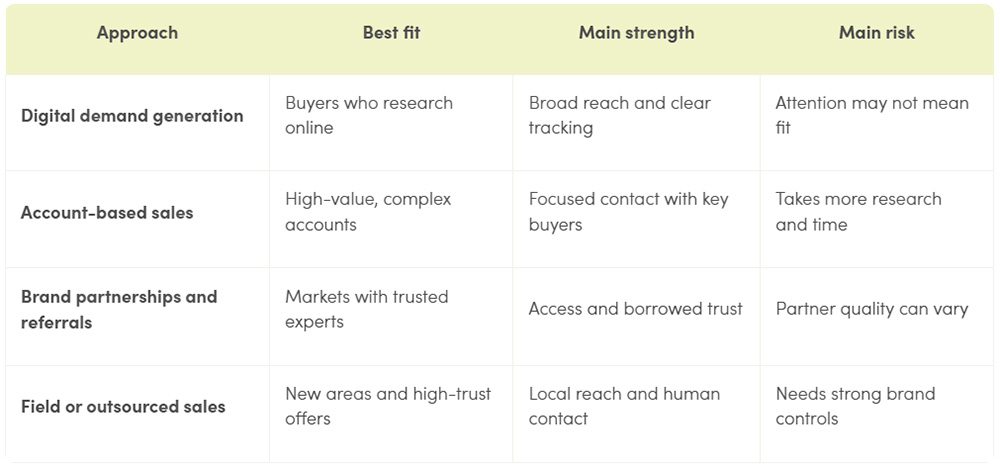
No method wins in every market. Digital marketing helps buyers discover your brand, understand your offer, and take an early step. Account-based sales focuses on a smaller list of valuable companies and builds relationships with the people involved in each decision. Brand partnerships create introductions through trusted advisers. Field sales adds a human conversation when buyers need live answers, demonstrations, or local support. Every channel has its place, you just have to do some digging to determine which is best for your goals.
The best new client acquisition strategies start with a clear client profile. Define the industries, locations, company size, buyers, use cases, likely revenue, and service needs of your ideal customer so you can begin to identify their needs and whether they are a fit for your firm.
It is just as important to define what accounts are not a good fit. Warning signs may include weak market economics, service needs your team cannot support, or an offer that does not solve a clear problem. Knowing what type of clients to exclude with your marketing strategy can cut costs by improving conversion rates and reducing the time wasted on prospects that were never going to turn into clients in the first place.
Use a simple scorecard before choosing a strategy:
*ROI: Return on Investment; LTV: Customer Lifetime Value
This step guards against a common mistake: treating every new contract as a good win. An account may look attractive at signing but become expensive if it needs too much support, cancels early, or never expands.
A smaller group of better-fit clients can bring more referrals, steadier revenue, and less service strain than a larger group of weak-fit accounts. The goal is not to close as many contracts as possible, but to build a book of business that is profitable and sustainable.
Different buyers take different paths to a decision. The more complex, local, or trust-based the offer, the more useful direct human contact can be in bridging gaps between seller and client.
Digital marketing works well when buyers can understand the offer quickly and compare choices online. Account-based sales fits when a decision involves several people, a long review period, or a large contract. Partnerships help when a trusted expert already has access to the market. Field sales can help with all of the above, as well as when buyers need live answers, product demos, or confidence in a local team.
Outsourced sales combine a planned campaign process, client support, and robust sales networks. Many programs can launch within weeks after the strategy is set, especially with an experienced sales partner with a focus on quality and a tried-and-true campaign process.
The outsourced model can help an enterprise brand test their reach in a market before building every sales function in-house. It can also show which messages, locations, and buyer groups respond before the company commits to a wider launch.
Many teams track leads, meetings, and short-term wins. These numbers demonstrate activity, but they don’t show whether those new clients become lasting, valuable clients.
For example, one channel may deliver a low cost per lead but attract buyers who rarely complete onboarding. Another may produce fewer leads but bring accounts that renew, expand, and refer others. If both channels are judged only by lead volume, leaders may end up putting more money into the weaker lead source.
Track each channel across four levels:
Customer acquisition cost (CAC), or the average amount spent to win one new customer is a great metric to measure, but isn’t enough on its own to pick the right new customer acquisition strategy. Compare CAC with the revenue, margin, retention, and growth potential of the accounts each channel brings in, and that calculation should give you a better idea of which to choose. Check out our acquisition KPI guidance for a deeper dive into how to measure success in sales, and do not scale a channel until its results justify the spend.
Retention should shape the first sales conversation. Set clear expectations, sell the right use case, and give the post-sale team the information it needs. That work helps prevent a fast win from becoming a costly loss.
A growth plan works at scale when everyone knows their role, and there is clear ownership of every task. Decide who sets the target, approves the message, runs the program, reviews results, and can pause work when quality drops or brand rules slip.
This matters even more when several teams or outside partners are involved. Without clear ownership, :leads can go unanswered, reports can use different terms, and problems can remain hidden until they affect revenue or the brand so much that they’re impossible to ignore.
If you outsource part of your sales process, confirm that your provider applies these controls as rigorously as you would. For example, Cydcor provides clients with dedicated campaign managers, regular performance reporting, compliance oversight, and strategic guidance backed by more than 30 years of customer acquisition experience across numerous industries, including telecommunications, energy, office supplies, home services, and more. That matters because acquisition is both a sales task and a brand development one, so every conversation with a prospect reflects on the company behind the offer.
The strongest new client acquisition strategies prioritize long-term customer value over short-term volume. Start with the client profile, match the channel to the buying process, measure quality after the sale, and scale only when your process can protect results.
Cydcor helps businesses break into new markets by delivering high-quality field sales programs, including B2B, retail, residential, and event services and staffing. With over 30 years of cross-industry customer acquisition experience, we can help businesses reach any ideal customer profile.
For large brands assessing field sales, market expansion, or a wider acquisition plan, Explore Cydcor’s Customer Acquisition Services.

For many enterprise organizations in industries such as telecom, energy, financial services, and consumer brands, face-to-face marketing can be a valuable complement to digital acquisition. As customer acquisition costs have continued to rise across channels,⁴ engaging prospects directly, in environments where trust is built through conversation, can be a meaningful differentiator.
Face-to-face marketing is customer acquisition through in-person conversations between brand representatives and prospective customers. It typically happens in four environments: retail, residential, B2B direct, and events. Enterprise brands use it alone or alongside digital channels to reach high-intent prospects, explain products in real time, and, in many cases, convert customers in a single interaction.
This piece examines how enterprise organizations deploy face-to-face marketing strategies across four primary environments: retail activation, residential outreach, Business-to-business (B2B) direct, and event-based marketing. For each, we look at conversion dynamics, what effective execution requires, and how performance is measured at scale.
Results vary by product, market, and program design. Planning considerations are general and will differ by campaign.
Face-to-face marketing can create meaningful customer interactions that strengthen broader acquisition strategies.
Retail environments give brands access to consumers who are already in a purchase-oriented mindset. In-store activations, pop-up programs, sampling campaigns, and kiosk-based engagement, for example, intercept prospects at the point of consideration rather than interrupting them from unrelated activities. That proximity to purchase intent can support same-session conversion, particularly for products that benefit from personal interaction or on-the-spot explanation.
Where within a retail environment a brand appears can have a significant impact on a campaign’s performance. Programs built around direct conversion and programs built around awareness or sampling serve different goals, so the right approach depends on what the brand wants to achieve. Early coordination with retailers to secure placement, scheduling, and compliance approvals is often what separates programs that launch on time from those compressed into a smaller window.
Best fit: Consumer brands seeking direct trial and/or conversion at scale; product launches or new geographic market entries; brands with demonstration-dependent or comparison-driven sales cases; convenience products.
Residential outreach places representatives at the door of the acquisition target, in the environment where household purchasing decisions are made. For telecom, energy, home services, and subscription products, this context is strategically significant: the decision-maker is present, the relevant infrastructure is visible, and the conversation can move from introduction to close within a single interaction. Research published in the Journal of Experimental Social Psychology found that in-person requests were about 34 times more likely to get a yes than the same request made over email.⁶ That effect may help explain why in-home conversations can be effective, since the prospect is in the right context to make a decision.
Territory planning is a key lever in residential programs. Geographic segmentation by demographic profile, competitive presence, and market density determines which areas are worth canvassing and in what sequence. Because the conversation takes place without the context of a store or event, clear brand standards, approved messaging, and compliance protocols are especially important and should be built into program design rather than addressed after launch. Independent sales companies recruit, hire, and train their own teams, while brands set the standards and client-mandated training those teams follow.
Best fit: Telecom, energy, home services, and consumer subscription brands; programs targeting specific geographic markets or demographic segments; products requiring documented consent at point of sale.
B2B direct outreach typically places representatives in contact with business decision-makers at their offices, in business districts, or through structured commercial canvassing. For SMB-targeted products and B2B services where the sale depends on trust and direct explanation, face-to-face access to decision-makers can compress the sales cycle more effectively than digital or phone-based prospecting. The consultative context of a direct business conversation tends to surface objections earlier, giving representatives the opportunity to address them in real time rather than losing prospects to unanswered concerns between touchpoints.
B2B direct programs work best when the approach fits the type of business being visited. Timing matters: decision-makers are more accessible and more attentive at certain times of day, days of the week, and points in the business cycle, and the right window varies by industry. Walk-in outreach with the flexibility to return when a decision-maker is available allows conversations to happen at the right moment, rather than depending on a scheduled slot. Access to a decision-maker is key, so it's worth confirming that it's realistic for the target businesses before investing.
Best fit: B2B service providers and SMB-targeted products that benefit from consultative selling; organizations entering new markets where brand recognition among local businesses is limited; products requiring proof-of-concept or demonstration conversations.
Event and experiential environments can support strong engagement and conversion because the audience is self-selected, engaged, and in a context designed for brand interaction. Trade shows, brand activations, community events, and live product demonstrations place brands in front of prospects who have expressed interest simply by attending. 85% of consumers report being more likely to purchase after participating in a live event experience, according to EventTrack 2018 data published by EventMarketer.²
The critical execution variable in event programs is representative engagement posture. Passive brand coverage (meaning representatives who are present but not actively initiating conversations) produces brand impressions rather than customers. Programs with sales-trained representatives with clear conversion targets and structured engagement protocols can consistently outperform passive presence activations. Event programs also carry the longest planning lead time of the four environments, as logistics, partner coordination, staffing, and materials must be confirmed well in advance. Post-event follow-up infrastructure such as contact capture, retargeting sequences, and CRM entry extends the conversion window for prospects who engaged but did not close on the day. A sales partner that offers expertise in both gives brands the flexibility to meet a variety of goals.
Best fit: Brand activations requiring trust-building through immersive experience; new product or market launches; high-consideration purchase decisions where extended conversation and demonstration support close rates.
Selecting the right environment for a face-to-face sales interaction relies largely on product complexity and target audience behavior. Here’s what that may look like for all four face-to-face marketing strategies:
Enterprises also need to decide between whether they’ll use an in-house or an outsourced team for their marketing program:
Execution quality is an important driver of face-to-face program performance in all four environments. Brands should build the following into program design:
Timely performance tracking, such as daily conversion reporting by territory, allows brands and their sales providers to identify underperforming areas and course-correct within a campaign cycle rather than after it.
Face-to-face and digital acquisition can perform better in combination than either does in isolation. Practical integration points include:
Customers acquired through referral and word-of-mouth can carry, on average, 16% higher lifetime value than non-referred customers with comparable profiles.³
* Quality signals vary by program goals and the data the brand tracks. Lower cancellation rates and higher retention and satisfaction generally indicate stronger customer quality. These are typically measured by the brand using its own customer data
Research Insights:
Enterprise organizations that treat face-to-face marketing as a structured, measurable program can build an acquisition mix that complements their digital efforts. Across retail, residential, B2B direct, and event environments, a consistent differentiator is program discipline: clear conversion objectives, brand standards and compliance protocols, and measurement systems that track quality alongside volume.
Cydcor gives brands access to a network of independently owned and operated sales companies, delivering outsourced customer acquisition across the U.S. and Canada. The network’s independent sales companies operate across retail, residential, B2B, and event environments.
For brands building a structured, performance-based face-to-face acquisition program, Become a client.
[Tech note: Please make Sources section collapsible]
¹ Center for Exhibition Industry Research (CEIR). CPL and ROI benchmarks. Available through IAEE membership at iaee.com/ceir
² EventMarketer. EventTrack 2018 Executive Summary. eventmarketer.com/wp-content/uploads/2018/06/eventtrack2018execsumm.pdf
³ Schmitt, P., Skiera, B., and Van den Bulte, C. (2011). "Referral Programs and Customer Value." Journal of Marketing, 75(1), 46–59. faculty.wharton.upenn.edu/wp-content/uploads/2012/04/Schmitt-Skiera-vandenBulte-2011-Referral-Programs-Customer-Value.pdf
⁴ Paddle/ProfitWell. "How Is CAC Changing Over Time?" October 2020. paddle.com/blog/how-is-cac-changing-over-time
⁵ WordStream. "Google Ads Benchmarks 2026: Competitive Data and Insights for Every Industry." May 2026. wordstream.com/blog/2026-google-ads-benchmarks
⁶ Roghanizad, M. and Bohns, V. (2017). "Ask in person: You're less persuasive than you think over email." Journal of Experimental Social Psychology, 69, 223–226. ecommons.cornell.edu/server/api/core/bitstreams/2dd2f22c-265c-4e73-b4a8-c6f4f19662e8/content
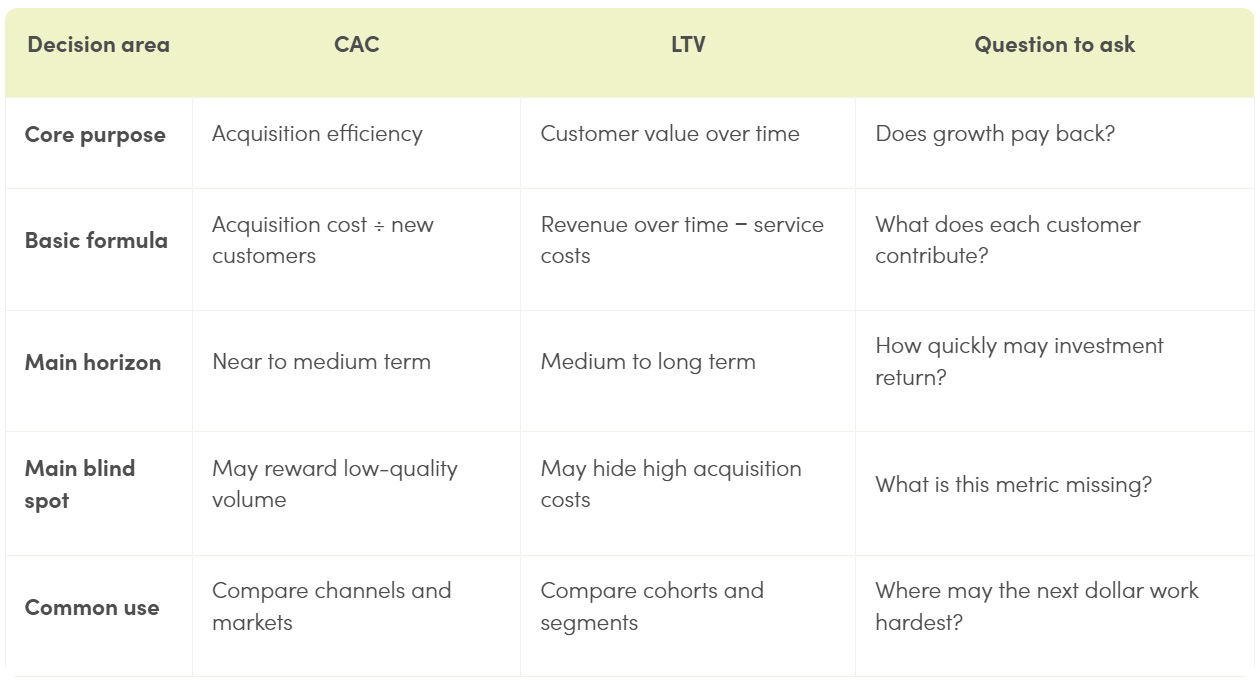
While business leaders often ask whether they should lower customer acquisition cost (CAC) or increase customer lifetime value (LTV), the more useful question may be how the two metrics work together.
CAC measures the cost of growth. LTV measures the value that growth creates.
A low CAC can hide weak customer quality, and a high LTV can look attractive if service costs are not included. To accurately track whether a firm is experiencing sustainable growth, tracking both metrics by cohort and channel is often more effective than tracking either one independently.
Now, regarding CAC vs LTV prioritization, there are instances wherein CAC may deserve priority, and others wherein LTV may deserve it. This report breaks down how customer acquisition teams can use both metrics to support durable growth.
Customer acquisition cost (CAC) is the total cost of winning a new customer. A standard calculation divides sales and marketing costs by the number of new customers acquired in the same period.¹ CAC can help leaders assess whether a growth channel may be efficient enough to scale, but it’s only one side of the equation.
Customer lifetime value (LTV) is an estimate of what a customer may contribute during the relationship. A practical model can include average revenue, expected lifespan, and the costs required to serve the account.² LTV can therefore reflect retention, adoption, expansion, and service quality, but it is primarily a measure of the amount of money taken in for a single average customer over the entirety of a business relationship.
CAC asks what it costs to create a customer relationship, while LTV estimates what that relationship may be worth over time. Looking at the two metrics together can give leaders a clearer picture of whether growth is creating durable value or simply adding customers who may not stay long enough to pay back what it cost to acquire them.
CAC may deserve priority when a company is deciding whether it can afford to scale. If acquisition costs rise faster than profit margin, growth may consume cash even while revenue increases. This may be especially important to monitor when a business enters a new market, adds a channel, or increases campaign volume.
A useful starting point may be a “fully loaded” CAC, meaning a calculation that includes both direct and indirect costs associated with acquiring a new customer. These costs may include media, sales labor, commissions, technology, onboarding, partner fees, travel, and other acquisition-related expenses.
A narrow CAC calculation may make one channel appear more efficient than it is if some costs sit with another team. That can overstate ROI and lead to investment decisions based on incomplete information.
These warning signs point to a broader question: Can the company explain how the next customer may pay back the cost of acquiring them? CAC may deserve priority when that answer depends on uncertain assumptions or incomplete cost data.
A higher-CAC channel may still be reasonable if its customers remain longer, require less support, or expand their relationship. Comparing fully loaded CAC with cohort-level LTV can help determine whether the added acquisition cost may be justified.
LTV may deserve priority when acquisition appears efficient but customers do not stay, adopt, renew, or expand. A customer who leaves before the business recovers its acquisition cost could reduce the value of an otherwise strong campaign. Salesforce describes LTV as a lens into customer satisfaction, adoption, churn risk, and long-term profit.²
Customer quality, therefore, becomes a financial issue. A prospect may convert but still end up appearing like a “weak” customer fit if the offer was unclear, expectations were misaligned, or the handoff was poor.
Retention can also influence profit. Bain has cited research showing that a 5% increase in retention may increase profits by 25% to 95%, depending on the business.³ The range should not be treated as a universal forecast, but it illustrates why retention may belong in acquisition decisions.
Human conversation may also matter when a purchase involves trust, complexity, or a long-term commitment. SurveyMonkey reports that 79% of Americans strongly prefer talking with a human over an AI agent, while 89% believe companies should offer the option to speak with a human.⁴ These findings do not mean every interaction should be manual. They may suggest that removing human access can create a customer-quality risk.
A successful operating model usually combines acquisition cost, customer value, payback speed, and customer quality to paint a more holistic financial picture. Reviewing these measures by cohort may provide more insight than relying on one company-wide average.
A commonly utilized LTV:CAC benchmark is 3:1, meaning expected customer value is three times acquisition cost.⁵ The ratio is widely used in subscription and SaaS businesses, and it can also serve as a helpful screening tool in other industries. Because margins, sales cycles, service costs, and capital needs vary widely, 3:1 is best treated as a starting point for evaluation rather than a fixed target.
Field sales, residential outreach, and event programs can offer a unique balance between CAC vs LTV. These channels may involve more upfront sales effort than lower-touch acquisition methods, but face-to-face conversations can give representatives more opportunity to explain the offer, answer questions, and assess customer fit before enrollment.
That added context can support LTV by helping reduce mismatched expectations and early drop-off. At the same time, outsourcing in-person acquisition can help brands manage CAC by expanding into new markets without building that capability internally.
Cydcor delivers outsourced, in-person customer acquisition across residential, retail, B2B, and event channels in the US and Canada, with campaign design, client reporting, and compliance oversight built in.⁶ For enterprise brands, this combination may provide a practical way to pursue acquisition volume while keeping customer quality and long-term value in view.
“CAC vs LTV” is a false dichotomy. These metrics offer two equally vital perspectives of the same growth analysis. CAC shows what the company spends to create a customer relationship. LTV estimates whether that relationship may generate enough value to justify the investment.
Leaders may consider lowering CAC when acquisition is inefficient, improving LTV when fit is weak, and preserving human connection when trust affects retention. Cydcor’s face-to-face customer acquisition model is designed to help brands balance customer acquisition cost with long-term customer value. Because in-person conversations give customers a chance to ask questions and understand an offer before they enroll, this approach can support stronger customer fit, which may help improve retention over time.⁶
For a customer acquisition strategy built around measurable execution and long-term customer value, Explore a Cydcor Partnership.

Door-to-door sales can be a great strategy for opening up new residential markets or pushing a new product, but its success rate depends on more than adding the right number of field sales reps. Well-planned field sales programs connect market planning, local rules, field training, and measurement to shift the odds in their favor. This makes investing in field marketing a more predictable and reliable driver of revenue instead of a costly gamble.
The sales model below turns a broad canvassing effort into a repeatable sales program:
Select territories based on the residents behind the door, not just the broad demographic of a neighborhood. Define the homes, service rules, income bands, home types, or other signals that make a location relevant. Then layer in useful constraints, such as travel time, access, weather, working hours, and expected contact rates to further distill the highest-value territories to target.
A market plan should produce more than a list of streets by defining the order of areas, daily route load, contact details for issues, parking guidance, and the handoff process for leads that need follow-up. This can help protect selling time and give managers a steady way to compare markets.
One of the higher performing field models is as a national reach with local work, supported by a network of independently owned sales companies and assigned program support. That combination can be useful when a brand needs one operating standard across markets without ignoring local rules.
Relevance matters at the door, so use buyer data, service access, prior campaign results, and local knowledge to rank areas before launch. A broad footprint can create activity, but a focused footprint creates learning.
Build a simple market score with four inputs: buyer fit, reachable homes, competitive rules, and field readiness. Keep the score visible to field leaders. When results change, managers can see whether the issue is the offer, the area, the route, or the execution.
It’s also good to remember that a “no” isn’t a net-zero outcome. Record why the household declined, whether the service was not available, and whether a better follow-up time exists. Those signals can improve the next route and help marketing teams add value to the wider acquisition message.
Compliance is part of the customer experience. Before a team enters a market, confirm solicitation rules, registration or permit requirements, restricted homes, sign-in procedures, working-hour limits, and any disclosure language. Assign one owner to maintain the market file and one clear contact for field questions.
Badging should be easy for a resident to verify. Use clear names, photos, company identification, campaign details, and a phone or web verification method. Train reps to show credentials without becoming defensive. If a resident asks the team to leave, a good response is a prompt and respectful exit.
Local and federal rules may apply to in-home transactions. Programs should have legal review for the offer, contract, disclosures, and state or local requirements before launch.
A script alone does not prepare a rep. Training should combine product knowledge, role-play, objection practice, privacy expectations, safety guidance, and route procedures. Reps should know what they can promise, what requires approval, and how to explain the next step in plain language.
Use a short talk structure: identify yourself, state the reason for the visit, ask a relevant question, connect the offer to the response, and confirm the next action. The goal is not to force every interaction into a sale. It is to create a clear, respectful path to a good-fit decision. Be sure to make eye contact, be engaging, and bring energy.
Cydcor’s field sales program describes a model in which independently owned sales companies hire, train, and lead reps, while Cydcor’s campaign team shares client needs and rules teams monitor programs. That division of responsibility can offer a useful model for scaling while keeping accountability visible.
Door count is an activity measure, not a growth strategy. Track the full path from assigned doors to talks, ability to reach decision-makers, good-fit opportunities, applications, sales, cancellations, and retained customers. Review the numbers by market, campaign, route, and time period.
A useful scorecard should answer three questions each week: Where are we finding demand? Where are buyers dropping out? What change will we test next? Include quality measures, such as complaint rate, documentation accuracy, cancellation rate, and customer feedback, alongside volume and conversion.
A multi-market program can benefit from campaign design, compliance oversight, reporting, and quality oversight. Those capabilities can help maintain a common measurement language, not just separate local reports.
Expand only after the first market produces a repeatable playbook. Document the route logic, approved materials, training sequence, rules checks, reporting rhythm, and local exceptions. Then use that playbook as a starting point, not a rigid script.
Each new market should have a launch owner, a local readiness review, a short pilot, and a decision gate. Continue when quality and unit cost meet the agreed threshold. Adjust when the issue is fixable. Pause when rules, customer experience, or unit cost remain below standard.
This is where a partner such as Cydcor can add scale. Its model offers customer acquisition outsourcing across residential, retail, B2B, and event channels, plus assigned campaign support. For large brands, the value is not simply more people at more doors. It can provide a repeatable system for local work under one brand standard.
Well-planned door-to-door sales strategies can treat field acquisition as a system. Plan markets around buyer fit, prepare for local requirements, train reps for real talks, measure quality through the full funnel, and scale only what can be repeated. With field support and local market knowledge, brands can extend home sales while protecting a consistent customer experience.

When an organization enters new markets, the choice between inside vs. outside sales can affect far more than staffing. Making the right decision can significantly improve how prospects experience the brand, how quickly the team can expand, and how much fixed cost the company must carry. Inside sales prioritizes remote engagement, while outside sales brings representatives into the markets and environments where customers make decisions, and each has a potential role to play in every business’s sales and marketing infrastructure.
As a result, for many enterprise brands, the answer is not choosing one model permanently. It is matching each channel to a specific customer, offer, territory, and/or acquisition goal. This guide compares the two approaches across a few different planes of observation to get a better idea of where each can be most effective, and when using both may be necessary to maximize value.
Inside vs. outside sales is about where and how the selling happens: Inside sales typically involves a rep selling remotely by phone, email, or video from an office or other dedicated workspace. Outside sales refers to reps selling face-to-face, generally meeting the customer where they are in a setting like their home, a store at which they shop, their business, or an event they attend.
The table below breaks down the different approaches used by inside and outside sales across the most common decision factors:
As outlined above, the decision becomes much easier once you identify your ideal customer. A prospect who prefers a quick online conversation may respond well to inside sales, while a shopper, homeowner, or business owner may prefer to have an in-person relationship with someone attached to your company before making a purchase.
Inside sales generally works well when a company needs broad coverage, frequent follow-up, or a controlled sales process. Since representatives can work from a central location, the team can communicate with prospects across multiple markets in a standardized manner without needing staff in the field. Inside sales can also be good for long sales cycles, since it makes it easier to balance a high-volume of low-touch accounts in a consistent way.
This model is usually stronger when buyers prefer a quicker or lower-touch sales process, making them more comfortable with remote communication. This is typically the case in industries where the offer is easy to explain, and customer data is organized well enough to support quick routing and follow-up. It can also support longer sales cycles by keeping prospects engaged between meetings without overwhelming them, and handling documentation after a field conversation in instances where both are leveraged.
The limitation is context. Remote conversations may not reveal local objections, physical buying conditions, or the customer’s full environment. When trust, education, demonstrations, or local access influence conversion, a remote interaction may not be enough proof of value for many prospects.
Outside sales gives representatives direct access to the people and places where buying decisions happen. A field representative can answer questions in real time, adapt to the conversation, and notice details that might never appear in a CRM record. That direct engagement is especially valuable when customers need confidence and/or trust before they commit.
Outside sales is often a strong fit for more complicated products that require explanation, customers who are difficult to reach digitally, and markets where understanding of the locality affects the relevance of a product. It also gives brands a way to create more memorable interactions while gathering firsthand feedback about customer needs and objections.
Cydcor operates in-person customer acquisition programs across residential, retail, B2B, and event channels. Its outsourced customer acquisition services reflect the different environments where customers live, shop, work, and gather. They offer specialized support based on the industry of their clients, and connect them with customers that fit their ideal profile. As an outsourced sales and customer acquisition partner, Cydcor tailors each program to the client's industry, products, and target customers, so brands get field sales without having to build that capability in-house.
Residential programs can help brands reach homeowners directly, while retail teams can demonstrate products and guide shoppers toward a purchase. In B2B settings, representatives can visit small and mid-sized businesses that are difficult to reach through telesales, opening conversations with decision-makers in their own environments.
Comparing salaries alone does not reveal the true cost of a sales model. Leaders should consider recruiting, training, technology, travel, management, benefits, compliance, and the time required to build a productive team.
Inside sales generally reduces travel and field expenses, while outside sales may require more coordination to manage territories and local execution. However, outside sales can reach customers and markets that remote teams struggle to access, which makes the higher operating complexity worthwhile in the right circumstances.
An outsourced outside sales model can change that equation. Rather than building every field capability internally, an enterprise brand can partner with an established network. Cydcor’s operating model gives brands access to independently owned sales companies across North America, and their broad sales network with the scale to support Fortune 100 companies.
Cydcor’s business model explains that Cydcor pays sales companies based on measurable outcomes, such as customer sign-ups or closed sales, although compensation structures vary by program. Programs are also built around the client's brand standard, which helps differentiate the brand from competitors and impact the customer's experience.
That approach may reduce fixed hiring exposure for the brand. It does not eliminate cost or risk, so agreements still require clear performance definitions, pricing, compliance standards, reporting, and brand protections. For companies entering new markets, it can provide a way to test demand before committing to a permanent internal field organization.
Outside sales depends on more than placing representatives in front of customers. Results also require preparation, consistency, resilience, coaching, and accountability. Cydcor’s model uses independently owned sales companies that recruit, train, and manage their own teams while remaining accountable for campaign performance and standards.
That structure creates a direct connection between ownership and execution. Cydcor’s network of independent sales companies emphasizes qualities such as grit, student mentality, coachability, mentorship, and consistency, all of which matter when representatives must earn trust in the field and adapt to different customer situations.
For enterprise buyers, motivation should support the process rather than replace it. A strong program connects performance expectations with training, compliance oversight, reporting, coaching, and a clear feedback loop from the market.
The best model depends on the customer journey rather than a general preference for remote or in-person selling. Inside sales may be the better starting point when the priority is efficient follow-up and broad outreach, while outside sales may be the better choice when local access, trust, and direct engagement drive conversion.
A hybrid model can combine both strengths: inside sales can qualify opportunities and manage follow-up, while outside sales creates the direct interaction that moves a prospect toward a decision. Both teams can then share customer feedback, performance data, and market intelligence.
For enterprise brands, the key question is which customer interactions require human presence, and which steps can happen efficiently through remote engagement.
The same framework applies to Cydcor’s customer acquisition services, event services, and residential, retail, and B2B programs.
Inside vs. outside sales doesn’t have to be a complicated choice. Inside sales offers efficiency, centralized control, and broad remote reach. Outside sales offers direct engagement, local access, and relationship-building in the environments where customers make decisions. For residential, retail, and B2B acquisition, outside sales can be especially valuable when trust, timing, education, or physical presence affects the purchase.
Cydcor helps enterprise brands build and manage in-person outside sales programs across these channels. Its outsourced, performance-oriented model gives brands access to field sales capacity without requiring them to assume every fixed cost of building an internal team. The right strategy may combine both approaches, using remote engagement where it improves efficiency and outside sales where human presence can strengthen acquisition and market reach.
While many smaller brands express some worry when it comes to outsourcing sales, it has proven to be a reliable way to break into new markets, deploy new products, or even just supplement an existing sales team. Retail sales outsourcing can add trained staff and field support without requiring a full internal build, which is made especially effective when you choose an outsourcing partner that knows how to work within retail environments and represent a brand within a store/retailer’s culture.
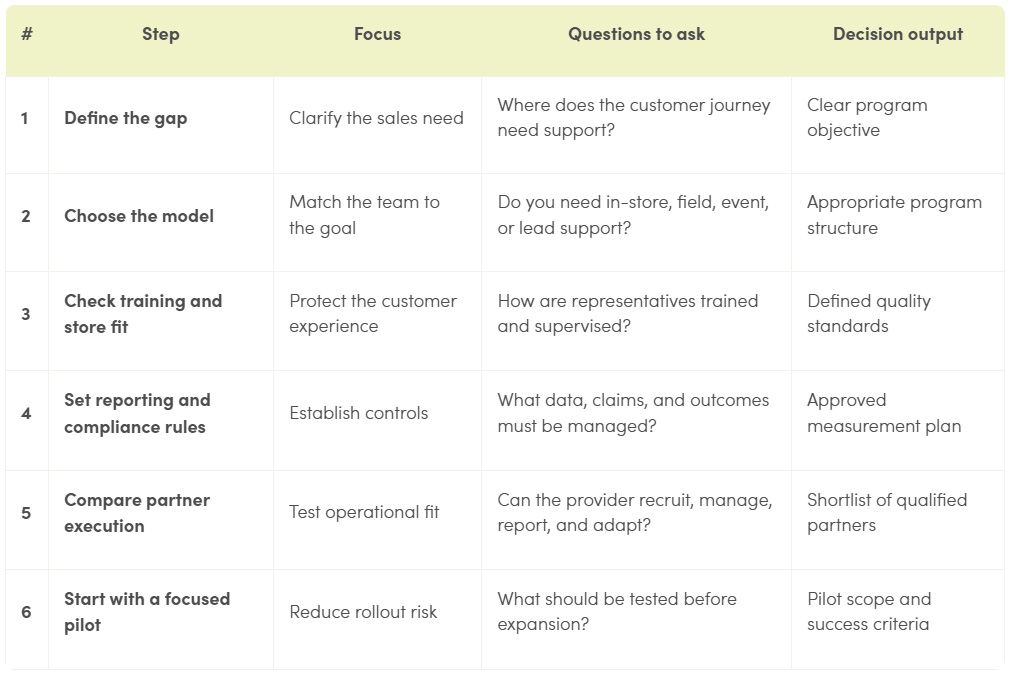
The key is finding the right outsourcing partner and model, which depends on the customer journey, store setting, compliance needs, and reporting plan. This guide breaks down where an outside team may help, and what to review before choosing a partner.
“Retail growth depends on delivering consistent customer experiences wherever buying decisions happen.”
As with any sizable business investment, decision makers should start with the problem. Figure out whether your biggest sales need is getting more product help at the shelf, wider store coverage, help breaking into new markets, or a quick increase in headcount to push a new product.
Outsourcing generally best fits work that is local, specialized, or hard to staff; it doesn’t need to be all of these things at once, though. It may also support an internal team instead of replacing it. In the end, the need must define the role of your outsourced sales partner.
Retail sales outsourcing may include in-store teams, field teams, or event teams. In-store staff can explain products, run demos, answer questions, and even sell themselves. Field teams can cover several locations. Event teams can support pop-ups, sampling, trade shows, and launches.
Some programs use more than one model. A launch could use event staff for awareness and in-store staff for product education and sales conversion.
Representatives are a visible part of the brand whether they are in-house or outsourced. Ask how the outsourced staff are trained on product details, approved claims, store rules, customer questions, and escalation steps to ensure they have enough runway for a successful deployment. It may also be helpful to inquire about what comparable brands they’ve worked with.
Training should fit the store. Staff need a clear message regardless of setting, but they also need room to answer real questions in a way that doesn’t feel rushed or rehearsed if they are in an environment where they’ll be dealing with a low volume of potential customers that want longer or more in-depth engagements. A single script may not work in every store or with every shopper.
Retailers should confirm how training is inspected, updated, and checked in the field. They should also ask how the provider handles product changes, store-specific rules, and customer concerns. Both of these play a key role in ensuring that value is maximized across every sales setting, and working with a quality outsourcing partner that truly understands the important nuances of representing a brand within a retail environment. The best do this by working alongside store employees and management, rather than just taking a post in a designated area and approaching prospects in an isolated manner, disconnected from the rest of the shopping experience.
Set a program goal before choosing reporting measures, so you know exactly what it is you’ll be reporting. An education program may track demos, questions, and feedback since the goal is simply to increase awareness or dispel initial customer concerns. A customer-acquisition program is more likely to strictly track leads, purchases, and/or handoffs. An event program may rely more on engagement and follow-up data that is indicative of a future purchase in industries with longer sales cycles.
Ask how data is collected, checked, shared, stored, and deleted. Clarify who owns customer data, and set a process for complaints and hard questions.
Finally, the Federal Trade Commission says advertising claims must be truthful, not misleading, and supported by evidence.¹ Retailers should review claims, disclosures, offers, and data practices with the right legal and compliance teams to avoid unnecessary liability.
A client list is only one part of the review; you should also ask how the provider recruits, trains, schedules, supervises, and reports on the team and compliance processes. Also, ask how it handles store coordination and program changes.
Compare each provider’s stated services with your campaign's needs by asking for examples that match your store type, customer, sales cycle, and market.
Review whether the partner can support the full operating process. That may include recruiting, training, scheduling, field supervision, reporting, and adjustments during the program.
A pilot can test the relationship before a wider rollout. Set the locations, dates, audience, training, reports, and review points in advance. Include a clear way to pause or change the work. Information from the right partner who is in the store can help perfect the pitch and enhance the customer experience with a brand.
The pilot should answer practical questions. Can the team represent the brand clearly? Does the data support decisions? Do store partners accept the model? Can the provider adjust while keeping the message consistent? Your outsourcing partner can help test these and refine them before sales reps are trained.
Goal setting should be part of the first discussion, whether you choose Cydcor or another provider. Define what the team will do, how performance will be reviewed, and what conditions would support expansion.
Retail sales outsourcing can help add customer-facing capacity for product education, market entry, event work, or customer acquisition. The right approach depends on your customer journey, retail environment, operating needs, and risk controls.
Before choosing a provider, confirm that the program has a clear scope, trained representatives, reliable field oversight, defined reporting, and appropriate compliance controls. A focused pilot can also help your team assess the model before a wider rollout.
Ready to explore whether outsourced retail sales support fits your growth goals? Get in touch with Cydcor about your retail customer-acquisition program.